Amanda's Creative Corner Crochet · Kitchen
Free Crochet Patterns Handmade with Love

Rose Filet Lace Bed Cover Crochet Pattern
Jump to Pattern
Rose Filet Lace Bed Cover Crochet Pattern
140-180 Hours 0 made this
Intermediate Level

You need double crochet, chain spaces and a little patience with petals.

140-180 Hours

A long project, but every square, band and rose is portable.

Heirloom Look

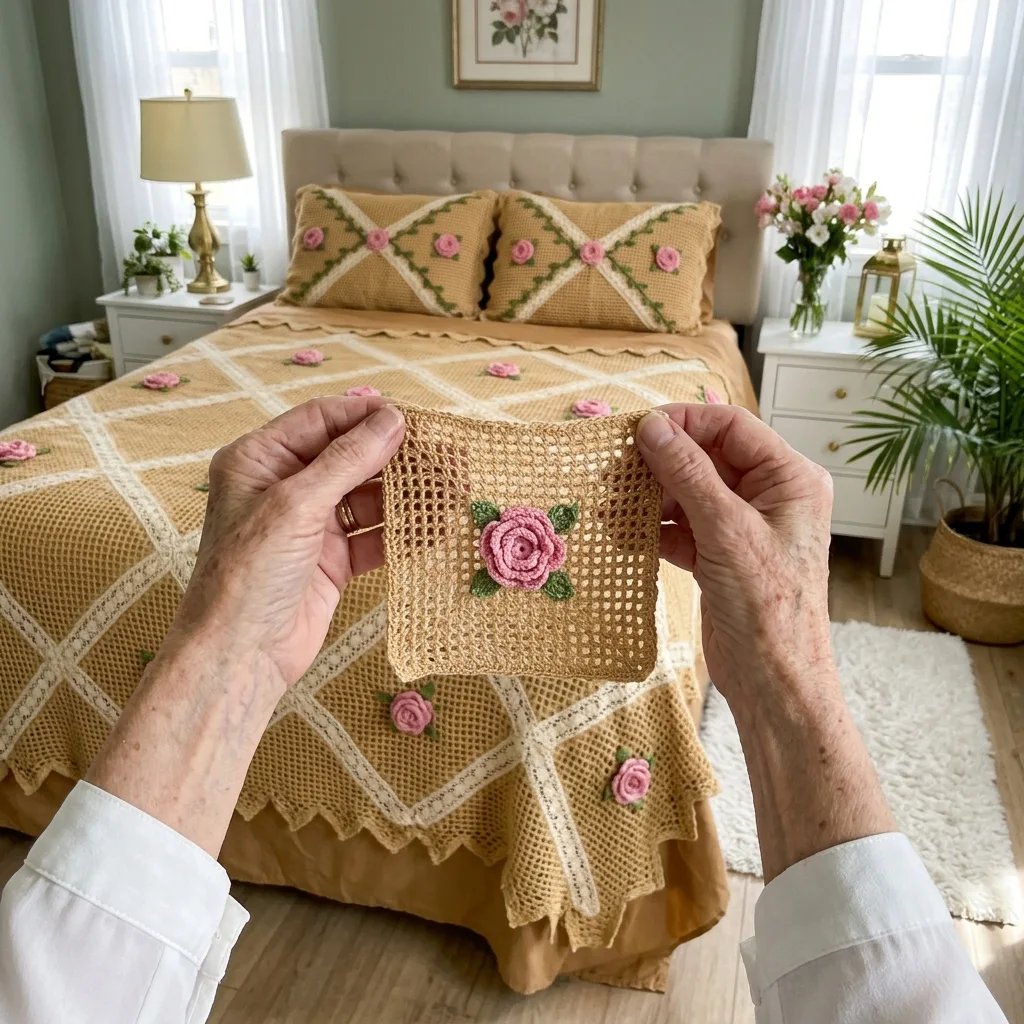
Open mesh, lace bands and 3D roses give a bedspread people remember.

About This Rose Filet Lace Bed Cover Crochet Pattern Pattern

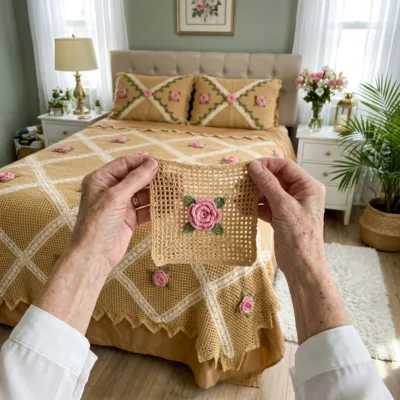
This rose filet lace bed cover is made from 30 golden sand mesh squares, 12 cream diagonal lace bands, pink three-dimensional roses and green leaves. It finishes at about 90 by 106 inches with the pointed scalloped edge, enough to drape over a queen bed and reach the floor on both sides.

You will use filet mesh, simple shells and layered petals. It suits crocheters who are comfortable with double crochet and ready for a big, rewarding project.
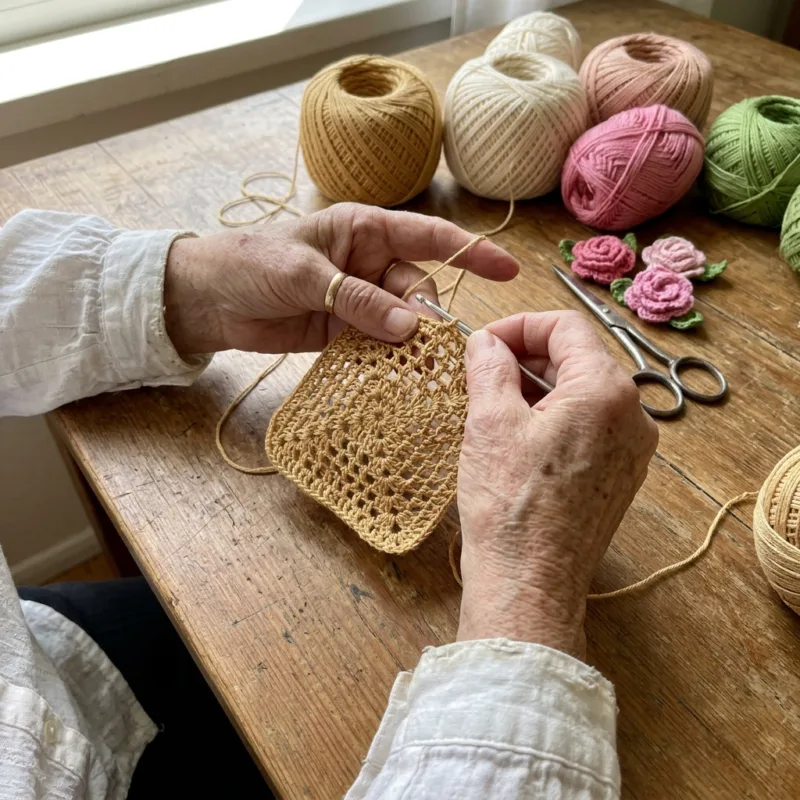
Rose Filet Lace Bed Cover Crochet Pattern step detail

Why You'll Love This Rose Filet Lace Bed Cover Crochet Pattern Pattern

I love that this bedspread is built from small pieces. I can make a square on the sofa, a rose at the kitchen table and a band while I wait for an appointment.

The open mesh feels light and airy, and the roses make the whole bedroom feel like a garden. It is a project I would happily give as a wedding or anniversary gift.

Switch Things Up

Try ivory mesh with blush roses, sage green mesh with cream roses, or soft blue mesh with white roses. Make 3 by 4 squares and 4 bands for a sofa throw, or 2 by 2 squares for a baby blanket. Sew two squares together and add one rose for a matching pillow sham, or swap the zigzag edge for a simple shell edge.


Materials Needed

— Main Fabric

01 Golden sand worsted weight cotton yarn for the squares: about 1,800 g (about 3,400 yd)
02 Cream worsted weight cotton yarn for the bands and edge: about 1,100 g (about 2,100 yd)
03 Rose pink worsted weight cotton yarn for 26 roses: about 300 g (about 570 yd)
04 Leaf green worsted weight cotton yarn for 130 leaves: about 200 g (about 380 yd)
05 Optional: a warm caramel or tan sheet or bedspread to lie under the mesh

— Tools Required

06 5.0 mm (H-8) crochet hook for the squares, bands and edge
07 4.0 mm (G-6) crochet hook for the roses and leaves
08 Yarn needle
09 Stitch markers
10 Scissors
11 Blocking mats and pins
12 Measuring tape

The Free Pattern

Intermediate 140-180 Hours

0% complete

— Filet Mesh Square (Make 30, golden sand) :

Use the 5.0 mm hook. Each square has 20 spaces across and 20 rows. Place a stitch marker every 5 spaces to keep your count.
Row 1: Ch 63. Dc in 6th ch from hook (the 5 skipped ch count as dc and ch-2 sp), (ch 2, skip 2 ch, dc in next ch) 19 times. (21 dc, 20 ch-2 sps)
Row 2: Ch 5 (counts as dc and ch-2 sp), turn. Dc in next dc, (ch 2, dc in next dc) 18 times, ch 2, dc in the 3rd ch of the previous row's beginning ch (for Row 2, the 3rd skipped ch of Row 1). (21 dc, 20 ch-2 sps)
Rows 3-20: Repeat Row 2 eighteen more times. Fasten off and weave in ends. (21 dc, 20 ch-2 sps in every row)
Block each square to about 17 in by 17 in. If yours is a different size, change your hook size so all 30 squares match.

— Diagonal Lace Band (Make 12, cream) :

Use the 5.0 mm hook. Each band is about 86 in long and 3 in wide.
Row 1: Ch 302. Sc in 2nd ch from hook and in each ch across. (301 sc)
Row 2: Ch 1, turn. Sc in first sc, (skip 2 sc, 5 dc in next sc, skip 2 sc, sc in next sc) 50 times. (51 sc, 50 shells)
Row 3: Ch 1, turn. Sc in first sc, (ch 5, skip next shell, sc in next sc) 50 times. (51 sc, 50 ch-5 arches)
Row 4: Ch 1, turn. Sc in first sc, (7 dc in next ch-5 arch, sc in next sc) 50 times. Fasten off. (51 sc, 350 dc)

— Rose (Make 26, rose pink) :

Use the 4.0 mm hook. 24 roses go on the cover, and 2 extra roses can be used on matching shams. Each rose is about 4 in wide.
Rnd 1: Make a magic ring, ch 3 (counts as dc), 11 dc in ring, sl st to top of ch 3. Pull the ring tight. (12 dc)
Rnd 2: Ch 1, sc in same st, ch 3, skip 1 dc, (sc in next dc, ch 3, skip 1 dc) 5 times, sl st to first sc. (6 sc, 6 ch-3 sps)
Rnd 3: Sl st into the first ch-3 sp. (Sc, hdc, 3 dc, hdc, sc) in each ch-3 sp around, sl st to first sc. (6 petals, 42 sts)
Rnd 4: Fold the petals forward. Working behind them, attach yarn with a sc in the back of any Rnd 2 sc, ch 5, (sc in the back of the next Rnd 2 sc, ch 5) 5 times, sl st to first sc. (6 sc, 6 ch-5 sps)
Rnd 5: Sl st into the first ch-5 sp. (Sc, hdc, 5 dc, hdc, sc) in each ch-5 sp around, sl st to first sc. (6 petals, 54 sts)
Rnd 6: Fold all petals forward. Working behind them, attach yarn with a sc in the back of any Rnd 4 sc, ch 6, (sc in the back of the next Rnd 4 sc, ch 6) 5 times, sl st to first sc. (6 sc, 6 ch-6 sps)
Rnd 7: Sl st into the first ch-6 sp. (Sc, hdc, 2 dc, 3 tr, 2 dc, hdc, sc) in each ch-6 sp around, sl st to first sc. Fasten off, leaving a long tail for sewing. (6 petals, 66 sts)

— Leaf (Make 130, leaf green) :

Use the 4.0 mm hook. You need 5 leaves for each rose.
Rnd 1: Ch 10. Sc in 2nd ch from hook, hdc in next ch, dc in next 2 ch, tr in next 2 ch, dc in next ch, hdc in next ch, 3 sc in last ch, then working along the other side of the chain: hdc in next ch, dc in next ch, tr in next 2 ch, dc in next 2 ch, hdc in next ch, sc in each of last 2 ch, sl st to first sc. Fasten off, leaving a tail for sewing. (20 sts)

— Layout :

Arrange the 30 golden sand squares in 6 rows of 5 squares (5 across, 6 down). Before the edge the cover measures about 85 in by 102 in.
Lay 6 cream bands from lower left to upper right and 6 cream bands from upper left to lower right, about 15 in apart measured along the top edge, so they cross and make large diamonds. Tuck the band ends under the edge.
Place 24 pink roses along the bands about 18 to 20 in apart, using the crossings first. Sew 5 green leaves around each rose, with one pointing up and two on each side.

— Scalloped Zigzag Edge (cream) :

Use the 5.0 mm hook. The cover has two 5-square sides (top and bottom) and two 6-square sides (left and right). Count your stitches on every side before you start Rnd 2.
Rnd 1: Join cream with a sl st in any outer corner dc. Ch 1. On the 5-square sides, work sc in each dc and 2 sc in each ch-2 sp of every square, skipping the last dc of each square (60 sc per square, 300 sc per side). On the 6-square sides, work 3 sc in each row end (60 sc per square, 360 sc per side). Work (sc, ch 2) in each outer corner dc. Sl st to first sc. If your count is off by a few, ease the extra stitches across the longest squares so each side totals 301 or 361 sc including its corner sc. (1,324 sc, 4 corner ch-2 sps)
Rnd 2: Join cream with a sl st in the first sc after a corner ch-2 sp. Side 1 (5-square side): ch 1, sc in same sc, (skip 2 sc, 5 dc in next sc, skip 2 sc, sc in next sc) 50 times, then (3 dc, ch 2, 3 dc) in the corner ch-2 sp. Side 2 (6-square side): sc in first sc, (skip 2 sc, 5 dc in next sc, skip 2 sc, sc in next sc) 60 times, then (3 dc, ch 2, 3 dc) in the corner ch-2 sp. Side 3: repeat Side 1. Side 4: repeat Side 2. Sl st to first sc. (220 shells, 4 corner groups, 224 sc)
Rnd 3: Ch 1, sl st in the first sc. On each shell: sc in each of the first 2 dc, (sc, ch 3, sl st in 3rd ch from hook, sc) in the middle dc, sc in each of the last 2 dc, sl st in the next sc. At each corner: sc in each of the 3 dc, (sc, ch 3, sl st in 3rd ch from hook, sc) in the corner ch-2 sp, sc in each of the next 3 dc, sl st in the next sc. Join with a sl st to the first sl st. Fasten off and weave in ends. (1,352 sc, 224 picot points)

Assembly Instructions

  1. Block all 30 filet mesh squares to the same size, about 17 in by 17 in, and let them dry completely.
  2. Lay the squares out in 6 rows of 5 and whipstitch them together with golden sand yarn, first into rows and then row to row, matching the stitches on each side.
  3. Pin the 12 cream diagonal lace bands over the mesh in a crossing lattice, 6 in each direction, then sew them down along both long sides with a yarn needle.
  4. Sew 5 green leaves around each of 24 roses, then sew the roses along the bands, starting with the crossings.
  5. Work the Scalloped Zigzag Edge around the whole cover, tucking the band ends under the first round as you go.
  6. Block the finished cover lightly and weave in all remaining ends.
  7. Lay it over a warm tan sheet so the mesh and roses stand out.

Common Mistakes & How to Fix Them

Losing count of the 20 ch-2 spaces in a row. Place a marker every 5 spaces and check the count at the end of each row.

Making squares in different sizes. Swatch one square first and block them all to 17 in so the grid and the edge counts stay even.

Working the edge without counting each side. Check 300 or 360 sc before Rnd 2 so the 6-stitch shell repeat ends exactly at each corner.

Pulling the chain loops behind the rose petals too tight. Keep them loose so each new layer of petals sits open and full.


Denise

Denise designs warm, detailed home decor crochet patterns with a love for lace, flowers and cozy bedrooms.


Important Notes

Gauge: one filet square should measure about 17 in by 17 in after blocking. Yarn amounts are estimates, so buy a little extra.

Block the squares, bands and roses before sewing. Cotton relaxes with blocking and the mesh opens evenly.

The mesh shows whatever lies under it. I like a warm caramel or tan sheet underneath so the roses and lace stand out.

Wash gently in cold water and lay flat to dry. Use a color catcher the first time, because the pink and green can bleed into the golden sand.


I hope you enjoy every square, band and rose as much as I do. Take your time, and send me a note when your bedroom starts to look like a garden.

Crochet Abbreviations

01 ch — chain
02 sl st — slip stitch
03 sc — single crochet
04 hdc — half double crochet
05 dc — double crochet
06 tr — treble crochet
07 sp — space
08 st — stitch
09 Rnd — round

You Ask, We Answer

What size is the finished bed cover?

It measures about 90 by 106 inches with the edge, which drapes over a queen bed to the floor on both sides. Use fewer squares for a throw or baby blanket.

Can I use a different yarn weight?

Yes. Lighter cotton makes a lacier mesh and needs more squares to reach the same size, while bulkier yarn grows faster but looks heavier. Swatch a square first and adjust the number of squares.

How do I wash and care for it?

Machine wash cold on a gentle cycle or hand wash, with a color catcher the first time. Lay it flat to dry and reshape the edge while it is damp.