
Cream Lace Granny Square Bedspread Crochet Pattern
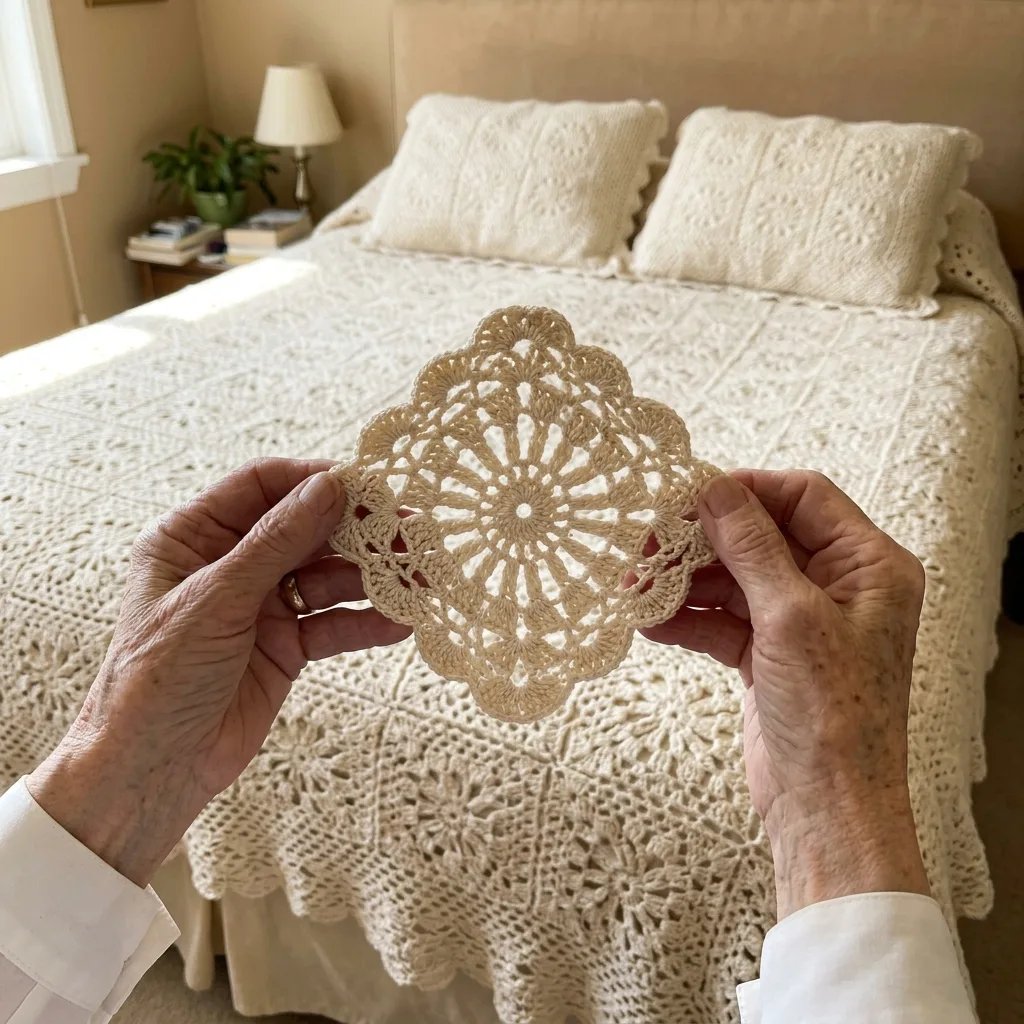
You need basic granny square skills and the patience for a long, rewarding project.
Each square is small and portable, so the time passes in short, easy sessions.
Open flower shapes appear wherever four square corners meet.
About This Cream Lace Granny Square Bedspread Crochet Pattern Pattern
This is a full-size crochet bedspread made from 168 small lace squares, all worked in one natural cream cotton. Every square starts at a magic ring and grows outward in five rounds of double crochet clusters separated by chain spaces. Those spaces give the fabric its light, lacy look. When you hold one square up to a window, you can see the daylight through it, and when the squares lie together on a bed, the open stitches throw tiny soft shadows across the whole cover.
The finished bedspread measures about 72 by 84 inches (183 by 213 cm). The squares are arranged in 12 columns and 14 rows, and a shell edge of 262 scallops runs around the outside to give the cover a soft, finished frame. At this size it lies over a twin or full-size bed with a generous drop at the sides. If you want it to hang closer to the floor on a queen or king bed, the grid is easy to change, because the number of squares is the only thing you need to adjust. I give the exact numbers for that in the variations below.
The techniques are simple. You need chain stitches, slip stitches, double crochet and single crochet, plus a magic ring. If you can make a classic granny square, you already know most of what is needed. What changes here is the rhythm. The squares are small, they use a steady repeating cluster, and the repeat is easy to memorize after the first two or three squares. That makes this a good long project for someone who has finished a few blankets and now wants something a little more special. I rate it Intermediate because of the size, the joining and the amount of patience it asks for, not because any single stitch is hard.
I chose cotton yarn on purpose. Cotton has a matte finish and a bit of body, so the open stitches hold their shape and the lace stays crisp instead of slumping. It washes well and does not fuzz up the way some soft blends do, which matters on a bed that will be used every day. A natural cream shade looks calm in almost any bedroom, and it shows off the stitch texture much better than a busy color would. If you like a soft, aged look, you can choose a slightly warmer cream. If you like a clean look, choose a cooler one. Just buy all the yarn for the project at the same time, from the same dye lot, so the squares match from the first to the last.
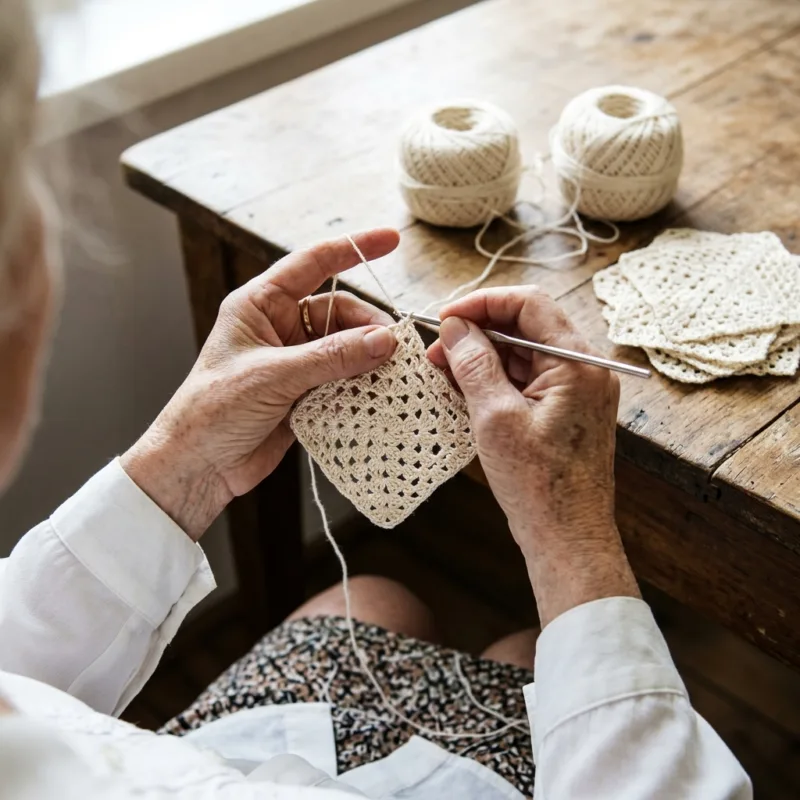
This pattern is written for a bedspread that you will make over several weeks or months. Each square is a small, portable unit, so you can crochet one at the kitchen table, in the car, or in a waiting room. I suggest making ten or twenty squares, then blocking them and checking the size before you carry on. Once the squares are finished, the joining and the edge go quickly, and the bed starts to look like a real project at last.
It suits crocheters who enjoy repetition and who like to see steady progress. Each finished square is a small win, and a pile of them is a very satisfying thing to look at. It also suits anyone who wants a handmade piece for a wedding gift, a new home, or a guest room that deserves something special. Matching pillow shams are easy to add from the same squares, and I give the numbers for those too, so your bed can look like one planned set.
Why You'll Love This Cream Lace Granny Square Bedspread Crochet Pattern Pattern
I love projects that let me sit down for twenty minutes and still feel that I made progress. A bedspread sounds huge, and it is, but when it is built from small squares, the size stops being scary. You only ever have one little square in your hands. You finish it, set it on the pile, and start the next one. After a few weeks, you look at the stack and realize that you have crocheted most of a bed cover without ever feeling that you were working on something enormous.
I also love how personal a handmade bedspread feels. A bed is the center of a bedroom, and a cover that someone crocheted by hand changes the whole mood of the room. The lace lets the light in, the texture catches the shadows, and the scalloped edge gives it a gentle, old-fashioned charm without feeling dusty or fussy. People often touch it before they say anything about it, and I think that tells you everything.
This design is also very forgiving. Because each square is made separately, a mistake never travels. If one square comes out a little tight, you can make it again in an evening, and nobody will ever know. If your tension changes over a few months, which it always does, blocking evens things out. I like a pattern that lets me be a real, imperfect maker and still end up with something I am proud of.
There is a quiet pleasure in the repetition as well. Once you know the cluster rhythm, your hands do the work and your mind can rest. I listen to the radio, or to a long phone call with a friend, and the rounds simply grow. For many people, this is the real reason to crochet. It is not only about the finished object. It is about those calm hours that you give yourself.
A cream bedspread like this one is a wonderful gift, too. It suits a wedding, a new baby's grown-up bed in years to come, a first home, or a mother or grandmother who has always loved lace. Because the pattern is made in squares, you can even share the work. A sister, a friend or a crochet group can each make a handful of squares, and you can join them together as a group gift. That turns a long project into a warm, shared one.
Finally, I love that it uses a humble, sensible yarn and still looks luxurious. Plain cream cotton does not cost a fortune, and the lace does the decorating for you. You do not need beads, ribbons or special stitches. You just need patience and a hook, and the result looks like something from a fine old house.
Switch Things Up
One of the best things about a square-based pattern is how easily you can change the size. All the numbers below keep the same 6 inch square, so the edge counts still divide evenly by the shell repeat. Use whichever size suits your bed, your sofa or your gift.
- Baby blanket: make 5 columns by 6 rows, which is 30 squares and about 30 by 36 inches. The edge has 448 single crochet and 112 shells.
- Throw for the sofa: make 8 columns by 10 rows, which is 80 squares and about 48 by 60 inches. The edge has 728 single crochet and 182 shells.
- Queen or king bedspread: make 14 columns by 16 rows, which is 224 squares and about 84 by 96 inches. The edge has 1,208 single crochet and 302 shells.
- Matching pillow front: make 4 columns by 4 rows, which is 16 squares and about 24 by 24 inches. The edge has 328 single crochet and 82 shells. Make two fronts for a pair of shams.
Color is the next easy change. Natural cream is classic, but the lace looks lovely in soft sage, dusty rose, pale blue or warm sand as well. For a lovely two-tone look, crochet the squares in cream and work the final shell edge in a soft color. You could also keep the squares in one color and alternate two shades of the same family, such as light and medium sage, in a checkerboard layout. If you do this, wash a small swatch first, because dark and light yarns can share dye in the wash.
You can also change the edge. The shell edge in this pattern is soft and traditional. If you prefer something plainer, work two or three rounds of single crochet in the same cream, which gives a clean, firm border. If you want something more delicate, work a picot round on top of the shell round by putting a chain 3 and a slip stitch in the center double crochet of each shell. Both versions keep the same stitch counts from the sc round, so the numbers above still work.
If you like a heavier, warmer cover for winter, try a thicker cotton blend and a 5.5 mm hook, and make fewer squares in each row. The squares will grow, so use the same layout idea and measure the first square before you decide how many you need. If you want a finer, lighter summer cover, use a sport weight cotton with a 3.5 mm hook and add one more round to each square. Test one square first and adjust the grid to the size you get.
Materials Needed
— Main Fabric
— Tools Required
The Free Pattern
0% complete
— Lace Square (Make 168, cream) :
— Layout :
— Shell Edge :
Assembly Instructions
- Weave in all the ends on every square, then block each one by pinning it to a mat at 6 inches, spraying it lightly with water and letting it dry flat, so the squares are all the same size.
- Lay out all 168 squares in 14 rows of 12, check that every square faces the same way, and mark the rows with small pieces of paper so you can keep the order while you sew.
- Place two squares with right sides together, or side by side with the right side up, and join them with cream yarn and a yarn needle, going through both loops of each stitch so the seam is flat and strong.
- Match the stitches carefully: each side has 15 dc and 4 ch-1 sp, and the corner ch-2 sp of each square meets the corner ch-2 sp of the next square.
- Join the squares into 14 strips of 12, then join the strips together, matching the seams so the corners meet in neat open flower shapes.
- Weave in the sewing ends, then block the whole bedspread flat on a clean floor or large mats, pinning it to about 72 by 84 inches.
- Work Edge Round 1 around the whole bedspread, with 3 sc in each outer corner and 1 sc in each seam, and check that you have 1,048 sc before you start the shells.
- Work Edge Round 2 to make the 262 shells, fasten off, weave in the last ends, and give the edge a final light steam so the scallops lie flat.
Common Mistakes & How to Fix Them
Making squares that vary in size is the most common problem in a project this big, because your tension changes over many weeks. Check every tenth square against a 6 inch template, block them all, and re-make any square that is more than half an inch off, so that the seams line up without puckering.
Skipping the ch-1 spaces or working too many dc into one space changes the stitch count and makes the lace look crowded. Count the clusters on each side at the end of every round: Round 3 should have 1 group on each side between corners, Round 4 should have 2, and Round 5 should have 3.
Joining squares in the wrong orientation or with the wrong sides facing makes the seams look uneven. Decide which side is the right side at the beginning, keep it the same for all 168 squares, and lay the squares out before you sew so you can spot a turned square at once.
Starting the edge without counting can leave the shells uneven at the corners. Count your Round 1 stitches in sections of 100, make sure you reach 1,048, and place a marker in every outer corner, so the shell repeat of 4 divides the round evenly.

You Might Also Like
Important Notes
The stitch counts, the size of the squares and the yarn amounts are estimated from the finished bedspread, so please make and block one square before you begin the rest, and check that it measures about 6 inches. If it is smaller, try a 5.5 mm hook, and if it is larger, try a 4.5 mm hook.
Always block the squares before you join them. Cotton relaxes when it is wet, and blocking opens up the lace, evens the stitches and gives you squares that fit together like tiles. Block the whole cover once more when it is finished and the edge is done.
Buy extra yarn from the same dye lot at the start, about 10 percent more than the amount listed, because cream cotton can vary slightly between batches and a mismatched skin shows clearly in a plain cream bedspread.
Wash the finished bedspread in cool water on a gentle cycle, and dry it flat or on low heat. Cream cotton is easy to care for, but a large lace cover is heavy when wet, so support its weight when you lift it. If you decide to use colored yarn for the edge or the squares, wash with a color catcher sheet until the water runs clear.
Thank you for crocheting this one with me. A bedspread is a long project, but every little square brings you closer, and the day you lay it on the bed will be worth every stitch. I hope it makes your bedroom feel calm, bright and a little bit special. Come back and tell me which room you made it for.
Crochet Abbreviations
You Ask, We Answer
What is the finished size of this bedspread?
As written, with 12 columns and 14 rows of 6 inch squares, the bedspread measures about 72 by 84 inches (183 by 213 cm) before the shell edge, which adds a small amount. It lies nicely over a twin or full-size bed with a generous drop at the sides. For a queen or king bed, make 14 columns by 16 rows, which is 224 squares and about 84 by 96 inches. For a sofa throw, make 8 columns by 10 rows. The stitch counts for the edge of each size are given in the variations section.
Can I use a different yarn weight or hook size?
Yes. A thicker yarn and a larger hook make bigger squares, so you will need fewer of them, and a finer yarn with a smaller hook makes smaller squares, so you will need more. Always measure one blocked square, divide the width and length of your bed by that measurement, and round to a whole number of squares. If you change the square size, work out the edge again: each square side has 19 sc, each seam has 1 sc, each outer corner has 3 sc, and the total must divide by 4 for the shell repeat. Cotton is the best choice for crisp lace.
How do I wash and care for the finished bedspread?
Wash it in cool water on a gentle cycle with a mild detergent, or by hand in a large tub if you prefer. Cotton gets heavy when it is wet, so lift it with both arms under the whole cover. Dry it flat on a clean sheet or towels, or tumble dry on low if your yarn label allows it, and reshape the scallops with your fingers while it is still damp. Avoid bleach, because it can weaken cotton, and avoid hanging the wet cover, which stretches the lace.
Success!
Thanks for subscribing — check your inbox for a welcome note.
Abbreviations
- ch — chain
- sl st — slip stitch
- sc — single crochet
- dc — double crochet
- sk — skip
- sp — space