
Denim Blue Christmas Ornament Strand Curtain Crochet Pattern
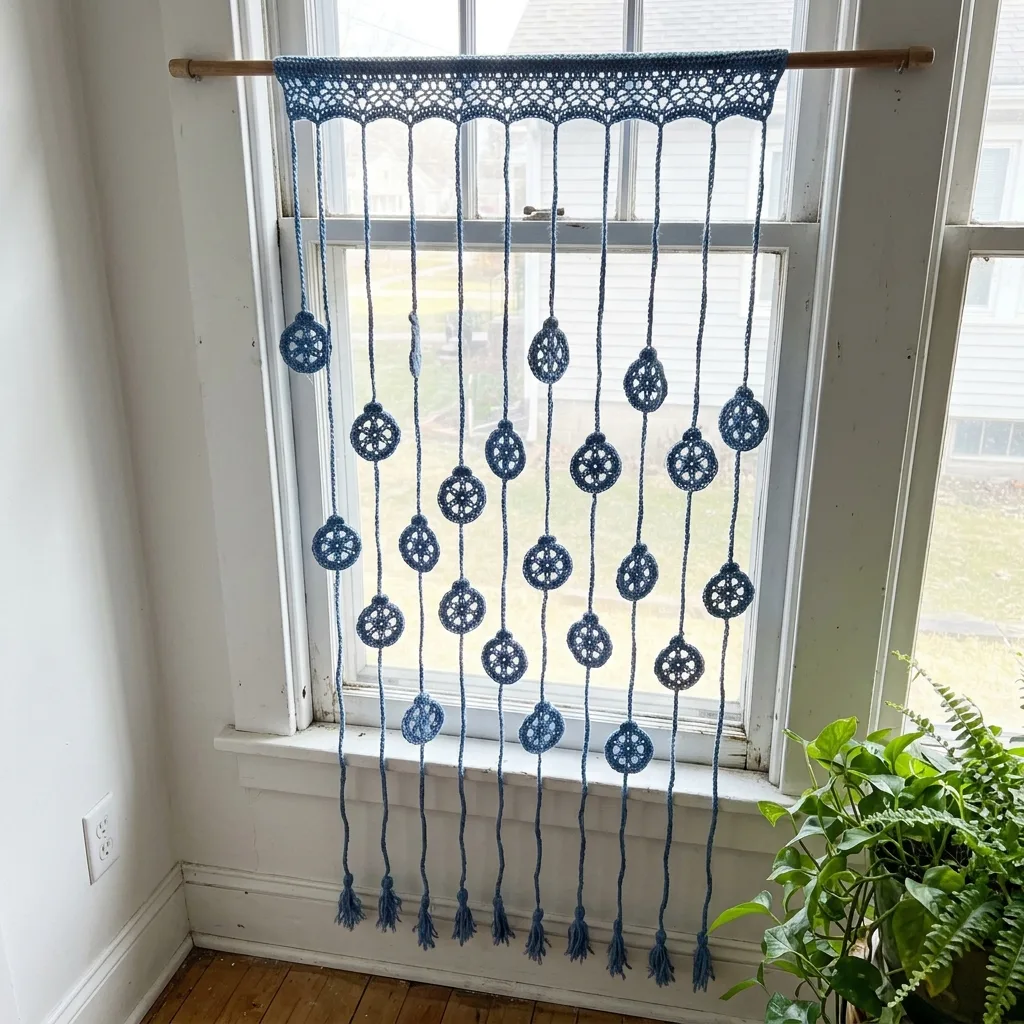
You need single crochet, double crochet, chain arches and patience with small lacy pieces and a bit of sewing.
One ornament takes about 15 minutes, so the fifty of them are easy to make a few at a time.
The winter light shines through the lace and throws little snowflake shadows across the room.
About This Denim Blue Christmas Ornament Strand Curtain Crochet Pattern Pattern
This curtain looks like a Christmas tree turned into a window. Nine long strands of twisted denim blue cord hang from a narrow lace band, and on each strand hang five or six small crochet ornaments. Every ornament is a round lace bauble with a six pointed snowflake in the middle and a tiny cap on top, and the ones on neighboring strands hang at different heights, so the whole curtain looks like snow falling in the window. Each cord ends in a tiny tassel. It is worked in one single color, a soft denim blue, so when the winter light comes through, the lace throws little snowflake shadows across the room.
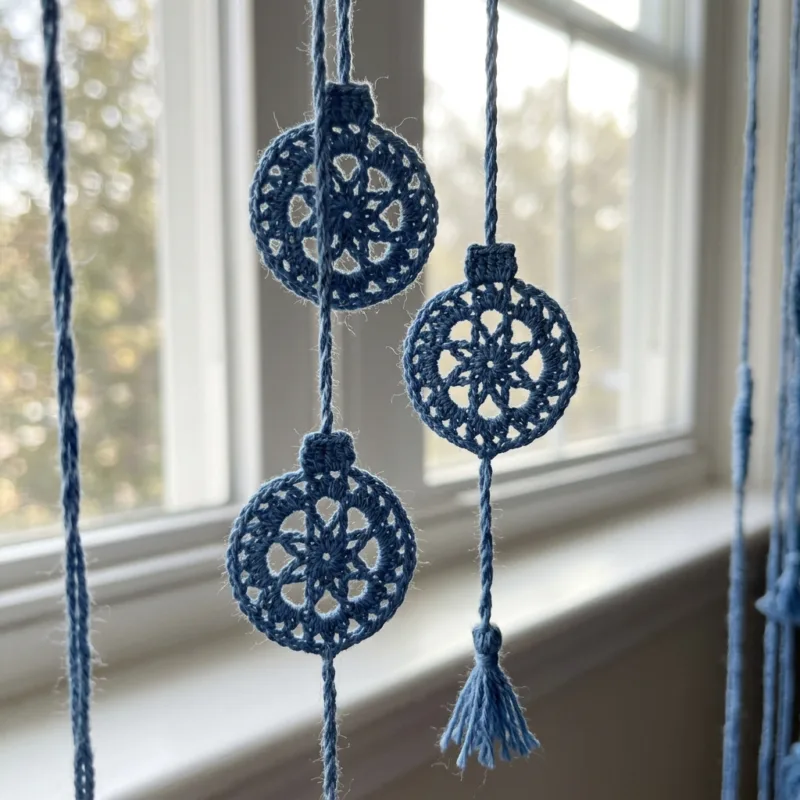
The ornament is a small round medallion worked in four rounds. You make a snowflake with six little arms in the center, then cover it with six big chain arches that become six round lobes, and you finish with a tiny pointed drop at the bottom and a small cap at the top. One ornament is about 2.2 inches (5.5 cm) wide and 3.1 inches (8 cm) tall with its cap and drop, and it takes about 15 minutes. There are 50 of them in all, so it is a wonderful project for evenings, a few at a time.
The strands are plain cord. You chain a long length, slip stitch back along it for a firm, twisted look, and attach it to the band at the same time. There are two kinds of strand. Five of them have six ornaments and start high, and four of them have five ornaments and start lower. When you hang them in the order high, low, high, low, the ornaments stagger across the window just like in the photo. The ornaments hang on the cord by their caps, so the cord passes behind each one and shows between them.
The top band is a little strip of lace, three rows deep and 105 stitches wide, with a row of small squares through the middle. The strands start on its lower edge, one every 12 stitches, and nine clip rings hold the band on a thin rod or a tension rod. I made the band narrow on purpose, so it looks like a ribbon and lets the ornaments be the stars. Because the whole curtain is made from one yarn, there is nothing to match, and nothing to sew together except the ornaments and their caps.
I made mine in denim blue because it feels calm and wintery, and because it looks good with white window frames, but you can change the color without changing a single stitch. Red and green make it look like a traditional Christmas, white and silver make it look like frost, and gold makes it look like a very grand tree. Cotton gives the ornaments a crisp, matte look, and a little spray starch keeps the lace round and lifted for the whole season.
This is a curtain for a window you love, a glass door or a doorway. It does not block the light or the view, and it makes a pretty frame for the garden. It also works as a room divider, a backdrop for a Christmas table or a hanging in a nursery or a kitchen. The curtain is light, weighs only about 150 g, and hangs from a simple rod, so you do not need heavy brackets. Because the strands are long cords, I hang it where small children and pets cannot pull on it.
Another thing I like about this design is how forgiving it is. The ornaments are separate little pieces, so if one comes out a bit uneven, you simply make another and nobody ever knows. You can also add or remove ornaments and strands to fit any window, because every number in the pattern is given for the narrow, wide, short and long versions. The cords are plain, the band is simple, and the only part that needs real attention is the placement of the caps, which the pattern gives you stitch by stitch.
I call this pattern intermediate. The stitches are simple, but the ornament has small, lacy rounds and a bit of sewing, and you make 50 of them, so it asks for a little patience. The cords are easy and quick, and the band is a single afternoon. Plan on about 22 to 28 hours in all. I make all the ornaments first, in front of the television, and then I make the cords and hang everything in one weekend. Start in October, and it will be ready for the first snow.
Why You'll Love This Denim Blue Christmas Ornament Strand Curtain Crochet Pattern Pattern
I love this curtain because it turns an ordinary window into something that feels like Christmas without a single light plugged in. When I hung it for the first time, the afternoon sun came through the lace, and the shadows of fifty little snowflakes moved slowly across my kitchen floor. My granddaughter stood in the middle of the room and tried to catch them with her hands. Then she asked me to count the ornaments with her, and we got to 50 before her mother called her for supper.
It is also a very relaxed project. An ornament is only four rounds, so it is finished before I get bored, and I can make one in the time it takes to drink a cup of tea. I keep the finished ones in a bowl on the table, and watching the bowl fill up is half the fun. By the time I had made 20, I could not stop, and I made the rest in one week of evenings. It is the kind of crochet that makes you want just one more.
The snowflake in the middle is my favorite part. It starts as a tiny ring, and then six small arms grow out of it, and when the arches go around them, it suddenly looks like a real ornament. Every time I finish one, I hold it up to the window and look at the light coming through. I think a window is the best place to show off crochet lace, because the light does half of the work for you.
This curtain changed my kitchen more than a wreath could. The window used to have a plain white blind that I kept closed, and now I leave the window open all day. The blue goes beautifully with my white frame, and the green plant next to it looks even greener. Friends touch the ornaments when they think I am not looking, and I love that. It looks festive in December, and in January I leave it up, because it just looks like snow.
It makes a wonderful gift for someone who loves a cozy home. Here is who I would make one for:
- a daughter or granddaughter who loves Christmas decorations
- a friend who has everything and loves handmade things
- a neighbor with a big kitchen window
- anyone who loves blue, white and winter
It is also kind to your stash. Each ornament uses only about 5.6 yards, so leftover balls of DK cotton work well, and if the shades differ a little, the strands look like real glass ornaments in different blues. For the band and the cords, I use one ball from the same dye lot, because those parts run through the whole curtain and show the most.
There is one more thing I love, and it is the quiet. When the curtain hangs in the window and a breeze comes through, the ornaments sway very slightly, and the cords whisper against the glass. It is a small sound, but it makes the kitchen feel calm in the middle of a busy December. I put the kettle on, sit by the window with my crochet and watch the light change on the blue. It is the best five minutes of my day.
Making it taught me a few things. I learned to block every ornament flat and spray it with starch, because soft cotton lace likes to curl at the edges. I learned to count the stitches on the cord, because a strand that is a few stitches off makes the whole row of ornaments look crooked. And I learned to sew each cap in at least four places, so the ornament hangs straight and does not spin. All of this is in the pattern, so yours goes up smoothly.
Switch Things Up
This curtain is easy to change, because it is built from one ornament, one cord and one band. Here are the variations I have made or planned, with the numbers you need for each one. Read through them before you buy yarn, since a new size changes how much you need. The ornament never changes, so once you know it, every version feels familiar.
Red, green, white, silver gray or gold. Make the whole curtain in one color. Red looks like a classic Christmas window, green looks like a pine garland, white looks like frost, silver gray looks like icicles and gold looks like a very grand tree. You can also make the ornaments in one color and the cords and band in another, for example white ornaments on silver gray cords. Use the same yarn weight so the pieces keep the same size.
A narrow window. For a window about 17 inches (43 cm) wide, make 7 strands instead of 9. The band has a foundation chain of 82 and 81 sc in Row 1, and in Row 2 the repeat [ch 1, skip 1 sc, dc in next sc] is worked 39 times. The strands start at sts 5, 17, 29, 41, 53, 65 and 77, in the order A, B, A, B, A, B, A. That makes 4 A strands and 3 B strands, 39 ornaments in all, and takes about 280 yd of yarn.
A wide window. For a window about 31 inches (79 cm) wide, make 13 strands. The band has a foundation chain of 154 and 153 sc in Row 1, and in Row 2 the repeat is worked 75 times. The strands start at sts 5, 17, 29 and so on up to 149, in the order A, B, A and so on. That makes 7 A strands and 6 B strands, 72 ornaments in all, and takes about 480 yd of yarn.
A short cafe curtain. For the lower half of a window, make strand A with 4 ornaments, with the caps at sts 15, 50, 85 and 120, and a cord of ch 156 (155 sl st). Make strand B with 3 ornaments, with the caps at sts 33, 68 and 103, and a cord of ch 139 (138 sl st). The curtain is about 31 inches (79 cm) long, has 32 ornaments, and takes about 230 yd of yarn.
A long curtain. For a tall window or a glass door, make strand A with 8 ornaments, with the caps at sts 15, 50, 85, 120, 155, 190, 225 and 260, and a cord of ch 296 (295 sl st). Make strand B with 7 ornaments, with the caps at sts 33, 68, 103, 138, 173, 208 and 243, and a cord of ch 279 (278 sl st). The curtain is about 60 inches (152 cm) long, has 68 ornaments, and takes about 480 yd of yarn.
A different yarn weight. The ornaments, cords and band grow or shrink with your yarn, so you can change the size without changing a single stitch count. Thicker yarn also makes a heavier curtain. Here is roughly what to expect for the 9 strand curtain as written:
- Fingering cotton with a 2.5 mm hook: ornament about 1.8 in (4.5 cm) wide, curtain about 17 in (43 cm) wide and 37 in (94 cm) long
- DK cotton with a 3 mm hook, as written: ornament about 2.2 in (5.5 cm) wide, curtain about 22 in (56 cm) wide and 46 in (117 cm) long
- Worsted cotton with a 4 mm hook: ornament about 2.9 in (7.4 cm) wide, curtain about 29 in (74 cm) wide and 60 in (152 cm) long
Materials Needed
— Main Fabric
— Tools Required
The Free Pattern
0% complete
— Layout :
— Top Band (Make 1) :
— Ornament (Make 50) :
— Strands (Make 9) :
— Tassels (Make 9) :
— Hanging :
Assembly Instructions
- Make the lace band, 105 sts wide and 3 rows deep, and block it flat.
- Make 50 ornaments, each with a snowflake center, 6 lobes, a drop and a cap, then block and starch them.
- Work the 9 cords onto the lower edge of the band, 5 of strand A and 4 of strand B, in the order A, B, A, B, A, B, A, B, A.
- Slide the ornaments onto the cords by their caps and sew each cap and drop to the cord at the positions in the pattern.
- Make 9 small tassels and tie one to the bottom loop of every cord.
- Clip 9 rings to the band, slide them onto the rod and let the curtain hang for 2 days before you adjust the ornaments.
Common Mistakes & How to Fix Them
Ornaments that curl and lose their round shape. Cotton lace is soft, and the six lobes of an ornament tend to curl at the edges, so the ornament looks like a crumpled flower instead of a crisp bauble. This is the most common problem with this design. Pin each ornament flat on a mat, with the snowflake centered and the lobes round, spray it with starch and let it dry fully before you sew anything. Repeat the starch after every wash. A little starch keeps the lace lifted for the whole season and lets the light show through.
Cords that stretch or twist. If you chain tightly and slip stitch back loosely, the cord twists like a corkscrew, and if you work both loosely, the cord grows when the ornaments hang on it. Count every chain, keep the same tension for the chain and the slip stitches, and use the same hook for all 9 cords. Hang the finished curtain for 2 days before you sew the drops, because cotton cord relaxes under weight, and you will want to place the ornaments on the final length.
Ornaments at the wrong heights. The staggered look comes from the positions of the caps, and if you sew them by eye, the rows of ornaments look crooked and the strands look the same. Mark the stitch numbers with a stitch marker on the cord, count them from the band, and sew the caps with their tops at the numbers in the pattern. Remember that strand A starts at st 15 and strand B starts at st 33. Lay the whole curtain flat and check that the pattern zigzags before you tie the tassels.
A band that bows or curls. A band of only three rows is narrow, and if your tension is tight, it pulls the strands together and bows the curtain. Work the foundation chain loosely, block the band flat, and pin it straight to the exact width of 21 inches. If the band still curls, press it lightly with a damp cloth. Clip a ring above every strand start, so the weight of each cord is held by the band and not by one or two points.

You Might Also Like
Important Notes
My gauge is 5 sts to 1 in (2.5 cm) in single crochet in DK cotton with a 3 mm hook. Make one ornament and one short cord of 30 sl st and block them before you buy all your yarn. If your ornament is bigger than 2.2 in, go down a hook size, and if it is smaller, go up one. Keep that hook for the whole curtain. Write your gauge on a card and keep it with the pattern, so the second curtain you make for a friend matches the first.
Block the band and every ornament before you sew anything. Pin each ornament flat on a mat, with the lobes round, mist it with water, spray it lightly with starch and let it dry fully. Do not press with a hot iron, because it flattens the lace. After you hang the curtain, you can steam the cords lightly from a distance to relax any twists. Starch the ornaments after blocking, not before, so the pins do not stick.
The curtain uses about 340 yd (311 m) of DK cotton, and I recommend buying about 450 yd (411 m). Buy all the yarn at once and check that the dye lot number is the same on every label. Blue shades can change a lot between lots, and one lighter ornament would show clearly when the light comes through the lace. Keep a small ball for sewing and for repairs.
The finished curtain weighs about 150 g, so a thin rod or a tension rod holds it well. Wash a small swatch first, because dark blue can bleed. To wash the curtain, hand wash it in cool water with mild soap, press out the water with towels and lay it flat to dry, then spray the ornaments with starch again. Keep the strands out of reach of small children and pets. Hang it away from heaters.
I hope this curtain brings as much Christmas light into your home as mine has brought into my kitchen. It looks like a very large project when you see it hanging, but it is really just fifty tiny ornaments and nine long cords. Take your time, enjoy each snowflake and do not worry if your first ornament is a little uneven. Starch will help, and every ornament you make will be better than the last.
So find your blue cotton tonight and make just one small ornament. Watch the snowflake grow in the middle, add the arches, hold it up to the window and see the light come through. Before long you will have a whole bowl of them and a window that looks like falling snow. Happy crocheting, my friend.
Crochet Abbreviations
You Ask, We Answer
What is the finished size of the curtain?
As written, the curtain is about 22 inches (56 cm) wide and about 46 inches (117 cm) long from the top of the band to the end of the longest strand. The band is about 21 inches wide, strand A is about 45 inches long, strand B is about 42 inches long, and each ornament is about 2.2 inches wide and 3.1 inches tall. These sizes are for DK cotton with a 3 mm hook and my gauge of 5 stitches to 1 inch. To fit your window, measure the width and divide by 2.4 inches to find how many strands fit, then use the narrow or wide numbers in this pattern. Always make one ornament and block it first, so your math uses your own gauge.
Can I use a different yarn weight or make the curtain bigger or smaller?
Yes, and you do not need to change any stitch counts. The ornaments, cords and band all grow or shrink with the yarn and hook. In fingering cotton with a 2.5 mm hook, the curtain is about 17 inches wide and 37 inches long, which suits a small window. In worsted cotton with a 4 mm hook, it grows to about 29 inches wide and 60 inches long. Thicker yarn also makes a heavier curtain, so use a sturdier rod. To change the size without changing the yarn, add or remove strands for width and ornaments for length, using the numbers in the variations. I recommend cotton or a cotton blend, because acrylic stretches and loses the crisp lace shape.
How do I wash and care for the curtain?
Cotton is easy to care for, but I treat this curtain gently because of its many small ornaments and long cords. Most of the time, a gentle shake outdoors every few weeks keeps it fresh. When it needs a real wash, take it down and unclip the rings. Lay it in a bathtub of cool water with a little mild soap, swish it gently without twisting or wringing, and rinse until the water runs clear. Press the water out with large towels, lay the curtain flat on dry towels with the strands straight and pin each ornament round. Let it dry fully, spray the ornaments with starch, and keep the curtain out of the dryer and strong direct sun.
Success!
Thanks for subscribing — check your inbox for a welcome note.
Abbreviations
- ch — chain
- sl st — slip stitch
- sc — single crochet
- dc — double crochet
- st(s) — stitch(es)
- RS — right side
- in — inch or inches
- cm — centimeters
- mm — millimeters
- yd — yards
- m — meters
- g — grams