
Cinnamon and Cream Spiral Bed Cover Crochet Pattern
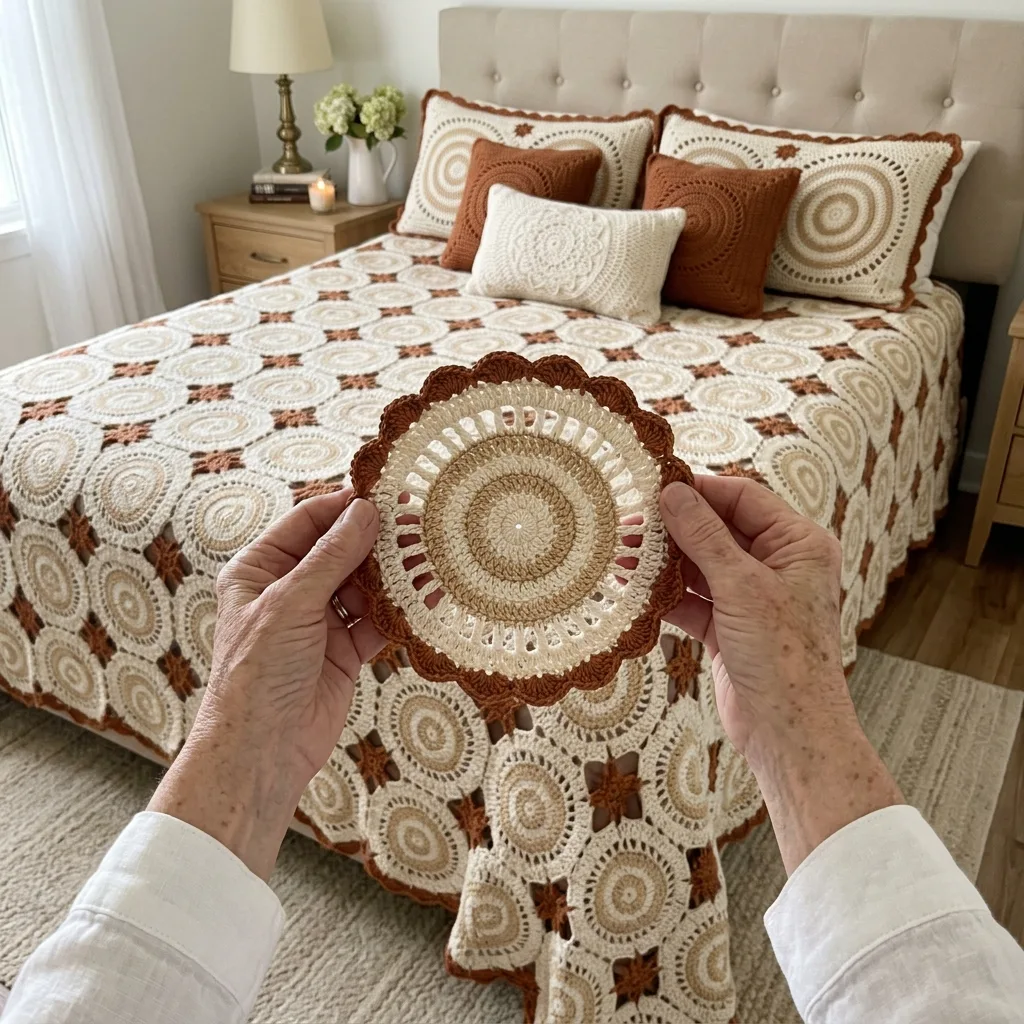
A seamless two-color spiral, then plain joined rounds and a join-as-you-go shell round.
Each motif takes about an hour, and the cover grows into one piece as you go.
Cream and sand twist together like a sweet roll, framed in warm cinnamon brown.
About This Cinnamon and Cream Spiral Bed Cover Crochet Pattern Pattern
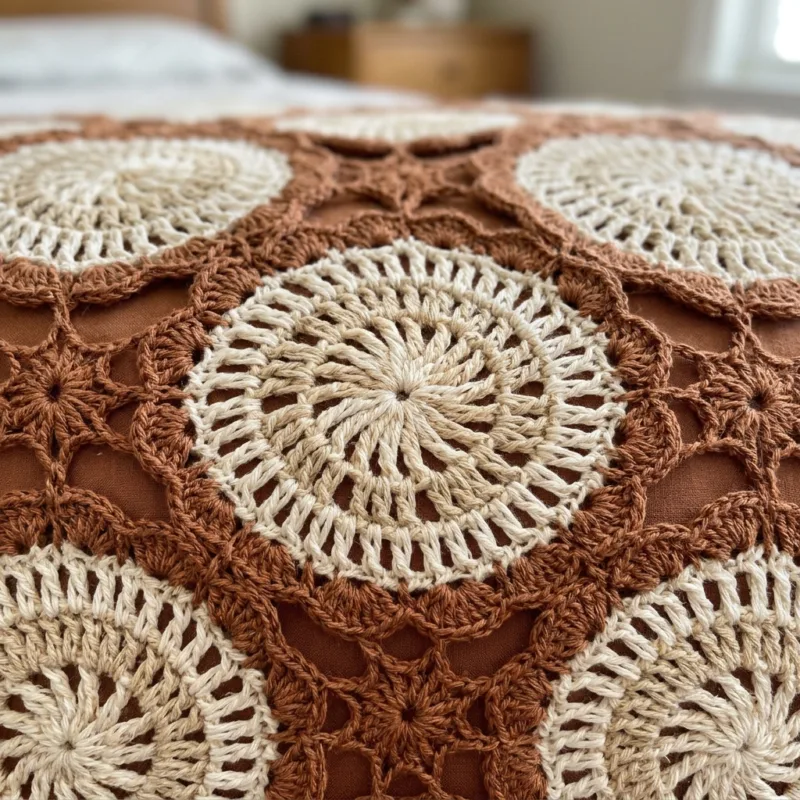
Every motif on this bed cover reminds me of a cinnamon roll fresh from the oven. In the center, a cream arm and a sand arm curl around each other in a soft swirl. Around them sits a ring of open cream spokes, then a cream round, and finally a scalloped edge in warm cinnamon brown. The circles are joined in neat rows, and between them little cinnamon stars hold everything together. On the bed, the brown edges and stars form a gentle lattice, and the cream and sand swirls glow inside it like a tray of pastries.
The spiral at the heart of each motif uses two colors at once. Cream and sand start together in one magic ring, and then they take turns, each color working half of every round before it waits on a stitch marker for the other. Because each color always works into the stitches the other one just made, the color change creeps around the circle and creates the swirl. After five rounds, both colors finish with a few shorter stitches, which taper the tips of the arms neatly into the circle.
The outer rounds are ordinary joined rounds, which feels very relaxing after the spiral. A round of cream single crochet frames the swirl, a round of cream treble crochet with chain spaces makes the wheel of spokes, and a round of cream single crochet closes it up again. Then cinnamon brown takes over for the last round, a ring of 24 little shells. This is the round where you join each new motif to its neighbors, through the center of two shells on each shared side, so there is no sewing.
Each motif measures about 8.5 inches across after blocking. The queen size uses 99 motifs, set in 9 columns and 11 rows, and 80 cinnamon stars, one in every gap where four circles meet. The finished cover measures about 77 by 94 inches before the edge. A final cinnamon round with picots runs around every free shell on the outside, which firms up the scallops and gives the cover a pretty, finished outline.
Three colors may sound like a lot, but only the spiral uses two at once, and the cinnamon appears only on the last round and the stars. The pattern uses chain, slip stitch, single crochet, half double crochet, double crochet and treble crochet. The intermediate part is the two-color spiral and the join-as-you-go round. I give stitch counts for each color in every spiral round and spell out the joining shell by shell, so you can always check where you are.
The finished cover is light and airy, with a lovely soft drape that falls in waves at the sides of the bed. The swirls look almost sculpted, and the open spokes let the light through, so the cover never looks heavy even though it is large. In cotton, it is comfortable in every season, cool in summer and pretty over a warm blanket in winter.
The colors are what make it feel so cozy. Cream, sand and cinnamon are the warm neutrals of a bakery or an autumn afternoon, and they sit beautifully with oak furniture, brass lamps, linen curtains and green plants. This cover suits a farmhouse bedroom, a cottage guest room or a modern room that needs a touch of warmth. If you have made a spiral motif before, you will enjoy the new rhythm of three colors, and if you have not, this is a delicious place to start.
Why You'll Love This Cinnamon and Cream Spiral Bed Cover Crochet Pattern Pattern
I fell for this color scheme on a cold autumn morning with a cup of coffee and a cinnamon bun on the table. The cream frosting, the golden dough and the brown spice swirled together, and I thought: that is a bed cover. When I made the first motif and the cream and sand arms curled into the center, then the cinnamon scallops went around the outside, it looked exactly like that breakfast. It still makes me smile every time I see the bed.
I love how the work moves through three moods. The spiral needs a little attention, with two colors and two loops to keep track of. The cream outer rounds are calm and easy, perfect for an evening in front of the television. Then the cinnamon shells feel like a little reward, because the motif suddenly looks finished and framed. Moving from one mood to the next keeps every motif interesting, even after dozens of them.
The stars are another favorite. They are tiny, just a ring of single crochet with eight chain arms, but they make such a difference. Before the stars go in, the joined circles have small open gaps between them. Once the stars are in, the cover looks tight, planned and complete, and the little brown points line up with the brown scallops to make a soft lattice across the whole bed. I made all 80 stars in one happy weekend.
Here are the habits that kept this project relaxed for me:
- Make the spiral centers in batches of five, then finish their outer rounds together.
- Put the waiting color on a locking stitch marker every time, without exception.
- Weave in the cream and sand tails before you add the cinnamon round.
- Lay the joined rows on the bed every week to enjoy the swirls growing.
I also love joining as I go. With every new motif, I work the cinnamon shells and slip stitch two of them into the circle beside it and two into the circle above it. There is no pile of motifs waiting to be sewn, and no weekend of seaming at the end. Instead, the cover grows across my lap row by row, and I can spread it over the bed at any time to see how far it has come.
The warmth this cover brings to a room is something special. Warm neutrals can sometimes look flat, but here the three shades and the open lace give the cover depth and movement. With a brass lamp glowing in the evening, the swirls look golden and the cinnamon looks rich and spicy. It turns a plain bedroom into a cozy nest, the kind of room you look forward to coming back to at the end of the day.
Finally, I love it as a gift for someone who loves comfort. I have seen how people touch the swirls without even thinking, tracing the arms with a fingertip. It is a cover that invites you in. If you make it for yourself, curl up under it with a warm drink and a good book, because that is exactly what it was made for.
Switch Things Up
Choose a new trio of colors. The design works with any three colors, one light, one medium and one deep. White, silver and charcoal make a crisp, modern version. Ivory, blush and dusty rose feel soft and romantic, and white, sky blue and navy look fresh and coastal. For a warm autumn look, try oatmeal, mustard and rust. Keep the deepest color for the shell round and the stars, so the lattice frames each swirl.
Make it for any bed. Each motif is about 8.5 inches across, so new sizes are simple to plan. Add or remove columns for the width and rows for the length. The number of stars is always one less than the columns times one less than the rows. These sizes are before the edge:
- Twin: 7 by 11 motifs, 77 motifs and 60 stars, about 60 by 94 inches
- Full: 8 by 11 motifs, 88 motifs and 70 stars, about 68 by 94 inches
- Queen: 9 by 11 motifs, 99 motifs and 80 stars, about 77 by 94 inches
- King: 11 by 11 motifs, 121 motifs and 100 stars, about 94 by 94 inches
Make a sofa throw. Six columns by seven rows, 42 motifs and 30 stars, makes a throw of about 51 by 60 inches. It uses a little over 40 percent of the yarn, so it is a good way to learn the spiral before a full bed. It looks lovely folded over the back of a sofa, with the cinnamon scallops hanging down the front, and it makes a warm housewarming gift for someone who loves cozy colors.
Make a baby blanket. Four columns by five rows, 20 motifs and 12 stars, gives a blanket of about 34 by 43 inches. For a baby, choose a soft cotton blend or baby acrylic, and close up the spokes by working Rnd 7 with ch 1 instead of ch 2. Then add one extra round of single crochet in the deep color around the outside. Pale colors such as cream, oatmeal and soft caramel look gentle and calm in a nursery.
Add matching pillows. One motif makes a sweet small pillow front, and four motifs joined 2 by 2 with one star in the middle make a 17 inch cushion. Sew it onto a cinnamon or cream fabric cover so the lace shows against a solid color. For a lumbar pillow, join three motifs in a row with two half stars between them. Matching pillows tie the bed together and use up the last of your yarn.
Use the stars as accents. The stars do not have to match the shells. Work them in cream for a lighter, airier look, or in sand so they blend into the swirls and the circles seem to float. You can also add a tiny cream center by working Rnd 1 of each star in cream and Rnd 2 in cinnamon. Make a few test stars and lay them between motifs before you decide.
Change the edge. The cinnamon picot edge is pretty and firm, but you can try other finishes. For a fuller frill, work a small shell of 5 dc at the tip of each scallop instead of a picot. For a clean, simple outline, work reverse single crochet all around the shells. You can also fill the dips between edge motifs with half stars before the edge round, so the sides run straighter.
Change the yarn weight. In DK cotton with a 4 mm hook, each motif comes out about 7 inches across, and a queen cover needs about 11 by 13 motifs, 143 in all. In bulky yarn with a 6.5 mm hook, motifs grow to about 11 inches, and a queen needs only 7 by 9 motifs, 63 in all. Always make and block one motif first, measure it, and divide your bed size by that number before you buy yarn.
Materials Needed
— Main Fabric
— Tools Required
The Free Pattern
0% complete
— Spiral Center (Make 99, cream and sand) :
— Outer Rounds (Make 99, cream and cinnamon brown) :
— Layout :
— Cinnamon Star (Make 80, cinnamon brown) :
— Edge :
Assembly Instructions
- Make one complete motif, block it and check that it measures about 8.5 inches across.
- Make the cream and sand spiral centers and the cream outer rounds for each motif, weaving in the ends as you go.
- Work the cinnamon shell round on each motif, joining it during Rnd 9 to the motif on its left and the motif above it, keeping every motif in the same orientation, until you have 11 rows of 9 motifs.
- Work a cinnamon star in each of the 80 gaps where four motifs meet, joining its 8 arms to the 8 corner shells around the gap.
- Work the cinnamon edge round with picots into every free shell around the outside of the cover.
- Weave in all remaining ends, then pin the cover out, spray it lightly with water and let it dry flat so the spirals and shells open evenly.
Common Mistakes & How to Fix Them
Cream and sand drifting out of balance. In the spiral, it is easy to pick up the wrong loop or to let a waiting loop slip, and then one color ends a round with more stitches than the other. Because cream and sand are close in tone, you may not notice until the swirl looks lopsided or the center starts to cup. Count each color at the end of every round: 6, 12, 18, 24 and then 30 stitches. If the counts are different, pull back to the last round where they matched. Working in good light helps a lot, because the two shades are so gentle.
Pulling the cinnamon shells too tight. The final round is worked in a new color, and many of us tighten up when we change yarn. If the cinnamon round is tight, it draws the edge of the motif in, the spokes bunch up and the motif cups into a bowl. If it is loose, the edge ruffles and the shells flop. Lay each motif on the table after Rnd 9 and check that it is flat. If you tend to crochet tightly in a new color, go up half a hook size just for Rnd 9 and keep that hook for every motif.
Misplacing the treble spokes. In Rnd 7 you skip two single crochet between every treble, and it is easy to skip one or three, especially in cream on cream. Then you end up with 23 or 25 spokes, Rnd 8 has the wrong count, and the 24 shells will not divide into four sides of six. The joins and the stars then land in the wrong places. Before Rnd 7, place a stitch marker every 18 sc of Rnd 6, then check that you have exactly 6 trebles between markers. After Rnd 8, count to 96 before you change to cinnamon.
Turning motifs when joining. Every motif must sit the same way, with shell 1 at the top left of Side A. If a motif is turned, its joining shells will not face its neighbors, the corner shells will not face the gaps, and the stars cannot reach them. Because the motifs are round, it is easy to lose track. Mark the first shell of every motif with a scrap of contrasting yarn before you start the joining round, and always hold it at the top. Lay out each new row against the row above it before you continue.

You Might Also Like
Important Notes
Gauge matters because 99 motifs must fit together. With a 5 mm hook, the spiral center after Rnd 5 should measure about 5 inches across, and the finished motif about 8.5 inches after blocking. A small difference is fine if every motif matches. Measure your first five motifs and then one in every ten. If the center cups, go up half a hook size; if it ruffles, go down half a size, and test again before continuing.
Block the first motif on its own to check the size, and block the whole cover after the stars and the edge are done. Pin it out on a clean surface or in sections on blocking mats, opening each spiral into a round shape and each shell into a neat curve. Spray with water until damp, straighten the spokes, and let it dry completely before unpinning. Blocking makes the lace crisp and the swirls clear.
The yarn amounts in the materials list are estimates for the queen size, including the stars and the edge. Buy all three colors at once, from the same dye lots, and keep the labels. Sand and cream in particular can shift between lots, and because they sit side by side in every spiral, even a small change would be easy to see. Buy one extra skein of each color for safety and for future repairs.
Wash the finished cover on a gentle cold cycle in a large mesh bag or a zipped duvet cover, with mild detergent. Cinnamon brown sits right next to cream, so always add a color catcher, especially for the first few washes. Never wring or twist the lace. Press out the water, lay the cover flat on towels or a clean drying rack, reshape the spirals and shells while damp, and let it dry fully.
Thank you for making this cinnamon and cream spiral bed cover with me. I hope you enjoy the gentle swirl of cream and sand, the calm cream rounds, the warm cinnamon shells and the tiny stars that finish it all. It is a cover full of warmth, and every motif you make brings that cozy feeling a little closer to your own bedroom.
So pour yourself something warm, find your three colors and make your first spiral today. Finish it, frame it in cinnamon and set it on your bed to admire. Then make the next one, and soon you will have a sweet, swirling bed cover to curl up under for many years.
Crochet Abbreviations
You Ask, We Answer
How big is the finished bed cover, and how many motifs do I need?
Following the pattern exactly, each motif measures about 8.5 inches across after blocking. The queen size uses 99 motifs in 9 columns and 11 rows, plus 80 cinnamon stars, and finishes at about 77 by 94 inches, with the scalloped edge adding a little more all around. On a standard queen mattress of 60 by 80 inches, that gives a drop of about 8 to 9 inches on each side and a long drape at the foot. For a deeper drop, add one column for width, which also adds 10 more stars. To plan your own size, measure the mattress width plus twice the drop you want, and the mattress length plus one drop, then divide each by 8.5 and round up. Remember that the stars are always one less than the columns times one less than the rows, and the edge round works for any size.
Can I use different yarn, or fewer colors?
Yes. Worsted cotton gives crisp spirals, straight spokes and clean shells, and it washes well. A cotton and acrylic blend makes a softer, lighter cover, and a smooth acrylic works if you want easy care. Avoid very fuzzy yarns, because they blur the swirl. DK cotton with a 4 mm hook gives motifs about 7 inches across, and bulky yarn with a 6.5 mm hook gives motifs about 11 inches across. If you prefer fewer colors, work the spiral in cream and sand and the shells and stars in cream for a soft two-color look, or work the whole motif in one color, using two strands of the same shade for the spiral. The technique stays the same; only the look changes. Always make and block one motif first, then plan the number of motifs and the yarn from its size.
How do I care for and store the bed cover so it lasts?
Wash it only when it really needs it, on a gentle cold cycle in a large mesh bag with mild detergent, and use a color catcher every time, because cinnamon brown can tint cream. Dry it flat, reshaping the spirals and shells while damp. Never use a hot dryer, which can shrink cotton and pull the lace out of shape. Between washes, shake the cover out and air it near an open window, away from strong direct sunlight, which can fade the cinnamon and yellow the cream over time. To store it, fold it loosely with tissue paper between the layers and keep it in a cotton bag or large pillowcase rather than plastic, so the yarn can breathe. Refold it along different lines every few months, and if a star arm or joining shell ever loosens, slip stitch it back with a little cinnamon yarn.
Success!
Thanks for subscribing — check your inbox for a welcome note.
Abbreviations
- ch — chain
- sl st — slip stitch
- sc — single crochet
- hdc — half double crochet
- dc — double crochet
- tr — treble crochet
- picot — ch 3, sl st in 3rd ch from hook
- st(s) — stitch(es)
- sp(s) — space(s)
- rep — repeat
- Rnd — round
- RS — right side