
Cream Lace Clover Flower Motif Bedspread Crochet Pattern
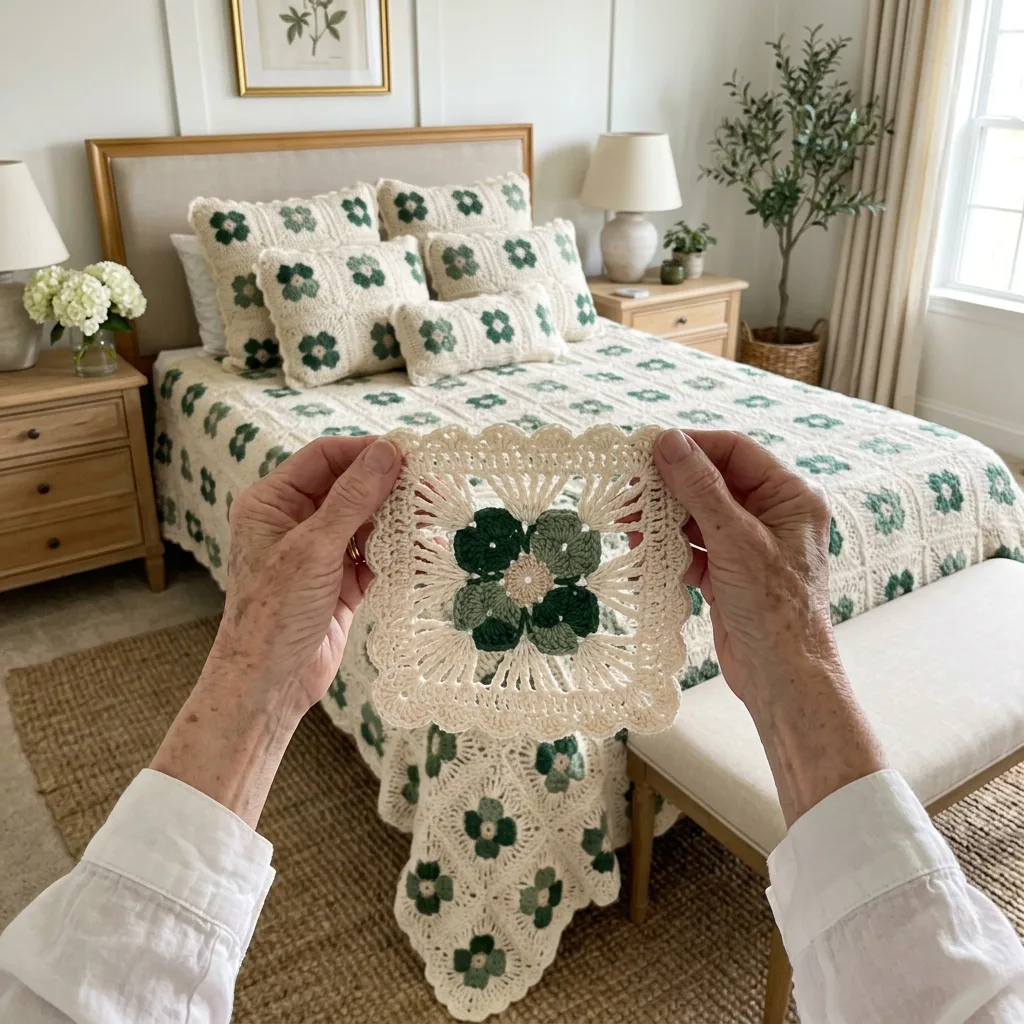
Short-row petals, treble spokes and a graded square, all counted round by round.
Each motif takes about an hour and a half, and they join as you go.
The motifs link at their picots while you work the last round, so there is no sewing at the end.
About This Cream Lace Clover Flower Motif Bedspread Crochet Pattern Pattern
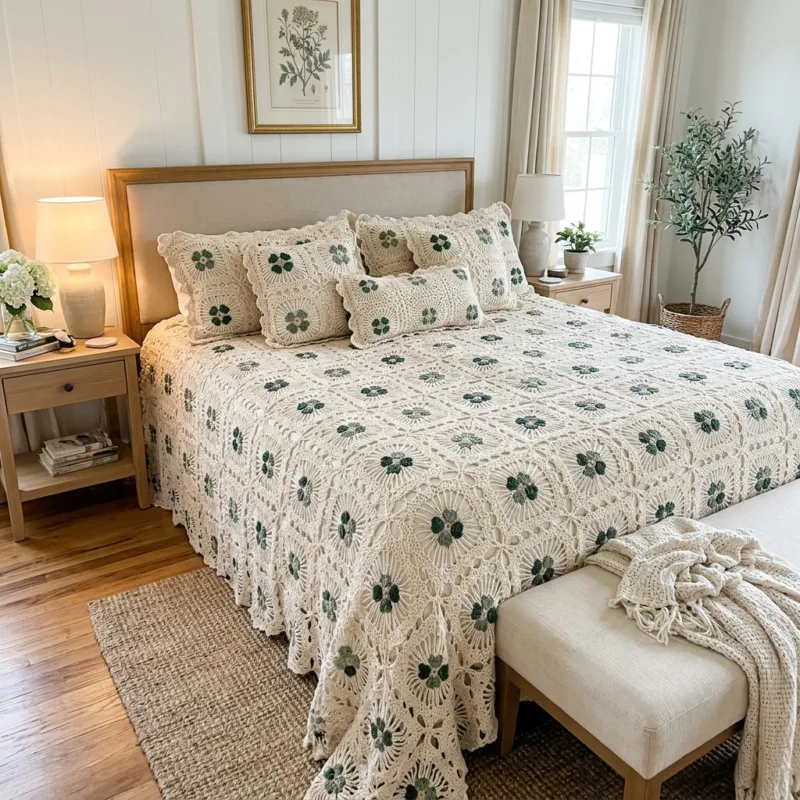
This bedspread is made from ninety cream lace motifs, each with a little green clover flower at its heart. The flower has four round petals, two in a deep forest green and two in a soft sage, sitting around a tiny oatmeal ring. Behind the flower, the cream lace bursts out in long treble crochet spokes, like rays of sunshine around a four-leaf clover. A round of single crochet steadies the circle, a graded round turns it into a square, and two final rounds of chain loops and picot scallops give every motif its lacy, scalloped frame. The motifs link to each other at the picots, so the whole bed becomes one airy sheet of lace dotted with green.
The finished bedspread measures about 102 by 113 inches (259 by 287 cm) including the edge. It is a grid of 9 motifs across and 10 motifs down, with each motif measuring about 11 inches after blocking, plus two rounds of picot loops around the outside. On a queen mattress that gives a drop of about 21 inches on each side and at the foot, so the lace hangs softly toward the floor. Because every motif is identical, there is no chart to follow, and the only thing to remember is to alternate the two greens in each flower.
The stitches are chain, slip stitch, single crochet, half double crochet, double crochet and treble crochet. The petals are worked in two short rows on three stitches of the center ring, so each one comes out round and plump. The spokes are trebles with two chains between, and the graded round steps down from treble at the corners to single crochet at the middle of each side. None of these is difficult, but together they make a motif that looks far more complicated than it really is.
The best part is the joining. In the final round, each scallop has a little ch-3 picot at its tip. When a motif sits next to one you have already made, you simply replace that picot with a chain, a slip stitch into the matching picot of the neighbor, and another chain. By the time you finish your last motif, the bedspread is already joined. A short edge of chain loops and picot shells finishes the outside and makes the soft scalloped hem.
In worsted weight cotton the bedspread has a lovely weight and drape, but the long spokes keep it light and open. The green flowers stand up slightly from the cream lace, so the surface has texture and a gentle play of light and shadow. The colors feel calm and natural, like a spring meadow with clover peeking through the grass. They suit honey wood, white paneling, linen, olive trees and fresh white flowers, and they bring a quiet freshness to any bedroom.
I rate this pattern as intermediate. You need to be comfortable working in the round, turning short rows for the petals and counting carefully in the graded round. The join-as-you-go needs a little attention at first, so I suggest joining your first few motifs on a table where you can see the layout. It suits a maker who loves lace and enjoys a project that grows into something beautiful one piece at a time. Every round is written out with its stitch count, so you can always check your work.
Why You'll Love This Cream Lace Clover Flower Motif Bedspread Crochet Pattern Pattern
When I was a little girl, I spent whole afternoons in my grandfather's field looking for four-leaf clovers. I never found one, but I never stopped looking either. This bedspread is my way of finally finding ninety of them. Every motif has a little clover at its heart, and every time I finish one, I feel that same small thrill of luck. It is a silly reason to love a pattern, but it makes me smile every single time.
I love the moment the petals go on. You work a tiny oatmeal ring, and then you add the four round petals, two dark and two light, one after another. They puff up a little as you finish them, and the center suddenly looks like a real clover. Then the cream spokes go on behind them, and the flower seems to glow in the middle of a sunburst. It is such a satisfying transformation, and it happens in just a few rounds.
I also love that there is no sewing at the end. For years I dreaded the weeks of joining that came after a big motif project. With this pattern, the motifs join as you work the last round, so when the final motif is done, the bedspread is nearly done too. I can lay the joined part over my lap as I work, and watching it grow across the sofa kept me going through the long winter evenings.
Here is why this bedspread is so special to me:
- Every motif has a cheerful clover at its heart.
- The two greens make each flower look alive.
- The motifs join as you go, with no sewing afterwards.
- The long spokes keep the lace light and airy.
- The scalloped picots make a pretty edge with no extra border to plan.
This bedspread brought our bedroom to life. We had cream walls, beige linen and pale wood, and the room was peaceful but a little sleepy. Now the green clovers pick up the olive tree by the window, the plants on the nightstand and the botanical print above the bed. It feels like the garden has come indoors. In the morning, when the sun comes through the lace, the whole bed seems to sparkle with little points of light.
Making it taught me a few useful lessons too. I learned to keep my treble spokes loose and even, because that is what makes the sunburst lie flat. I learned to always double check which picot I am joining to, since a single wrong join can twist a whole row. And I learned to make the centers in batches, all the rings and petals first, which made each evening's work feel faster and more relaxed.
Most of all, I love that this is a bedspread to keep and pass on. Cotton lace lasts for generations if it is cared for gently, and these soft colors will never feel out of fashion. I like to imagine one of my grandchildren spreading it on their bed one day and counting the clovers, just as I used to count them in my grandfather's field. That would be the luckiest thing of all.
Switch Things Up
The easiest change is the flower color. Keep the cream lace and choose two shades of one color for the petals, one dark and one light, and the clover will always look lively. Navy and sky blue feel fresh and coastal, while burgundy and rose look rich and romantic. Mustard and butter yellow are sunny and cheerful, and plum with lilac is soft and dreamy. For a playful version, make every flower in a different pair of colors, like a field of wildflowers.
You can change the size by changing the number of motifs. Each motif is about 11 inches after blocking, and the edge adds about 1.5 inches on every side. The sizes below include a drop on the sides and the foot, so the lace reaches toward the floor. For a coverlet that sits only on top of the mattress, take away two motifs in each direction.
- Twin: 6 by 8 motifs (48), about 69 by 91 inches
- Full: 8 by 9 motifs (72), about 91 by 102 inches
- Queen: 9 by 10 motifs (90), about 102 by 113 inches
- King: 11 by 10 motifs (110), about 124 by 113 inches
A sofa throw is a lovely smaller version. Make 4 by 5 motifs, twenty in total, and work the edge around them for a throw of about 47 by 58 inches. It takes around thirty hours and uses less than a quarter of the yarn. It looks beautiful draped over a cream sofa or across the foot of a bed. It is also the perfect way to learn the join-as-you-go method before you begin the full bedspread.
For a baby keepsake, make 3 by 4 motifs in soft baby cotton, with pale mint and white petals or soft lemon and cream, for a pram cover of about 36 by 47 inches. The lace has long open spokes and picots, so I keep this kind of piece for the pram, a christening or a keepsake, used with an adult nearby, rather than as loose bedding in a crib. It makes a precious gift for a new baby in the family.
Matching pillows tie the whole bed together. Four motifs joined in a 2 by 2 block make the front of a large sham, and you can sew it onto a plain cover in sage or cream so the green shows softly through the lace. A row of three motifs joined end to end makes a lovely lumbar pillow. One motif on its own makes a sweet cushion for a reading chair or a window seat.
The motif also makes beautiful table linens. A single motif is a lovely doily under a vase or a lamp. A row of six motifs joined as you go makes a table runner of about 66 by 11 inches, and a 4 by 4 block makes a square tablecloth for a small table. Green clovers on cream lace look especially pretty on a spring or Easter table, and they are a wonderful way to use up leftover yarn.
If you would like a round motif instead, like the one I am holding in my photo, stop after Round 5 and work Rounds 7 and 8 straight into the circle: ch 5, skip 2, sc in next all the way around, then the scallop round. Round motifs joined at four points make a more open, airy bedspread with little diamond gaps between them. You can fill those gaps with tiny cream filler circles if you like.
You can also play with the yarn weight. In DK cotton with a 4 mm hook, motifs come out at about 9 inches, so you need more of them, but the lace is finer and lighter. In aran cotton with a 5.5 mm hook, motifs grow to about 12 inches, and 8 by 9 motifs cover a queen bed. Acrylic or a cotton blend works too and is lighter and warmer. Always make one test motif in your new yarn and measure it before you buy the rest.
Materials Needed
— Main Fabric
— Tools Required
The Free Pattern
0% complete
— Clover Sunburst Motif (Make 90, cream, two greens and oatmeal) :
— Layout and Join As You Go (9 x 10 grid, 90 motifs) :
— Picot Loop Edge (Color A) :
Assembly Instructions
- Make the centers of all 90 Clover Sunburst Motifs through Round 7, weaving in the petal ends as you go.
- Work Round 8 of each motif following the Layout and Join As You Go section, joining each new motif at its picots to the motif on the left and the motif above.
- Lay each new row out on a table before joining it, so the flowers all face the same way and nothing twists.
- Work Rounds 1 and 2 of the Picot Loop Edge around the whole bedspread.
- Weave in the last ends, then wet block the finished bedspread on a clean floor, opening the spokes and pinning out the edge.
Common Mistakes & How to Fix Them
Working the petals into both loops. The petals must go into the front loops only of Round 1, so the back loops stay free for the cream chain loops of Round 2. If you work into both loops, there is nothing left to anchor Round 2, and the cream lace ends up pulling on the petals from the front. The flower then looks squashed and the spokes lean. Look closely at each oatmeal stitch before you insert the hook, and choose the loop nearest to you. If you made a mistake on one petal, undo only that petal and work it again.
Spokes that pull the circle out of shape. Round 4 has 48 treble spokes with two chains between them, and they only lie flat when every treble is the same height and every chain is relaxed. Tight chains make the circle cup like a bowl, and loose chains make it ruffle. Work each treble fully, pulling the loops up to their natural height, and keep the chains as loose as your other stitches. Lay the motif flat after Round 5. If it cups or ruffles, change your hook by half a size for the spoke round only.
Miscounting the graded round. Round 6 depends on exactly 24 stitches per quarter, with 4 dc, 4 hdc, 7 sc, 4 hdc and 4 dc between corners. If you work one extra single crochet on one side and one fewer on another, the square comes out crooked and the picots in Round 8 will not line up with the next motif. Place markers in the 1st, 25th, 49th and 73rd stitches before you start, and count each section as you work it. After the round, count 27 stitches on every side.
Joining to the wrong picot. When you join as you go, it is easy to skip a picot or join two picots to one, especially near the corners. Then the seam puckers, one motif sits a little lower than its neighbor, and the error carries along the whole row. Before you start Round 8, lay the new motif next to its neighbors and count the 9 side picots on each joining side. Join in order, starting from the corner, and say the numbers out loud. If you do join a wrong picot, undo back to it and rework the scallops from there.

You Might Also Like

Important Notes
Gauge and motif size matter in this pattern. With worsted weight cotton and a 5 mm hook, Rounds 1 to 5 should measure about 8 inches (20 cm) across, and the finished motif should block to 11 inches (28 cm). Make one motif and block it before you buy all your yarn. If it is smaller, go up a hook size. If it is larger, go down a size. All the grid sizes in this pattern assume an 11 inch motif.
Lace looks its best after wet blocking. Block your first few motifs individually so you can check the size. After that, you can block the bedspread in sections as it grows. Soak it in cool water, press out the water with towels, and pin it flat with straight edges, opening the spokes with your fingers. Let it dry completely. Block the whole bedspread once more after the edge is done.
This bedspread uses about 4,200 grams of cream, 200 grams of each green and 50 grams of oatmeal for the queen size. Buy all the cream at once, and check that every ball has the same dye lot number. On a big sheet of cream lace, a change in dye lot will show clearly in daylight. Buy one or two extra balls of cream so you do not run short at the edge.
Wash the bedspread on a gentle cold cycle in a large machine, or by hand in a bathtub, with a mild detergent. The dark forest green sits right against cream, so always add a color catcher sheet, especially in the first several washes. Never use bleach, which would fade the greens. Do not wring or twist the lace. Press out the water with towels and lay it flat to dry, shaping the edge as you go. Avoid the dryer.
I hope this bedspread brings a little luck and a lot of calm to your bedroom. It is a long project, but it is made of small, happy moments: a tiny oatmeal ring, four round green petals, a sunburst of cream spokes and a row of picots that link one motif to the next. Do not let the number ninety worry you. You do not have to make them all today. You only have to make the first clover.
So gather your cream and your two greens, find a sunny chair and a cup of tea, and start with that little ring. Watch the petals puff up and the spokes spread out like sunshine. Block your first motif, hold it up to the light and imagine the whole bed covered in clovers. Then make another. Before you know it, you will have a meadow of lace to treasure for years. Happy crocheting, my friends.
Crochet Abbreviations
You Ask, We Answer
What is the finished size of this bedspread?
The bedspread in the photos measures about 102 by 113 inches (259 by 287 cm) including the edge. It is made from 90 motifs in a grid of 9 across and 10 down, and each motif measures about 11 inches after blocking. The picot loop edge adds about 1.5 inches on every side. On a standard queen mattress, which is 60 by 80 inches, this size gives a drop of about 21 inches on each side and at the foot, so the lace falls toward the floor, with extra length at the head to tuck under the pillows. If your bed is taller or lower, measure from the top of the mattress to the floor and add or remove motifs to suit. Since the motifs join as you go, plan your layout before you begin. Always measure your first blocked motif before buying all your yarn, because the final size depends on your gauge.
Can I use a different yarn weight or make it smaller?
Yes. The motif works in any yarn weight, but its size will change, so you need to adjust the number of motifs. In DK cotton with a 4 mm hook, motifs come out at about 9 inches, and you would need about 11 by 12 motifs for the same queen size. In aran cotton with a 5.5 mm hook, motifs grow to about 12 inches, and 8 by 9 motifs cover a queen bed. To make a smaller piece, simply make fewer motifs: twenty motifs in a 4 by 5 grid make a sofa throw, and twelve motifs make a pram cover. The rounds and stitch counts of the motif stay exactly the same in every case, and so do the join and the edge. The edge always works out evenly, with one loop for each free picot and each joined corner point, so you never need to recalculate a repeat.
How do I wash and care for the bedspread?
Cotton lace is easy to care for, but a bedspread this size is heavy when wet, so treat it gently. Wash it on a cold, gentle cycle in a large capacity machine, or by hand in the bathtub with a mild wool or baby detergent. Always add a color catcher sheet, because the dark forest green can release a little dye onto the cream lace, especially in the first washes. Never use bleach, as it weakens cotton and would fade the green petals. Do not hang it wet from a line, since the weight will stretch the spokes and pull the motifs out of shape. Instead, press out the water with towels and lay it flat to dry, opening the spokes and the edge. Between seasons, fold it loosely and store it in a cotton bag, not plastic, with a sachet of lavender or cedar to keep moths away.
Success!
Thanks for subscribing — check your inbox for a welcome note.
Abbreviations
- A — Color A, cream
- B — Color B, dark forest green
- C — Color C, sage green
- D — Color D, oatmeal beige
- ch — chain
- sl st — slip stitch
- sc — single crochet
- hdc — half double crochet
- dc — double crochet
- tr — treble crochet
- sk — skip
- st(s) — stitch(es)
- sp(s) — space(s)
- ch-3 sp — the space made by 3 chains (same for ch-2, ch-5 and ch-7)
- rep — repeat