
Rust and Cream Checkerboard Diamond Curtain Crochet Pattern
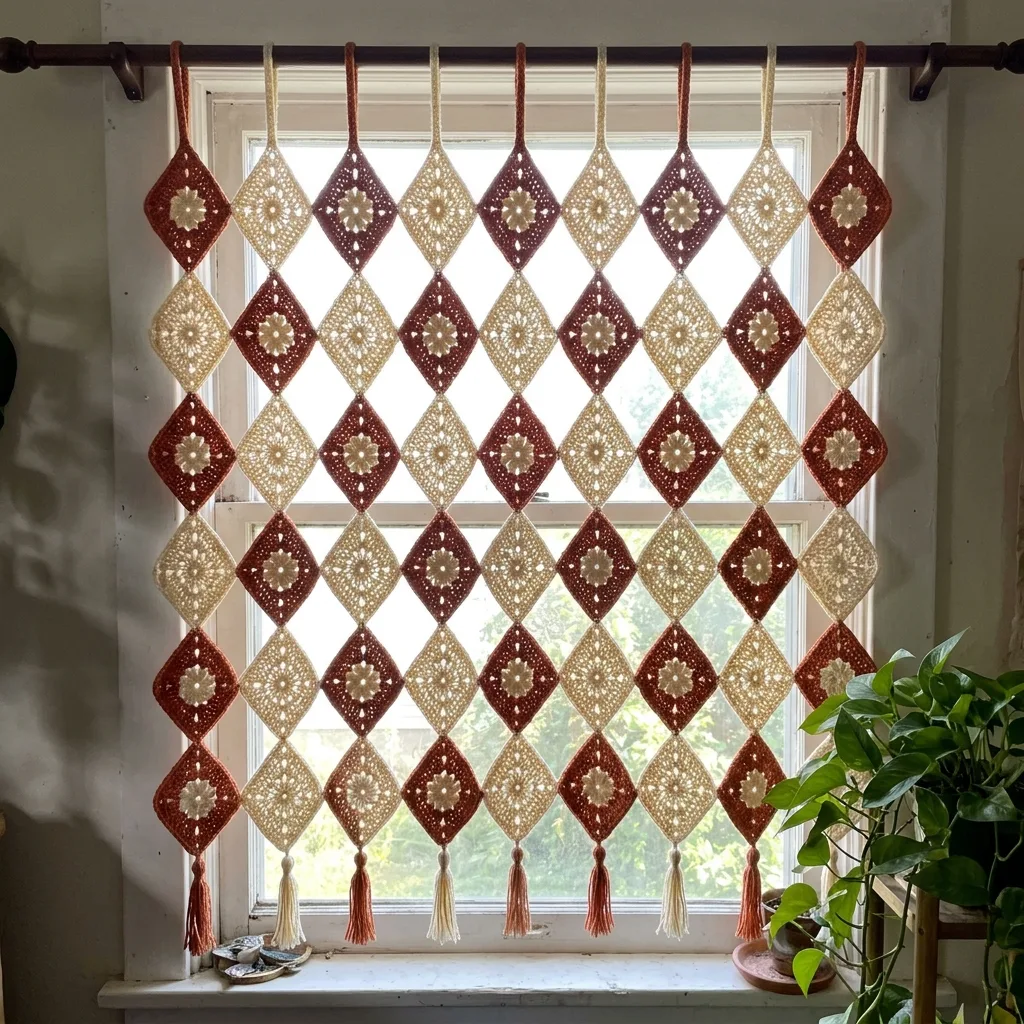
Just chains, slip stitches, single and double crochet, with one easy color change in the rust motifs.
Each diamond takes about 25 minutes, so three or four a day finishes the curtain in about a month.
Rust and cream diamonds trade places in every row, so the window glows with an earthy, cozy pattern from morning to evening.
About This Rust and Cream Checkerboard Diamond Curtain Crochet Pattern Pattern
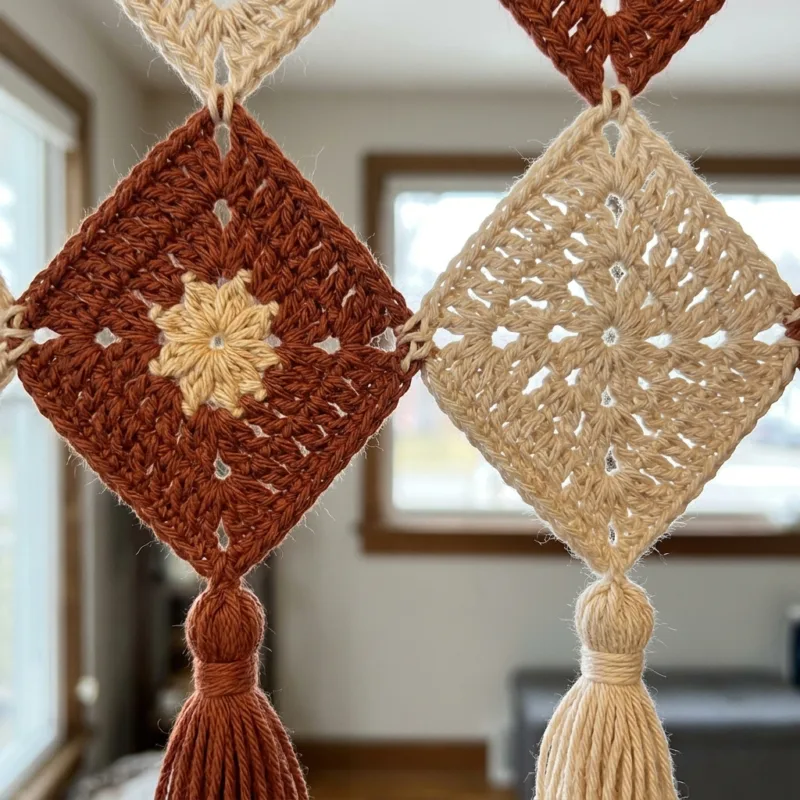
This curtain is a checkerboard of little diamonds hanging in a window. It is made of eighty-one small square motifs, each one turned on point so it sits like a diamond, joined into nine columns that hang side by side. The colors are rust terracotta and warm cream, and they trade places in every row and every column, just like the squares of a game board. Every rust diamond carries a little cream flower in its center, and every cream diamond is lacy all over. The result is warm and earthy, like autumn leaves and fresh milk on a sunny kitchen table.
Each motif begins as a small flower. You make a ring of sixteen double crochet, then open it into eight tiny petals with chain spaces between them. In the rust motifs those first two rounds are worked in cream, and then you join the rust and turn the flower into a square with four corners. The fourth round grows the square with neat clusters of three double crochet, and the fifth round is a crisp border of single crochet with a little chain space at each corner. The cream motifs are worked the same way in one color, so you only ever learn one pattern.
The corner spaces become the top and bottom points of every diamond, and that is where the chain links go. I work each link as five chains and then slip stitch back along it, so it turns into a firm cord about three quarters of an inch long. Nine diamonds make one column, and the columns hang with their side points nearly touching. Between the columns you get a second row of diamond shapes, made only of light, which makes the whole curtain feel airy even though the colors are rich.
At the top, each column hangs from a long yarn loop covered in single crochet, worked in the color of its top diamond, so the rod shows a neat row of rust and cream loops. At the bottom, each column ends in a short, full tassel about four inches long, also in the color of its bottom diamond. The finished curtain measures about 63 inches wide and 75 inches long from the rod to the tips of the tassels. Each motif blocks to 5 inches square, which is about 7 inches from point to point when it hangs as a diamond.
I made mine in worsted weight cotton with a 5 mm hook. Cotton keeps the diamond points sharp, it does not stretch much, and it has a soft matte look when the light comes through it. The rust motifs need one color change, which is simply joining a new yarn in a chain space, so there is no tricky color work. The rest of the project is small, calm repetition, and every piece can be made away from home. The joining, the loops and the tassels wait until the end, when you can spread everything out on a bed.
This is a lovely project for a beginner who has made a granny square or two, and a relaxing one for anyone who enjoys counting rounds while listening to a story. Because the pattern repeats in a checkerboard, it is easy to see at a glance if something is out of place. The curtain looks beautiful in a kitchen, a living room, a glass door or as a room divider in a small apartment. With the sun behind it, the rust glows almost copper and the cream turns soft gold, and the whole room feels warmer.
Why You'll Love This Rust and Cream Checkerboard Diamond Curtain Crochet Pattern Pattern
I fell in love with this curtain because of its colors. Rust and cream remind me of my mother's kitchen, with its clay pots and cream tablecloths, and of long autumn walks under copper trees. Hanging those colors in a window means they are lit from behind all day long, so they look even richer than they do in a ball of yarn. When I see the checkerboard glowing in the afternoon, I feel the same calm I feel with a cup of tea in my hands.
I also love that the work is so portable. Each motif needs only a hook, two small balls of yarn and about twenty-five minutes. I made the cream flower centers in batches while waiting at appointments, then added the rust rounds at home in the evenings. Splitting the work like that kept it interesting, and it meant I always had a small, easy job ready to pick up whenever I had a few minutes to spare. On busy weeks I set myself a small goal of three or four motifs, and that steady pace carried the whole project without ever feeling like a chore. Little by little, the rust and cream piles grew taller.
Here is what makes this pattern special to me:
- One simple motif, made two ways, so there is nothing new to learn halfway.
- The checkerboard layout is easy to plan and easy to check.
- It uses up leftover cream cotton in the flower centers.
- It brightens a room without closing out the light.
- The tassels and loops make it look finished and grown-up.
There is a deep satisfaction in watching the board fill up. I kept my rust motifs in one basket and my cream ones in another, and every week I laid out the columns on the bed and counted how many diamonds were still missing. Seeing those empty spaces disappear, one row at a time, kept me going far better than any deadline. When the last motif went into place, the curtain came together in a single happy afternoon of joining.
This curtain also makes a meaningful gift. I can imagine it in a daughter's new kitchen, in a son's first house or in a friend's sunny reading corner. The colors are warm enough for autumn and gentle enough to stay up all year, and because each column hangs on its own loop, it fits almost any rod. A handmade curtain is something people keep for a very long time, and it brings a little of you into their home every day.
I learned a few things along the way, too. I learned to check my motif size every ten motifs, because my tension loosens when I relax. I learned that joining the rust yarn in a different chain space each time keeps the color join from lining up in one spot. And I learned that laying the whole checkerboard out before joining saves a lot of unpicking. I hope these little lessons make your own curtain go smoothly.
Switch Things Up
This pattern is very easy to change, because the motif is small and the layout is just a grid. My first idea is always color. Rust and cream feel warm and earthy, but red and white gives you a cheerful country kitchen, blue and white looks fresh and calm like old china, and green and cream feels like a cottage garden. For a nursery or a little girl's room, pink and white is sweet and soft. Keep one deep color and one light color so the checkerboard still reads clearly from across the room.
You can also play with the flower centers. In this version the rust motifs have cream centers, but you could give the cream motifs rust centers too, so every diamond has a flower in the opposite color. For a dressy look, try white with golden details, making every motif in white and working the second round of each flower with a fine gold metallic thread held together with your yarn. It catches the evening lamp light beautifully and suits a dining room.
Changing the size is simple. Each column adds about 7 inches of width, and each motif with its chain link adds about 7.75 inches of length. The top loop and the tassel add about 6 inches together. An odd number of columns and an odd number of motifs per column keeps the same color at all four corners. Here are the sizes I use:
- Narrow window, about 35 by 44 inches: 5 columns of 5 motifs, 25 motifs.
- Standard window, about 63 by 75 inches: 9 columns of 9 motifs, 81 motifs.
- Door, about 35 by 83 inches: 5 columns of 10 motifs, 50 motifs.
- Room divider, about 84 by 91 inches: 12 columns of 11 motifs, 132 motifs.
A shorter cafe curtain is one of my favorite variations. Hang it on a tension rod halfway up a kitchen window and make each column only 3 motifs long. That gives you about 29 inches of drop with the loops and tassels, which covers the lower half of most windows and leaves the top open for light. It is also a quick way to test the colors and the motif before you commit to the full curtain, and it makes a sweet small gift.
For a doorway curtain, I like to space the columns about 8 inches apart instead of 7, so the diamonds no longer touch and the strands part easily when people walk through. Make the columns long enough to reach just above the floor, and make the top loops a little bigger, with 20 chains instead of 16, so they slide along the rod. It looks lovely between a kitchen and a hallway, and it lets the light pass from one room to the next.
The tassels can change the whole mood. These short, plump tassels of 4 inches look tidy and a little bit traditional, while long 8 to 10 inch tassels feel more relaxed and dramatic. You can also make every tassel two colored, mixing rust and cream strands, to tie the columns together. If you prefer a clean finish, skip the tassels and end each column with a small pompom or simply the point of the last diamond.
Finally, you can change the yarn weight. In DK cotton with a 4 mm hook, each motif comes out about 4 inches square and 5.7 inches point to point, so you will need about 11 columns of 12 motifs for the same window. In chunky cotton with a 6.5 mm hook, the motifs grow to about 6.5 inches square and about 9 inches point to point, and 7 columns of 7 motifs cover a standard window. Always make a test motif, block it and measure it before you plan your layout.
Materials Needed
— Main Fabric
— Tools Required
The Free Pattern
0% complete
— Diamond Flower Motif (Make 81: 41 rust with cream centers, 40 all cream) :
— Layout :
— Chain Links and Joining :
— Tassels (Make 9: 5 rust, 4 cream) :
— Top Loops and Hanging (Make 9: 5 rust, 4 cream) :
Assembly Instructions
- Make all 81 Diamond Flower Motifs, 41 rust with cream centers and 40 all cream, and block each one to 5 inches square.
- Following the Layout, arrange the motifs on point in 9 columns of 9 in a checkerboard, starting the odd columns with rust and the even columns with cream.
- Join the motifs of each column point to point with the Chain Links, 8 links per column and 72 in total, each in the color of the upper motif.
- Work a Top Loop on the top point of each of the 9 columns in the color of its top motif.
- Make the 9 Tassels and sew each one to the bottom point of a column in the color of its bottom motif.
- Slide the loops onto the rod about 7 inches apart, mist the columns lightly and let them hang overnight so the links settle.
- Trim all the tassels together to an even 4 inches once the curtain has settled on the rod.
Common Mistakes & How to Fix Them
The most common problem with this curtain is rust and cream motifs that come out slightly different sizes. It happens because the rust motifs have a color change and an extra pair of tails to weave in, and many of us crochet a little tighter after joining a new yarn. Across nine motifs in a column, that small difference makes the rust-heavy columns shorter than the others. To avoid it, block one rust and one cream motif first and compare them. If they differ by more than a quarter inch, change hook size half a step for the rust rounds only.
Another mistake is joining the rust yarn in the same spot every time, or leaving the color join loose. When every join sits at the same corner, the little bump shows on every rust diamond in the same place, and a loose join can leave a small gap in the cream flower. It happens because we fall into a habit without noticing. Join the rust in a different ch-2 sp now and then, pull the new yarn snug, and work over the cream tail for a few stitches before weaving it in, so the join disappears inside the rust rounds.
Many people break the checkerboard while joining. It is very easy to pick up two rust motifs in a row when the baskets are mixed, and once a column is joined, a wrong color is hard to fix without cutting links. The mistake usually shows up only when the curtain is on the rod and a rust diamond sits beside another rust diamond. Lay the whole grid out on a bed before you join anything, take a phone photo of it, and join one column at a time straight from that layout, checking each row across before you move on.
The last common mistake is loose links and uneven tassels at the bottom edge. A loose ch 5 link stretches under the weight of the motifs below, so one column slowly hangs lower than its neighbors, and the tassels stop lining up. Tassels also go uneven when the wraps are not counted or when they are trimmed lying on a table. Keep your chains snug and work every slip stitch back along the link. Count exactly 25 wraps per tassel, use the same cardboard for all nine, and trim them together while the curtain hangs on the rod.

You Might Also Like
Important Notes
Gauge matters on this curtain because every column must hang to the same length. With worsted cotton and a 5 mm hook, Rounds 1 to 4 should measure 4.5 inches across, and the finished motif after Round 5 and blocking should measure 5 inches square, about 7 inches from point to point. If your motif is bigger, go down half a hook size. If it is smaller, go up. Make and block one rust and one cream test motif before you buy all the yarn.
Block every motif before you join it. Pin each one to your mats as a square with straight sides and sharp corners, mist it with water and let it dry completely. Cotton keeps the shape you give it, so blocked motifs hang flat and the corner spaces stay open for joining. After joining, hang the columns on the rod and mist the links lightly, so the whole curtain settles to one length before you trim the tassels.
You need about 950 yards of rust, roughly 480 g, and about 1,450 yards of cream, roughly 730 g. The cream amount is larger because every rust motif also has a cream flower center. Buy all the yarn for each color at the same time and check that every ball has the same dye lot number. With daylight behind the curtain, even a slightly different shade of rust in one column will stand out clearly.
The finished curtain weighs about 1.2 kg, so hang it on a sturdy rod with good brackets. To wash it, place it in a large mesh bag and use a gentle cold cycle, or hand wash it in the bathtub. Rust is a deep color that can bleed onto cream, so always add a color catcher sheet, especially the first few times. Never wring the columns. Lay them flat on towels to dry, then reshape the diamonds and comb the tassels.
I hope this curtain brings as much warmth into your home as mine has brought into my kitchen. From across the room it looks like a big, complicated piece, but up close it is just one small flower motif after another, made two ways and set in a simple checkerboard. Every single piece is easy, and every one you finish brings the whole window a little closer.
So pick up your hook, wind a small ball of cream and a small ball of rust, and make your first motif tonight. Block it, hold it up to the window and watch the light come through that little flower. I think that one diamond will be all the encouragement you need to make the next eighty. Happy crocheting, my friends.
Crochet Abbreviations
You Ask, We Answer
How big is the finished curtain, and how do I make it fit my window?
The curtain as written is about 63 inches wide and 75 inches long, measured from the rod to the tips of the tassels. That comes from 9 columns of 9 motifs, with each motif blocked to 5 inches square, or about 7 inches from point to point, plus about 2 inches for the top loop and 4 inches for the tassel. To fit your own window, divide the width you want to cover by 7 to find the number of columns. For the length, measure from the rod to where you want the tassel tips to end, subtract 6 inches for the loop and tassel, and divide what is left by 7.75 to get the number of motifs per column. If you use an odd number of columns and an odd number of motifs, all four corners of the checkerboard will be rust, just like mine. Always plan with your own blocked test motif, because every hand crochets a little differently.
Can I use a different yarn weight or make the motifs bigger?
Yes, the pattern works the same way in any weight, and only the size changes. In DK cotton with a 4 mm hook, each motif comes out about 4 inches square, so you will need more of them to cover the same window. In chunky cotton with a 6.5 mm hook, the motifs grow to about 6.5 inches square and you will need fewer. I recommend cotton or a cotton blend, because it holds the diamond points and does not stretch much in a long column. Acrylic works too, but it can stretch over time, so keep your chain links firm and short. Whatever you choose, make one rust and one cream motif, block them and measure them from point to point. Then redo the column and motif math from the first question. Remember that the cream yardage will change most, because it is used in every single motif, so buy a little extra cream when you change weights.
How do I wash and care for the curtain?
I wash mine about twice a year, or whenever it starts to look dusty in the sun. Take it off the rod, slip the columns into a large mesh laundry bag, and wash on a gentle cold cycle with a mild detergent. Hand washing in the bathtub is even kinder to the tassels and links. Always add a color catcher sheet, because rust is a deep shade that can tint the cream if it bleeds. Do not wring or twist the columns. Press the water out with a towel, then lay each column flat and straighten every diamond with your fingers so the points are sharp again. Comb the tassels gently and let everything dry completely before hanging. Strong afternoon sun can slowly fade rust over the years, so a sheer curtain behind it helps protect the color. Store it rolled loosely in a cotton pillowcase, never in plastic.
Success!
Thanks for subscribing — check your inbox for a welcome note.
Abbreviations
- ch — chain
- sl st — slip stitch
- sc — single crochet
- dc — double crochet
- st — stitch
- sp — space
- rep — repeat
- * — repeat the instructions after the asterisk as directed
- [ ] — work the instructions inside the brackets the number of times stated