
Purple Lotus Flower Granny Square Bed Cover Crochet Pattern
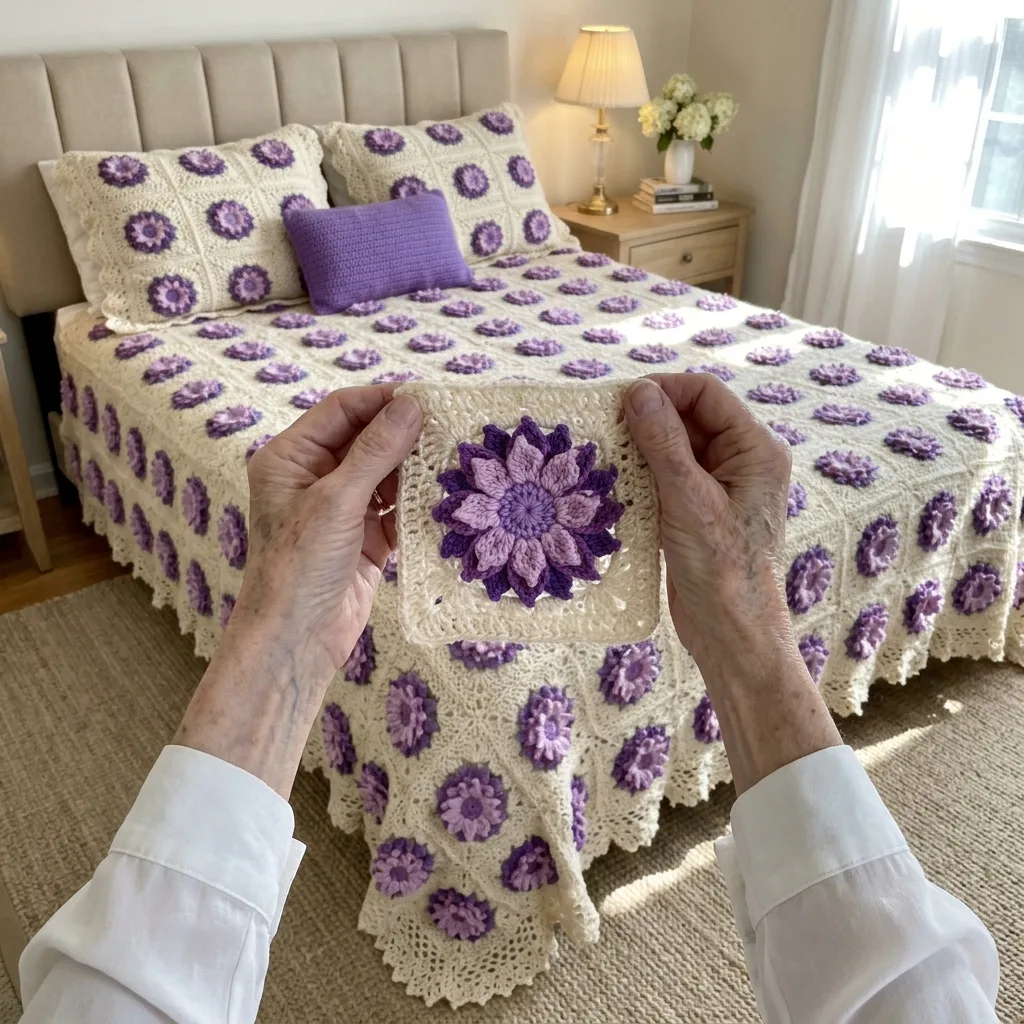
Basic stitches plus back post single crochet, which builds each new layer of pointed petals behind the last.
Each square takes about two and a half hours, so three or four squares a week finishes the cover in about three months.
Three layers of pointed lilac and purple petals open like a real lotus and stand up off every square.
About This Purple Lotus Flower Granny Square Bed Cover Crochet Pattern Pattern
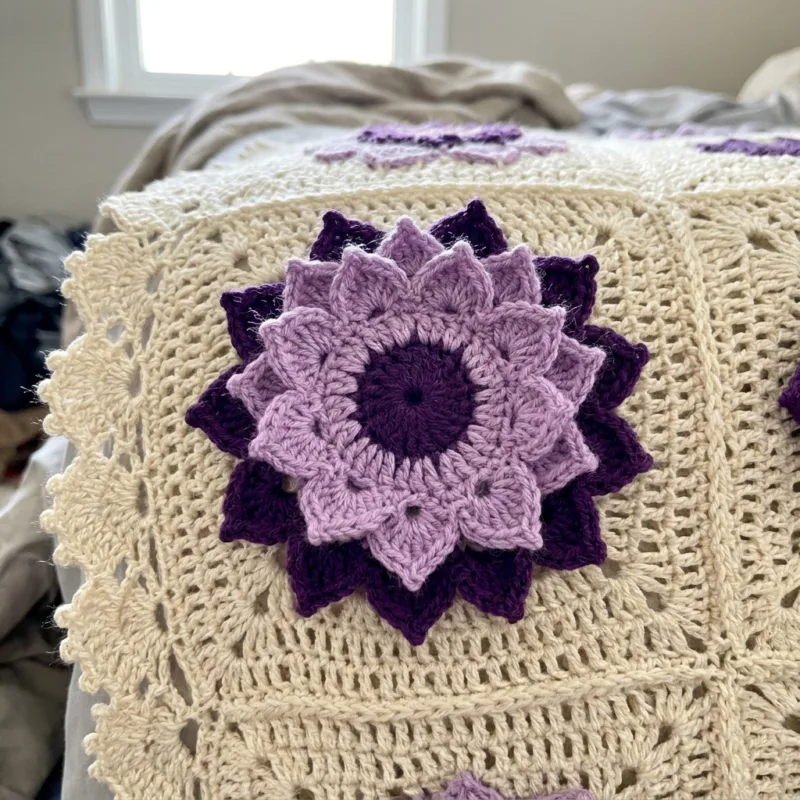
This bed cover is a pond full of purple lotus flowers. It is made from forty eight cream lace granny squares, and every square holds a big raised lotus in two shades of purple. The flower starts with a small deep purple center wrapped in a lilac ring and a purple outline, then opens into two layers of pointed lilac petals and a final layer of larger pointed deep purple petals. The petals stand up off the square and overlap like a real water lily. Around the flower, a soft cream lace frame of mesh and solid rounds turns the circle into a square, and a round of shells scallops every edge.
The finished size is about 72 by 94 inches including the border. Each square measures about 11 inches, and the layout is 6 squares across and 8 squares down. That covers the top of a full or queen bed and drapes down both sides, with a deep lace fan border hanging at the edges. I worked mine in worsted weight yarn, which gives the petals body so they hold their pointed shape, and gives the whole cover a cozy, comforting weight. The cream background keeps it light and calm, so the purple flowers really glow.
The lotus is built in layers, one behind the other. After the center rounds, you make a ring of chain loops and work the first layer of pointed petals into them. Then you reach behind those petals and work a back post single crochet around the stitches of the loop round, which gives you anchor points for a new, bigger ring of loops. The second layer of petals grows from those loops, sitting behind and outside the first. You repeat this once more in deep purple for the outer petals. Nothing is sewn on, and every petal grows naturally from the one before it.
The petals get their point from a simple shape: single crochet, half double, double crochet, a pair of treble crochets with a chain in between at the tip, then the same stitches going back down. The outer petals are a little longer, with two treble crochets on each side of a chain 3 tip, so they reach past the inner layers. Those chain tips are also the anchors for the cream square. Four of them become corners and four become the middle of the sides, which is how a round flower turns into a square so neatly.
The cream frame has four rounds: a round that connects the petal tips, a solid round, a mesh round with little open windows, and a solid round that gives every side exactly the right number of stitches for the shells. The last round of each square is a shell edge, and the squares are joined as you go by slip stitching each shell to its neighbor. That creates lacy, scalloped seams between the squares instead of heavy lines. The border is a deep lace fan edge with picots, which hangs beautifully over the side of the bed.
I rate this pattern Intermediate. The stitches are simple, but you need to be comfortable working back post stitches behind the petals, counting petals and loops, and joining as you go. Once you have made two squares, the rhythm becomes easy and relaxing. This project suits someone who loves dimensional flowers, enjoys a bold color against a soft background, and wants a showpiece bed cover that people will want to touch. If you have made a layered flower square before, this lotus is a lovely next step.
Why You'll Love This Purple Lotus Flower Granny Square Bed Cover Crochet Pattern Pattern
I love this bed cover because it feels peaceful. The lotus is a flower that rises clean and beautiful out of muddy water, and it has long been a symbol of calm and new beginnings. Seeing forty eight of them resting on a soft cream bed feels like stepping into a quiet garden. The two shades of purple are rich without being loud, and the cream lace keeps everything airy. When I walk into my bedroom, my shoulders drop a little, and that is exactly what I want a bedroom to do.
I also love the moment each lotus opens. The center is small and simple, and the first layer of lilac petals looks sweet but modest. Then you reach behind for the back post stitches, add the second layer, and suddenly the flower is twice as full. When the deep purple petals go on last, the lotus is complete, and it always makes me want to hold it up to the light. Even after making all forty eight, I still feel that little thrill every single time a flower comes to life in my hands.
The squares are easy to carry with me. One square needs only small amounts of each color, so I wind little balls of cream, lilac and purple, and keep them in a pouch with my hook and a few stitch markers. I worked on petals while waiting for appointments, while sitting in the garden, and in my favorite armchair in the evenings. A big bed cover never feels overwhelming this way, because I only ever think about one flower at a time, and the stack quietly grows.
Here is what I learned while making it:
- Folding the petals forward before each back post round makes the anchors easy to see.
- Making all the centers first, then all the lilac layers, saves a lot of yarn changes.
- Blocking with the petals lifted, not pressed, keeps the lotus full and pointed.
- Joining as you go means the cover is nearly finished the day the last square is done.
This bed cover makes a meaningful gift. Because the lotus stands for peace and fresh starts, it is a beautiful piece for a wedding, a new home, a retirement, or someone beginning a new chapter of life. I like to fold it with a small card explaining what the lotus means, along with the yarn names and care notes. A handmade gift like this carries all the quiet hours that went into it, and the person who receives it can feel that.
Finally, I love how it brings the whole room together. With a beige headboard, warm wood furniture, a vase of white hydrangeas and a golden lamp, the purple lotus flowers become the heart of the bedroom. Add the matching lotus pillows and a small solid purple pillow, and the bed looks finished and inviting. In the evening, when the lamp glows and the petals cast soft shadows across the lace, it feels like the flowers are floating, and I never get tired of that view.
Switch Things Up
Try a new flower color. The lotus looks wonderful in any pair of light and dark shades of the same color. Blush and deep rose feel soft and romantic, sky blue and navy feel calm and fresh, peach and coral feel warm and cheerful, and pale yellow with gold feels sunny. For a classic water lily look, try white inner petals with soft pink outer petals. Keep the background cream so the flowers stand out, or switch it to pale gray for a modern look.
Make it in other bed sizes. Each square is about 11 inches, so planning a new size is simple. Measure the top of the mattress, add the drop you want on each side, and divide by 11. The squares join as you go and the border works on chain loops, so any grid works. Here are some grids to start from:
- Twin: 5 x 8 squares, 40 squares, about 61 x 94 inches.
- Full: 7 x 8 squares, 56 squares, about 83 x 94 inches.
- Queen: 8 x 9 squares, 72 squares, about 94 x 105 inches.
- King: 9 x 9 squares, 81 squares, about 105 x 105 inches.
Make a baby blanket. Six squares joined 2 across and 3 down make a baby blanket of about 28 by 39 inches with the border. For a baby, I would make only the two lilac petal layers so the flowers lie lower, and tack each petal tip down with a few stitches so little fingers cannot pull them. Soft pastel shades like lavender, mint or pale pink look lovely in a nursery, and a soft cotton blend is gentle on new skin.
Make a throw or a table topper. Twelve squares joined 3 across and 4 down make a throw of about 39 by 50 inches, perfect for draping over the back of a sofa or folding at the foot of a bed. Four squares joined 2 by 2 make a pretty table topper, and a single square with the fan border makes a beautiful centerpiece doily. These smaller pieces use up leftover yarn and make thoughtful, quick gifts.
Add matching pillows. My shams are each made from 2 squares joined side by side for the front, with a back panel of plain cream double crochet, joined with single crochet on three sides. For the small solid purple pillow, work a rectangle about 10 by 18 inches in deep purple using rows of single crochet in the back loop for a ribbed texture, then fold and seam it around a pillow form. The solid pillow gives the eye a calm place to rest among all the flowers.
Change the edge. If you want a simpler finish, stop after the first border round of chain loops and work a shell in every loop for a light scallop. For a more dramatic edge, add a second fan round, working 9 dc fans into the picot loops of the first, so the border hangs deeper over the side of the bed. You could also work the picot round in lilac to tie the border to the flowers.
Change the yarn weight. In DK yarn with a 4.0 mm hook, each square comes out about 9 inches and the petals look more delicate, so a queen needs roughly 10 x 12 squares. In bulky yarn with a 6.0 mm hook, squares grow to about 14 inches and the lotus flowers become big and plush. Always make one test square, block it and measure it, then plan your grid and yarn amounts from that real size.
Use up your stash. The flowers use small amounts of color, which makes this a great stash project. Keep the cream background and the deep purple outer petals the same in every square, and use any leftover light shades for the inner petals: lilac, pink, pale blue or soft yellow. The steady cream frame and purple outline hold everything together, so a scrappy version still looks calm and planned, like a pond with lotus flowers in many soft colors.
Materials Needed
— Main Fabric
— Tools Required
The Free Pattern
0% complete
— Lotus Square, Rnds 1 to 13 (Make 48, cream A, deep purple B, lilac C) :
— Layout :
— Rnd 14, Shell Edge and Join As You Go :
— Lace Fan Border (cream A) :
Assembly Instructions
- Make 48 Lotus Squares through Rnd 13 and weave in every end on the WS.
- Block each square with the petals lifted, pinning only the cream frame, and let them dry completely.
- Work Rnd 14 on the first square, then work Rnd 14 on every other square while joining it as you go, following the Layout grid of 6 across and 8 down.
- Work the three rounds of the Lace Fan Border around the whole cover.
- Weave in the last ends, then mist the border and pin out each fan and picot on a clean flat surface until dry.
Common Mistakes & How to Fix Them
Working the back post stitches into the wrong round. In Rnd 6 the BPsc goes around the sc of Rnd 4, and in Rnd 8 it goes around the BPsc of Rnd 6. With petals in the way, it is easy to grab a stitch from the petal round instead, and then the next layer sits too far forward and the lotus looks crowded and flat. Fold the petals toward you and look at the back of the work, where you will see the little posts standing between the petals. Place a marker on the first one, and pull out the round right away if the layer looks wrong.
Petals that lose their points. The point of each petal comes from the chain between the two treble crochets at the tip. If you skip that chain, or work it too tightly, the petal turns round and the flower looks like a rose instead of a lotus. Always work the ch 2 or ch 3 at the tip, and keep it the same size as your other chains. When you block, pull each tip gently outward with your fingers. The chain tips are also the anchors for the cream frame in Rnd 10, so a missing tip will throw off the corners too.
Squeezing the square frame. In Rnd 10, the cream frame is built from the eight outer petal tips: four corners and four side groups. If you put a corner on two tips in a row, or work into the petal stitches instead of the tip spaces, the square comes out lopsided or curls. Count the tips before you begin, and mark every other one as a corner. After Rnd 11, lay the square flat and check that each side has exactly 27 dc. If a side is off, fix it now, because Rnd 13 must have 37 dc per side for the shells to fit.
Squares that end up different sizes. Over forty eight squares, tension changes. The petal rounds use a lot of yarn and can make you crochet tighter, while the cream rounds often loosen up when you relax. Measure each square after Rnd 13 and set aside any that are more than half an inch off. Block them all to the same size on the same mat before joining. If a square is far off, remake it, because uneven squares make the shell joins pull, the cover wavy and the border uneven.

You Might Also Like
Important Notes
Gauge matters on a bed cover. Make one full square, block it and measure it. It should be about 11 x 11 inches after the shell round. If it is smaller, go up half a hook size, and if it is larger, go down half a size. Write your hook size on a tag in your project bag and recheck every tenth square to catch any drift early.
Block with care to keep the lotus full. Pin each square by its cream frame only, then mist the frame with water. Do not press or steam the petals, because they should stand up and keep their points. Let each square dry completely before joining. After the border is done, mist it lightly and pin out every fan and picot so the edge hangs evenly.
Buy all your yarn at once and check that every ball of each color has the same dye lot number. Purples especially can lean blue or red from one lot to the next, and a slightly different flower stands out clearly in daylight. The amounts in the materials list are generous estimates for the 6 x 8 size, but buy one extra ball of each color as insurance.
Machine wash the cover on a gentle cool cycle with a mild detergent, or hand wash it. Because deep purple and lilac sit right against cream, always add a color catcher sheet, especially in the first few washes. Never wring it. Roll it in towels to press out water, fluff the petals with your fingers, and dry it flat or tumble dry on low if your yarn label allows it.
Thank you for spending this time with me and my purple lotus flowers. This bed cover is a long project, but it is made of small, peaceful moments, and every square you finish is a little flower you can hold in your hand. You do not need to think about the whole bed today. All you need to begin is a magic ring, a bit of deep purple yarn and a ball of lilac.
Make one square this week. Watch the first lilac petals open, then the second layer, then the deep purple petals that finish the lotus, and see how it makes you feel. I think you will want to make another right away. Before long you will have a basket full of lotus flowers, and soon a bed that feels like a calm garden pond. Happy crocheting, my friends.
Crochet Abbreviations
You Ask, We Answer
How big is the finished bed cover?
The finished bed cover measures about 72 by 94 inches including the border. Each square is about 11 inches, joined 6 across and 8 down, which gives about 66 by 88 inches, and the three rounds of the lace fan border add about 3 inches on every side. On a full bed this covers the top and drapes down both sides with the lacy fans hanging at the edges. On a queen it covers the top with a shorter side drop. If you want the cover to reach the floor on both sides, measure the mattress width plus twice the height from the mattress top to the floor, then divide by 11 to find how many squares you need across. Do the same for the length, adding one drop for the foot. Because the squares join as you go and the border is worked into chain loops, any grid works without recounting.
Can I use a different yarn weight or fiber?
Yes. Worsted weight yarn gives the petals enough body to hold their points, which is why I chose it, but other yarns work too. In DK yarn with a 4.0 mm hook, each square comes out about 9 inches and the lotus looks more delicate, so you need more squares. In bulky yarn with a 6.0 mm hook, squares grow to about 14 inches and the flowers become plush and bold. Acrylic is soft, light and easy to wash, and it holds petal shapes well. Cotton gives crisp stitches and a cool feel, but it is heavier, and the petals may droop a little more, so crochet slightly tighter on the petal rounds. Wool blends are warm and block beautifully. Whatever you choose, make one test square, block it and measure it before planning your grid and buying your yarn.
How do I wash and care for the bed cover?
Treat it gently and the lotus flowers will stay full for years. Machine wash it on a gentle, cool cycle with a mild detergent, or hand wash it in a bathtub. Always add a color catcher sheet, because deep purple and lilac can release a little dye into the cream background, especially in the first few washes. Never wring or twist the cover. Press out the water, roll it in big towels, then lay it flat on a clean sheet to dry, fluffing each lotus with your fingers so the petals stand up and keep their points. If your yarn label allows, you can tumble dry on low and take it out while still slightly damp. Between washes, shake it out and air it near a window. Store it folded loosely in a breathable cotton bag, away from direct sun, so the purples stay rich and bright.
Success!
Thanks for subscribing — check your inbox for a welcome note.
Abbreviations
- A — color A, cream
- B — color B, deep purple
- C — color C, lilac
- MR — magic ring
- ch — chain
- sl st — slip stitch
- sc — single crochet
- BPsc — back post single crochet
- hdc — half double crochet
- dc — double crochet
- tr — treble crochet
- st(s) — stitch(es)
- sp(s) — space(s)
- RS — right side
- WS — wrong side
- rep — repeat
- Rnd — round