
Mustard Sunburst Granny Square Bed Cover Crochet Pattern
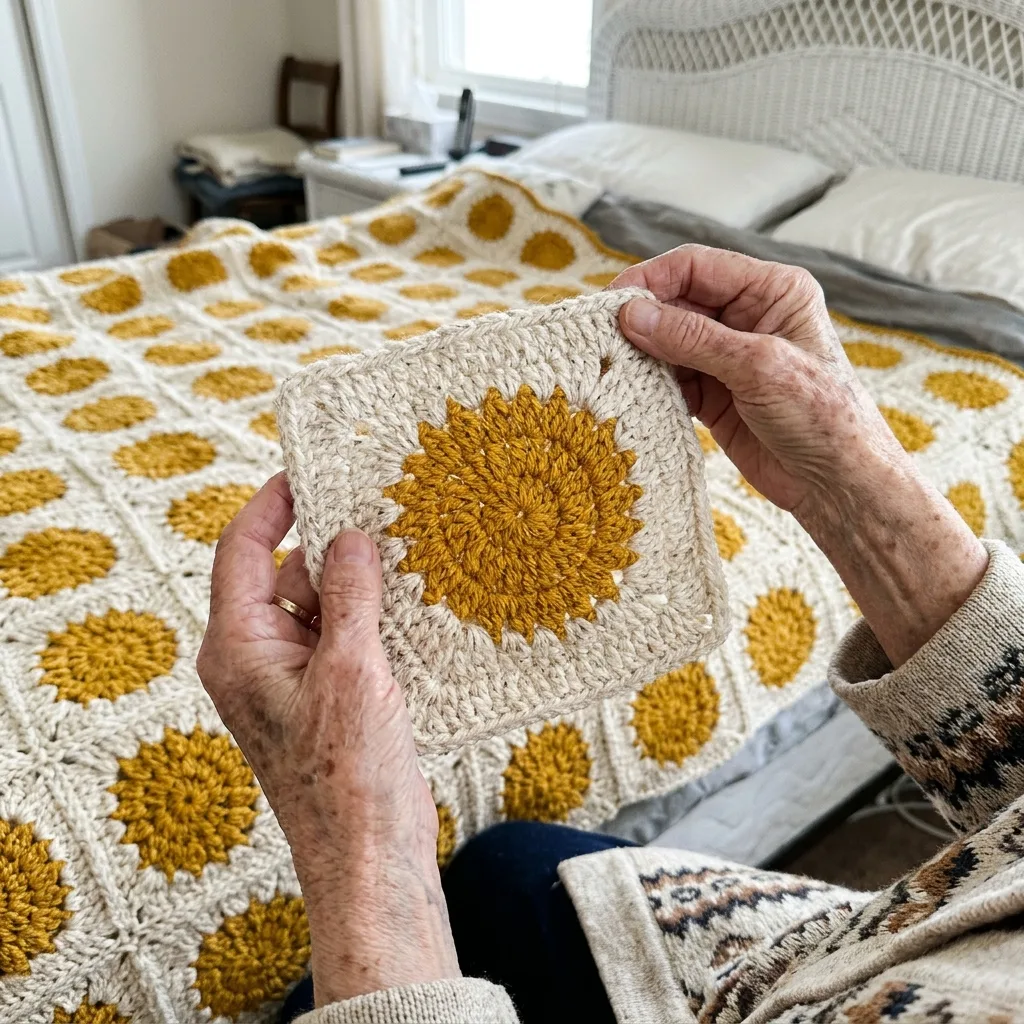
Friendly granny groups plus simple clusters and a squaring round, all written out step by step.
About forty minutes per square, so one or two each evening add up fast.
Every cream square holds a golden mustard sun that brightens the whole room.
About This Mustard Sunburst Granny Square Bed Cover Crochet Pattern Pattern
This bed cover is made from one sunny square repeated across the whole bed. Each square starts with a golden mustard sunburst in the center, a round flower with sixteen little petals that look like rays of sunshine. Around it, soft cream rounds turn the circle into a square and finish in a neat granny pattern. When all the squares are joined with cream, the bed fills with rows of golden suns on a warm cream background, cheerful and calm at the same time. It looks detailed, but there is only one square to learn, and it works up quickly.
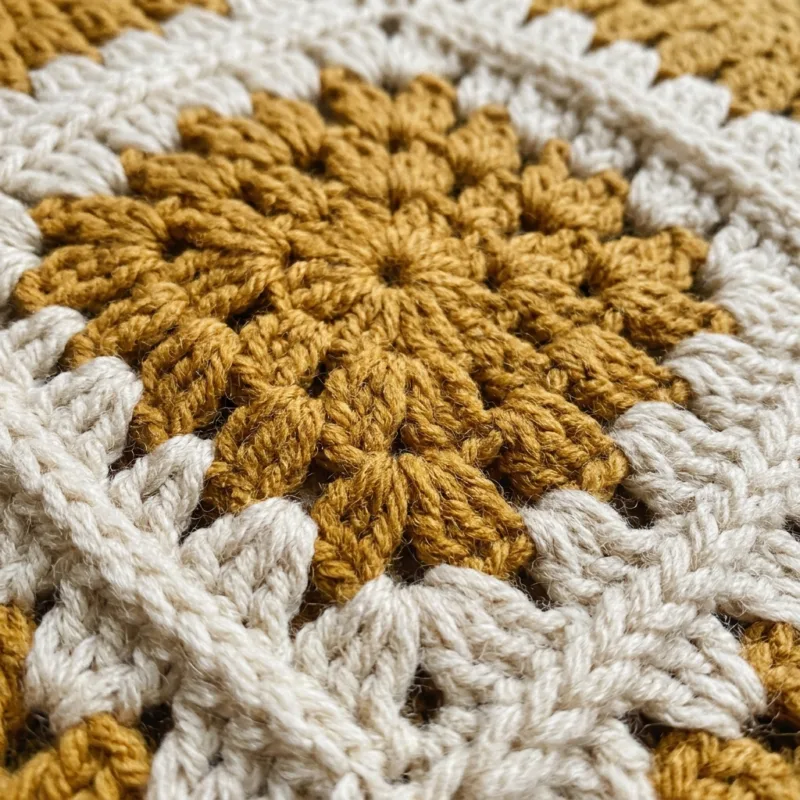
Each square is worked in the round from a magic ring. The sunburst takes three mustard rounds: a ring of sixteen double crochet, a round of double crochet pairs with a chain between them, and a round of sixteen clusters that make the rays. Then you switch to cream. The first cream round squares off the circle with treble crochet at the corners, double crochet beside them and half double crochet in the middle of each side, so the round edge becomes straight without any puckering. Three more cream rounds of granny groups and a final round of single crochet complete the square.
Each square ends on 104 single crochet with four corner spaces, and the finished, blocked square measures about 7.5 inches. The sunburst itself is about 4 inches across. The clusters give the petals a soft, puffy texture you can feel with your hand, and the little holes between the rays let a bit of light through, which gives the center its sunny, open look. The cream granny rounds around it are light and airy too, so the whole bed cover feels soft rather than heavy.
The queen size uses 168 squares in a grid of 12 squares across and 14 squares down. The joined center measures about 90 by 105 inches. A border of cream, two rounds of mustard and a cream shell round adds about 1.5 inches on every side, for a finished size of roughly 93 by 108 inches. That covers a queen mattress and drapes well down both sides toward the floor.
The squares are joined with a cream slip stitch seam through the back loops of the last round. Because the outside of every square is cream, the seams almost disappear and the suns look like they are floating on one big piece of fabric. A thin line of mustard in the border picks up the color of the suns, and the cream shell edge softens the outside with a gentle scallop.
The finished bed cover is light, soft and bright, the kind of blanket that makes a room feel warm even on a gray morning. I would call this an intermediate project, mostly because of its size and the clusters in the sunburst. The stitches are friendly for a confident beginner, but 168 squares ask for steady tension and patience over many weeks. If you can make one granny square and you love a happy color, you can make this whole bed cover one sunny square at a time.
Why You'll Love This Mustard Sunburst Granny Square Bed Cover Crochet Pattern Pattern
I love mustard yellow. It is warm and golden, a little earthy, like honey or a field of sunflowers at the end of summer. It is bright without being loud, and it looks wonderful with cream, white wicker, light wood and soft gray. When I put this bed cover on the guest bed, the whole room seemed to fill with sunshine. Even on a rainy day, walking into that room makes me smile, and I think that is the best thing a handmade blanket can do. It is like keeping a little piece of summer in the house all year.
The sunburst center is my favorite part. There is something so satisfying about watching the clusters puff up round after round until a little golden sun sits in your hand. Then the cream rounds come in and square it off, and the circle settles into a perfect square like magic. I still love the moment I finish the treble crochet round and lay the square flat to see the corners appear. It never gets old, even after more than a hundred squares.
I also love that the squares are small and quick. One square takes me about forty minutes, so I can finish one or two in an evening with a cup of tea. A square and two little balls of yarn fit in my handbag, and I take them everywhere: to the doctor's office, to my granddaughter's dance class, out on the porch in the morning. Every finished square goes into a basket, and watching that basket fill up with little suns is the best motivation I know.
Here are a few more reasons this one stays close to my heart:
- There is only one square to learn, so your hands soon know it by heart.
- Only two colors, so there is very little to plan.
- The squares are quick, so you always feel progress.
- It makes a cheerful gift for a new home, a wedding or a daughter's first apartment.
Each of these makes a big project feel calm and doable, even on busy weeks.
A handmade bed cover changes a room like nothing else. You can paint the walls or buy new curtains, but a crochet bed cover adds a warmth that store-bought bedding just cannot match. When I make the bed in the morning and smooth this cover over the pillows, the rows of suns line up so neatly that the whole room looks finished and bright. Guests always reach out to touch the clusters, and they always ask me how long it took.
This project taught me to enjoy the slow middle part. With 168 squares, there is always a stretch where the basket seems to stop filling up. I learned to stop counting and just enjoy each square for itself, the soft yarn, the rhythm of the hook, the little sun appearing in my hands. When I worked the last shell and spread the cover across the bed, I was almost sad to be finished. That is how I know a pattern is a good one.
Switch Things Up
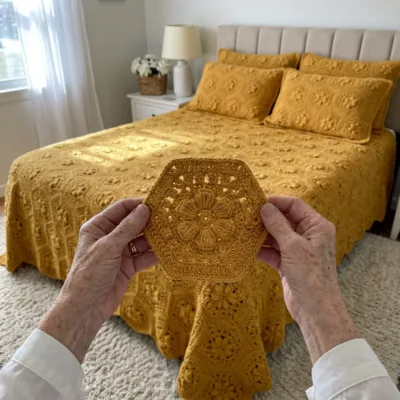
Try a new color pair. The sunburst looks lovely in any bold color with a light background. Coral with cream feels warm and summery, and dusty blue with cream is calm and fresh. Sage green with white is gentle and garden-like, and deep rust with oatmeal gives a cozy autumn look. Keep the outer rounds light so the suns stand out and the seams almost disappear.
Make it for a different bed. Every square is about 7.5 inches, so changing the size only means changing the grid. Add or remove a column to change the width, and add or remove a row to change the length. Here is a quick guide with the border included:
- Twin: 8 across by 14 down, 112 squares, about 63 by 108 inches
- Full: 10 across by 14 down, 140 squares, about 78 by 108 inches
- Queen: 12 across by 14 down, 168 squares, about 93 by 108 inches
- King: 14 across by 14 down, 196 squares, about 108 by 108 inches
For a taller bed or a longer drape, add one more row to the length.
Make a sofa throw. A grid of 6 squares across by 8 squares down uses 48 squares and makes a throw of about 48 by 63 inches with the border. It is a lovely size for the back of a couch or the foot of the bed, and it uses less than a third of the yarn of the queen size. It is also a good way to try the pattern before you commit to the full bed. If you love it, just keep going and turn it into a bed cover later.
Make a baby blanket. A grid of 5 squares across by 5 squares down gives you 25 squares and a blanket of about 40 by 40 inches. The sunbursts are worked right into the squares, so there are no sewn-on parts to worry about. Use a soft, washable baby yarn. Butter yellow with white, mint with cream, or soft peach with cream all look sweet and sunny in a nursery.
Make matching pillow shams. A grid of 4 squares across by 3 squares down makes a sham front of about 30 by 22 inches, which fits a standard pillow with a little room to spare. Use sunburst squares on the front and plain cream granny squares on the back. Join front and back on three sides with cream single crochet, slip the pillow in, and close the last side. Matching shams make the whole bed look planned and finished.
Change the edge. For a simple, tailored look, skip the shells and finish with one more round of cream single crochet. For a deeper scallop, work 7 double crochet in each shell instead of 5 and keep the same spacing. You could also work the shells in mustard so the edge matches the suns. Each small change gives the cover a new mood, from neat and modern to soft and old-fashioned.
Use a different yarn weight. In DK yarn with a 4.0 mm hook, each square comes out at about 6.25 inches, so a queen needs a grid of about 14 across by 17 down. In bulky yarn with a 6.5 mm hook, each square grows to about 9 inches, and a queen needs about 10 across by 12 down. Always make and block one square first, measure it, and plan your grid from that. Weigh your first square too, so you can work out your yarn amounts.
Mix up the suns. Make some sunbursts in mustard and some in a lighter butter yellow or a deep orange, and scatter them across the bed for a field of flowers. Or alternate sunburst squares with plain cream granny squares in a checkerboard for a calmer look and fewer color changes. Each sunburst uses only about 7 grams of yarn, so this is a happy way to use up leftovers. Keep the cream the same so the bed still looks planned.
Materials Needed
— Main Fabric
— Tools Required
The Free Pattern
0% complete
— Sunburst Square (Make 168, mustard center with cream rounds) :
— Layout and Joining (12 squares across by 14 squares down) :
— Border (cream, mustard and cream shells) :
Assembly Instructions
- Make 168 Sunburst Squares, weaving in the ends as you go.
- Block every square to 7.5 by 7.5 inches and let it dry completely, without pressing the clusters flat.
- Lay out the squares in 14 rows of 12 as shown in the Layout and Joining section and take a photo so you can keep track.
- With cream, join the 12 squares of each row into a strip with the slip stitch seam, then join the 14 strips together with long seams worked the same way.
- Work the 4 Border rounds around the whole bed cover, weave in all remaining ends and give the cover a light final block.
Common Mistakes & How to Fix Them
Working the squaring round in the wrong spaces. The first cream round turns the round sunburst into a square, and it only works if every space gets the right stitch. Each side uses four ch-3 spaces: a corner with treble crochet, then double crochet, half double crochet and double crochet. If you put treble crochet in the wrong space or skip a space, the square comes out lopsided or one side bulges. Before you join the cream, count the 16 ch-3 spaces and place a marker in every fourth one to show where the corners go.
Making the clusters too tight. The sunburst rays are 3 dc clusters with ch 3 between them. If you pull the clusters or the chains tight, the sunburst cups up like a bowl and the cream rounds will never lie flat around it. Keep each loop of the cluster pulled up to the full height of a double crochet, and make the chains as loose as your stitches. After Round 3, lay the sunburst flat on the table. It should lie flat with no ruffles and no cupping before you start the cream.
Letting the squares come out in different sizes. With 168 squares, tension drifts over the weeks, especially when you are tired or crocheting while you talk. A square that is a quarter inch smaller does not look like much, but across a row of 12 squares the seams pucker and the rows of suns stop lining up. Keep your first blocked square as a measuring square and check every new square against it. If a square is more than a quarter inch off, redo the last round or two with a different hook.
Pulling the joining seams too tight. A tight slip stitch seam is shorter than the square edges, so the bed cover puckers along each line and will not lie flat over the mattress. This happens most when you work quickly or hold the squares too firmly. Keep each slip stitch as loose as the stitches of the square, and go up one hook size for joining if you need to. Join the squares of each row into strips first, then join the strips. After every long seam, lay the cover flat and check that it lies smooth.

You Might Also Like
Important Notes
Gauge and square size: The mustard sunburst, Rounds 1 to 3, should measure about 4 inches across, and each finished, blocked square should be about 7.5 inches. Every square must match the others, so make one square, block it and measure it before you start the rest. If it is larger, try a 4.5 mm hook, and if it is smaller, try a 5.5 mm hook. Sizes and yarn amounts are estimates from the photo, so trust your own measuring square.
Blocking: Pin each square to 7.5 by 7.5 inches on blocking mats with rust-proof pins. For acrylic, hold a steam iron a few inches above the square without touching it, then let it cool and dry completely before you unpin it. For cotton or wool blends, mist lightly with water and let it dry. Do not press the clusters flat. Blocking sharpens the corners and makes the cream seams straight and easy.
Yarn amounts and dye lots: For the queen size you need about 1,400 grams of mustard and about 3,350 grams of cream in worsted weight yarn, including the joining and the border. These numbers depend on your tension. Buy all of each color at the same time and check that the dye lot numbers match. Mustard can shift toward brown or toward bright yellow from one lot to the next, and a different lot shows up clearly in the suns.
Washing and drying: Follow your yarn label first. Most acrylic bed covers can be machine washed on a gentle cycle in cool water inside a large mesh bag, then dried flat or tumbled on low. Because mustard sits right next to cream, add a color catcher sheet to every wash so no yellow dye settles on the cream rounds. Wash wool blends by hand in cool water. Never hang the cover wet, since the water will stretch it.
Every time I make this bed, I think about where it started: one mustard magic ring and a little sun that grew in my hands. Nothing in it is hard. It is just one cheerful square, made again and again, until a whole bed is covered in sunshine. I hope you enjoy every round of it as much as I did, and that it brings a little summer into your home all year long.
So wind a ball of mustard and a ball of cream, and make one square today. Do not think about all 168 yet. Make one, then another, and soon your basket will be full of little suns waiting to become something your family will love for years. Please share your first sunburst square with me. Happy crocheting, my friend.
Crochet Abbreviations
You Ask, We Answer
How big is the finished bed cover?
The queen size in this pattern measures about 93 by 108 inches with the border. It is made from 168 squares in a grid of 12 squares across and 14 squares down, and each blocked square is about 7.5 inches. The joined center is about 90 by 105 inches, and the four border rounds add about 1.5 inches on every side. On a standard queen mattress, which is 60 by 80 inches, that leaves about 16 inches to drape down each side and enough length to tuck under the pillows. If your bed is very tall, add a column of squares on each side. Your own size may be a little different, because everyone crochets with a slightly different tension. Measure your first blocked square, multiply by your grid, and adjust the number of squares before you buy all of your yarn.
Can I use a different yarn weight or make a different size?
Yes, and the square makes it simple. The stitches stay the same, and only the size of each square changes. In DK yarn with a 4.0 mm hook, a square is about 6.25 inches, so a queen needs about 14 across by 17 down. In bulky yarn with a 6.5 mm hook, a square is about 9 inches, so a queen needs about 10 across by 12 down. For other beds in worsted yarn, use 8 squares across for a twin, 10 for a full, 12 for a queen and 14 for a king, all 14 squares down. A sofa throw is 6 across by 8 down, and a baby blanket is 5 by 5. Whatever you choose, make one square, block it and measure it, then multiply by your grid to see the finished size. Weigh that first square too, so you can work out how much yarn of each color you need.
How do I wash and care for the bed cover?
Always start with your yarn label, because care depends on the fiber. Acrylic is the easiest choice for a bed cover. Wash it on a gentle cycle in cool water inside a large mesh laundry bag or a pillowcase tied shut, so the clusters do not rub against the drum and get fuzzy. Add a color catcher sheet to every wash, because mustard dye can bleed onto the cream, especially in the first few washes. Dry it flat on towels or tumble it on the lowest heat. For cotton or wool blends, wash by hand in cool water, press out the water without wringing, roll the cover in towels and lay it flat to dry. Never hang it wet. Between washes, shake it outside and air it in the sun. Store it loosely folded in a cotton bag rather than plastic.
Success!
Thanks for subscribing — check your inbox for a welcome note.
Abbreviations
- ch — chain
- sl st — slip stitch
- sc — single crochet
- hdc — half double crochet
- dc — double crochet
- tr — treble crochet
- sp — space
- st(s) — stitch(es)
- Rnd — round
- rep — repeat
- sk — skip
- BLO — back loop only
- cl — cluster
- 2-dc cl — 2 double crochet cluster: (yo, insert hook in sp, pull up a loop, yo, pull through 2 loops) 2 times, yo, pull through all 3 loops on hook
- 3-dc cl — 3 double crochet cluster: (yo, insert hook in sp, pull up a loop, yo, pull through 2 loops) 3 times, yo, pull through all 4 loops on hook