
Mustard Puff Flower Hexagon Bed Cover Crochet Pattern
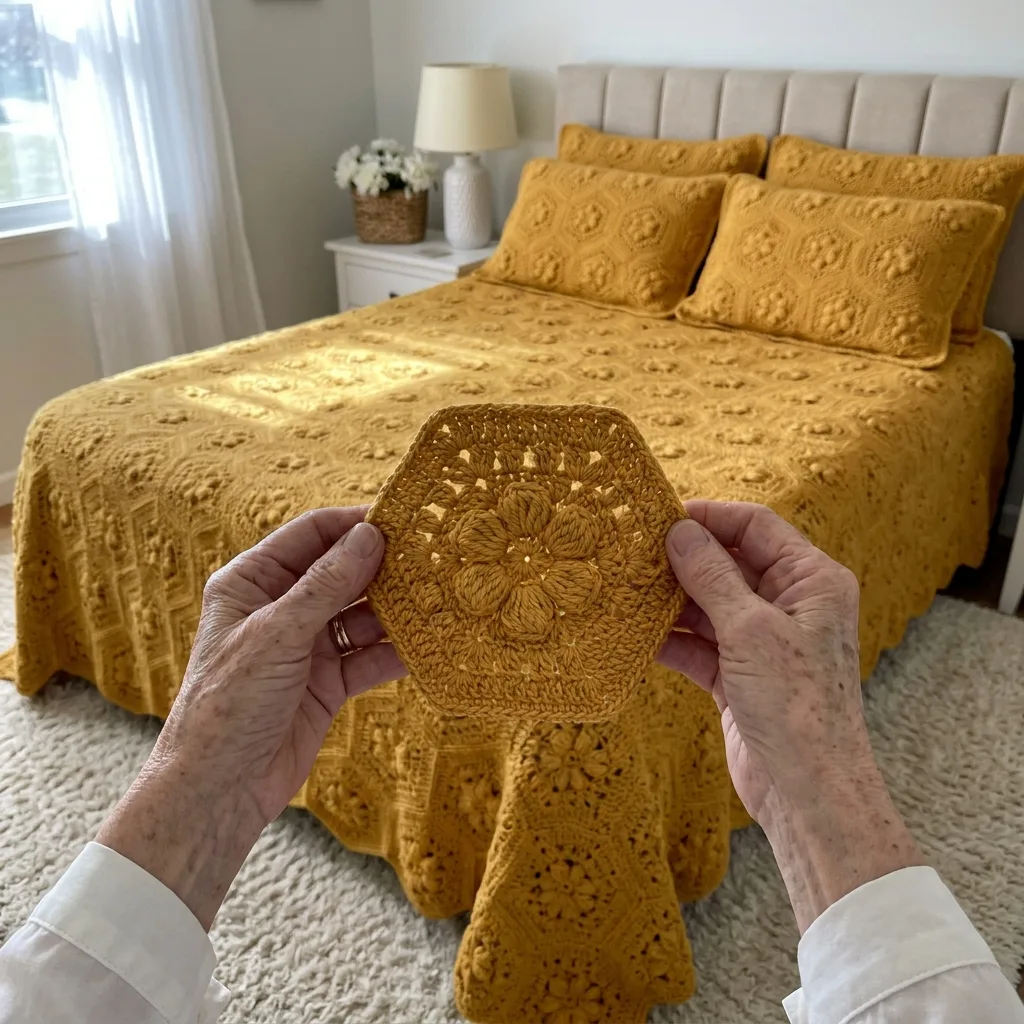
You need puff stitches, double crochet and a simple hexagon shape with six corners.
Each hexagon takes about forty-five minutes, so a couple a day turns into a full bed cover over a few months.
Every hexagon holds a raised puff flower, and together they make a warm honeycomb of blooms across the bed.
About This Mustard Puff Flower Hexagon Bed Cover Crochet Pattern Pattern
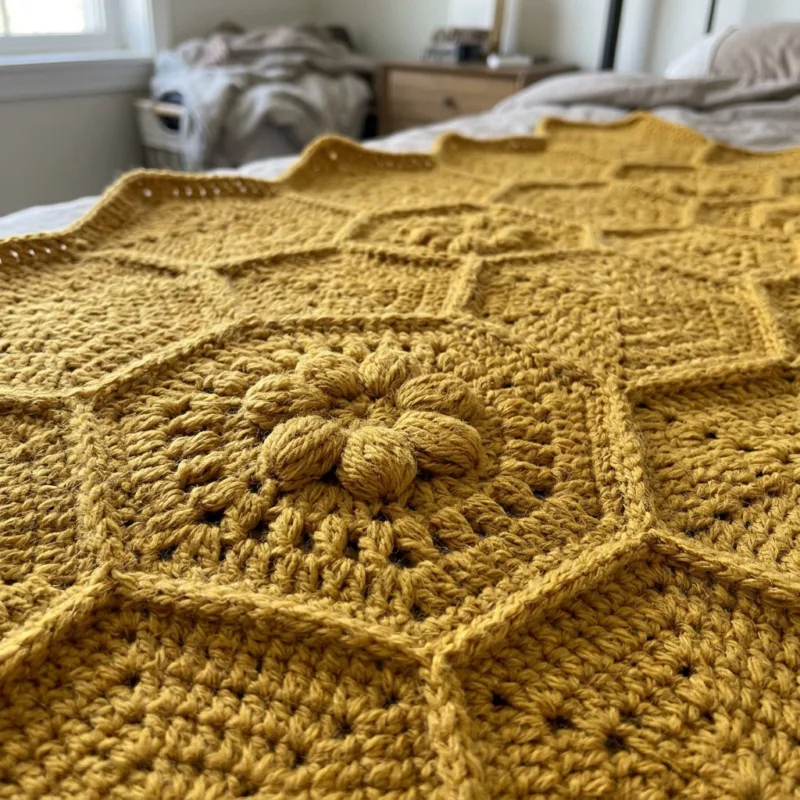
This mustard bed cover is made from hexagons, and each one holds a raised puff flower right in the middle. The flower has six plump petals around a tiny open center. Around it sits a lacy ring of smaller puff petals with open spaces between them, and then a solid outlined frame that gives each hexagon its crisp six-sided shape. Joined together, the hexagons form a warm honeycomb that covers the whole bed. Along the sides, the hexagon points make a soft zigzag edge that hangs toward the floor. In warm mustard yellow, it feels like sunshine and honey on a cool autumn morning.
Each hexagon is worked in rounds from the center out. You start with a magic ring of double crochet, then work six large puff stitches with chain spaces between them. These are the big petals of the center flower, and they stand up from the surface with a lovely raised texture. In the next round, you work pairs of smaller puffs into each space, with chains between them, and that makes the lacy ring of petals. Then you shape the hexagon with clusters of double crochet and six corners, work a second double crochet round and finish with a single crochet round that outlines the hexagon.
The hexagons are joined with single crochet worked on the right side, so each seam forms a small raised ridge. These ridges trace a honeycomb pattern over the bed and add strength to the cover. You join the hexagons into rows first, then join the rows to each other along the zigzag edges, which fits together like a puzzle. A short border of single crochet and reverse single crochet follows the zigzag points all the way around, giving the edge a neat rope finish that matches the seams.
The finished bed cover measures about 98 by 109 inches. It uses 276 hexagons in 19 rows that alternate between 15 and 14 hexagons. Each hexagon is about 6.5 inches across from flat side to flat side, and about 7.5 inches from point to point. On a queen bed, the cover lies across the top and drops about 19 inches on each side and about 29 inches at the foot, with the hexagon points reaching toward the floor. I used worsted weight matte cotton with a 5 mm hook, which makes chunky puffs and a warm, cozy fabric.
The finished cover is soft, warm and full of texture. The puff flowers are thick and squishy under your hand, while the lacy rings keep the fabric from feeling too heavy. Mustard yellow is a rich, cheerful color that brings warmth to any room. It looks wonderful against neutral walls, beige headboards and white furniture, and it glows beautifully in lamp light. Because the whole cover is one color, the design comes from the texture and shadows of the puffs, which makes it feel elegant rather than busy.
This pattern suits an intermediate crocheter who is comfortable with puff stitches and working in the round. The hexagon has only six rounds, so once you have made a few, you will barely need to look at the pattern. Joining hexagons is a little different from joining squares, but after the first row you will see how the pieces fit together. Since every hexagon uses just one color, there are very few ends to weave in. Each piece is small and light, perfect for carrying in a bag and working on wherever you go.
Why You'll Love This Mustard Puff Flower Hexagon Bed Cover Crochet Pattern Pattern
I love this bed cover because it feels like a warm hug. Mustard yellow is one of my favorite colors for cooler months. It reminds me of sunflowers at the end of summer, honey in a jar and golden leaves on the trees. When this cover is on the bed, the whole room feels cozy and bright, even on gray days. I find myself smiling every time I walk past the bedroom door and see that honeycomb of little flowers.
The puff flowers are what make this hexagon special. Puff stitches are plump and soft, and they stand up from the fabric like little pillows. When you make six of them in a circle, they bloom into a flower that you can feel with your fingertips. The lacy ring around the flower adds a lighter touch, so the hexagon looks delicate and full at the same time. I could happily make these flowers for hours, and some evenings I did exactly that.
I also love working with hexagons. They are a little more interesting than squares, and they fit together in such a natural, pleasing way. There is something satisfying about laying out rows of hexagons and watching them click into a honeycomb. The zigzag edge is a happy surprise too. Instead of a plain straight border, the hexagon points make a playful edge that looks lovely hanging over the side of the bed.
- One color only, with very few ends to weave in.
- Six simple rounds per hexagon, easy to memorize.
- Raised puff flowers with rich texture.
- A honeycomb layout that looks special on any bed.
This cover truly changes a bedroom. My room used to be all white and beige, and it felt calm but a little flat. The mustard cover brought it to life. It added warmth, color and texture without making the room feel busy. Friends who visit always stop to touch the puffs and ask how long it took. When I tell them every hexagon was made by hand, they look at it with new eyes. A handmade bed cover gives a room a story.
Making this cover taught me a lot about puff stitches and patience. I learned to keep every puff the same height so the flowers look even. I learned to count my corners carefully so every hexagon has exactly six sides. And I learned that joining a honeycomb is easier than it looks once you lay out the first two rows. If you want a big, cozy project full of texture and warmth, I think you will love this one as much as I do.
Switch Things Up
The first and easiest change is the color. Mustard is warm and cheerful, but this hexagon looks beautiful in any solid shade. Sage green feels calm and earthy. Dusty rose looks soft and romantic. Terracotta brings a rich, cozy autumn feel, and soft cream looks timeless and elegant. For a bolder design, you can make the puff flowers in one color and the rest of the hexagon in another, such as white flowers on a sage background or mustard flowers on a cream background. Two-color hexagons look especially pretty in a honeycomb.
You can make this bed cover for any bed size by changing the number of hexagons. Each hexagon is about 6.5 inches from flat side to flat side, and each new row adds about 5.6 inches in length. Here are the layouts I use:
- Twin: 15 rows alternating 12 and 11 hexagons, 172 hexagons, about 78 by 86 inches.
- Full: 17 rows alternating 14 and 13 hexagons, 230 hexagons, about 91 by 98 inches.
- Queen: 19 rows alternating 15 and 14 hexagons, 276 hexagons, about 98 by 109 inches.
- King: 19 rows alternating 17 and 16 hexagons, 314 hexagons, about 111 by 109 inches.
For a sofa throw, make 11 rows that alternate 8 and 7 hexagons. That uses 83 hexagons and finishes at about 52 by 64 inches. A throw is a wonderful way to try the pattern before you commit to a whole bed cover. It looks lovely draped over the back of a sofa or folded at the foot of a bed, and the zigzag edge makes it feel special. If you make two hexagons most evenings, you can finish a throw in about six weeks.
A baby blanket works beautifully in this pattern too. Make 7 rows that alternate 5 and 4 hexagons, for 32 hexagons and a blanket about 33 by 41 inches. Use a soft cotton or cotton blend in a gentle shade such as butter yellow, mint or pale peach. The puff flowers make it cozy and textured for tummy time, and it photographs beautifully. Families often keep a handmade baby blanket long after the baby years, so it becomes a sweet keepsake.
You can also straighten the edges if you prefer a rectangle. Make half hexagons to fill the gaps along the two long sides: work the center flower and petal ring as written, then work the hexagon rounds back and forth across only three sides. Fill the top and bottom edges the same way. A straight edge makes the cover easier to tuck in, while the zigzag edge looks more decorative. Lay out a few rows to see which you like best before you join.
To make matching pillow covers, join 3 rows of 4, 3 and 4 hexagons for a panel about 26 by 19 inches, which fits a standard pillow. Make two panels and join them around the edges with single crochet, slipping in the pillow before closing the last side. Use a pillow insert in mustard or a warm neutral so the lacy spaces show a matching color. Matching pillows make the whole bed look planned and finished.
Finally, try a different yarn weight. In DK cotton with a 4 mm hook, each hexagon is about 5.5 inches across, so a queen needs about 23 rows alternating 18 and 17 hexagons. In bulky yarn with a 6.5 mm hook, a hexagon grows to about 8.5 inches, and a queen needs only about 15 rows alternating 12 and 11 hexagons. Bulky yarn makes the puffs extra chunky and the cover very cozy. Always make one test hexagon in your chosen yarn and block it before planning your layout.
Materials Needed
— Main Fabric
— Tools Required
The Free Pattern
0% complete
— Puff Flower Hexagon (Make 276, mustard) :
— Layout :
— Border (mustard) :
Assembly Instructions
- Make one Puff Flower Hexagon, block it and check that it measures about 6.5 inches from flat side to flat side.
- Make all 276 hexagons, weaving in the two ends of each hexagon as you finish it.
- Block the hexagons in batches so they are all the same size before joining.
- Lay the hexagons out in 19 rows that alternate 15 and 14 hexagons, all with a point at the top.
- Join the hexagons of each row along their flat sides with single crochet on the right side, then join the rows to each other along the zigzag sides.
- Work Border Rounds 1 and 2 around the whole zigzag edge.
- Block the finished bed cover flat, pinning each outward point, and let it dry completely.
Common Mistakes & How to Fix Them
The most common mistake is making puff stitches of different heights. If some loops are pulled up long and others short, the center flower looks lopsided and the petal ring will not lie flat. This happens easily when you are relaxed or chatting while you work. To fix it, pull every loop up to about half an inch, the height of a double crochet, before the next yarn over. Some makers hold the loops lightly with a finger to keep them even. If a flower looks uneven, pull out that round and redo it before moving on.
Another mistake is putting the corners in the wrong spaces in Round 4. The six corners must go into the ch-2 spaces between each pair of small puffs, and the side clusters go into the ch-2 spaces between the pairs. If you swap them, the hexagon twists and the flower turns at an angle to the frame. It also makes the hexagons hard to join, because the sides no longer match. Before you start Round 4, place a stitch marker in each space between a pair of puffs. Those six markers show you exactly where each corner goes.
Many makers end up with hexagons that cup or ruffle. If your hexagon curls up like a shallow bowl, your puffs or chain spaces are too tight. If it waves at the edges, they are too loose, or you added too many stitches. This usually comes from tension changing in Rounds 2 and 3. Lay your first hexagon flat on a table after Round 4. If it cups, go up half a hook size for the puff rounds; if it ruffles, go down half a size. A flat hexagon makes a smooth honeycomb when joined.
The last common mistake is laying out the rows wrong before joining, so the honeycomb does not fit. Odd rows have 15 hexagons and even rows have 14, set halfway between the hexagons above. If you put 15 in every row, the zigzag sides will not line up and the edges will be uneven. Lay out at least the first three rows on the floor before you start joining, and count each row. Join the hexagons of each row first, then join row to row. This keeps the layout neat and stops the cover from drifting to one side.

You Might Also Like
Important Notes
Gauge matters because small differences add up across 276 hexagons. A blocked hexagon should measure about 6.5 inches from flat side to flat side. If yours is a quarter inch larger, the bed cover will grow by almost 4 inches across and several inches in length. Make one test hexagon and block it before you buy all of your yarn. Compare new hexagons with your first one every few weeks, because tension often changes during a long project.
Blocking flattens the hexagons and makes the six sides straight, which makes joining much easier. Pin each hexagon to a blocking mat with a pin in every corner, mist it with cool water and let it dry fully. Be gentle with the puff flowers and do not press them flat. After joining and working the border, block the whole bed cover again, pinning each outward point so the zigzag edge hangs evenly over the sides.
The yarn amount is for the queen size in worsted weight cotton, so adjust it for other sizes or yarns. With a single strong color like mustard, dye lots matter, because a slightly brighter or duller shade will show clearly across the bed. Buy all of your yarn from the same dye lot at once, plus about 10 percent extra. If you must use two lots, mix hexagons from both lots evenly across the layout so any small difference is spread out.
Wash the bed cover by hand or on a gentle cold cycle inside a large mesh laundry bag. Wash it on its own the first few times, because deep yellows can release a little dye, and add a color catcher sheet for safety. Use a mild detergent and no bleach. This cover is heavy when wet, so never hang it to dry, because it will stretch. Lay it flat on towels, shape the hexagons and points and let it dry completely.
I hope this mustard puff flower bed cover brings a warm glow into your bedroom. It is a big project, but each hexagon is a small, happy piece that blooms in your hands in under an hour. Take your time with the puffs, and enjoy watching the honeycomb grow as you lay out your stack of little flowers.
You do not have to think about all 276 hexagons today. Just make a magic ring and finish one flower. Then make another tomorrow. Before long, you will be joining rows into a honeycomb and seeing a whole bed of golden blooms come together. Happy crocheting, my friend.
Crochet Abbreviations
You Ask, We Answer
What is the finished size of this bed cover?
The queen version finishes at about 98 by 109 inches after blocking, measured from point to point. It uses 276 hexagons in 19 rows that alternate between 15 and 14 hexagons. Each hexagon is about 6.5 inches from flat side to flat side and about 7.5 inches from point to point. On a standard queen mattress, the cover lies across the top and drops about 19 inches on each side and about 29 inches at the foot, so the hexagon points reach toward the floor on most bed frames. If your bed is taller, add one hexagon to each row and two more rows. If you prefer a coverlet that stops at the side of the mattress, use the full layout. Measure your own bed, including the mattress and frame height, and plan from your blocked hexagon size before you buy yarn.
Can I use a different yarn weight or make a different size?
Yes, this pattern works in many yarn weights because the hexagon is the same in every size. In DK cotton with a 4 mm hook, each hexagon is about 5.5 inches across, and in bulky yarn with a 6.5 mm hook it grows to about 8.5 inches. The stitch counts never change, only the hexagon size and the number you need. Make one test hexagon in your chosen yarn, block it and measure it from flat side to flat side. Divide your bed width by that number to get the hexagons per long row, and divide your length by about three quarters of the point-to-point size to get the number of rows. The section on switching things up lists layouts for twin, full, queen, king, a throw and a baby blanket. The border always fits, because it follows the open sides, points and valleys of any layout.
How do I wash and care for this crochet bed cover?
Wash it by hand in cool water or on a gentle cold cycle inside a large mesh laundry bag to protect the puff stitches and seams. Use a mild detergent and never use bleach, because it can fade the mustard color and weaken the cotton. Wash it on its own the first few times and add a color catcher sheet, since deep yellow dyes can release a little color. Do not wring or twist the cover. Gently press out the water, then lay it flat on clean towels and shape the hexagons and zigzag points with your hands. Let it dry completely before putting it back on the bed. Never hang it while wet, because the weight of the wet cotton will stretch it. Between seasons, fold it loosely and store it in a breathable cotton bag, away from direct sunlight, so the warm color stays rich.
Success!
Thanks for subscribing — check your inbox for a welcome note.
Abbreviations
- ch — chain
- sc — single crochet
- dc — double crochet
- large puff — (yo, insert hook, yo and pull up a loop) 4 times, yo and pull through all 9 loops
- small puff — (yo, insert hook, yo and pull up a loop) 3 times, yo and pull through all 7 loops
- yo — yarn over
- rev sc — reverse single crochet (crab stitch), worked from left to right
- sc2tog — single crochet 2 together
- sl st — slip stitch
- MR — magic ring
- beg — beginning
- sk — skip
- st(s) — stitch(es)
- sp(s) — space(s)
- rep — repeat
- Rnd — round