
Brown and Cream Lace Stripe Bed Cover Crochet Pattern
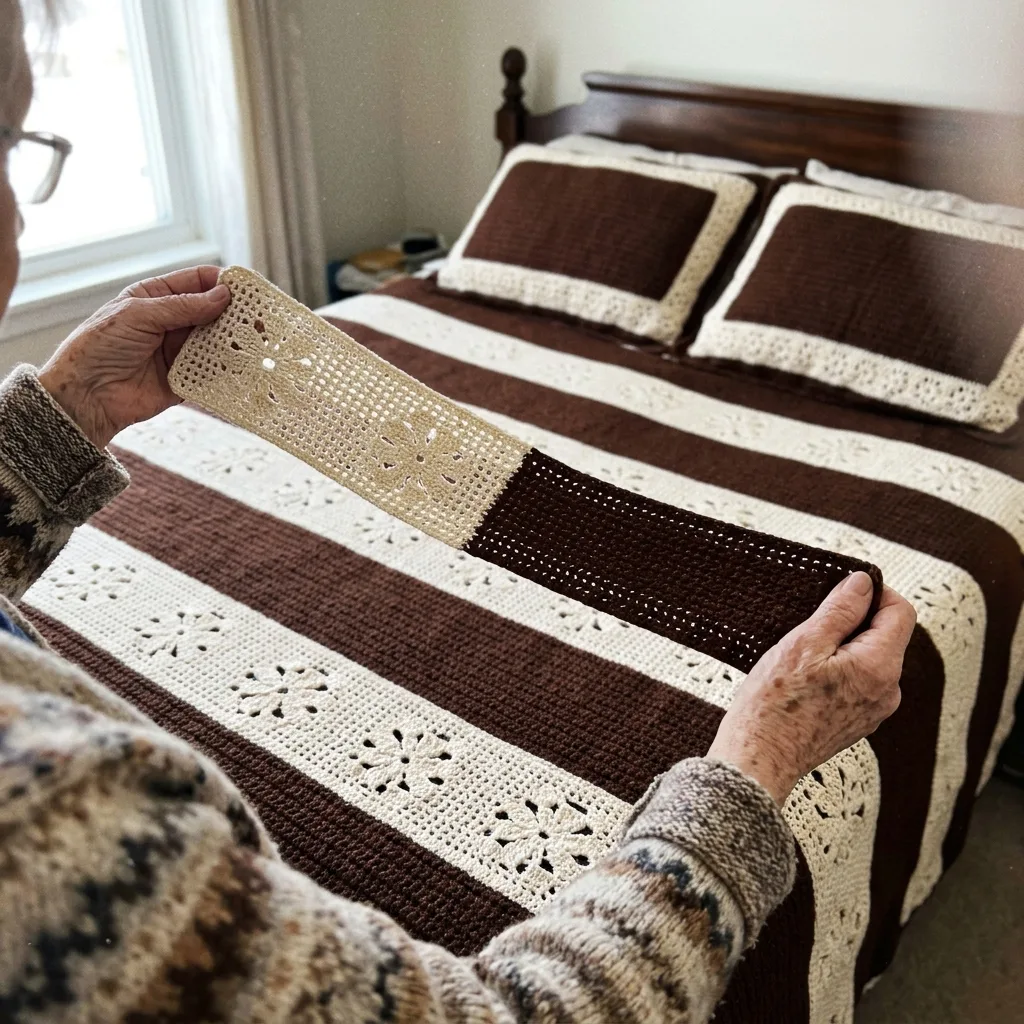
Basic stitches in long rows, with a shell lace that has an exact stitch count on every row.
Worked in one piece with no joining, so when the last row is done you are almost finished.
Wide bands of vintage cream lace sit between warm brown stripes for a timeless heirloom look.
About This Brown and Cream Lace Stripe Bed Cover Crochet Pattern Pattern
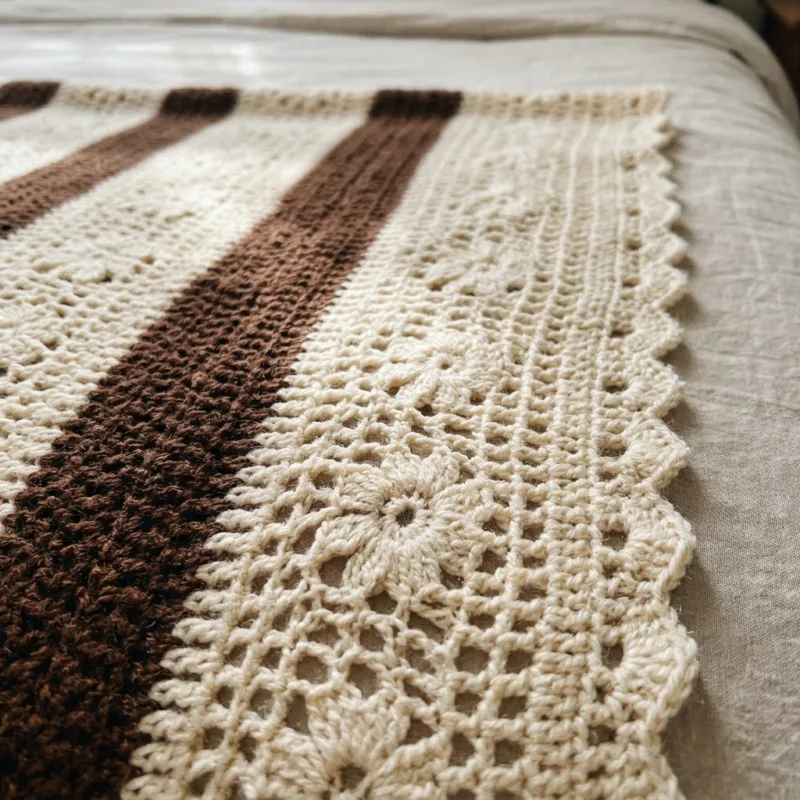
This bed cover is made of wide stripes that run across the bed: solid bands of warm chocolate brown and lacy bands of soft cream. The brown bands are plain rows of double crochet, smooth and cozy. The cream bands are an open shell lace, with fans of double crochet and little chain windows that let the light through, so they look almost like old lace curtains. Side by side, the two textures make each other look even better. The brown makes the lace look delicate, and the lace keeps the brown from feeling heavy.
Unlike a granny square blanket, this bed cover is worked in one piece, in long rows from the bottom edge to the top. There are no squares to join and very few ends to weave in, because you only cut the yarn when the color changes. Each row is 313 stitches wide. You start with a brown band of nine rows of double crochet, then switch to cream for a lace band of ten rows, and keep going, brown, cream, brown, until the bed is covered. There are nine brown bands and eight cream bands in all.
The lace is a classic shell pattern built from a four row repeat. A row of shells, a row of chain mesh, a row of shells that sits between the shells below, and another row of mesh. After two repeats, a smoothing row of treble, half double and single crochet levels the top of the lace so the next brown band starts on a flat, straight edge. Every row is written out with its exact stitch count, so you always know where you are, even on a row this long.
The finished queen size measures about 90 by 101 inches with the border. Each brown band is about 5 inches tall and each cream lace band is about 7 inches. The bands run across the width of the bed, so when the cover is on the mattress you see wide stripes from the pillows to the foot, just like in the photo. The border is simple: one round of brown single crochet and one round of crab stitch, which gives the edge a neat corded look that will not stretch or ruffle.
Because it is one piece, the bed cover drapes beautifully over the sides of the mattress with no seams to pull or pucker. The brown double crochet bands give it weight and warmth, while the lace bands keep it breathable and light. It is a cover you can use in every season. In summer it is airy enough to sleep under on its own, and in winter it looks lovely layered over a quilt.
I would call this an intermediate project. The stitches are only chain, single, half double, double and treble crochet, but the rows are long and the lace asks you to keep careful count. If you have made a blanket in rows before and you are comfortable reading a pattern, you will enjoy this one. It is a wonderful project for anyone who loves the look of vintage lace but wants something warm and practical for the bedroom.
Why You'll Love This Brown and Cream Lace Stripe Bed Cover Crochet Pattern Pattern
I love brown and cream together. It is the color of coffee with cream, of an old farmhouse kitchen, of a wooden sleigh bed with crisp white pillows. Brown is warm and grounded and never looks tired, and cream keeps it bright and gentle. On a dark wood bed like the one in the photo, this cover looks like it has always belonged there. It is calm and classic, and it goes with almost any room, from a cabin to a cottage to a plain modern bedroom.
The lace bands are my favorite part. There is something so satisfying about watching the shells line up row after row and then seeing the little windows open between them. When I hold a finished band up to the window, the light comes through like sunshine through a lace curtain. Then I switch back to brown, and the plain double crochet rows feel like a rest for my hands and my mind. That rhythm of lace and plain, busy and calm, is what keeps me going.
I also love that there are no squares to join. I have made many square blankets, and joining always takes longer than I expect. With this one, when the last row is done, the bed cover is almost finished. Two border rounds and a little blocking, and it is ready for the bed. There are only a few ends to weave in, all at the color changes, and I hide them in the band of the same color so they never show.
Here are a few more reasons this one stays close to my heart:
- It is worked in one piece, so there is no joining at the end.
- Every row has an exact stitch count, so it is easy to check your work.
- The plain brown bands are relaxing rows to work while chatting or watching a show.
- It makes a gift that looks like a family heirloom from the very first day.
Each of these makes a big project feel calm and doable, even when the rows are long.
A handmade bed cover changes a room like nothing else. When I make the bed in the morning and smooth this cover over the pillows, the stripes line up so neatly that the whole room looks finished and peaceful. The matching striped shams make it look like something from a magazine. Guests always run their hands over the lace and ask if it is an antique. I love telling them I made it myself, one long row at a time.
This project taught me patience with long rows. The first lace band felt slow, because I was counting every shell. By the third band, I had learned to place a stitch marker every ten shells, and the rows began to fly by. When I worked the last crab stitch around the edge and spread the cover over the bed, I could hardly believe how much it looked like the lace my grandmother kept in her cedar chest. That is a feeling I wish for everyone who makes it.
Switch Things Up
Try a new color pair. The bands look lovely in many color pairs. Navy with white is crisp and coastal, and sage green with cream feels like a spring garden. Burgundy with ivory is rich and romantic, and charcoal gray with white looks calm and modern. Keep the lace bands in the lighter color, because lace shows its pattern best in light yarn.
Make it for a different bed. The width depends on your starting chain, which must be a multiple of 6 plus 3 chains, giving a row of 6 shells plus 1 stitch. At a gauge of 14 dc to 4 inches, here are some starting points with the border:
- Twin: ch 231 for 229 dc, about 66 inches wide
- Full: ch 279 for 277 dc, about 80 inches wide
- Queen: ch 315 for 313 dc, about 90 inches wide
- King: ch 381 for 379 dc, about 109 inches wide
For all of these, the stitch counts in the lace rows change: the number of shells is the number of dc minus 1, divided by 6. Keep the same 9 brown and 8 cream bands for a length of about 101 inches.
Make a sofa throw. Start with ch 177 for 175 dc, about 50 inches wide, and work 5 brown bands and 4 cream bands for a throw about 50 by 54 inches. In the lace rows, you will have 29 shells instead of 52. It is a lovely size for the back of a couch or the foot of the bed, and it uses about a third of the yarn of the queen size. It is also a good way to learn the lace before you commit to a whole bed.
Make a baby blanket. Start with ch 129 for 127 dc, about 36 inches wide, and work 4 brown bands and 3 cream bands for a blanket about 36 by 41 inches, with 21 shells in each lace row. For a baby, I work the brown bands in a soft color like pale blue, blush or mint and keep the lace in white. Use a soft, washable baby yarn, and check that no lace windows are big enough for little fingers to get caught.
Make matching pillow shams. Start with ch 93 for 91 dc, about 26 inches wide, and work 2 brown bands with 1 cream band between them for a sham front about 26 by 17 inches, with 15 shells in each lace row. Make a plain brown back the same size. Join front and back on three sides with brown single crochet, slip the pillow in, and close the last side. Matching shams make the whole bed look planned and finished, just like in the photo.
Change the band widths. For a lacier cover, make the cream bands three repeats tall instead of two, or make the brown bands only five rows tall. For a cozier cover, add more brown rows. You could also add a thin stripe of cream in the middle of each brown band for a ticking stripe look. Each change gives the cover a new mood, so try a small swatch first and see which you like best.
Use a different yarn weight. In DK yarn with a 4.0 mm hook, the gauge is about 18 dc to 4 inches, so a 90 inch wide queen needs about ch 405 for 403 dc, with 67 shells in each lace row. In bulky yarn with a 6.5 mm hook, the gauge is about 11 dc to 4 inches, so the queen needs about ch 249 for 247 dc, with 41 shells. Always make a swatch first, measure it, and work out your chain from that.
Add a fancier edge. For a softer finish, replace the crab stitch round with a cream shell edge along the top and bottom only, where the lace already sits nearby. For a heavier, tailored look, add a second round of brown single crochet before the crab stitch. You could also add short cream tassels along the foot of the bed. Each small change gives the cover a new look without changing the bands.
Materials Needed
— Main Fabric
— Tools Required
The Free Pattern
0% complete
— Brown Band (Make 9, chocolate brown) :
— Cream Lace Band (Make 8, cream) :
— Layout (9 brown bands and 8 cream lace bands) :
— Border (chocolate brown) :
Assembly Instructions
- Work the first Brown Band from the foundation chain, then change to cream.
- Work a Cream Lace Band, then a Brown Band, and keep alternating in the order shown in the Layout section until you have 9 Brown Bands and 8 Cream Lace Bands.
- Fasten off after the last brown row and weave in every color change tail inside the band of the same color.
- Work the 2 Border rounds around the whole bed cover, following the stitch counts for each band so the sides stay straight.
- Block the finished bed cover flat on a bed or a towel-covered floor, gently opening the lace bands and straightening the edges.
Common Mistakes & How to Fix Them
Losing count on the long lace rows. Each lace row has 52 shells or 52 mesh repeats across 313 stitches, and it is easy to skip one or work one twice. If the count is off, the shells in the next row will not line up and the lace looks crooked. Place a stitch marker after every 10 shells on Row 1 of each lace band and move the markers up as you go. At the end of each row, check the count in brackets before you turn. If a row is off, pull it back right away, because the next row depends on it.
Working the shells into the wrong place. In the shell rows, the 5 dc always go into a single stitch: into a sc on Row 1, into a dc on Rows 3 and 5. The ch-2 spaces in the mesh rows are skipped, not worked into. If you put a shell into a chain space, the shells drift sideways and the lace loses its neat columns. Before each shell, look for the stitch below that sits between two ch-2 spaces. Working into that stitch keeps every shell stacked straight above the mesh.
Letting the lace bands pull in or spread out. Lace often has a different tension than solid double crochet. If your lace is tighter, the cream bands come out narrower than the brown ones and the side edges of the bed cover wave in and out. If it is looser, the cream bands bulge. After your first lace band, measure the width of the cream and brown bands. If they differ by more than an inch, go up or down one hook size for the lace rows only, and keep using that hook for every lace band.
Leaving the side edges messy. The turning chains at the ends of long rows can get loose, especially in the lace bands, and the sides of the bed cover look ragged. That also makes the border round hard to work evenly. Keep every turning chain snug, and always work the last stitch of each row into the top of the turning chain from the row below. When you work the border, follow the stitch counts for each band, so the sides stay straight and do not ruffle or pull in.

You Might Also Like
Important Notes
Gauge: 14 dc and 7 rows of dc measure about 4 inches with a 5.0 mm hook. One brown band of 9 rows should measure about 5 inches tall, and one cream lace band of 10 rows about 7 inches. Make a small swatch in both the solid rows and the lace before you start, and measure it after blocking. If your gauge is off, change your hook size, or adjust your starting chain to a different multiple of 6 plus 3.
Blocking: Because the bed cover is one large piece, the easiest way to block it is on a bed or a clean floor covered with towels. For acrylic, lay it flat and hold a steam iron a few inches above it without touching, section by section. For wool blends, mist it lightly and let it dry. Gently stretch each lace band to open the shells, and pat the side edges straight before it dries completely.
Yarn amounts and dye lots: For the queen size you need about 1,700 grams of chocolate brown and about 1,500 grams of cream in worsted weight yarn, including the border. These numbers depend on your tension. Buy all of each color at the same time and check that the dye lot numbers match. On a striped piece this large, a new dye lot shows up clearly as a band that does not quite match.
Washing and drying: Follow your yarn label first. Most acrylic bed covers can be machine washed on a gentle cycle in cool water inside a large mesh bag, then dried flat or tumbled on low. Because dark brown sits right next to cream lace, add a color catcher sheet to every wash so no brown dye settles in the lace. Wash wool blends by hand in cool water. Never hang the cover wet, since the water will stretch it.
Every time I make this bed, I think about the first lace band, when the shells lined up and the little windows opened under my hook. Nothing in this pattern is hard on its own. It is just rows of shells and rows of double crochet, made with care, band after band, until a whole bed is covered in warm stripes of brown and lace. I hope it brings a little vintage charm into your home.
So wind a ball of brown and a ball of cream, chain your first row, and start your first band today. Do not think about all 161 rows yet. Work one band, then the next, and soon you will have a bed cover that looks like a treasured heirloom. Please share your first lace band with me. Happy crocheting, my friend.
Crochet Abbreviations
You Ask, We Answer
How big is the finished bed cover?
The queen size in this pattern measures about 90 by 101 inches with the border. The width comes from the 313 stitches in every row, at a gauge of 14 double crochet to 4 inches. The length comes from 9 brown bands of about 5 inches each and 8 cream lace bands of about 7 inches each, plus the two border rounds. On a standard queen mattress, which is 60 by 80 inches, that leaves about 15 inches to drape down each side and enough length to tuck under the pillows. Your own size may be a little different, because everyone crochets with a slightly different tension, and lace can relax after blocking. Measure your swatch before you start. If the width is off, adjust your starting chain to a different multiple of 6 plus 3, and if the length is off, add or remove a band.
Can I use a different yarn weight or make a different size?
Yes. The bands work in any weight, as long as your stitch count is a multiple of 6 plus 1. In DK yarn with a 4.0 mm hook, the gauge is about 18 dc to 4 inches, so a 90 inch queen starts with ch 405 for 403 dc. In bulky yarn with a 6.5 mm hook, the gauge is about 11 dc to 4 inches, so the queen starts with ch 249 for 247 dc. For other beds in worsted yarn, start with ch 231 for a twin, ch 279 for a full, ch 315 for a queen and ch 381 for a king. To find the shells in each lace row, take the number of dc, subtract 1 and divide by 6. Change the length by adding or removing bands, and weigh one finished band so you can work out how much yarn the whole cover needs.
How do I wash and care for the bed cover?
Always start with your yarn label, because care depends on the fiber. Acrylic is the easiest choice for a bed cover. Wash it on a gentle cycle in cool water inside a large mesh laundry bag, so the lace does not catch on the drum. Add a color catcher sheet to every wash, because brown dye can bleed onto the cream lace, especially in the first few washes. Dry it flat on towels or tumble it on the lowest heat. For wool blends, wash by hand in cool water with a gentle wool wash, press out the water without wringing, roll the cover in towels and lay it flat to dry. Never hang it wet, because the lace will stretch. Between washes, shake it outside and air it in the shade. Store it loosely folded in a cotton bag, and refold it along different lines now and then.
Success!
Thanks for subscribing — check your inbox for a welcome note.
Abbreviations
- ch — chain
- sl st — slip stitch
- sc — single crochet
- reverse sc — reverse single crochet, also called crab stitch: sc worked from left to right
- hdc — half double crochet
- dc — double crochet
- tr — treble crochet
- sp — space
- st(s) — stitch(es)
- Rnd — round
- rep — repeat
- sk — skip