
Blue and White Daisy Motif Curtain Crochet Pattern
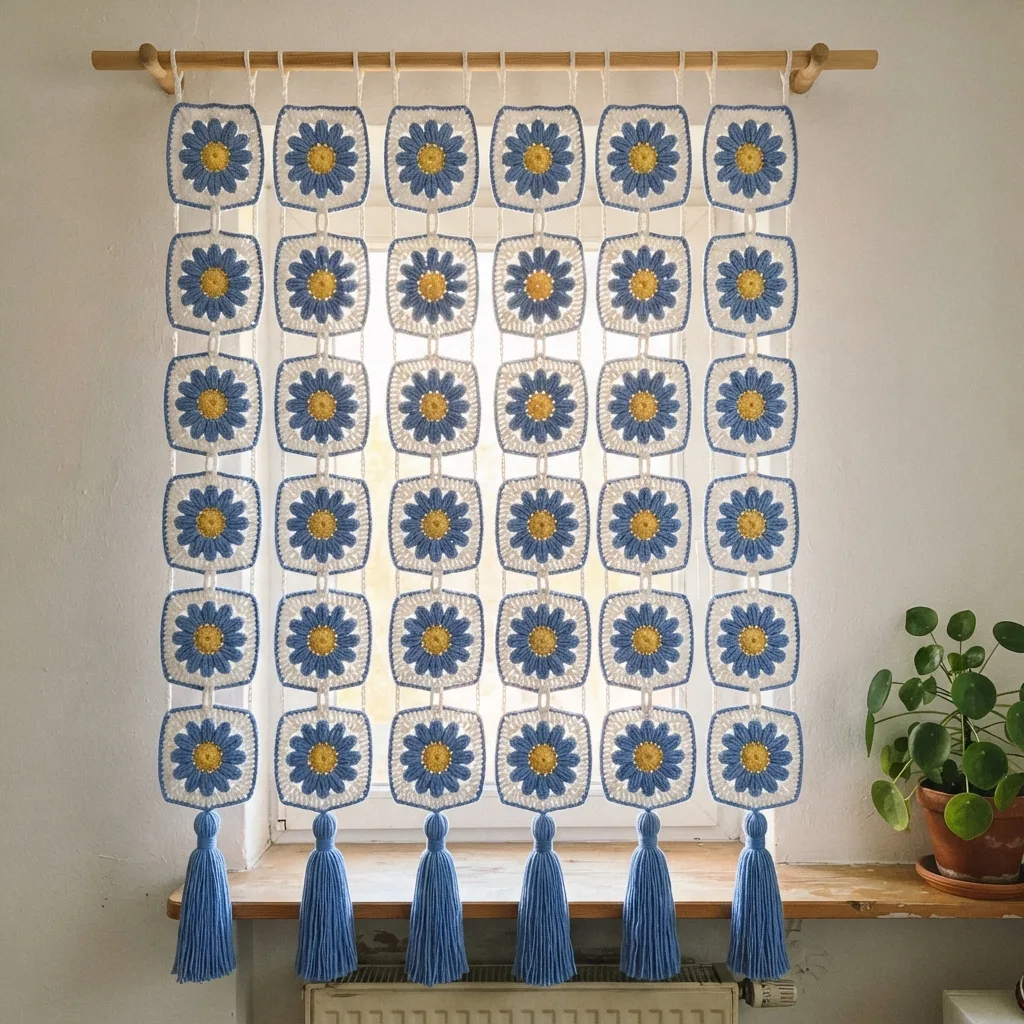
The daisy petals are simple chains worked back down, so anyone comfortable with granny squares can make this curtain.
Each daisy takes about 45 minutes, which makes it easy to finish a column in one cozy weekend.
Cornflower blue and bright white bring the fresh look of a seaside house to any window in your home.
About This Blue and White Daisy Motif Curtain Crochet Pattern Pattern
This blue and white daisy curtain always reminds me of whitewashed houses by the sea, with blue shutters and flowers in every window box. It is made of 48 square motifs. Each one holds a cornflower blue daisy with 12 long, rounded petals around a small sunny yellow center. A bright white border squares off the flower, and a thin blue edge outlines every square so the shape stays crisp from across the room. The motifs hang in 8 separate columns of 6, linked by short white chains, and every column ends in a long, full blue tassel.
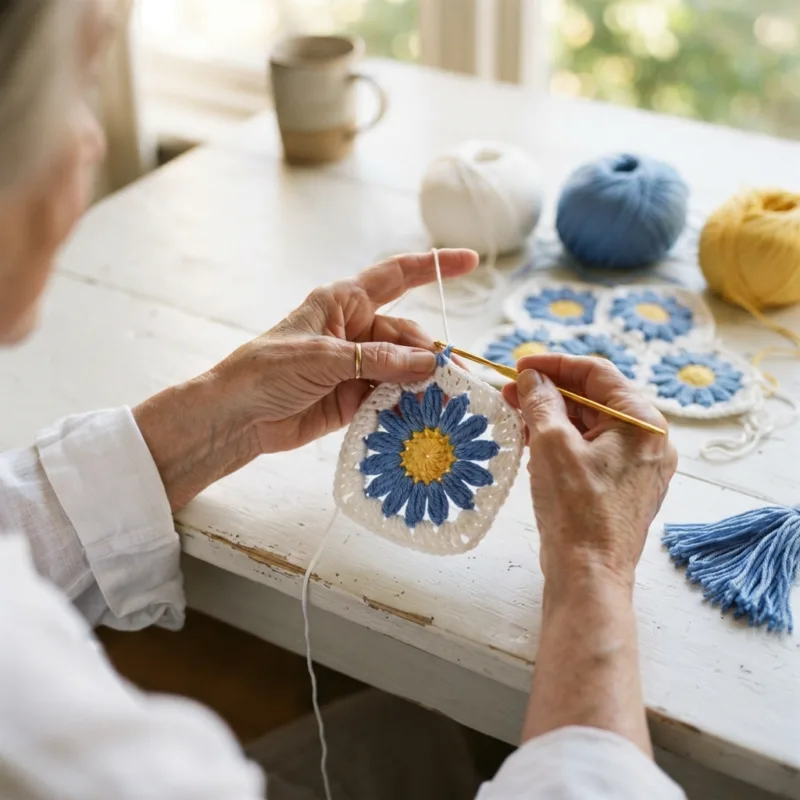
Let me take you through one motif. It starts with a tiny ring of yellow single crochet, which becomes the heart of the daisy. Then 12 blue petals grow out of that ring, one from each stitch. Every petal is a chain of seven that you work back down with a slip stitch, a single crochet, two half double crochet and two double crochet, so it is narrow at the tip and fuller near the center. The white border links the petal tips, turns the circle into a square over three rounds, and a final round of blue single crochet frames everything with a clean line.
The finished curtain measures about 59 inches wide on the rod and about 60 inches long from the top of the loops to the ends of the tassels, which is roughly 150 by 152 cm. Each motif is about 6.5 inches square after blocking, each chain link adds about 2 inches, and each tassel hangs about 9 inches. That covers most standard windows with a little room to spare. Since the curtain is made of separate columns, you can change its width and length very easily, and I give you a full size guide further down.
The stitches are all ones you probably know already: chain, slip stitch, single crochet, half double crochet and double crochet. There are no post stitches and no layered petals in this one, which makes it a gentle project to settle into. The only thing that needs care is the third white round, where you work into both the petal tips and the spaces between them. I have written every stitch out so you can count as you go, and after the first motif it becomes a calm, steady rhythm.
The columns are joined with doubled chain links rather than sewn seams. You chain from the center of the bottom edge of one motif down to the center of the top edge of the next, then slip stitch back up the same chain so the link is firm and does not stretch. The blue tassels tie on under the last motif of each column, and two white loops worked into the top corners of the first motif slide straight onto your curtain rod.
Once it is hanging, the curtain feels fresh and breezy. Daylight falls through the gaps between the columns and around the chains, and the white borders seem to shine while the blue daisies stay bright and clear. It filters the view without darkening the room, so it works beautifully in a bathroom, a kitchen, a bedroom or a sunroom. With a white wall behind it, the whole window looks like a postcard from a summer holiday.
I call this an intermediate project because of its size and the steady patience it asks for, not because any step is hard. You will make the same daisy 48 times, and the curtain looks its best when every square matches. If you have made a few granny squares and enjoy small repeating pieces, you will feel right at home here. A careful beginner can manage it too, especially if you take your time over the first motif and use it to check all the others.
Why You'll Love This Blue and White Daisy Motif Curtain Crochet Pattern Pattern
I love this curtain because blue and white is a color pair that never gets tired. It looks fresh in summer and calm in winter, and it goes with almost any room. When I hung mine in the bathroom, the whole space suddenly felt cleaner and brighter, like a little seaside cottage. Even on a gray morning the blue daisies make me think of sunshine and open windows.
I also love how relaxing the daisies are to make. The yellow center takes only a minute, and then the petals come one after another in a steady, soothing rhythm. Chain seven, work back down, slip stitch into the next stitch, and do it again. By the time I have made 12 petals, my shoulders have dropped and my mind is quiet. It is the kind of crochet I reach for at the end of a long day when I want my hands busy but my head at rest.
Watching the curtain grow is a real pleasure. One daisy is cute, a column of six with a blue tassel is charming, and eight columns side by side are truly special. I hang each column on the rod as soon as it is finished, so the window fills in a little more every week. It keeps me excited, and it lets me see how the light comes through long before the last motif is done.
Here is why it has become one of my favorite projects:
- The petals are quick and soothing to work.
- The blue edge makes every square look crisp.
- There is no big seaming job at the end.
- It brightens a bathroom or kitchen instantly.
- It travels easily in a small project bag.
It is also a lovely way to use up yarn. The yellow centers need only a tiny bit each, so one leftover ball easily covers all 48. Small amounts of blue and white from other projects can go into a few motifs too, as long as the weight and fiber match and the shades are close. I like to keep a jar of little balls on my shelf, and this curtain empties it in the best possible way.
This project taught me a lot about consistency. When I made my first column, a couple of the daisies were smaller than the rest because I had crocheted them late at night when I was tired. They stood out right away once the column was hanging. Since then I measure every motif on a little card before I add the border, and I set aside any that are off. That small habit has made all of my motif projects look more polished.
And of course, I love it as a gift. A blue and white curtain is a wonderful present for someone who loves the sea, a friend moving into a new apartment or a daughter setting up her first bathroom. It is used every single day and seen by everyone who visits, so it carries your care with it for years. I cannot think of a nicer way to say I made this just for you.
Switch Things Up
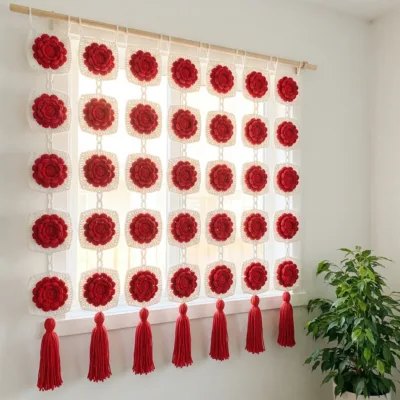
For a classic garden look, make white daisies on green and cream. Work the petals in white, keep the yellow centers, make the border cream and use a soft sage green for the outer edge and the tassels. It looks just like a meadow of real daisies and is lovely in a kitchen that opens onto a garden. The yarn amounts stay the same, you just swap the colors around.
If you like a bolder contrast, try navy and white. Use navy for the petals, the edge and the tassels, keep the white border and choose a golden yellow center. Navy gives the curtain a smart, nautical feeling that suits a living room or a study. Because navy is a strong dark color, always wash it with a color catcher so the white stays bright.
For softer rooms, a pink and white version is sweet and gentle. Make dusty pink petals, a white border, a pink edge and pink tassels, and keep the yellow centers for a cheerful touch. If you prefer something elegant, go for white with golden details: white petals and borders with golden yellow centers, edges and tassels. Both palettes work with the same pattern and need no changes at all.
Resizing is simple because every column is the same. Each column is about 6.5 inches wide plus a 1 inch gap, and each motif with its chain link adds about 8.5 inches of length. The loops and tassel add about 11 inches to each column. Here is a quick guide:
- Narrow window, about 29 by 44 inches: 4 columns of 4 motifs (16 motifs).
- Standard window, about 59 by 60 inches: 8 columns of 6 motifs (48 motifs).
- Door, about 37 by 78 inches: 5 columns of 8 motifs (40 motifs).
- Room divider, about 74 by 86 inches: 10 columns of 9 motifs (90 motifs).
A short cafe curtain is perfect for a bathroom or a kitchen sink window. Make 8 columns of 3 motifs each, which is 24 daisies, and hang them on a rod across the middle of the window. The curtain will be about 35 inches long including the tassels. You get privacy where you need it, and the top of the window stays open to the sky.
For a doorway curtain, follow the door layout and space the columns about 2 inches apart so it is easy to walk through. Make the chain links 18 chains long instead of 12, which lightens the curtain and lets it move gently when someone passes. Use short tassels of about 6 inches so they do not catch on shoulders or bags. It looks charming between a kitchen and a hallway or at a balcony door.
The tassels are an easy place to play. Short, chunky tassels of about 6 inches, wound 40 times around a 7 inch card, look fun and modern. Long tassels of about 12 inches, wound 30 times around a 13 inch card, look graceful and dramatic, especially on a tall window. For the long version, plan about 5 extra yards of blue for each tassel.
Changing the yarn weight changes the size of everything. In sport weight cotton with a 3 mm hook, each daisy square is about 5.5 inches, and the standard layout is about 51 inches wide. In worsted cotton with a 4.5 mm hook, each square grows to about 7.5 inches, and the standard layout is about 67 inches wide, so you may want 7 columns instead of 8. Always make one motif first, block it and measure it before you plan the full curtain.
Materials Needed
— Main Fabric
— Tools Required
The Free Pattern
0% complete
— Daisy Motif (Make 48, yellow center, blue petals, white border, blue edge) :
— Layout :
— Chain Links and Joining (Make 40, white) :
— Tassels (Make 8, blue) :
— Top Loops and Hanging (Make 16, white) :
Assembly Instructions
- Block all 48 daisy motifs to 6.5 in (16.5 cm) square and lay them out in 8 columns of 6 motifs.
- Join the motifs in each column from the top down with 5 doubled white chain links, for 40 links in total.
- Make 8 blue tassels and tie one to the center sc of the bottom side of the last motif in each column.
- Work 2 white hanging loops into the top corners of the first motif in each column, for 16 loops in total.
- Slide the columns onto the wooden rod in order, spacing them about 1 in (2.5 cm) apart.
- Give the hanging curtain a light steam, let it rest for a day, then trim all the tassels to the same length.
Common Mistakes & How to Fix Them
The most common mistake in this curtain is losing the sc between the corners in Round 4. Because you work into the petal tips and the spaces in turn, it is easy to skip one of the single crochet and end up with 16 dc on a side instead of 17. The square then pulls crooked and the blue edge in Round 6 will not count out to 23 per side. To avoid it, count each side as soon as you reach the next corner. You should have 3, then 11, then 3 double crochet between corner spaces. Fix a short side right away.
Daisy petals of different lengths make the white border bunch up or stretch. This happens when the ch-7 is tight on some petals and loose on others, or when you lose count and make 6 or 8 chains. A short petal also pulls its tip inward, so Round 3 sits unevenly and the motif will not block square. Keep a relaxed, even grip for every chain and count all seven each time. Before joining white, lay the flower flat and look at it closely. If one petal is clearly shorter or longer, pull it out and work it again.
A plain chain will slowly stretch once several motifs hang from it. If you skip the slip stitch row back up each link, the lower daisies pull the chains longer and the columns become uneven and droopy after a few weeks in the window. It happens because a single chain has almost no structure. Always slip stitch back up the link into the back bump of each chain, keep those slip stitches relaxed and use exactly 12 chains every time. Comparing finished columns side by side before hanging makes any short or long link easy to spot.
Blue dye can run onto the white border if the curtain gets damp or is washed for the first time without care. This happens because many bright cotton blues release a little extra dye early on, and white cotton picks it up very easily. The result is a faint blue haze that is very hard to remove. Before you start, soak a small piece of the blue yarn with a scrap of white in warm water and check for bleeding. When you wash the finished curtain, always use cool water and a color catcher sheet, and never leave it sitting wet.

You Might Also Like
Important Notes
Gauge for this curtain is one motif of 6.5 inches (16.5 cm) square after blocking, made in DK cotton with a 3.5 mm hook. The daisy after Round 2 should measure about 3 inches from petal tip to petal tip. If your motif comes out larger, go down half a hook size, and if it is smaller, go up half a size. Keeping all 48 motifs the same size matters more than matching gauge exactly, so save your first motif as a sample.
Block every motif before you join it. Pin each one to a 6.5 inch square on a blocking mat, with straight sides and square corners, spray it until damp and let it dry completely. While it is damp, smooth each petal flat with your fingertips so the daisy looks even. Blocking one column of 6 motifs at a time keeps things tidy. After assembly, a light steam from above relaxes the chain links and helps the tassels hang straight.
This curtain uses about 880 yards of white, 640 yards of cornflower blue and 80 yards of yellow DK cotton, including the tassels, chain links and hanging loops plus a little extra for your gauge motif. Buy all the yarn for each color from the same dye lot at the same time. Blues often vary a lot from one dye lot to the next, and even a small shift shows clearly when two columns hang next to each other in bright daylight.
The finished curtain weighs about 560 grams, so hang it on a sturdy rod with brackets screwed into the wall, not on a light tension rod. Wash it by hand in cool water with mild soap, or on a gentle machine cycle inside a mesh laundry bag. Add a color catcher sheet every time, because the blue is washed together with the white. Press out the water in a towel, then lay each column flat, smooth the petals and comb the tassels.
I hope this blue and white daisy curtain brings a fresh seaside breeze into your home. It is a big project when you look at it all at once, but every daisy is small, calm and quick, and each one brings you a little closer to that wonderful moment when the last column goes up and the light shines through.
So do not think about all 48 motifs today. Just pick up your yellow yarn, make that tiny ring and add your 12 blue petals. Then make another daisy tomorrow. Bit by bit, your window will fill with flowers, and you will wonder why you waited so long to start. Happy crocheting, and thank you for making this with me.
Crochet Abbreviations
You Ask, We Answer
What is the finished size of this curtain?
As written, the curtain measures about 59 inches wide on the rod and about 60 inches long from the top of the hanging loops to the ends of the tassels, which is roughly 150 by 152 cm. It is made of 8 columns with 6 motifs in each, so 48 daisy motifs in total. Each motif is about 6.5 inches square after blocking, each chain link adds about 2 inches and each tassel hangs about 9 inches below the last motif. The width allows for a gap of about 1 inch between columns, and you can close it up or spread it a little by sliding the loops along the rod. To change the size, add or remove columns for width and add or remove motifs for length. Each extra column adds about 7.5 inches of width, and each extra motif with its link adds about 8.5 inches of length. Measure your window carefully before you begin.
Can I use a different yarn weight or make it in another size?
Yes, the pattern works in any yarn weight, and the stitch counts stay exactly the same. Only the size of each square and the amount of yarn change. In sport weight cotton with a 3 mm hook, each daisy square is about 5.5 inches. In DK with a 3.5 mm hook, it is about 6.5 inches, and in worsted cotton with a 4.5 mm hook, it grows to about 7.5 inches. Heavier yarn makes a heavier curtain, so make sure your rod and brackets can carry it. I recommend cotton or a cotton blend, because it hangs straight, shows the petals clearly and does not stretch over time the way some acrylic yarns do. Whichever yarn you choose, crochet one motif first, block it and measure it. Then divide your window width by that size plus the gap to find the number of columns, and divide the length the same way to find motifs per column.
How do I wash and care for the curtain?
Take the columns off the rod before washing so the loops and chain links do not stretch. Hand washing in cool water with a mild wool or baby soap is the gentlest option. If you prefer the machine, put each column in a mesh laundry bag and use a cold, gentle cycle with a slow spin. Always add a color catcher sheet, because blue cotton can release dye onto the white, especially during the first few washes. Never wring the curtain. Roll each column in a large towel and press out the water instead. Then lay the columns flat on a dry towel, square up the motifs, smooth each petal and comb the tassels with your fingers so they dry straight. Avoid the dryer, because heat can shrink the cotton and make the squares uneven. When everything is dry, hang it back up and give it a day to settle into place.
Success!
Thanks for subscribing — check your inbox for a welcome note.
Abbreviations
- ch — chain
- sl st — slip stitch
- sc — single crochet
- hdc — half double crochet
- dc — double crochet
- st(s) — stitch(es)
- sp(s) — space(s)
- rep — repeat