
Sunflower Motif Hanging Curtain Crochet Pattern
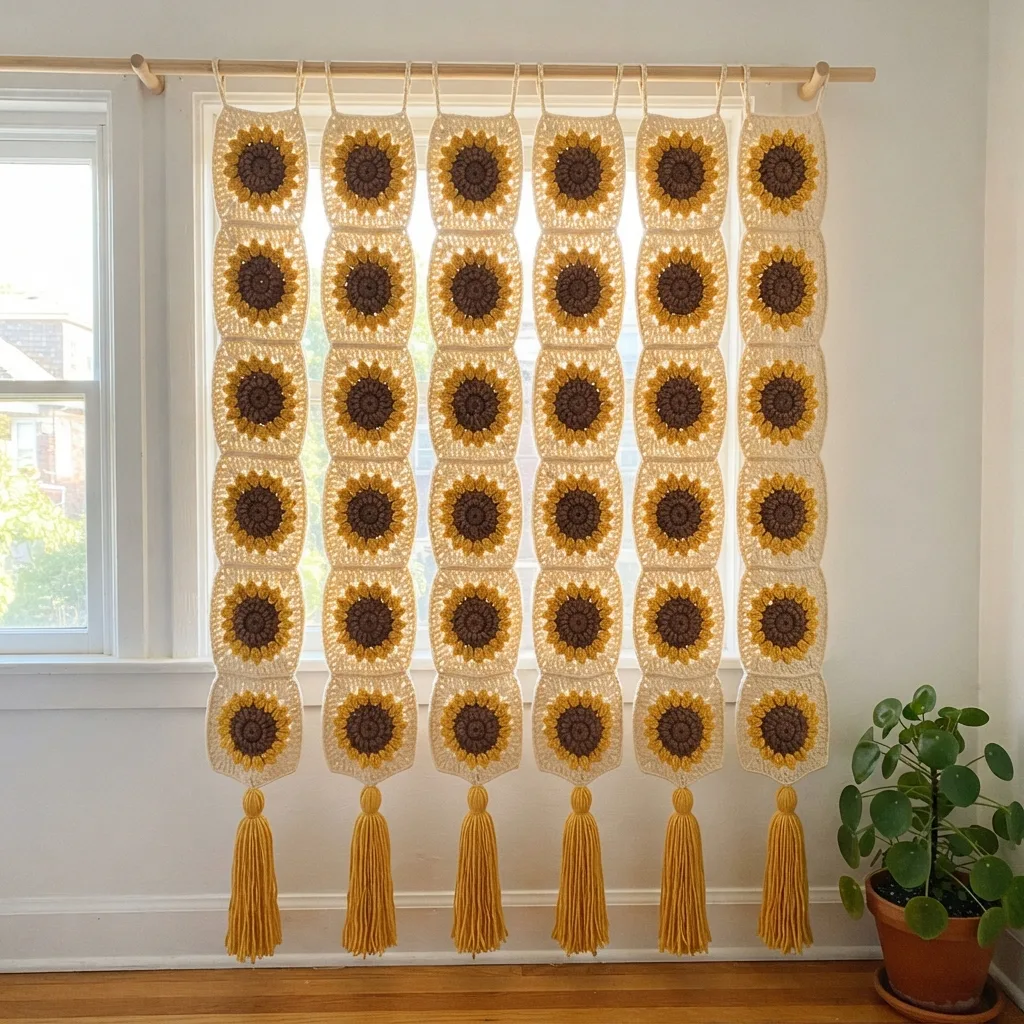
If you can make a chain, a double crochet and a simple square, you can work these pointed sunflower petals with ease.
Each sunflower takes under an hour, so three or four a week give you a finished window in a couple of months.
Golden petals and tassels catch the daylight, so your window feels like a sunny field even on a gray winter morning.
About This Sunflower Motif Hanging Curtain Crochet Pattern Pattern
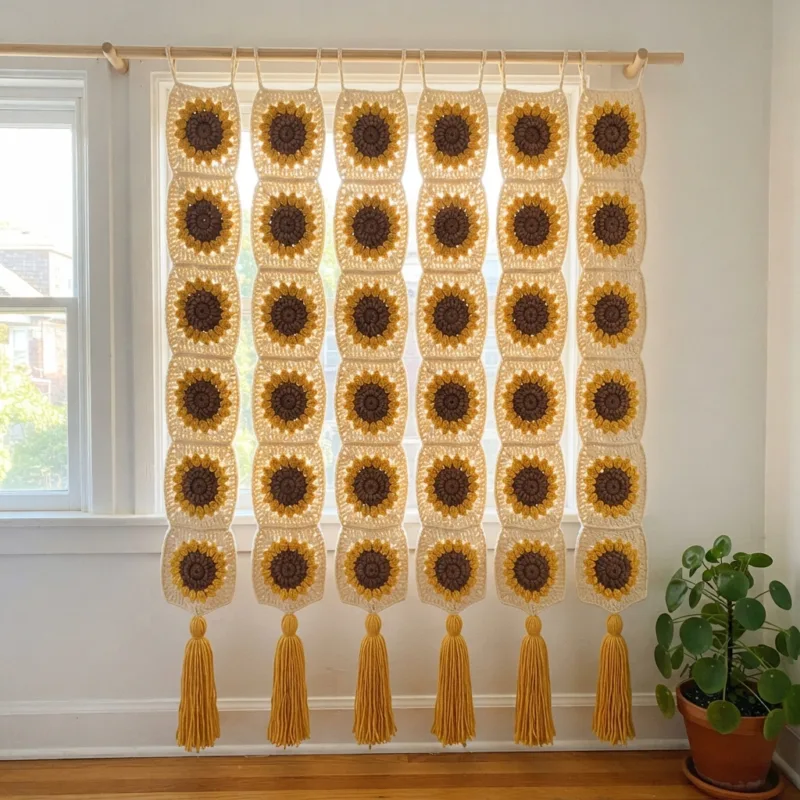
This sunflower curtain is pure happiness in a window. It is made of 35 square motifs, and each one holds a bright sunflower with a raised chocolate brown center and 16 pointed golden yellow petals. A warm cream border frames every flower and turns it into a neat square. The squares hang in 7 separate columns of 5, joined by short cream chains, and each column finishes with a long, full golden tassel. The columns are not stitched to each other, so the light slips between them and the whole curtain moves a little when a breeze comes through the window.
Here is how each motif comes together. The center is two rounds of brown double crochet, which gives you a flat, solid disk that looks just like the seed head of a real sunflower. The petals are worked in one round of golden yellow. Each petal is a short chain that you work back down with a slip stitch, a single crochet, a half double crochet and a double crochet, so it ends in a soft point. Then the cream border connects the petal tips and squares everything off in three more rounds, finishing with a firm single crochet edge.
The finished curtain measures about 55 inches wide on the rod and about 55 inches long from the top of the loops to the ends of the tassels, which is roughly 140 by 140 cm. Each motif is about 7 inches square after blocking, each chain link adds about 2 inches, and each tassel hangs about 9 inches below its column. That is a good fit for a standard kitchen or bedroom window. Because the curtain is made of separate columns, it is very easy to make it wider, narrower, shorter or longer, and I explain exactly how further down.
You only need basic stitches for this pattern: chain, slip stitch, single crochet, half double crochet and double crochet. There are no post stitches and no tricky joins inside the motif. The one skill that needs a little attention is keeping the petal chains the same length, so all 16 petals point out evenly. After two or three motifs your hands will find the rhythm, and the petals will start to look the same without you even thinking about it. It is a lovely pattern to settle into on a quiet afternoon.
The columns are joined with a doubled chain link. You chain from the center of the bottom edge of one motif to the center of the top edge of the next, then slip stitch all the way back up. That second pass makes the link firm, so it does not stretch when the lower motifs hang from it. The golden tassels tie on under the last motif of each column, and two small cream loops are worked into the top corners of the first motif, so the column slides straight onto the rod.
When it hangs in the window, the curtain feels light and cheerful. The sun shines through the spaces between the columns and around each chain link, and the golden petals almost seem to glow from the inside. It softens the view without hiding it, which makes it a nice choice for a kitchen, a sunroom, a child's bedroom or a back door with a glass panel. In the evening, with a lamp on behind it, the brown centers and golden petals look warm and cozy.
I would call this an intermediate project, mostly because of its size and the patience it needs. Each motif is simple, but you will make 35 of them, and they all need to match. If you have made granny squares before and enjoy repeating a small piece many times, you will feel right at home. A curious beginner can also do it, as long as you make your first motif slowly, check the stitch counts and keep that motif as your guide for all the rest.
Why You'll Love This Sunflower Motif Hanging Curtain Crochet Pattern Pattern
I love this curtain because it brings summer indoors. Sunflowers have always made me smile, and having a whole window full of them changes my mood every morning. When I open the kitchen door and see the golden petals with the light behind them, the day feels brighter before I even have my coffee. It is the kind of cheerful that does not need any other decoration in the room.
I also love how easy it is to carry around. Each sunflower uses three small amounts of yarn, so I keep a little pouch with the three colors, my hook and a pair of scissors. I make a center at the doctor's office, add the petals on the bus and finish the cream border on the sofa in the evening. Because the pieces are small, I never feel buried under a big project, and I always have something to show for a short break.
There is a special joy in watching this one grow. A single sunflower looks sweet on the table, but a column of five with a golden tassel looks like a real piece of home decor. I hang each finished column as soon as it is done. Some weeks the window has three columns, some weeks five, and every time I add one, the room changes a little more. That slow progress keeps me going much better than a big panel that looks unfinished for months.
Here is what makes it a favorite for me:
- The petals are quick and very satisfying.
- Only three colors, all easy to find.
- No sewing between the columns.
- It brightens even a dark room.
- It makes a warm gift for a new kitchen.
This curtain is also kind to your yarn stash. The brown centers use very little yarn, so a leftover ball of brown cotton from another project is often enough for all of them. The same goes for the yellow, as long as the shade is close and the weight is the same. I like knowing that the odds and ends in my basket can become something I will look at every day instead of sitting in a drawer.
Making it taught me to be gentle with my own tension. The first few petals I made were tight and stubby, because I was gripping the hook too hard. When I relaxed my hand and let the chains be the same size each time, the petals opened up and looked much more like real sunflower petals. Now I take a deep breath before each petal round, and I see the difference in all my crochet, not only in this curtain.
Finally, I love giving it. A sunflower curtain says welcome home in a way that store bought curtains never can. I made a short cafe version for my neighbor when she moved into her first little house, and she told me it was the first thing she hung up. Every time I walk past her window, I see my sunflowers looking back at me, and that is the best thank you I could ask for.
Switch Things Up
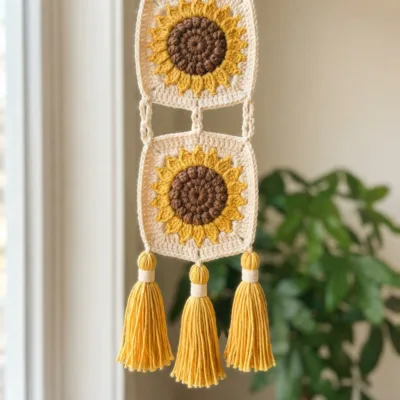
The classic look is golden yellow and cream, but a soft orange and cream version is just as pretty. Work the petals in a warm pumpkin or apricot shade, keep the brown centers and cream borders, and make the tassels orange to match. It looks wonderful in autumn and suits a kitchen with wooden cabinets. The yarn amounts stay exactly the same, so you only swap one color.
For a calm, elegant look, try white with golden details. Make the border and chains white, keep the petals golden yellow and work the centers in a light tan instead of dark brown. The result is softer and fits nicely in a bright living room or a bedroom with white furniture. White tassels make it airy, while golden tassels keep a little sparkle at the bottom.
If you like cool colors, a lilac and white curtain turns the sunflowers into fantasy flowers. Use lilac petals, a deep purple center and a white border, then add lilac tassels. A green and cream version, with leaf green petals and a cream border, looks fresh and quiet near a window full of plants. Both palettes use the same pattern without a single change, so you can plan them with the yarn list below.
Changing the size is easy because every column is the same. Each column is about 7 inches wide plus a 1 inch gap, and each motif with its chain link adds about 9 inches of length. The loops and tassel add about 11 inches to every column. Here is a quick guide:
- Narrow window, about 23 by 46 inches: 3 columns of 4 motifs (12 motifs).
- Standard window, about 55 by 55 inches: 7 columns of 5 motifs (35 motifs).
- Door, about 31 by 82 inches: 4 columns of 8 motifs (32 motifs).
- Room divider, about 71 by 90 inches: 9 columns of 9 motifs (81 motifs).
A short cafe curtain is a sweet option for a kitchen. Make 7 columns of only 3 motifs each, which is 21 motifs, and hang them on a rod across the middle of the window. The curtain will be about 37 inches long with the tassels. You keep privacy at the counter while the top of the window stays open for the light, and you can finish it in a couple of weeks.
For a doorway curtain, use the door layout and space the columns about 2 inches apart so people can pass through easily. Make the chain links 18 chains long instead of 12, which makes the curtain lighter and lets it swing nicely when someone walks through. Shorter tassels of about 6 inches keep the bottom from tangling. It looks lovely between a kitchen and a garden door.
Tassels change the mood more than you might expect. Short, chunky tassels of about 6 inches, wound 40 times around a 7 inch card, look playful and work well in a child's room. Long tassels of about 12 inches, wound 30 times around a 13 inch card, look dramatic and graceful at the bottom of a tall window. For the long ones, plan about 5 extra yards of golden yellow for each tassel.
You can also change the yarn weight. In sport weight cotton with a 3 mm hook, each motif comes out about 6 inches, and the standard layout becomes about 48 inches wide. In worsted cotton with a 4.5 mm hook, each motif grows to about 8 inches, and the standard layout becomes about 62 inches wide, so you could drop to 6 columns. Always make one motif first, block it and measure it before you plan the full curtain.
Materials Needed
— Main Fabric
— Tools Required
The Free Pattern
0% complete
— Sunflower Motif (Make 35, brown center, golden yellow petals, cream border) :
— Layout :
— Chain Links and Joining (Make 28, cream) :
— Tassels (Make 7, golden yellow) :
— Top Loops and Hanging (Make 14, cream) :
Assembly Instructions
- Block all 35 sunflower motifs to 7 in (18 cm) square and lay them out in 7 columns of 5 motifs.
- Join the motifs in each column from the top down with 4 doubled cream chain links, for 28 links in total.
- Make 7 golden yellow tassels and tie one to the center sc of the bottom side of the last motif in each column.
- Work 2 cream hanging loops into the top corners of the first motif in each column, for 14 loops in total.
- Slide the columns onto the wooden rod in order, spacing them about 1 in (2.5 cm) apart.
- Give the hanging curtain a light steam, let it rest for a day, then trim all the tassels to the same length.
Common Mistakes & How to Fix Them
The most common problem with this curtain is petals of different lengths. It happens when the ch-5 for each petal is made tight one time and loose the next, or when you count only 4 chains by accident. Short petals pull the cream border in at that spot, so the motif comes out lopsided and will not block square. To avoid it, keep the same relaxed grip for every chain and count all five every time. If one petal looks clearly shorter than its neighbors, pull it out right away and redo it before you join the cream, because fixing it later is much harder.
Another mistake is working Round 3 into the wrong number of stitches, so you end up with 15 or 17 petals instead of 16. This happens because the brown dc of Round 2 are close together and easy to miscount, especially in dark yarn. With the wrong petal count, the corners of Round 5 no longer land evenly and the square twists. Before you start the petals, place a marker in every eighth dc of Round 2. You should make exactly 4 petals between markers. If the count is off when you reach a marker, fix it then, not at the end.
A plain chain stretches once the weight of several motifs hangs from it. If you skip the slip stitch pass back up each link, the lower motifs slowly pull the chains longer and the columns end up uneven and droopy after a few weeks in the window. It happens because a chain alone has no structure. Always slip stitch back up each link into the back bump of the chains, keep those slip stitches relaxed and use exactly 12 chains every time. Lay finished columns side by side and compare them before hanging, so a short or long link is easy to spot.
Tassels that look thin or messy spoil the bottom of the curtain, and they are the first thing people reach out to touch. This happens when the yarn is wound too loosely, when the number of wraps changes from tassel to tassel, or when the tassels are trimmed before the curtain has hung. Wind exactly 30 times for every tassel with the same gentle tension, tie the top very tightly and wrap the neck firmly. Hang the finished curtain, let it rest for a full day, then trim all seven tassels to the same length while they hang straight.
You Might Also Like
Important Notes
Gauge for this curtain is one motif of 7 inches (18 cm) square after blocking, made in DK cotton with a 3.5 mm hook. The brown center after Round 2 should be about 2.5 inches across. If your motif is larger, go down half a hook size, and if it is smaller, go up half a size. Matching gauge exactly matters less than making every motif the same size, so keep your first motif as a measuring sample for all the others.
Block the motifs before joining them. Pin each one to a 7 inch square on a blocking mat with straight sides and sharp corners, spray it until damp and let it dry completely. While the yarn is still damp, use your fingertips to straighten each petal so it points neatly outward. Blocking in batches of 7, one column at a time, saves time and keeps you organized. After assembly, a light steam from above relaxes the chain links and the tassels.
This curtain uses about 770 yards of cream, 330 yards of golden yellow and 160 yards of chocolate brown DK cotton, which includes the tassels, chain links and hanging loops plus a little extra for your gauge motif. Buy all the yarn for each color from the same dye lot at the same time. Yellows in particular can vary a lot between lots, and the difference shows clearly when two columns hang side by side in daylight.
The finished curtain weighs about 500 grams, so use a sturdy rod with brackets screwed into the wall instead of a light tension rod for the full size. Wash it by hand in cool water with mild soap, or on a gentle machine cycle inside a mesh laundry bag. Add a color catcher sheet every time, because the dark brown and golden yellow are washed together with the cream. Press out the water in a towel, lay each column flat and reshape the petals and tassels.
I hope this sunflower curtain brings a little sunshine into your home every single day. It is a big project, but it is built from small, cheerful pieces, and each sunflower you finish is a happy little moment of its own. When you finally hang that last column and see the light coming through all those golden petals, I think you will feel as proud as I did.
So do not worry about all 35 motifs today. Just pick up your brown yarn, make that first small circle and add your 16 petals. Then make another sunflower tomorrow. Little by little your window will turn into a field of flowers. Happy crocheting, and thank you for spending this time with me.
Crochet Abbreviations
You Ask, We Answer
What is the finished size of this curtain?
As written, the curtain measures about 55 inches wide on the rod and about 55 inches long from the top of the hanging loops to the ends of the tassels, which is roughly 140 by 140 cm. It is made of 7 columns with 5 motifs in each, so 35 sunflower motifs in total. Each motif is about 7 inches square after blocking, each chain link adds about 2 inches, and each tassel hangs about 9 inches below the last motif. The width allows for a gap of about 1 inch between columns, and you can close it up or spread it out a little by sliding the loops along the rod. To make it bigger or smaller, change the number of columns for width and the number of motifs for length. Each extra column adds about 8 inches of width, and each extra motif with its link adds about 9 inches of length. Always measure your window before you start.
Can I use a different yarn weight or make it in another size?
Yes. The stitch counts stay the same in any yarn weight, and only the size of the motifs and the yarn amounts change. In sport weight cotton with a 3 mm hook, each sunflower comes out about 6 inches square. In DK with a 3.5 mm hook, it is about 7 inches, and in worsted cotton with a 4.5 mm hook it grows to about 8 inches. A heavier yarn also makes a heavier curtain, so check that your rod and brackets can hold it. I recommend cotton or a cotton blend, because it hangs straight, holds the pointed petals well and does not stretch the way some acrylic yarns do over time. Whatever you pick, crochet one motif first, block it and measure it. Then divide the width of your window by that measurement plus the gap to find the number of columns, and divide the length the same way to find the motifs per column.
How do I wash and care for the curtain?
Slide the columns off the rod before washing, so the loops and chain links are not pulled out of shape. Hand washing in cool water with a mild wool or baby soap is the gentlest way to clean it. If you prefer the machine, place each column in a mesh laundry bag and use a cold, gentle cycle with a low spin. Always add a color catcher sheet, because the brown and golden yellow can bleed onto the cream, especially in the first washes. Never wring the curtain. Roll each column in a large towel and press to remove the water. Then lay the columns flat on a dry towel, straighten the motifs, point each petal outward with your fingers and comb the tassels so they dry straight. Skip the dryer, because heat can shrink the cotton and make the motifs uneven. Once dry, hang it back up and let it settle for a day.
Success!
Thanks for subscribing — check your inbox for a welcome note.
Abbreviations
- ch — chain
- sl st — slip stitch
- sc — single crochet
- hdc — half double crochet
- dc — double crochet
- sk — skip
- st(s) — stitch(es)
- sp(s) — space(s)
- rep — repeat