
Burgundy and Cream Heart Square Bed Cover Crochet Pattern
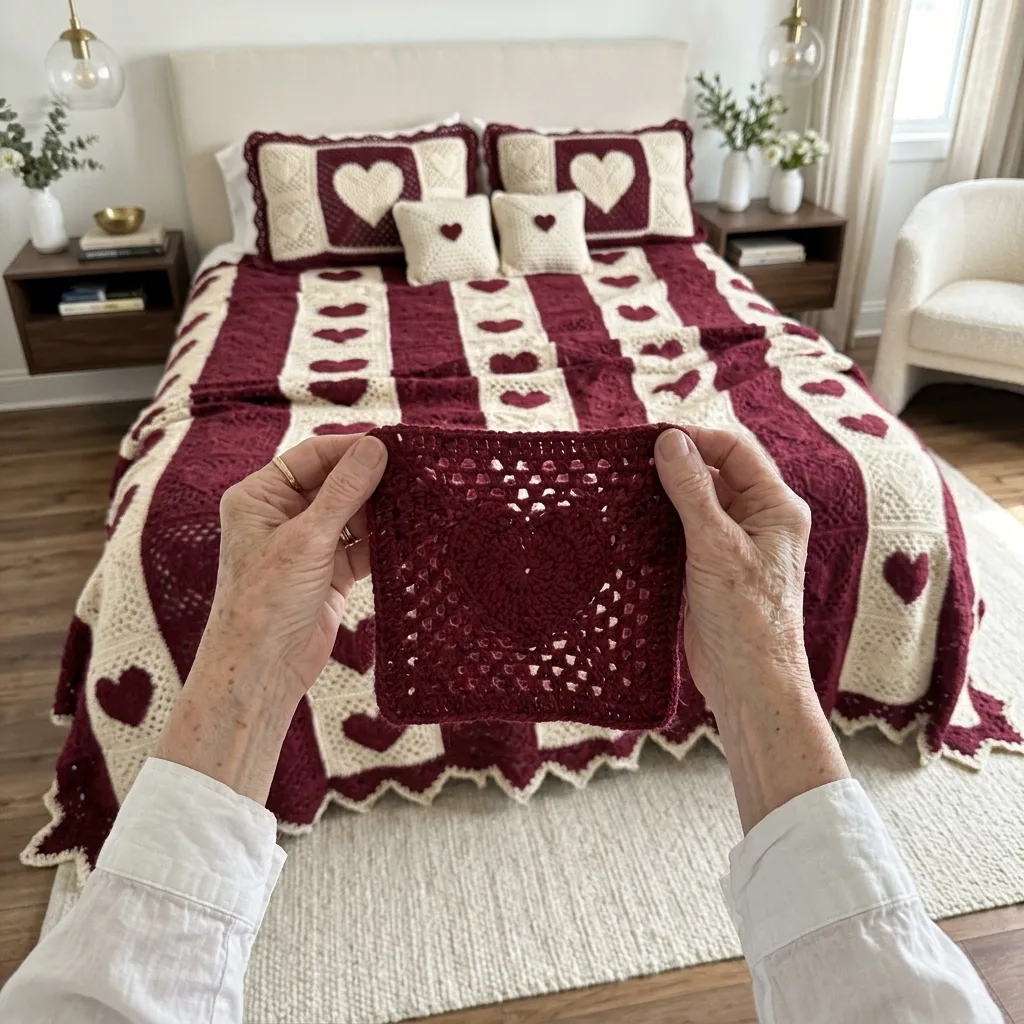
Simple lacy squares, small shaped hearts and granny points, with careful counting along the way.
A big romantic project made of small pieces, one square and one heart at a time.
Every square carries its own raised heart, set in stripes of burgundy and cream like ribbons.
About This Burgundy and Cream Heart Square Bed Cover Crochet Pattern Pattern
This bed cover is a love letter in yarn. It is made of 99 lacy squares, each with a solid heart sitting in the center, and the squares are set in tall stripes of burgundy and cream that run from the head of the bed to the foot. The burgundy columns look rich and deep, the cream columns look soft and light, and together they look like wide ribbons laid side by side. Along both sides and across the foot, every edge square ends in a lacy point, so the cover hangs in a row of little pennants all around the bed.
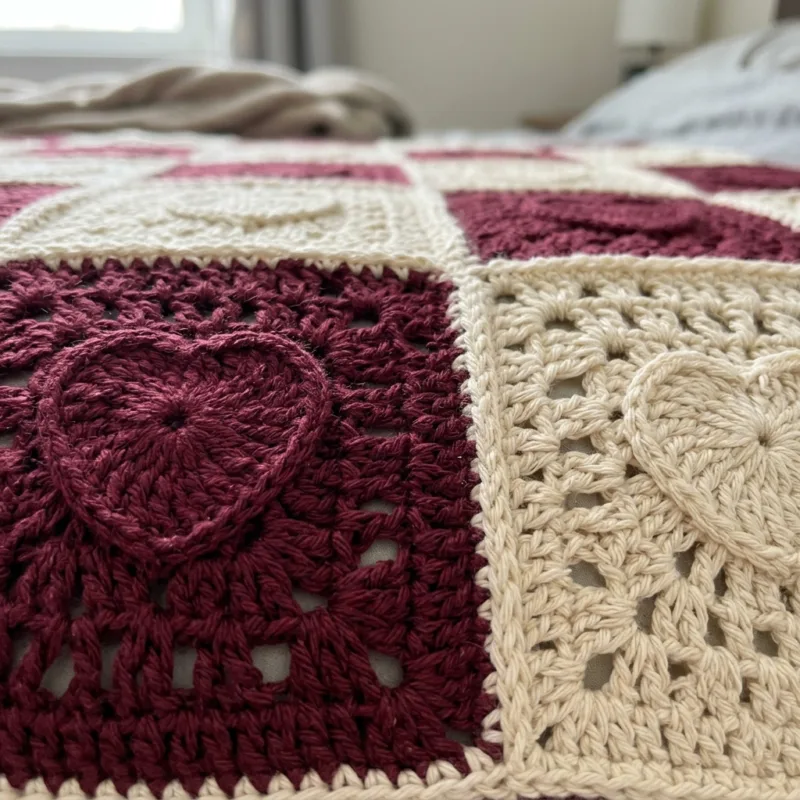
Each square is worked in rounds from the center. The first four rounds are solid double crochet, which make a firm base for the heart. Then two lacy rounds of chain arches open up the square, followed by a round of double crochet and two rounds of single crochet that give it a straight, sturdy edge. The finished square is about 8.5 inches on each side. The lacy rounds are what you see around each heart, a ring of little windows that let the light through and keep the cover from feeling heavy.
The hearts are made separately in rows of single crochet. Each one starts with three stitches at the point and grows two stitches every row until it is 21 stitches wide. After a few straight rows, it splits into two lobes, which shrink to round off the top. A round of single crochet tidies the edge, and a round of slip stitches in the back loops gives every heart a neat, raised outline. You then sew each heart onto the center of its square, burgundy hearts on burgundy squares and cream hearts on cream squares, with all the points facing the foot of the bed.
The squares are joined in 9 columns of 11, alternating burgundy and cream, with a cream whipstitch through the back loops. The cream seams frame every square, even the burgundy ones, and give the whole cover a crisp, tailored look. The queen size has 5 burgundy columns and 4 cream columns, so the outer edges are both burgundy, which makes the cover look balanced on the bed.
The pointed edges are granny triangles worked straight onto the outer squares. Each point starts with nine granny groups along the edge of the square and loses one group every row until a single group forms the tip. The points take the color of the square they hang from, so the stripes continue right to the end. A final cream round of single crochet and a picot at every tip runs around the whole cover and finishes it neatly. With the points, the cover measures about 85 by 98 inches.
The stitches are chain, slip stitch, single crochet and double crochet, plus two simple decreases. What makes this pattern intermediate is the number of pieces, the shaping of the hearts and the counting in the long edge round. Each step on its own is easy, and I give a count at the end of every round and row so you always know you are on track.
The finished cover is warm, romantic and beautifully balanced between solid and lace. The hearts stand up slightly from the squares, so they catch the light, and the lacy rings around them keep the cover airy. Burgundy and cream look elegant in a modern bedroom with walnut furniture and brass lamps, and just as lovely in a cottage room full of flowers. It would make a wonderful wedding or anniversary gift.
Why You'll Love This Burgundy and Cream Heart Square Bed Cover Crochet Pattern Pattern
I love hearts, and I love stripes, and this cover lets me have both. When I first laid out a few burgundy and cream squares in columns, they looked like ribbons tied around a present. Then I sewed the hearts on and the ribbons came to life. Every time I walk into the bedroom, the stripes make the bed look tidy and tailored, and the hearts make me smile. It is a cover that feels both elegant and sweet.
The hearts are my favorite little pieces to make. Each one takes me about twenty-five minutes, and I make them in the evenings in small batches, five burgundy and five cream. They grow from three tiny stitches into a full heart in your hands, and splitting the lobes at the top always feels like a small celebration. When I finish a batch, I lay them out on the table in a row, and it looks like a box of chocolates.
The squares have a lovely rhythm too. The solid center rounds go quickly, the lacy arches feel light and fun, and the last rounds of single crochet are calm and soothing. One square takes me a little over an hour. I like to make all of one color for a few weeks, then switch to the other, which keeps my tension steady and makes it easy to keep count of how many of each I have finished.
Here are the habits that made this project smooth for me:
- Make one complete square with its heart sewn on before you go further.
- Leave a long tail on every heart for sewing it down.
- Pin each heart with its point toward you, so all the points face the same way.
- Keep burgundy and cream pieces in separate bags with a count on a label.
I also love the pointed edges. After all those squares, working the granny points feels like decorating the hem of a dress. They hang down the sides of the bed like little lace pennants and sway gently when you walk past. Because each point matches its square, the stripes seem to keep flowing right off the edge of the bed, which gives the whole cover a playful, finished look.
The colors feel very special to me. Burgundy is deep, warm and a little bit regal, the color of good wine and winter roses. Cream softens it and keeps it fresh. Together they suit almost any bedroom, and they change with the light: crisp and bright in the morning, glowing and cozy in the evening under a warm lamp. It is a cover that looks good in every season.
Finally, I love what this cover means. Ninety-nine hearts is a lot of love, and I think whoever sleeps under it can feel that. I made one as a gift for my niece's wedding, and she says it is the first thing she shows every guest. If you make it for yourself, you will have a bed full of hearts to come home to every night, and that is a lovely thing.
Switch Things Up
Choose new stripe colors. The stripes and hearts look wonderful in many pairs. Navy and white feels crisp and coastal, dusty rose and ivory is soft and romantic, and sage and oatmeal is calm and natural. For a bold room, try red and white for a classic Valentine look. Keep one color deep and one light so the stripes stand out, and keep the seams and the final edge in the light color to frame every square.
Make it for any bed. Each square is about 8.5 inches, and the points add about 4.5 inches on the sides and foot. Use an odd number of columns so both outer stripes are the deep color. The number of points is the number of columns plus twice the number of rows. These sizes include the points:
- Twin: 7 by 11 squares, 77 squares and 29 points, about 68 by 98 inches
- Full or queen: 9 by 11 squares, 99 squares and 31 points, about 85 by 98 inches
- King: 11 by 11 squares, 121 squares and 33 points, about 102 by 98 inches
Make a sofa throw. Five columns by seven rows, 35 squares, with points only along the two short ends, makes a throw of about 43 by 69 inches. That is 10 points in all, five at each end, so the throw looks like a long table runner of hearts with lacy pennants at both ends. It drapes beautifully over the back of a sofa, and it is a lovely size for a Valentine or anniversary gift.
Make a baby blanket. Five by five squares, 25 in all, without points, gives a blanket of about 43 by 43 inches. Add just the cream edge round for a neat finish. For a nursery, try soft pink and white or pale blue and cream. Sew each heart all the way around its outline with small stitches, so nothing can catch little fingers, and use a soft, washable cotton blend.
Make matching pillow shams. For a sham like the ones in my photos, make one cream heart square and two burgundy squares worked only to Rnd 7, then join the burgundy squares on either side of the cream one. Work two rounds of burgundy single crochet around the joined front and back it with a plain burgundy panel. A single heart square on its own makes a sweet small pillow or a cushion for a reading chair.
Change the layout. The stripes are elegant, but the same squares can make other patterns. Alternate the colors in every row to make a checkerboard, or put cream hearts on burgundy squares and burgundy hearts on cream squares for a bolder contrast. You can also place all the hearts point to point in pairs to make little bows. Lay out a few rows on the floor before you decide, and take a photo of your favorite.
Change the edge. The granny points are playful and pretty, but you can choose a simpler finish. Skip the points and work two rounds of cream single crochet and a round of picots for a straight, tailored edge. Or work the points in cream on every square for a lighter frame. If you prefer a softer look, replace each point with a large shell of 11 double crochet worked into the center stitch of each square's outer side.
Change the yarn weight. In DK cotton with a 4 mm hook, each square comes out about 7 inches, and a queen cover needs about 11 by 13 squares. In bulky yarn with a 6 mm hook, the squares grow to about 10.5 inches, and a queen needs only 7 by 9 squares. The hearts change size with the yarn, so they still fit their squares. Always make one complete square with its heart first and measure it before you plan.
Materials Needed
— Main Fabric
— Tools Required
The Free Pattern
0% complete
— Lacy Square (Make 99: 55 burgundy and 44 cream) :
— Heart (Make 99: 55 burgundy and 44 cream) :
— Sewing the Hearts (99 squares) :
— Layout and Joining :
— Pointed Edge :
Assembly Instructions
- Make one complete square with its heart sewn on, block it and check that it measures about 8.5 inches.
- Make all 99 lacy squares, 55 in burgundy and 44 in cream, and all 99 hearts in matching colors.
- Sew each heart to the center of a square of the same color, with every heart point toward the side that will face the foot of the bed.
- Lightly block every square to 8.5 by 8.5 inches, smoothing the heart flat.
- Lay the squares out in 9 columns of 11, alternating burgundy and cream columns, with all heart points toward the foot.
- Whipstitch the squares into columns with cream through the back loops, then join the columns side by side.
- Work a granny point on the outer side of every square along both long sides and the foot, then work the cream edge round around the whole cover and give it a light final blocking.
Common Mistakes & How to Fix Them
Sewing hearts facing different ways. Every heart must point toward the foot of the bed, and it is very easy to pick up a square and sew its heart on sideways or upside down. Because the squares are symmetrical, you will not notice until the cover is laid out, and then one turned heart stands out across the whole bed. Before you sew, place a small safety pin on the side of the square that will face the foot, and always pin the heart with its point toward that safety pin. When you lay out the squares for joining, check every heart again before you sew a single seam.
Hearts with uneven lobes. Each lobe must have exactly 10 stitches in Row 15, and the center stitch of Row 14 must be skipped. If you skip two stitches or none, one lobe ends up wider than the other, and the heart looks lopsided. If your decreases in Rows 16 to 18 are not at both ends, the lobes lean. Count 10 stitches for each lobe and place a stitch marker in the center stitch before you start Row 15. After Row 18, fold the heart in half along the center: the two lobes should match closely.
Losing count in the lacy rounds. In Rnd 5 each side has exactly 5 arches between the corners, and in Rnd 6 each side has 6 single crochet and 7 chain spaces. If you skip one or three stitches by mistake in Rnd 5, the arches shift, and then Rnd 7 will have the wrong number of stitches, so the square will not be 30 stitches per side in the end. The joins with its neighbors will not line up. Count the arches on each side before you start Rnd 6, and count to 26 per side after Rnd 7. Fixing a lacy round at once is much faster than later.
Pulling the granny points out of shape. The points hang from the edge of the cover, and if you work Row 1 too tightly into the square's edge, the edge puckers, while working it too loosely makes it ruffle. Points that are not blocked can also curl. Work Row 1 at a relaxed tension and check that the edge of the square still lies straight. After the edge round, pin each point into a neat triangle with its tip pulled down, spray it lightly with water and let it dry. Blocked points hang straight and look like crisp little pennants.

You Might Also Like
Important Notes
Gauge matters because 99 squares and 99 hearts must fit together. With a 5 mm hook, the first four rounds of the square should measure about 4.25 inches, the finished square about 8.5 inches, and the heart about 5.25 inches wide and 4 inches tall. Measure your first five squares and hearts and then one in every ten. If your heart is too big for its square, go down half a hook size for the hearts only, so the lacy ring around it still shows.
Block the squares after the hearts are sewn on, and block the cover once more after the edge. Pin each square to 8.5 by 8.5 inches, open the chain arches so the little windows show, smooth the heart flat, spray with water and let it dry completely. After the edge round, pin each point into a sharp triangle. Blocking makes the lace crisp, the stripes straight and the hearts neat and even.
The yarn amounts in the materials list are estimates for the queen size, including the joining, points and edge. Buy all of the burgundy and all of the cream at the same time, from the same dye lots, and keep the labels. Deep reds like burgundy can vary between lots, and a slightly different shade would show clearly in a long stripe. Buy one extra skein of each color for safety and future repairs.
Wash the finished cover on a gentle cold cycle in a large mesh bag or a zipped duvet cover, with mild detergent. Burgundy sits next to cream in every seam, so always add a color catcher, and for the very first wash you can soak it in cold water with a splash of vinegar. Never wring or twist the cover. Press out the water, lay it flat on towels or a clean drying rack, reshape the squares and points while damp, and let it dry fully.
Thank you for making this burgundy and cream heart square bed cover with me. I hope you enjoy every little heart, every lacy square and that lovely moment when the first stripes come together on the bed. It is a big project, but it is built of small, happy pieces, and each one adds a little more love to the whole.
So find your burgundy and your cream, make your first square and your first heart today, and sew them together. Lay it on your bed and admire it. Then make the next one, and soon you will have stripes of hearts and lacy points that make your bedroom feel warm and full of love for many years.
Crochet Abbreviations
You Ask, We Answer
How big is the finished bed cover, and how many pieces do I need?
Following the pattern exactly, each square measures about 8.5 inches. The queen size uses 99 squares in 9 columns of 11, which makes a panel of about 76.5 by 93.5 inches. The granny points add about 4.5 inches along both long sides and the foot, so the finished cover measures about 85 by 98 inches. You need 99 squares and 99 hearts, 55 of each in burgundy and 44 of each in cream, plus 31 points. On a standard queen mattress, that gives a generous drop on both sides with the points hanging below. For other sizes, keep an odd number of columns so both outer stripes are burgundy. The number of points is always the number of columns plus twice the number of rows. Measure your bed, add the drop you want, and divide by 8.5 to plan your own layout.
Can I crochet the hearts into the squares instead of sewing them on?
You can, but I recommend sewing them. Working a heart into a square means charting it and changing colors or stitch patterns inside every round, which is slow and makes the lacy rings around the heart much harder to keep neat. A separate heart sewn on top is quicker, lets you place it exactly in the center and gives it that lovely raised look, with the slip stitch outline catching the light. For the yarn, worsted cotton shows the hearts and lace clearly and washes well, a cotton and acrylic blend is softer and lighter, and a smooth acrylic works for easy care. DK yarn with a 4 mm hook gives squares of about 7 inches, and bulky yarn with a 6 mm hook gives squares of about 10.5 inches. Make one full square with its heart first and measure it before you plan the rest.
How do I care for and store the bed cover so it lasts?
Wash it only when it really needs it, on a gentle cold cycle in a large mesh bag or zipped duvet cover, with mild detergent, and always add a color catcher, because burgundy sits right next to cream. Dry it flat, reshaping the squares and pulling each point straight while it is damp. Never use a hot dryer, which can shrink cotton and make the hearts pucker. Between washes, shake it out and air it near an open window, away from strong direct sunlight, which can fade burgundy over time. To store it, fold it loosely with tissue paper between the layers and keep it in a cotton bag or large pillowcase rather than plastic, so the yarn can breathe. Refold it along different lines every few months, and once a year check the hearts and seams, resewing any spot that has loosened.
Success!
Thanks for subscribing — check your inbox for a welcome note.
Abbreviations
- ch — chain
- sl st — slip stitch
- sc — single crochet
- sc2tog — single crochet 2 together (also worked over 2 corner spaces at a seam)
- dc — double crochet
- picot — ch 3, sl st in 3rd ch from hook
- BLO — back loop only
- st(s) — stitch(es)
- sp(s) — space(s)
- rep — repeat
- Rnd — round
- RS — right side