
Burgundy Puff and Cream Scallop Bedspread Crochet Pattern
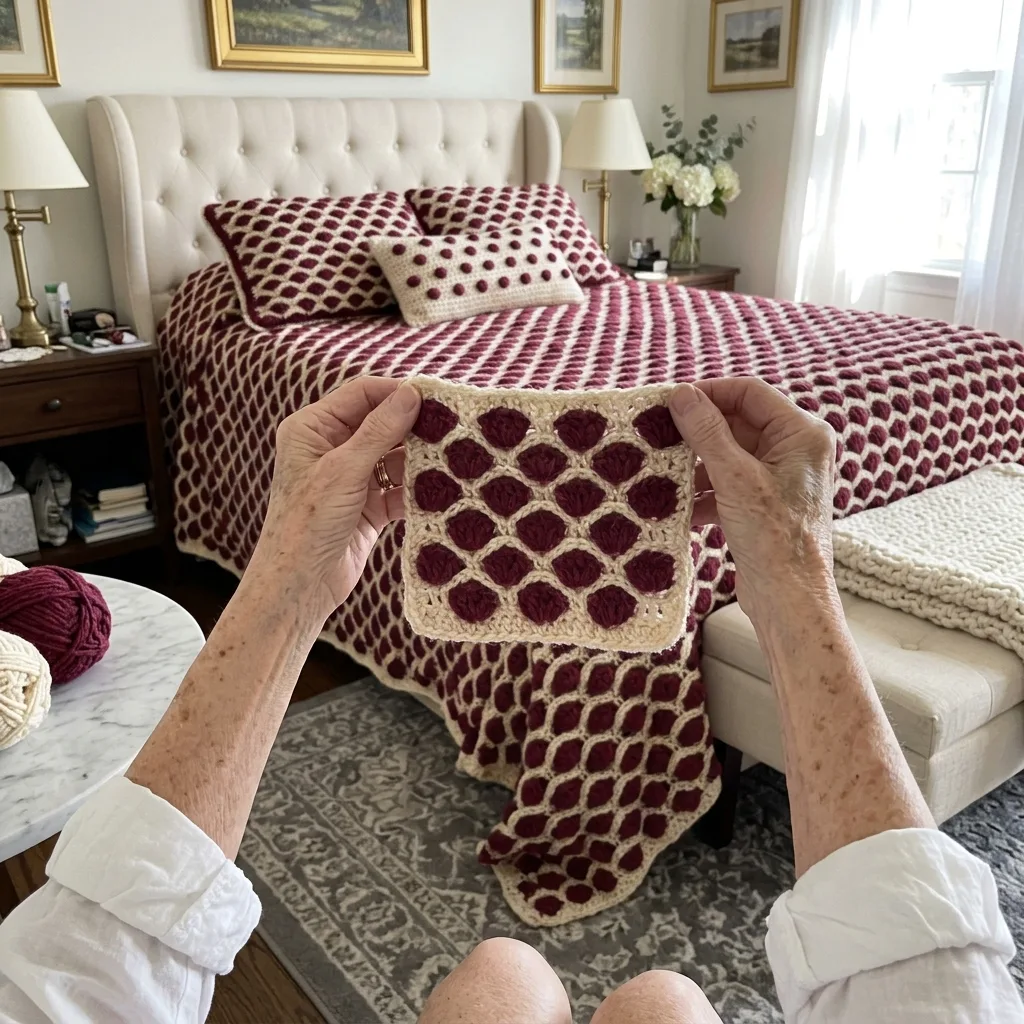
A six-row repeat of puffs and arches, worked in rows with simple color changes.
Chunky yarn and a big hook make this bedspread grow faster than you might think.
Worked in rows from edge to edge, so there are no motifs to sew together.
About This Burgundy Puff and Cream Scallop Bedspread Crochet Pattern Pattern
This bedspread is worked in one piece, row by row, in a deep burgundy and a warm cream chunky yarn. Every burgundy row is full of plump puff stitches, and every cream row lays a little chain arch over each puff, then fills it with single crochet. The arches curve over the puffs like the edges of fish scales or roof tiles, and because each new row of puffs is shifted halfway along, the scales nest neatly into each other. From a distance, the whole bed looks covered in rich burgundy berries tucked into cream shells. Up close, every puff is soft and squishy, and every arch stands up in a raised cream ridge.
The finished bedspread measures about 103 by 115 inches (262 by 292 cm) including the border. It is worked over 201 stitches, which gives fifty puffs across the first puff row, and the six-row pattern repeats thirty-two times. On a queen mattress that gives a drop of about 21 inches on each side and at the foot, so the heavy chunky fabric falls toward the floor in deep, cozy folds. Three rounds of cream border frame the whole piece with a thick, rope-like edge.
The stitches are chain, slip stitch, single crochet, half double crochet, reverse single crochet and the puff stitch. The puff stitch is four loops pulled up in the same stitch and closed together, with a chain to lock it. The arches are just five chains worked from one single crochet to the next, held on the right side of the work so they lie over the puffs. Then three single crochet go into each arch to make the solid cream scallop. Once you have worked the six rows twice, you will know the pattern by heart.
Because the bedspread is worked in one piece, there is nothing to join at the end. You start with a long foundation chain and simply keep going. The burgundy rows are only two of every six, so most of your time is spent on easy cream single crochet, with the fun puff rows coming along regularly to keep things interesting. When the last row is done, the border goes around in one sitting, and the bedspread is ready for the bed.
In chunky yarn the bedspread is thick, warm and wonderfully heavy, the kind of cover that makes you want to stay in bed on a winter morning. The puffs give it a deep, three-dimensional texture, and the cream arches catch the light like little rims of frost. Burgundy and cream together feel rich, warm and a little festive, perfect for the colder months and lovely at Christmas. They suit walnut wood, brass lamps, white hydrangeas and soft gray rugs, and they make any bedroom feel like a cozy country inn.
I rate this pattern as intermediate. The stitches are easy, but the rows are long and the color changes need care, and you need to keep the puffs even across a whole row. It suits a maker who enjoys a big, steady project and likes seeing a finished piece grow on their lap. Before you start, I ask you to make the small gauge swatch in the first pattern section. It teaches you the whole six-row repeat in miniature, and it checks your size before you commit to the long rows.

Why You'll Love This Burgundy Puff and Cream Scallop Bedspread Crochet Pattern Pattern
I fell in love with this stitch on a cold November evening, when I was playing with leftover burgundy and cream yarn and a big hook. I made a little swatch just to see what would happen if I laid chain arches over puff stitches, and the result looked like a bowl of cranberries in cream. I could not put it down. By the end of the week, the swatch had become a scarf, and by the end of the winter, it had become this bedspread.
I love how the pattern feels in my hands. The puff rows are soft and squishy, and every puff gives a satisfying little pop as you close it. The cream rows that follow are calm and simple, just chains and single crochet, so I can rest my mind after the puffs. That rhythm of busy and calm, busy and calm, makes the long rows go by surprisingly quickly. It is the perfect project for listening to an audiobook or chatting with friends.
I also love that there is no joining. I have made many motif bedspreads over the years, and I always dread the sewing at the end. With this one, every row adds directly to the finished piece. Watching it grow across my lap, getting heavier and warmer with each row, is one of the coziest feelings I know. By the time it reached the floor, it was keeping my legs warm through the whole winter.
Here is why this bedspread is such a favorite of mine:
- Chunky yarn and a big hook make fast progress.
- The puffs are soft, squishy and fun to make.
- The cream arches turn simple rows into a beautiful scale pattern.
- It is worked in one piece, with no joining at the end.
- It is warm and heavy, perfect for winter nights.
This bedspread changed our bedroom for the colder months. Our room is mostly cream and walnut, with brass lamps and white flowers, and it can feel a little cool in winter. Now the deep burgundy brings warmth to the whole space, and it looks wonderful with candles and a few sprigs of eucalyptus. At Christmas it makes the room feel festive without a single decoration. My grandchildren love to burrow under it and count the puffs.
Making it taught me a few useful lessons. I learned to work my puffs to the same height every time, by pulling each loop up to the length of my fingertip. I learned to work over the color tails as I go, so there are very few ends to weave in at the end. And I learned to measure the width every ten rows, because chunky fabric is heavy and can stretch as it grows. Those small habits made the long project calm and enjoyable.
Most of all, I love that this is a bedspread for real life. It is warm, sturdy and washable, and it does not need to be saved for special occasions. I hope it will be pulled over sleepy children on winter mornings and wrapped around shoulders on the sofa for many years. A blanket that gets used and loved is the best kind of heirloom there is.
Switch Things Up
The easiest change is the color pair. Keep the arches in cream and choose a new color for the puffs, and the whole bedspread changes character. Forest green with cream looks like holly in snow, and navy with cream feels crisp and nautical. Mustard with oatmeal is warm and autumnal, while dusty rose with ivory is soft and romantic. For a calm, modern look, try charcoal puffs with light gray arches.
You can change the size by changing the number of stitches and rows. The pattern is worked over a multiple of 4 stitches plus 1, so the foundation chain is a multiple of 4 plus 2. Every 4 stitches add about 2 inches of width, and every 6-row repeat adds about 3.5 inches of length. Here are some sizes that include a drop on the sides and foot.
- Twin: chain 150 for 149 stitches and 37 puffs, 26 repeats, about 77 by 95 inches
- Full: chain 182 for 181 stitches and 45 puffs, 29 repeats, about 93 by 105 inches
- Queen: chain 202 for 201 stitches and 50 puffs, 32 repeats, about 103 by 115 inches
- King: chain 242 for 241 stitches and 60 puffs, 32 repeats, about 123 by 115 inches
A sofa throw is a lovely smaller version. Chain 102 for 101 stitches and work 16 repeats, for a throw of about 53 by 60 inches with the border. It takes about twenty-five to thirty hours and uses about a quarter of the yarn. It is perfect for curling up on the sofa with a book, and it makes a wonderful Christmas gift. It is also the best way to practice before you begin the full bedspread.
For a baby blanket, use a soft chunky baby yarn and a 6 mm hook, and chain 62 for 61 stitches and about 12 repeats, for a blanket of about 32 by 44 inches. Pale pink puffs with white arches, or soft sage with cream, are lovely for a nursery. The puffs are firmly closed and the fabric is solid, but always use it with an adult nearby and keep heavy blankets out of the crib for young babies.
Matching pillows make the bed look finished. Make a panel of 41 stitches and 7 repeats, about 20 by 25 inches, for the front of a sham, and back it with a panel of plain cream single crochet. Join the two with cream single crochet on three sides, slip in the pillow and close the last side. For a lumbar pillow, make a long strip with just two repeats and wrap it around a cream cushion, so a single row of burgundy scales runs across the front.
The same stitch makes beautiful accessories too. A long strip of 21 stitches makes a cozy scarf, and a panel of 41 stitches sewn into a tube makes a lovely cushion cover or a bench pad. In a smaller yarn, the stitch is pretty on a tote bag or a basket liner. These are wonderful ways to use up the leftover yarn from the bedspread, and they make thoughtful handmade gifts.
If you would like a different edge, there are easy options. For a softer look, replace the reverse single crochet round with a round of small cream shells. For a bolder frame, work the first border round in burgundy and the next two in cream. For a cabin feel, add chunky burgundy tassels at the four corners, or a short cream fringe along the bottom edge. Whatever you choose, keep the border wide enough to balance the heavy fabric.
You can also play with the yarn weight. In worsted yarn with a 5 mm hook, the scales are smaller and the bedspread lighter, so chain about 302 for the same width and work about 48 repeats. In super bulky yarn with a 9 mm hook, the scales are big and dramatic, and you need far fewer stitches and rows. Acrylic and wool blends are lighter and warmer than cotton, which can be very heavy in chunky weights. Always make the gauge swatch in your chosen yarn before you begin.
Materials Needed
— Main Fabric
— Tools Required
The Free Pattern
0% complete
— Gauge Swatch (Make 1, cream and burgundy) :
— Bedspread Body (201 sts, 193 rows) :
— Cream Corded Border (Color A) :
Assembly Instructions
- Make the Gauge Swatch, edge it, and measure it to check your hook size before you start the bedspread.
- Work the Bedspread Body in rows from the foundation chain, changing colors as written and working over the tails as you go.
- Measure the width every 10 rows and adjust your tension in the cream rows if needed.
- Work Rounds 1 to 3 of the Cream Corded Border around the whole bedspread without fastening off after the body.
- Weave in the remaining ends, then lay the bedspread flat overnight so the border settles.
Common Mistakes & How to Fix Them
Puffs of different sizes. A puff stitch only looks plump and round when all four loops are pulled up to the same height. If some loops are short, that puff looks skinny, and across a whole bedspread the uneven puffs make the scales look messy. It usually happens when you hurry or when your hand gets tired near the end of a long row. Pull each loop up to about three quarters of an inch, roughly the length of your fingertip, and keep the loops loose on the hook. Close each puff with one smooth pull and the closing chain.
Arches on the wrong side. The cream ch-5 arches must lie on the right side of the work, over the top of each puff, so they frame the puff like a scale. In Row 3 this happens naturally, but in Row 6 you are working from the wrong side, so you need to hold the chains to the back. If you forget, the arches end up on the wrong side and the puffs look bare. Before you start Row 6, turn your work and look at which side the Row 3 arches sit on, and keep the new arches on that same side.
Losing the offset in Row 5. Row 5 starts with a half repeat, so the puffs sit between the puffs of Row 2 and the scales nest together. If you start Row 5 the same way as Row 2, the puffs stack straight on top of each other, and the fish scale effect is lost. Remember that Row 5 always begins with sc, ch 1, skip 1, sc before the first puff. Count 49 puffs at the end of the row. If you count 50, the offset is wrong, and it is best to undo the row and start again.
Fabric that grows wider as you go. Chunky fabric is heavy, and as it grows, the weight can pull the stitches longer and make the bedspread wider at the top than at the bottom. Some makers also relax their tension in the long cream rows. Measure the width every 10 rows with the work lying flat on a table or the floor, not hanging from your lap. If it is growing, work the cream single crochet rows a little more firmly. Keep the puffs the same, since changing them would change the look of the scales.

You Might Also Like
Important Notes
Gauge matters in this pattern. With bulky yarn and a 6.5 mm hook, 8 stitches should measure about 4 inches (10 cm), and one 6-row repeat about 3.5 inches (9 cm). Always make the Gauge Swatch first. It takes about an hour and teaches you the whole pattern. If your swatch is smaller, go up a hook size. If it is larger, go down a size. All the sizes in this pattern assume this gauge.
Chunky acrylic and wool blends do not need wet blocking. Instead, lay the finished bedspread flat on a clean floor and smooth it gently with your hands, easing the edges straight and the corners square. Let it rest overnight so the border settles. If you use cotton, which is much heavier in chunky weights, wet block it flat on towels and allow plenty of drying time.
This bedspread uses about 3,300 grams of cream and 2,700 grams of burgundy for the queen size. Buy all of it at once, and check that every ball has the same dye lot number on the label. Deep reds and burgundies can vary a lot between lots, and on a large piece worked in rows, a change in shade will show as a clear band across the bed. Buy one or two extra balls of each color.
Wash the bedspread according to the yarn label, usually on a gentle cool cycle in a large capacity machine. Because the burgundy is so much darker than the cream, add a color catcher sheet to every wash, at least for the first several times. Do not wring or twist it, since the wet weight is considerable. Lay it flat to dry over a drying rack or clean towels, turning it once. Avoid a hot dryer, which can felt wool blends.
I hope this bedspread keeps you warm through many winters, just as it keeps me warm in mine. It is a big project, but it is made of the simplest pleasures: a plump burgundy puff, a little cream arch over the top, and a calm row of single crochet before the next puffs come along. Do not let the long rows worry you. You do not have to make the whole bedspread today. You only have to make the little swatch.
So gather your burgundy and your cream, find your coziest chair and a warm drink, and start with those eighteen chains. Work the six rows twice, edge your swatch and hold it in your hands. That little square holds the whole bedspread inside it. Then begin your long foundation chain, and before you know it, your bed will be wrapped in warm scales. Happy crocheting, my friends.
Crochet Abbreviations
You Ask, We Answer
What is the finished size of this bedspread?
The bedspread in the photos measures about 103 by 115 inches (262 by 292 cm) including the border. It is worked over 201 stitches, with 50 puffs in the first puff row, and the six-row pattern repeats 32 times for 193 rows. The cream border adds about 1.5 inches on every side. On a standard queen mattress, which is 60 by 80 inches, this size gives a drop of about 21 inches on each side and at the foot, so the heavy fabric falls toward the floor. If your bed is taller or lower, measure from the top of the mattress to the floor and change the number of stitches or repeats to suit. Remember that every 4 stitches add about 2 inches of width and every repeat adds about 3.5 inches of length. Always make the gauge swatch before you start, because the final size depends on your gauge.
Can I use a different yarn weight or make it smaller?
Yes. The stitch works in any yarn weight, but the size of the scales will change, so you need to adjust the number of stitches and rows. The pattern is always worked over a multiple of 4 stitches plus 1, so the foundation chain is a multiple of 4 plus 2. In worsted yarn with a 5 mm hook, chain about 302 and work about 48 repeats for a queen bed. In super bulky yarn with a 9 mm hook, chain about 142 and work about 22 repeats. To make a smaller piece, chain fewer stitches and work fewer repeats: 101 stitches and 16 repeats make a sofa throw. The six rows of the pattern stay exactly the same in every case, and so does the border. Just count your side edge stitches for the border as 8 per repeat plus 1, and always make the swatch first.
How do I wash and care for the bedspread?
Always follow the care instructions on your yarn label, since chunky yarns vary a lot. Most acrylic and wool blends can be washed on a gentle cool cycle in a large capacity machine with a mild detergent. Always add a color catcher sheet, because deep burgundy can release dye onto the cream arches, especially in the first washes. Never use bleach. A chunky bedspread is very heavy when wet, so do not hang it from a line, as the weight will stretch the rows and pull the border out of shape. Instead, lay it flat over a drying rack or on clean towels, turning it once so it dries evenly. Avoid a hot dryer, which can felt wool blends and pill acrylic. Between seasons, fold it loosely and store it in a cotton bag, not plastic, with a sachet of lavender or cedar to keep moths away.
Success!
Thanks for subscribing — check your inbox for a welcome note.
Abbreviations
- A — Color A, warm cream
- B — Color B, deep burgundy
- ch — chain
- sl st — slip stitch
- sc — single crochet
- hdc — half double crochet
- reverse sc — reverse single crochet (crab stitch), worked from left to right
- puff st — puff stitch
- yo — yarn over
- sk — skip
- st(s) — stitch(es)
- sp(s) — space(s)
- ch-5 arch — the arch made by 5 chains (ch-1 sp is the space made by 1 chain)
- rep — repeat