
Cornflower Blue Pineapple Bobble Square Bed Cover Crochet Pattern
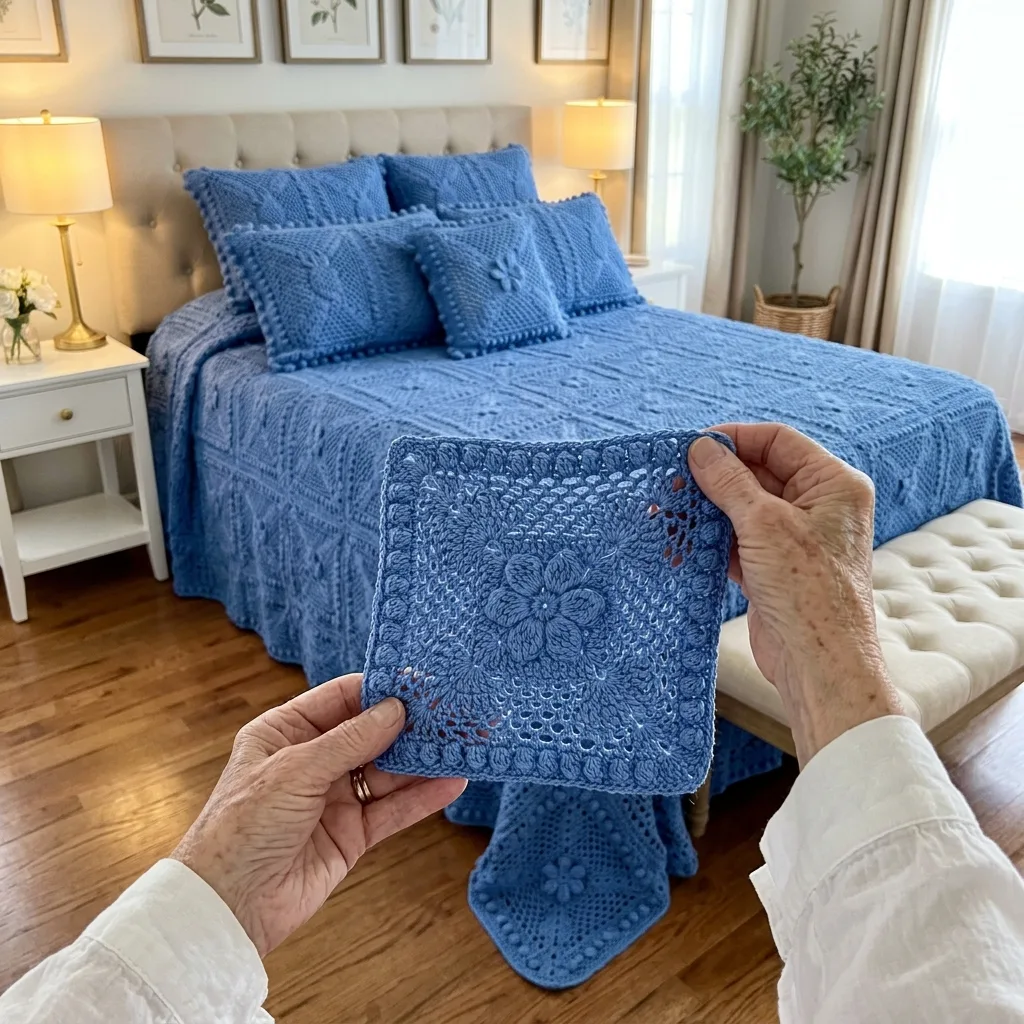
You need layered petals, treble crochet fans, bobbles, chain mesh and steady counting in each round.
Each square takes about two hours, so a few squares a week build into a full bed cover over a season.
A raised flower, four pineapple fans and bobble lines to the corners all grow together in one square.
About This Cornflower Blue Pineapple Bobble Square Bed Cover Crochet Pattern Pattern
This cornflower blue bed cover is made from large lace squares that are full of texture and detail. In the center of every square blooms a raised, layered four-petal flower. From the flower, four pineapple fans spread out toward the middle of each side, with soft chain mesh panels on either side of them. Running from the center to every corner, double lines of plump bobbles form an X across the square, like strings of tiny pearls. The squares are joined in a straight grid with neat raised seams, and the edge of the cover is finished with hanging bobble drops that swing gently over the sides of the bed.
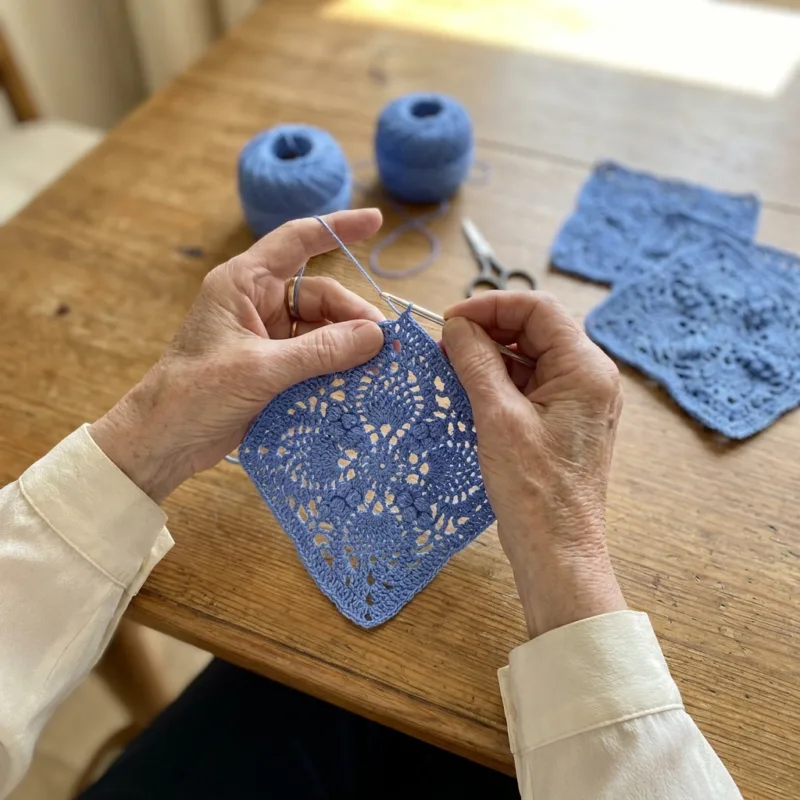
Each square is worked in rounds from the center out. You begin with a small magic ring and work two layers of petals, each layer behind the one before it, so the flower stands up from the lace. A third layer of chain loops joins the petals to the rest of the square, and a round of double crochet turns the flower into a ring of 48 stitches. Then a round of chain loops divides the square into four quarters. In each quarter, one loop becomes the corner, where the bobble lines begin, and another becomes the base of a pineapple fan.
From there, each round follows a simple rhythm. The corners gain two new bobbles every round, building the double bobble lines outward. The pineapples lose one loop every round as they narrow toward a point. The mesh panels on each side of the pineapples gain one loop every round, filling the growing space. After six of these rounds, the pineapple tips reach the middle of each side. A round of double crochet squares everything up, and a round of single crochet gives a neat, even edge for joining.
The finished bed cover measures about 103 by 103 inches with the bobble border. That is 9 squares across and 9 squares down, which makes 81 squares, each about 11 inches across after blocking. On a queen bed, the cover lies across the top and drops about 21 inches on each side and at the foot, with the bobble drops reaching toward the floor on most frames. I used DK weight matte cotton with a 3.5 mm hook, which gives clear pineapples, crisp mesh and round, firm bobbles.
The finished cover has real weight and rich texture. The bobbles and raised flowers are soft and dimensional, while the mesh and pineapples keep it airy and breathable. Cornflower blue is a fresh, happy color that feels like a clear summer sky. It looks beautiful with white furniture, gold lamps, cream walls and white flowers, and it brings a calm, cottage feeling to any bedroom. Because the whole cover is one color, the light and shadow on all the bobbles and petals show off every detail of the design.
This pattern suits an intermediate crocheter who is comfortable with treble crochet, bobbles and working in the round. The square has seventeen rounds, but each one follows a clear pattern, and you will soon know it by heart. Count your loops carefully in the pineapple and mesh rounds, and keep your bobbles even. Since you use only one color, there are just two ends per square. Each square is a satisfying evening project, and your stack of blue lace will grow steadily from week to week.
Why You'll Love This Cornflower Blue Pineapple Bobble Square Bed Cover Crochet Pattern Pattern
I love this bed cover because it has a little bit of everything I enjoy in crochet. There is a raised flower in the middle, classic pineapple lace, airy mesh and plump bobbles. Every round brings something different, so the work never feels boring. When I finish a square, I always run my fingers over the bobble lines and the petals, because the texture is so satisfying. It feels like a small treasure in my hands.
Cornflower blue is one of my favorite colors. It reminds me of summer skies, blue china and the little cornflowers that grew along the edge of my grandmother's garden. It is bright without being loud, and it makes a bedroom feel fresh and happy. When I put this cover on my bed, the whole room seemed to wake up. The white furniture looked brighter, the gold lamps glowed warmer and the white flowers on the nightstand suddenly looked like they belonged in a magazine.
I especially love the bobble lines. Watching them grow from the flower out to the corners, two bobbles at a time, is so rewarding. When the squares are joined, the bobble lines from four squares meet at every corner and form big X shapes across the bed. It is a lovely surprise the first time you see it. And the bobble drops along the edge add a playful, old-fashioned touch, like the fringe on a vintage bedspread.
- One color only, with just two ends per square.
- A raised flower in every square.
- Pineapple fans, mesh and bobbles in one design.
- A fresh blue that brightens any bedroom.
This cover also makes a beautiful gift. I made a smaller throw for my neighbor when she moved into her new home, and she keeps it on her sofa where everyone can see it. People always ask about the bobbles and the raised flowers. A handmade bed cover like this tells a story of patience and love. It becomes an heirloom from the very first day, the kind of piece that is passed down and cherished for generations.
Making this cover taught me a lot. I learned to keep my bobbles the same size so the lines look neat and even. I learned to count the pineapple and mesh loops every round, because one mistake shows right away. And I learned that combining different lace techniques in one square is not hard when each round follows a clear rhythm. If you want a textured, eye-catching bed cover that will keep you happily busy, I think you will love this one.
Switch Things Up
The first and easiest change is the color. Cornflower blue is fresh and cheerful, but this square looks beautiful in many solid shades. Classic white or ivory gives a timeless vintage look, perfect for a cottage bedroom. Soft sage green feels calm and natural. Dusty rose or blush pink looks romantic, and deep navy makes the bobbles and pineapples look rich and elegant. Choose a smooth cotton with good stitch definition, so the bobbles stay round and the pineapple fans show clearly.
You can make this bed cover for any bed size by changing the number of squares. Each square is about 11 inches across after blocking, and the bobble border adds about 2 inches on each side. Here are the counts I use:
- Twin: 7 by 9 squares, 63 squares, about 81 by 103 inches.
- Full: 8 by 9 squares, 72 squares, about 92 by 103 inches.
- Queen: 9 by 9 squares, 81 squares, about 103 by 103 inches.
- King: 10 by 9 squares, 90 squares, about 114 by 103 inches.
For a sofa throw, join 4 squares across and 5 down. That is 20 squares and finishes at about 48 by 59 inches with the border. A throw is a wonderful way to try the pattern before committing to a whole bed cover. It looks lovely draped over a sofa or a reading chair, and the bobble drops add a playful touch. If you make two or three squares a week, you can finish a throw in about two months, and it makes a thoughtful gift.
This square also makes beautiful table linens. Join 2 squares by 5 for a runner about 26 by 59 inches with the border, or 3 by 3 squares for a square tablecloth about 37 inches across. A single square makes a pretty doily or centerpiece under a vase. In white, these pieces look like heirloom table lace, and in blue they bring a cheerful touch to a breakfast table. Smaller projects like these are perfect for using up leftover yarn.
You can also simplify the design. For a quicker square, skip the second layer of petals and go straight from the first petals to the chain loop round. For a lighter look, replace the bobbles in the corners with plain double crochet, so the corners become simple V-shaped lines. You could also leave off the bobble drops and finish the edge with a simple picot round. Make one test square of any change first to check the size.
To make matching pillow covers, join 2 by 2 squares for a cushion front about 22 inches square, or 2 by 3 squares for a standard pillow sham. Make a back panel in simple rows of double crochet or a second lace panel. Join the front and back around three sides, slip in the pillow and close the last side. Add a narrow bobble edge around the cushion to match the bed cover. Use a blue pillow insert so the lace shows a matching color. Matching pillows make the whole bed look planned.
Finally, try a different yarn weight. In fine sport weight cotton with a 3 mm hook, each square is about 9.5 inches across, so a queen needs about 10 by 10 squares, and the lace looks more delicate. In worsted weight cotton with a 4.5 mm hook, a square grows to about 13.5 inches, and a queen needs only about 7 by 7 squares. Worsted makes chunky bobbles and a very cozy cover. Always make one test square in your chosen yarn and block it before you plan your layout.
Materials Needed
— Main Fabric
— Tools Required
The Free Pattern
0% complete
— Pineapple Bobble Square (Make 81, cornflower blue) :
— Layout :
— Bobble Drop Border (cornflower blue) :
Assembly Instructions
- Make one Pineapple Bobble Square, block it and check that it measures about 11 inches across.
- Make all 81 squares, weaving in the two ends of each square as you finish it.
- Block the squares in batches so they are all the same size before joining.
- Lay the squares out in a straight grid of 9 across and 9 down.
- Join the squares wrong sides together with single crochet so the raised seams sit on the right side, first in rows and then in columns.
- Work Border Rounds 1 to 3 around the whole bed cover, adding a bobble drop at every bobble.
- Block the finished bed cover flat, gently shaping the raised flowers and letting the bobble drops hang straight, and let it dry completely.
Common Mistakes & How to Fix Them
The most common mistake is making bobbles of different sizes, so the bobble lines look lumpy and uneven. If you pull some loops up tall and others short, the bobbles change size from round to round, and the X shapes across the bed lose their neat look. Always pull each loop up to the height of a double crochet before you yarn over, and close every bobble firmly. Some makers pinch the bobble lightly after closing it so it pops to the right side. Check your corners after every round. If a bobble looks too small or too large, redo it.
Another mistake is losing track of the mesh and pineapple loops in Rounds 11 to 15. Each round, the pineapple loses one loop and each mesh panel gains one loop. If you forget the extra mesh loop, the square pulls in and cups. If you forget to drop a pineapple loop, the pineapple tip ends up off center. Place a bright stitch marker at the start of each pineapple and count both the mesh and the pineapple loops before moving to the next corner. The bracket counts after each round are your best friend here.
Many makers work the petals of the flower in front instead of behind in Rounds 4 and 6. These chain loops must be worked around the posts of the stitches from the round before, behind the petals, so each new layer sits behind the last one. If you work them in front, the petals get squashed flat and the flower loses its raised look. Fold the petals toward you before you work into the posts. When you finish Round 7, the flower should stand up clearly from the double crochet ring around it.
The last common mistake is working the border bobble drops too loosely, so they stretch and look like loops instead of round drops. A loose ch 5 makes the drop long and floppy, and after washing it can hang unevenly. Keep the chains firm, work the bobble into the 4th chain from the hook and close it tightly, then slip stitch back into the same sc. Check the first few drops against each other before you continue. Even drops make the edge look neat and polished as they hang over the sides of the bed.

You Might Also Like
Important Notes
Gauge matters because small differences add up across 81 squares. A blocked square should measure about 11 inches across. If yours is a quarter inch larger, the bed cover will grow by more than 2 inches in each direction. Make one test square and block it before you buy all of your yarn. Compare new squares to your first one every few weeks, because tension often changes during a long project with many rounds.
Blocking opens up the pineapples and mesh and makes the squares straight and even. Pin each square flat at 11 inches, placing pins in the corners and along the sides, and gently open the mesh with your fingers. Mist with cool water and let it dry fully. Do not press the raised flowers or bobbles flat. After joining and working the border, block the whole cover again so the seams lie straight and the bobble drops hang evenly.
The yarn amount is for the queen size in DK weight cotton, so adjust it for other sizes or yarns. Bobbles use more yarn than plain stitches, so do not skimp on the extra. With a single color like cornflower blue, dye lots matter a great deal, so buy all of your yarn from the same dye lot at once, plus about 10 percent extra. If you must use two lots, alternate squares from both lots in a checkerboard.
Wash the bed cover by hand or on a gentle cold cycle inside a large mesh laundry bag to protect the bobbles and drops. Blue dyes can release a little color, so wash the cover on its own and add a color catcher sheet to the first few washes. Use a mild detergent and no bleach. Do not hang the cover to dry, because wet cotton is heavy and will stretch the lace. Lay it flat on towels, shape the squares and flowers and let it dry fully.
I hope this cornflower blue bed cover brings a bright summer sky into your bedroom. It is a big project, but every square is a happy evening of petals, pineapples and bobbles. Take your time with the counting, enjoy the texture under your fingers and watch your stack of blue squares grow week by week.
You do not have to think about all 81 squares today. Just make a magic ring and finish one raised flower. Then keep going to the corners and finish your first square. Before long, you will lay your squares out on the bed and see the bobble lines meet in big X shapes across it. Happy crocheting, my friend.
Crochet Abbreviations
You Ask, We Answer
What is the finished size of this bed cover?
The queen version finishes at about 103 by 103 inches with the bobble border. That is 9 squares across and 9 squares down, with each square measuring about 11 inches across after blocking, plus about 2 inches of border on each side. On a standard queen mattress, the cover lies across the top and drops about 21 inches on each side and at the foot, so the bobble drops reach toward the floor on most bed frames. If you want a longer cover, add one more row of squares. If you prefer a coverlet that stops at the side of the mattress, use the full layout of 8 by 9 squares. Measure your own bed, including the mattress and frame height, and divide by your blocked square size before you buy yarn from one dye lot.
Can I use a different yarn weight or make a different size?
Yes, this pattern works in many yarn weights because the square keeps the same stitch counts in every size. In fine sport weight cotton with a 3 mm hook, each square is about 9.5 inches across, and in worsted weight cotton with a 4.5 mm hook it grows to about 13.5 inches. Only the number of squares changes. Make one test square in your chosen yarn, block it and measure it, then divide your bed size by that number. The section on switching things up lists square counts for twin, full, queen, king, a throw and table linens. For the border, count 47 sc for each square along an edge, plus one sc at each seam and one at each end, and keep each edge total a multiple of 4 so the bobbles and drops come out even.
How do I wash and care for this crochet bed cover?
Wash it by hand in cool water or on a gentle cold cycle inside a large mesh laundry bag to protect the raised flowers, bobbles and drops. Use a mild detergent and never use bleach, because it can leave pale spots on blue cotton. Wash the cover on its own and add a color catcher sheet to the first few washes, since blue dyes can release a little color. Do not wring or twist the cover. Gently press out the water, then lay it flat on clean towels, shape the squares and flowers with your hands and straighten the bobble drops along the edge. Let it dry completely, away from direct sunlight, which can fade blue over time. Never hang it while wet, because the weight of the wet cotton will stretch the lace. Between seasons, fold it loosely and store it in a breathable cotton bag.
Success!
Thanks for subscribing — check your inbox for a welcome note.
Abbreviations
- ch — chain
- sc — single crochet
- hdc — half double crochet
- dc — double crochet
- tr — treble crochet
- bobble — 4 dc worked in the same st or sp and closed together
- yo — yarn over
- sl st — slip stitch
- MR — magic ring
- beg — beginning
- sk — skip
- st(s) — stitch(es)
- lp(s) — loop(s)
- sp(s) — space(s)
- rep — repeat
- Rnd — round