Amanda's Creative Corner Crochet · Kitchen
Free Crochet Patterns Handmade with Love

Dusty Rose Filet Chevron Bed Cover Crochet Pattern
Jump to Pattern
Dusty Rose Filet Chevron Bed Cover Crochet Pattern
180-220 Hours 0 made this
Intermediate Level

You need to be comfortable with double crochet and reading a simple filet chart.

180-220 Hours

Three long strips and four narrow bands, all made one piece at a time.

Soft Rose Chevrons

Open mesh and solid arrows give a lacy bed cover that still feels cozy.

About This Dusty Rose Filet Chevron Bed Cover Crochet Pattern Pattern

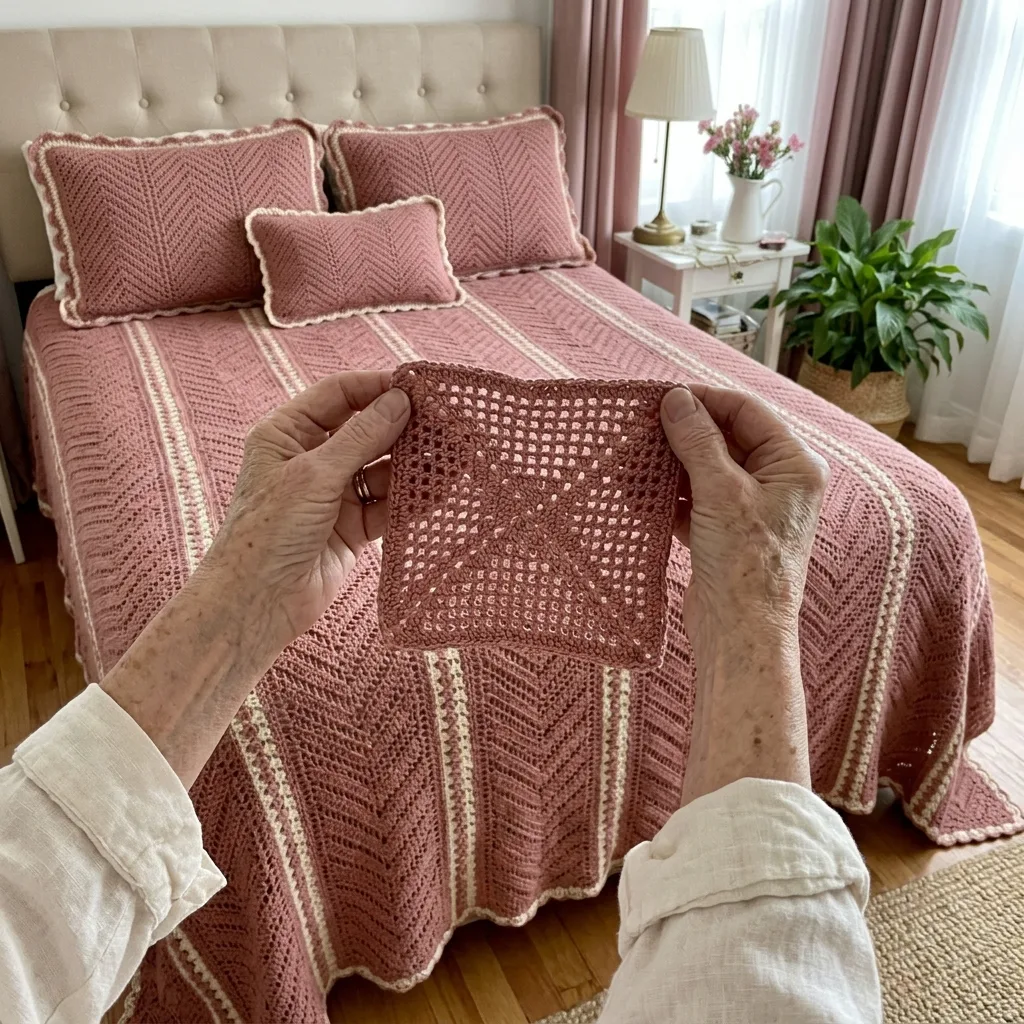
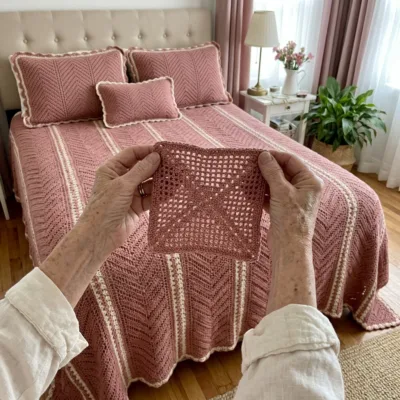
This bed cover is made from three wide filet strips in dusty rose and four narrow bands of cream and rose clusters. Each filet strip has solid chevron arrows that point toward the headboard, set on open square mesh with a solid frame on both sides.

The finished cover measures about 77 by 92 inches (196 by 234 cm) and drapes over a queen bed with a generous drop. You only need chain, double crochet and a simple cluster stitch. It suits a crocheter who has finished a few blankets and wants a big, lasting project.
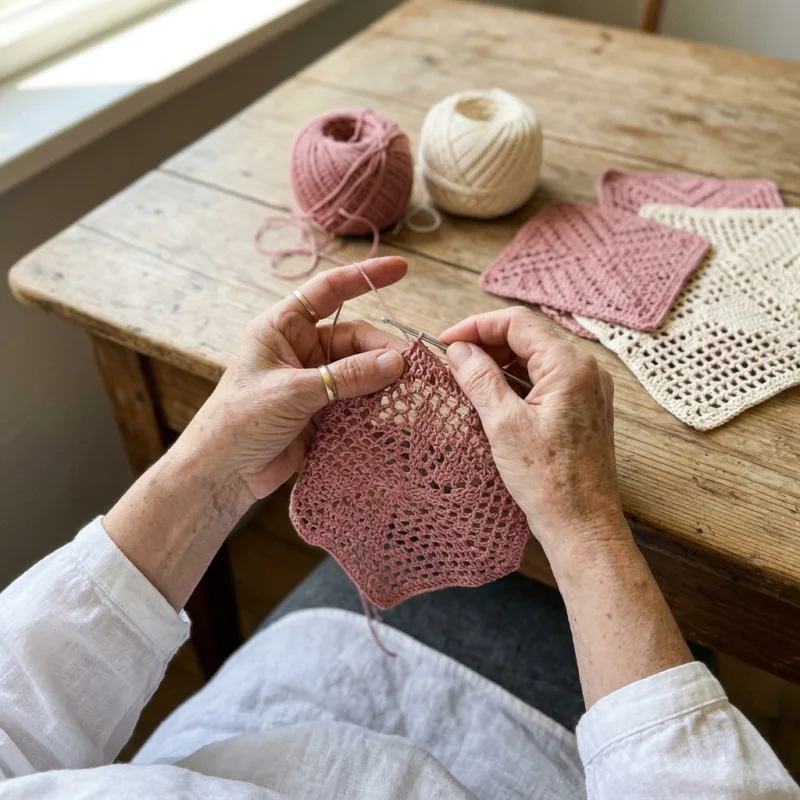
Dusty Rose Filet Chevron Bed Cover Crochet Pattern step detail

Why You'll Love This Dusty Rose Filet Chevron Bed Cover Crochet Pattern Pattern

I love that every strip is portable. You can crochet a few rows on the sofa, in the garden or on a long car ride, and nothing is too heavy until the very end.

The open mesh lets the light through, and the cream cluster bands break up the pink in a gentle way. It makes a bedroom feel calm and a little old-fashioned in the best sense. It also makes a lovely wedding or housewarming gift.

Switch Things Up

Try sage green and cream, or navy and soft grey, for a different mood. Make only one filet strip and one band on each side for a throw size, or use two strips for a baby blanket. You can work the same chevron chart over 21 squares for a matching pillow cover. For a softer finish, swap Round 4 for a simple row of single crochet and a picot.


Materials Needed

— Main Fabric

01 Worsted weight cotton yarn in dusty rose: about 6,100 yd (5,580 m, about 3,200 g) including 10 percent extra
02 Worsted weight cotton yarn in warm cream: about 1,900 yd (1,740 m, about 1,000 g) including 10 percent extra, used for the band rows and the border
03 Amounts are based on yarn with about 190 yd (174 m) per 100 g and include the edge

— Tools Required

04 3.5 mm (E-4) crochet hook, or the size that gives you the gauge
05 Yarn needle
06 Stitch markers
07 Scissors
08 Blocking mats and pins
09 Measuring tape

The Free Pattern

Intermediate 180-220 Hours

0% complete

— Filet Strip (Make 3, dusty rose) :

Special terms: S (solid square) = dc in each of the next 3 sts. When working a solid square over an open square of the previous row, work 2 dc in the ch-2 space and 1 dc in the next dc. O (open square) = ch 2, skip the next 2 sts, dc in the next st. Every row starts with ch 3, which counts as the first dc, and ends with a dc in the top of the turning ch of the previous row. Each row has 31 squares and 94 sts, counting each ch of a ch-2 space as 1 st.
Gauge: one filet square (3 sts wide, 1 row tall) measures about 0.6 in (1.5 cm) wide and 0.5 in (1.3 cm) tall after blocking. Each strip is about 19 in (48 cm) wide and 87 in (221 cm) long. Row 1 is the foot end of the bed and the chevron points face the headboard.
Row 1: With dusty rose, ch 96. Dc in the 4th ch from hook and in each ch across. (94 sts)
Row 2: Ch 3, turn. Dc in each st across, ending with a dc in the top of the turning ch. (94 sts, 31 solid squares)
Rows 3-15 are the chevron chart. Work them 13 times in total (13 rows x 13 repeats = 169 rows). Place a marker in Row 15 of each repeat to keep count.
Row 3: Ch 3, S4, O23, S4. (94 sts)
Row 4: Ch 3, S2, O1, S2, O21, S2, O1, S2. (94 sts)
Row 5: Ch 3, S2, O2, S2, O19, S2, O2, S2. (94 sts)
Row 6: Ch 3, S2, O3, S2, O17, S2, O3, S2. (94 sts)
Row 7: Ch 3, S2, O4, S2, O15, S2, O4, S2. (94 sts)
Row 8: Ch 3, S2, O5, S2, O13, S2, O5, S2. (94 sts)
Row 9: Ch 3, S2, O6, S2, O11, S2, O6, S2. (94 sts)
Row 10: Ch 3, S2, O7, S2, O9, S2, O7, S2. (94 sts)
Row 11: Ch 3, S2, O8, S2, O7, S2, O8, S2. (94 sts)
Row 12: Ch 3, S2, O9, S2, O5, S2, O9, S2. (94 sts)
Row 13: Ch 3, S2, O10, S2, O3, S2, O10, S2. (94 sts)
Row 14: Ch 3, S2, O11, S2, O1, S2, O11, S2. (94 sts)
Row 15: Ch 3, S2, O12, S3, O12, S2. This is the point of the arrow. (94 sts)
Rows 16-171: Repeat Rows 3-15 twelve more times (156 rows). (94 sts in every row)
Rows 172-173: Ch 3, dc in each st across. Repeat once more. Fasten off. (94 sts in each row, 173 rows in total)

— Cluster Band (Make 4, cream and dusty rose) :

cl (cluster) = [yo, insert hook in the st, yo, pull up a loop, yo, pull through 2 loops] 3 times in the same st (4 loops on hook), yo, pull through all 4 loops. Change color on the last yo of the last st of each row and carry the unused yarn loosely up the side edge, where the seam will hide it. Each band is about 4 in (10 cm) wide and has 173 rows, the same as a filet strip.
Row 1: With dusty rose, ch 21. Dc in the 4th ch from hook and in each ch across. (19 sts)
Row 2: With cream, ch 3, turn. Dc in each st across. (19 sts)
Row 3: With dusty rose, ch 1 (does not count as a st), turn. Cl in the first st, (dc in the next st, cl in the next st) 9 times. (19 sts: 10 cl and 9 dc)
Row 4: With cream, ch 3, turn. Dc in each st across. (19 sts)
Row 5: With dusty rose, ch 1, turn. Dc in the first st, (cl in the next st, dc in the next st) 9 times. (19 sts: 9 cl and 10 dc)
Rows 6-173: Repeat Rows 2-5 forty-two more times (168 rows). Row 173 is a dusty rose cluster row. Fasten off. (19 sts in every row, 173 rows in total)

— Layout :

Arrange the pieces side by side in this order: band, strip, band, strip, band, strip, band. All Row 1 edges sit at the foot of the bed and the chevron points face the headboard. The top and bottom edges together have 4 x 19 + 3 x 94 = 358 sts, and each long side has 173 row ends.
Finished size before the border is about 71 in (180 cm) wide and 87 in (221 cm) long. The border adds about 3 in (8 cm) on every side.

— Border (dusty rose and cream) :

Round 1: With dusty rose and the right side facing, join in the top right corner st. Work (sc, ch 2, sc) in the corner st. Sc in each of the next 356 sts across the top. Work (sc, ch 2, sc) in the next corner st. Work 2 sc in each of the next 171 row ends down the side (342 sc). Corner. Sc in each of the next 356 sts across the bottom. Corner. Work 2 sc in each of the next 171 row ends up the side. Join with a sl st to the first sc. (1,404 sc and 4 ch-2 corner spaces)
Round 2: Join cream in any corner ch-2 sp. Work (cl, ch 3, cl) in the corner sp. Along the top edge work (ch 1, skip 1 sc, cl in the next sc) 179 times. Corner. Along the side work (ch 1, skip 1 sc, cl in the next sc) 172 times. Corner. Along the bottom work (ch 1, skip 1 sc, cl in the next sc) 179 times. Corner. Along the last side work (ch 1, skip 1 sc, cl in the next sc) 172 times. Join with a sl st to the first cl. (710 cl, 702 ch-1 sps and 4 ch-3 corner spaces)
Round 3: Join dusty rose in any corner ch-3 sp. Work (2 sc, ch 2, 2 sc) in the corner sp. Sc in each cl and in each ch-1 sp along the edge (360 sc on the top and bottom edges, 346 sc on each side, counting the cl on each side of the corner). Work (2 sc, ch 2, 2 sc) in each corner sp. Join with a sl st to the first sc. (1,428 sc and 4 ch-2 corner spaces)
Round 4: Join cream in any corner ch-2 sp. Work (3 dc, ch 2, 3 dc) in the corner sp. Along each top or bottom edge work (sc in the next st, 3 dc in the next st) 182 times (364 sts). Along each side work (sc in the next st, 3 dc in the next st) 175 times (350 sts). Work (3 dc, ch 2, 3 dc) in each corner sp. Join with a sl st to the first dc. Fasten off and weave in the ends. (714 sc and 2,166 dc)

Assembly Instructions

  1. Weave in all ends on the three filet strips and the four cluster bands, then block each piece flat to its size: strips about 19 by 87 in (48 by 221 cm) and bands about 4 by 87 in (10 by 221 cm).
  2. Lay the pieces on a large floor in this order: band, strip, band, strip, band, strip, band, with every Row 1 edge at the same end and the chevron points facing the same way.
  3. Join the pieces one seam at a time. Place two neighbors with right sides together and sl st through both row ends, working 173 sl sts per seam so that every row meets its partner.
  4. Check that each seam is the same length as its neighbors. If a seam is longer, ease it in evenly rather than skipping row ends in one place.
  5. Press the seams flat with a damp cloth and lay the cover out once more to check that the chevron points line up.
  6. Work the four border rounds in the order given: Round 1 in dusty rose, Round 2 in cream, Round 3 in dusty rose and Round 4 in cream.
  7. Block the finished cover again, pinning the scalloped edge into shape, and let it dry completely before you put it on a bed.

Common Mistakes & How to Fix Them

Losing count in the chevron chart. Place a marker in Row 15 of every repeat and check that you have 13 repeats before you work the solid end rows.

Skipping the ch-2 space when working a solid square over an open one. Always work 2 dc into the space so that the arrow keeps its shape and the stitch count stays at 94.

Pulling the carried yarn too tight along the side of a cluster band. Keep it loose so the band does not pucker and stay shorter than the filet strip next to it.

Joining pieces without matching row ends. Count 173 row ends on both pieces before you seam them.


Denise

Denise designs warm, clearly written crochet patterns for the home and shares them with friends who love to make.


Important Notes

Make a swatch of 10 squares by 10 rows first. One square should be about 0.6 in (1.5 cm) wide and 0.5 in (1.3 cm) tall, and a different gauge will change the finished size.

Yarn amounts are estimates for a queen bed. Buy all your dusty rose yarn from the same dye lot.

Wash on a gentle cycle in cool water and use a color catcher, because the dusty rose and cream yarns are used side by side. Dry flat.

Block every piece before joining. Cotton relaxes and grows, and blocking makes the strips and bands the same length.


I hope you enjoy every row of this one. Take it slowly, one strip at a time, and send me a photo when it lands on your bed.

Crochet Abbreviations

01 ch — chain
02 sl st — slip stitch
03 sc — single crochet
04 dc — double crochet
05 yo — yarn over
06 cl — cluster (3 unfinished dc worked in the same st and closed together)
07 sp — space
08 st(s) — stitch(es)
09 S — solid square (dc in each of the next 3 sts)
10 O — open square (ch 2, skip 2 sts, dc in the next st)

You Ask, We Answer

What size is the finished bed cover?

It measures about 77 by 92 inches (196 by 234 cm) after blocking, which covers a queen bed with a good drop on both sides.

Can I use a different yarn weight or make it smaller?

Yes. A DK cotton on a 3 mm hook gives a finer fabric, but you will need to swatch and change the number of squares and rows to reach your size. For a throw, make one strip and one band on each side.

How do I wash the finished bed cover?

Wash it by hand or on a gentle cycle in cool water with a color catcher, then dry it flat. Do not wring it, and reshape the scalloped edge while it is damp.