Amanda's Creative Corner Crochet · Kitchen
Free Crochet Patterns Handmade with Love

Sage Green Lantern Flower Bed Cover Crochet Pattern
Jump to Pattern
Sage Green Lantern Flower Bed Cover Crochet Pattern
170-210 Hours 0 made this
Intermediate Level

You need to be comfortable with granny rounds, magic rings and joining motifs.

170-210 Hours

98 small motifs that you can make a few at a time.

Lantern Net Look

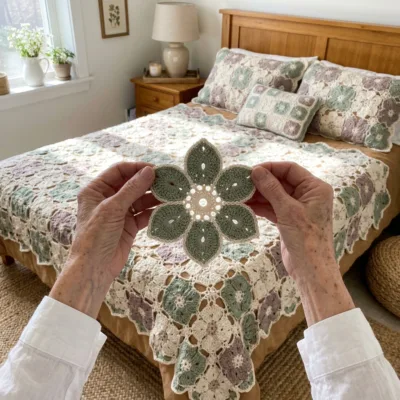
The sage outlines join into soft lantern shapes around every flower.

About This Sage Green Lantern Flower Bed Cover Crochet Pattern Pattern

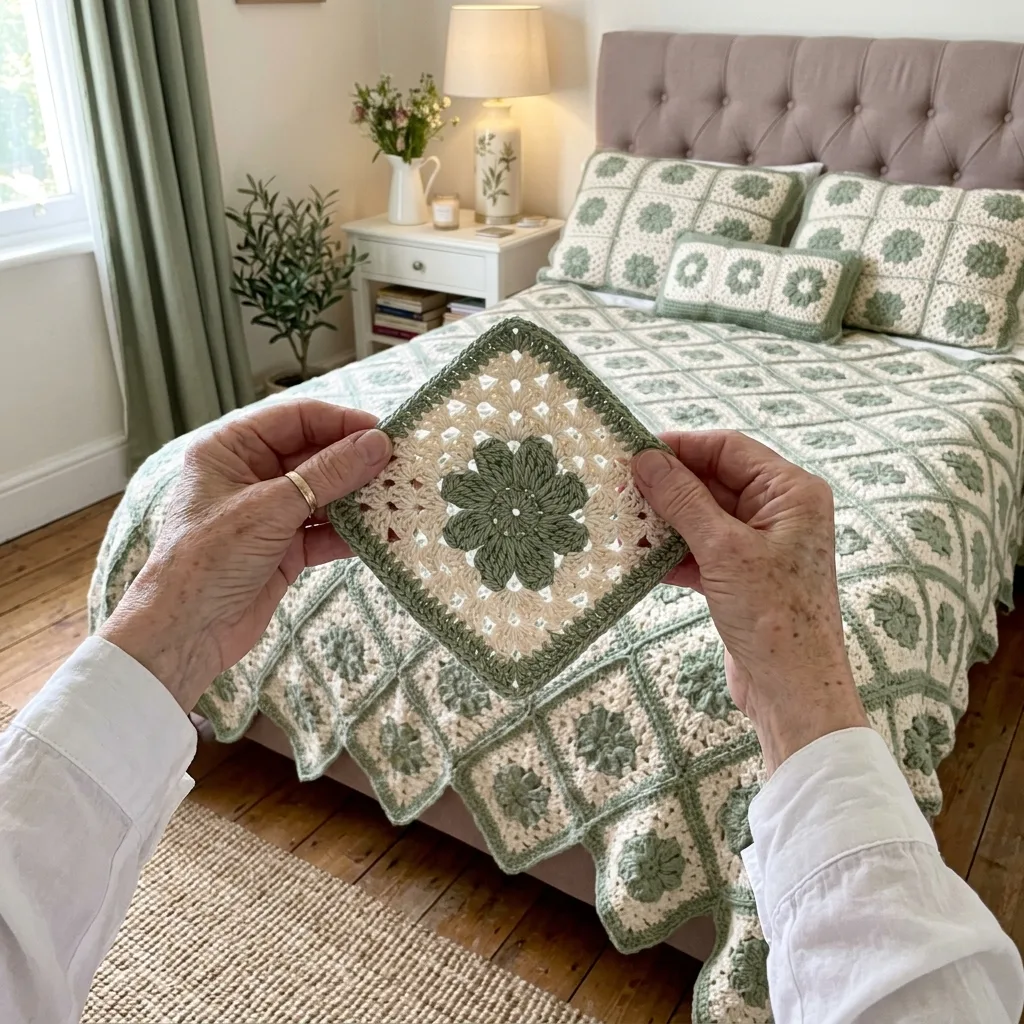
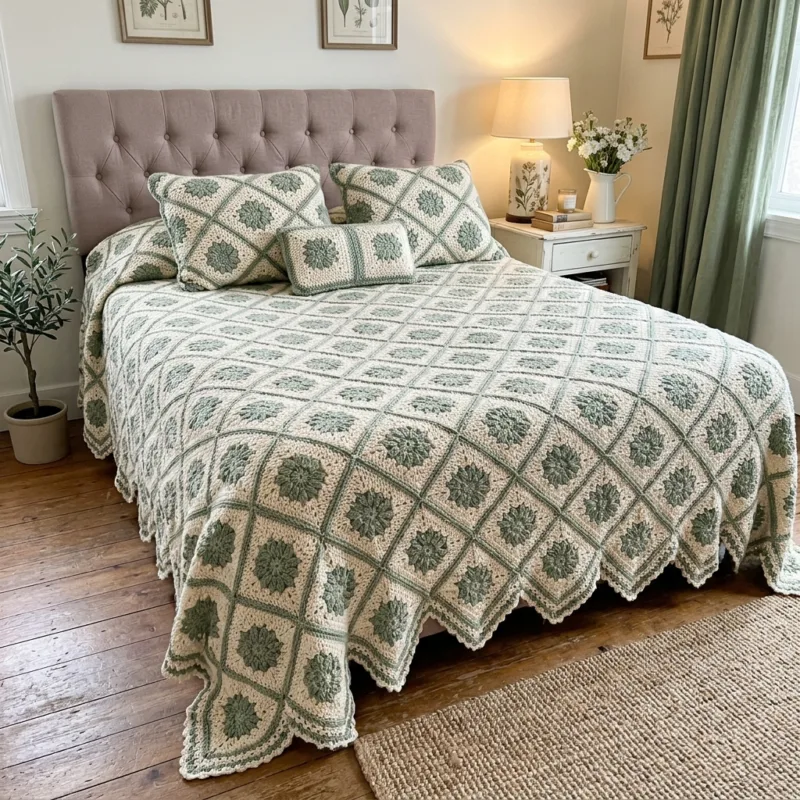
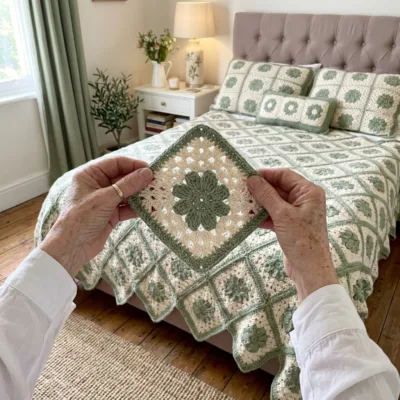
This bed cover is made from 98 cream granny motifs, each with an eight-petal sage flower in the center and a sage outline. The motifs are turned on point and joined side to side, so the green outlines make a net of lantern shapes across the bed.

The finished cover measures about 80 by 92 inches (203 by 234 cm) with a zigzag edge and a row of tiny scallops. It is made only with single crochet, half double crochet and double crochet, so it suits a crocheter who has made granny squares before and wants a big, rewarding project.
Sage Green Lantern Flower Bed Cover Crochet Pattern step detail

Why You'll Love This Sage Green Lantern Flower Bed Cover Crochet Pattern Pattern

I love that every motif is small enough to carry in a bag. You can make one on the bus, one at the kitchen table and one on a rainy afternoon, and the pile grows without you noticing.

The cream rounds keep the cover light, and the sage gives it a calm, leafy feel. It looks lovely in a quiet bedroom and makes a gift that will be kept for many years.

Switch Things Up

Try dusty blue and cream, or terracotta and cream, for a different mood. Make 24 motifs and join them in a 4 by 6 grid for a throw, or make just 6 and sew them into a cushion cover. You can also swap the flower center for a bright color. For a simpler finish, work only the cream round of the border.


Materials Needed

— Main Fabric

01 Worsted weight cotton yarn in soft sage green: about 5,170 yd (4,730 m, about 2,720 g) including 10 percent extra
02 Worsted weight cotton yarn in warm cream: about 5,600 yd (5,120 m, about 2,950 g) including 10 percent extra
03 Amounts are based on yarn with about 190 yd (174 m) per 100 g and include the border. Each motif uses about 50 yd of cream and 42 yd of sage

— Tools Required

04 3.5 mm (E-4) crochet hook, or the size that gives you the gauge
05 Yarn needle
06 Stitch markers
07 Scissors
08 Blocking mats and pins
09 Measuring tape

The Free Pattern

Intermediate 170-210 Hours

0% complete

— Lantern Flower Motif (Make 98, sage and cream) :

Each motif is worked in the round with the right side facing and measures about 8 in (20 cm) square after blocking. Check your gauge: the finished side should hold 39 sts from one corner space to the next. A corner group in Rounds 10-12 is (2 sc, ch 2, 2 sc).
Round 1: With sage, make a magic ring. Ch 1, work 8 sc in the ring, join with a sl st to the first sc. (8 sc)
Round 2: Ch 1, 2 sc in each st around, join with a sl st to the first sc. (16 sc)
Round 3: Ch 1. *(Sc, hdc, dc, hdc, sc) in the next st, sl st in the next st; repeat from * 7 more times. Fasten off sage. (8 petals and 8 sl sts between the petals)
Round 4: Join cream with a sc in any sl st between two petals. *Ch 4, sc in the next sl st between petals; repeat from * 6 more times, ch 4, join with a sl st to the first sc. Keep the petals in front and work the chains behind them. (8 sc and 8 ch-4 sps)
Round 5: Sl st into the first ch-4 sp. Ch 3 (counts as dc), 2 dc, ch 2, 3 dc in the same sp for the first corner, ch 1. *In the next ch-4 sp work 3 dc, ch 1. In the next ch-4 sp work (3 dc, ch 2, 3 dc), ch 1.* Repeat from * to * 2 more times, then in the last ch-4 sp work 3 dc, ch 1. Join with a sl st to the top of the beginning ch 3. (36 dc, 8 ch-1 sps and 4 ch-2 corner sps)
Round 6: Sl st in each of the next 2 dc and in the corner ch-2 sp. Ch 3, 2 dc, ch 2, 3 dc in the same sp, ch 1, (3 dc in the next ch-1 sp, ch 1) 2 times. *(3 dc, ch 2, 3 dc) in the next corner sp, ch 1, (3 dc in the next ch-1 sp, ch 1) 2 times; repeat from * 2 more times. Join with a sl st to the top of the beginning ch 3. (48 dc, 12 ch-1 sps and 4 corner sps)
Round 7: Sl st in each of the next 2 dc and in the corner sp. Work as Round 6, but work (3 dc in the next ch-1 sp, ch 1) 3 times along each side. Join. (60 dc, 16 ch-1 sps and 4 corner sps)
Round 8: Sl st in each of the next 2 dc and in the corner sp. Work as Round 6, but work (3 dc in the next ch-1 sp, ch 1) 4 times along each side. Join. (72 dc, 20 ch-1 sps and 4 corner sps)
Round 9: Sl st in each of the next 2 dc and in the corner sp. Work as Round 6, but work (3 dc in the next ch-1 sp, ch 1) 5 times along each side. Join and fasten off cream. (84 dc, 24 ch-1 sps and 4 corner sps)
Round 10: Join sage in any corner ch-2 sp. Ch 1, (2 sc, ch 2, 2 sc) in the corner sp. *Sc in each of the next 27 sts (21 dc and 6 ch-1 sps), (2 sc, ch 2, 2 sc) in the next corner sp; repeat from * 2 more times, sc in each of the next 27 sts. Join with a sl st to the first sc. (124 sc and 4 corner sps)
Round 11: Sl st in the next sc and in the corner sp. Ch 1, (2 sc, ch 2, 2 sc) in the same sp. *Sc in each of the next 31 sc, (2 sc, ch 2, 2 sc) in the next corner sp; repeat from * 2 more times, sc in each of the next 31 sc. Join. (140 sc and 4 corner sps)
Round 12: Sl st in the next sc and in the corner sp. Ch 1, (2 sc, ch 2, 2 sc) in the same sp. *Sc in each of the next 35 sc, (2 sc, ch 2, 2 sc) in the next corner sp; repeat from * 2 more times, sc in each of the next 35 sc. Join. Fasten off and weave in the ends. (156 sc, 4 corner sps, 39 sts from one corner sp to the next)

— Layout and Joining :

Turn every motif on point, with one corner at the bottom. Lay the motifs in 15 rows, numbered from the foot of the bed. Rows 1, 3, 5, 7, 9, 11, 13 and 15 have 7 motifs. Rows 2, 4, 6, 8, 10, 12 and 14 have 6 motifs and sit half a motif in from each side, so each one fits between two motifs of the row below. This gives 8 x 7 + 7 x 6 = 98 motifs.
Each motif measures about 11.3 in (28.7 cm) from point to point and each row steps up by about 5.7 in (14.4 cm). The joined cover is about 79 in (201 cm) wide and 90.5 in (230 cm) long before the border.
Join: With right sides together, match the corner spaces and sl st through the back loops of both motifs from one corner space to the next (1 sl st in each corner sp and 1 sl st in each of the 39 sts between). Each side seam has 41 sl sts. Where four corners meet, tack all four corner spaces together with a few sl sts. Join row by row, from Row 1 to Row 15. (98 motifs, 168 side seams)

— Border (cream and sage) :

The outline of the joined cover has 56 motif sides: 14 along the top, 14 along the bottom, 14 down the left and 14 down the right. It has 30 outer tips (7 on the top, 7 on the bottom, 8 on the left and 8 on the right) and 26 inner notches (6 on the top, 6 on the bottom, 7 on the left and 7 on the right). Sc2tog = insert hook in the first sp, pull up a loop, insert hook in the next sp, pull up a loop, yarn over and pull through all 3 loops.
Round 1: Join cream in the ch-2 corner sp of any outer tip. Along each outer motif side work sc in each of the 35 sc. At each outer tip work sc in each of the 2 sc before the corner sp, (sc, ch 2, sc) in the corner sp, then sc in each of the next 2 sc (6 sc and one ch-2 sp). At each inner notch work sc in each of the last 2 sc of the first motif, sc2tog over the corner sp of the first motif and the corner sp of the second motif, then sc in each of the first 2 sc of the second motif (5 sc). Join with a sl st to the first sc. (56 sides x 35 = 1,960 sc, 30 tips x 6 = 180 sc, 26 notches x 5 = 130 sc; 2,270 sc and 30 ch-2 tip sps in total)
Round 2: Join sage in any tip ch-2 sp. Ch 3 (counts as dc), 2 dc, ch 2, 3 dc in the same sp. Sc in each of the next 3 sc. Along each side work (sc in the next st, 3 dc in the next st) 17 times, sc in the next st (35 sts). At each notch work sc in each of the 5 sts. At each tip work sc in each of the 3 sc before the corner sp, (3 dc, ch 2, 3 dc) in the corner sp, then sc in each of the next 3 sc. Join with a sl st to the top of the beginning ch 3. Fasten off and weave in the ends. (1,318 sc and 3,036 dc: 56 sides x 18 sc = 1,008 sc and 56 x 51 dc = 2,856 dc, 30 tips x 6 = 180 sc and 180 dc, 26 notches x 5 = 130 sc)

Assembly Instructions

  1. Weave in the ends on all 98 motifs and block each one flat to about 8 in (20 cm) square, pinning the corners so they are sharp.
  2. Lay the motifs on a large floor on point, with Row 1 at the foot of the bed. Rows of 7 and rows of 6 alternate, and the shorter rows sit between the motifs of the row below.
  3. Join the motifs from Row 1 upward with a back-loop sl st seam, working from corner space to corner space on every shared side.
  4. Where four corners meet, tack the four corner spaces together so the sage outlines form a clean point.
  5. Check that the cover measures about 79 by 90.5 in (201 by 230 cm) before the border. Press the seams lightly with a damp cloth.
  6. Work Round 1 of the border in cream, counting 35 sc along each outer side, then work Round 2 in sage.
  7. Block the finished cover again, pinning the zigzag edge and the scallops into shape, and let it dry completely.

Common Mistakes & How to Fix Them

Skipping the chain 4 loops in Round 4 behind the petals. Keep the petals in front, or the flower will not sit flat.

Losing track of the side groups in Rounds 6-9. The side groups go 2, 3, 4 and 5, so count them against the ch-1 spaces of the previous round.

Joining motifs with the right sides facing. Keep right sides together so the seam sits on the back and the sage lines stay neat.

Making the motifs different sizes. Block them all to the same measurement before you join, or the diagonal rows will not line up.


Denise

Denise designs warm, clearly written crochet patterns for the home and shares them with friends who love to make.


Important Notes

Make one motif first. It should measure about 8 in (20 cm) and have 39 sts from one corner space to the next. A different size changes the motif count, yarn amount and border counts.

Yarn amounts are estimates for a queen bed. Buy all your sage and all your cream yarn from the same dye lot.

Wash on a gentle cycle in cool water with a color catcher, because the sage and cream are used side by side. Dry flat.

The border counts work for the 98-motif layout. If you change the layout, recount the outer sides, tips and notches.


I hope you enjoy making every little flower. Take your time, make a few motifs at a time, and send me a photo when your cover is on the bed.

Crochet Abbreviations

01 ch — chain
02 sl st — slip stitch
03 sc — single crochet
04 hdc — half double crochet
05 dc — double crochet
06 sc2tog — single crochet 2 together
07 sp — space
08 st(s) — stitch(es)

You Ask, We Answer

What size is the finished bed cover?

It measures about 80 by 92 inches (203 by 234 cm) with the border, which covers a queen bed with a generous drop on both sides.

Can I make it smaller?

Yes. Use 24 motifs in a 4 by 6 grid for a throw or 6 motifs for a cushion cover. For any other size, recount the outer sides, tips and notches of the border.

How do I wash the finished bed cover?

Wash it by hand or on a gentle cycle in cool water with a color catcher, then dry it flat. Reshape the pointed edge while it is damp.