
Gray and Ivory Window Granny Square Bedspread Crochet Pattern
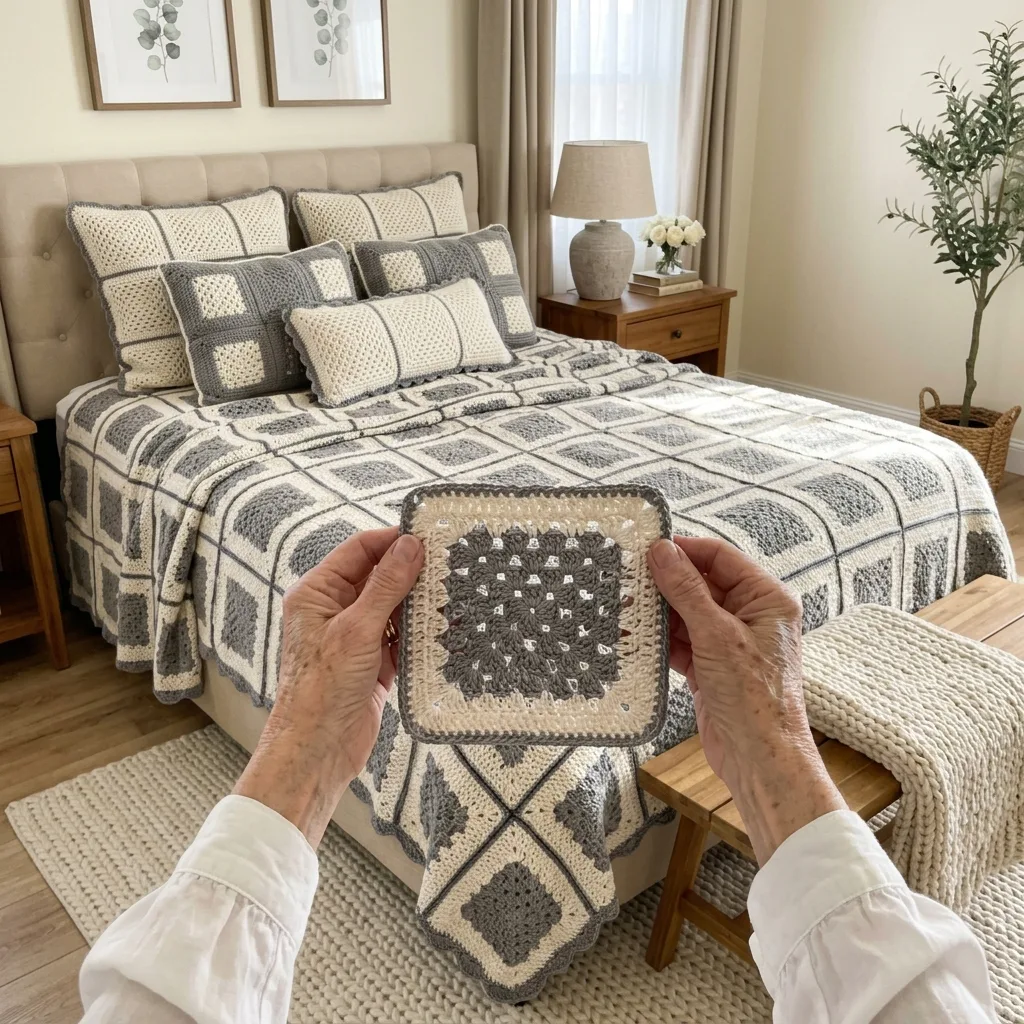
Only chains, single crochet and double crochet, worked in simple counted rounds.
Each square takes under an hour, plus the joining and the shell edge.
Tiny openings in the gray centers and eyelets in the ivory frames let light dance across the bed.
About This Gray and Ivory Window Granny Square Bedspread Crochet Pattern Pattern
This bedspread is made from one hundred and ten matching squares in a soft medium gray and a clean ivory white. Each square begins with a gray center full of little windows: a ring of open spaces in the first round, then two more rounds that square it up while keeping a small opening in the middle of every side. Around the gray, an ivory frame grows in four rounds of double crochet. The corner spaces of each round line up into a diagonal row of eyelets, and one extra eyelet sits in the middle of every side. A thin gray outline finishes the square, so each one looks like a little framed window.
The finished bedspread measures about 104 by 114 inches (264 by 290 cm) including the border. It is a grid of 10 squares across and 11 squares down, with each square measuring 10 inches after blocking, plus a gray scalloped shell edge. On a queen mattress that gives a drop of about 22 inches on each side and at the foot, so the shells fall close to the floor and the mattress is completely hidden. The extra length at the head tucks neatly under the pillows. Every square is the same, so there is nothing to plan and no chart to follow.
The stitches are the very first ones most of us learn: chain, slip stitch, single crochet and double crochet, plus a single crochet decrease is not even needed here. The windows come from simple chain spaces, not from any special stitch. The square is worked in the round from the center out, joined with a slip stitch at the end of every round, so you never turn your work. There are only two color changes per square, which means only four ends to weave in, and I like to do that as soon as each square is finished.
The squares are joined with gray single crochet on the right side, through both squares at once. That makes a slim gray ridge between every square, and together the ridges form a neat grid across the whole bed, like the panes of a window. Once all the seams are done, a round of single crochet goes around the edge with a few extra stitches at each corner, a second round evens it out, and a round of seven double crochet shells finishes it with a soft scalloped hem. The gray edge frames the ivory beautifully and hides everyday wear.
In worsted weight cotton the bedspread is warm and substantial, with a gentle drape. The gray centers have a little texture from the windows, and the ivory frames feel smooth and flat under your hand. The colors are fresh and calm, and they suit a modern farmhouse bedroom, a Scandinavian style room, or a cozy space with wood, linen and plants. It feels classic and current at the same time, which is why I think it will never go out of style.
I rate this pattern as beginner friendly. If you can make a basic granny square and count your stitches on each side, you can make this whole bedspread. It suits someone who enjoys repetition and wants a portable project for the evenings or for travel. It is a lovely first big project, because every square teaches you something about tension and counting, and by the end your stitches will look wonderfully even. Experienced makers will enjoy it as a relaxing project they can work almost without looking.

Why You'll Love This Gray and Ivory Window Granny Square Bedspread Crochet Pattern Pattern
I have made many granny square blankets over the years, but this one feels special because of the little windows. When you hold a square up to the light, you can see right through the tiny openings in the gray center and the eyelets in the ivory frame. On the bed, the morning sun shines through them and makes a pattern of little dots on the sheet below. It is such a small detail, but it makes the whole bedspread feel light and alive.
I love how fast each square comes together. The gray center takes only a few minutes, and then the ivory rounds move along at a steady, soothing pace. I can finish one or two squares in an evening while listening to the radio or chatting with my husband. Each square is small enough to tuck into my handbag, so it comes with me to waiting rooms, on the bus and to visit my sister. Little by little, the pile in my basket grows.
I also love the colors. Gray and ivory feel so calm and fresh, like a quiet winter morning. In our bedroom they sit with a beige headboard, warm wood furniture and a potted olive tree, and the whole room feels peaceful and put together. The gray grid of seams gives the bed a tailored look that I find very restful. And the gray edge is practical too, because it hides the little marks that always happen where the bedspread touches the floor.
Here is why this bedspread makes me so happy:
- It only uses the most basic stitches.
- There are just two colors and four ends per square.
- Each square is quick and fits in a small bag.
- The windows and eyelets add lightness without any lace work.
- The gray seams make the joining look intentional and neat.
Making it taught me a few useful things. I learned to keep my ivory rounds a little relaxed, because plain double crochet tempts me to work faster and tighter. I learned to count the stitches on each side after every round, which takes a moment but saves a lot of frogging later. And I learned that blocking makes the windows open up and the squares match perfectly. Those little habits now help me in every project.
Most of all, I love that this is a bedspread to use every single day. Cotton washes well and gets softer with time, and the classic colors will suit a bedroom for years to come. I can picture it someday on a grandchild's bed in their first apartment, a little piece of home they can take with them. That is what I hope for every blanket I make, and this one feels made for that journey.

Switch Things Up
The simplest change is the color pair. Keep a darker shade for the center, the outline, the seams and the edge, and a lighter shade for the frame, and the window effect will always show. Navy and white make a crisp, nautical bedspread, while sage and cream feel fresh and gentle. Dusty rose with ivory is soft and romantic, and mustard with oatmeal is warm and cheerful. For a striking modern look, try black and white.
You can change the size by changing the number of squares. Each square is 10 inches after blocking, and the border adds about 2 inches on every side. The sizes below include a drop on the sides and the foot, so the edge reaches toward the floor. For a coverlet that sits only on top of the mattress, take away two or three squares in each direction.
- Twin: 7 by 9 squares (63), about 74 by 94 inches
- Full: 9 by 10 squares (90), about 94 by 104 inches
- Queen: 10 by 11 squares (110), about 104 by 114 inches
- King: 12 by 11 squares (132), about 124 by 114 inches
A sofa throw is a lovely smaller version. Make 5 by 6 squares, thirty in total, for a throw of about 54 by 64 inches with the border. It takes about thirty hours and uses roughly a quarter of the yarn. It is a great way to try the pattern before you commit to a full bedspread, and it makes a thoughtful housewarming gift that suits almost any living room.
For a baby blanket, make 3 by 4 squares for about 34 by 44 inches, or 4 by 4 squares for a square blanket of about 44 inches. Use a soft baby cotton or cotton blend in the same weight. Pale gray with white is lovely for a modern nursery, and soft mint with cream is gentle too. You may want to skip the shells and work three rounds of single crochet instead, for a firm, simple edge that holds up to lots of washing.
Matching pillows make the bed look finished. Join four squares in a 2 by 2 block for a sham front and make a back from four more squares, or from a plain ivory panel worked in rows of double crochet. Join front and back with gray single crochet on three sides, slip in a 20 inch pillow, and close the last side. For a lumbar pillow, join three squares in a row. One square on its own makes a sweet little cushion for a reading chair.
If you would like a different edge, there are easy options. Three rounds of single crochet and a round of reverse single crochet give a neat corded border that suits a tailored room. A round of picots on top of the shells adds a vintage touch. For a softer farmhouse look, add gray tassels at the four corners. Whatever you choose, keep the edge in the darker shade so it frames the bed.
You can also play with the yarn weight. In DK cotton with a 4 mm hook, squares measure about 8 inches, so you need more of them, but the bedspread is lighter and drapes more. In a bulky yarn with a 6.5 mm hook, squares grow to about 13 inches, and 8 by 9 squares cover a queen bed much faster. Acrylic or a cotton blend works too and is warmer and lighter. Always make one test square in your new yarn and measure it before you buy the rest.
Finally, try a scrappy version. Make each gray center in a different leftover color, such as soft blues, greens, pinks and yellows, and keep the ivory frames, the outlines, the seams and the edge in one steady color. The calm frame holds all the colors together, so the bed looks cheerful but never messy. It is a perfect way to use up the small balls that collect at the bottom of every yarn basket.
Materials Needed
— Main Fabric
— Tools Required
The Free Pattern
0% complete
— Window Granny Square (Make 110, gray and ivory) :
— Layout (10 x 11 grid, 110 squares) :
— Gray Ridge Join (Color B) :
— Gray Shell Border (Color B) :
Assembly Instructions
- Make 110 Window Granny Squares and weave in the four ends of each square as you finish it.
- Block every square to 10 by 10 inches, pinning the corners square and opening the windows, and let them dry completely.
- Lay the squares out in 11 rows of 10 following the Layout section, mixing squares from different days.
- Work all the horizontal seams with the Gray Ridge Join, wrong sides together, one full row at a time.
- Work all the vertical seams the same way, with a ch 1 across each place where four corners meet.
- Work Rounds 1 to 3 of the Gray Shell Border around the whole bedspread.
- Weave in the last ends, then give the finished bedspread a final light blocking on a clean floor, pinning out the scallops.
Common Mistakes & How to Fix Them
Closing up the windows in Round 3. The little openings in the gray center only stay open if you chain one and skip the ch-1 space of Round 2 on every side. It is easy to work a double crochet into that space out of habit, especially after the rhythm of the corners. Then the window disappears, that side has an extra stitch, and the ivory rounds will not match the count. Say it to yourself as you go: three, chain, three, chain, three. After the round, count 13 dc and 2 windows on every side before you fasten off.
Losing the middle eyelet in Round 5. The eyelet in the center of each side sits after exactly 9 dc. If you count 8 or 10, the eyelet shifts off center, and on the finished bed you will see it wander from square to square. Place a stitch marker in the 10th dc of each side before you start the round, so you know where to chain one and skip. Count 22 dc and one eyelet on each side when you finish. A minute of counting here saves a lot of frustration later.
Ivory rounds that pull tighter than the gray. Plain double crochet goes quickly, and many of us speed up and tighten our tension in the frame. The square then cups or curls at the corners, and when you join it to looser squares, the grid wobbles. Keep the ivory stitches relaxed, and pull each loop up to the full height of a double crochet. If a square cups, try a half size larger hook for the ivory rounds only. Measure every tenth square against your first one to stay consistent across the bedspread.
Joining with the ridge on the wrong side. The gray ridge should sit on the right side of the bedspread, where it frames each square like a window pane. If you hold the squares right sides together, the ridge hides on the back, and the neat gray grid is lost. If you pull the seam too tight, the squares bunch up and the bedspread will not lie flat. Always hold wrong sides together, count 35 sc on every seam, and stretch the seam gently every few inches. Check each joined row on the floor before starting the next.

You Might Also Like
Important Notes
Gauge and square size matter more than anything in this pattern. With worsted weight cotton and a 5 mm hook, Rounds 1 to 3 should measure about 4 inches (10 cm), and the finished square should block to 10 inches (25 cm). Make one square and block it before you buy all your yarn. If it is smaller, go up a hook size. If it is larger, go down a size. All the grid sizes in this pattern assume a 10 inch square.
Block every square before you join. Pin it to a blocking mat at 10 by 10 inches, with straight sides and square corners. Spray it with water until damp, then let it dry completely, which usually takes a day. Blocking opens the windows and eyelets and makes every square the same size, which makes the joining much easier. Block the finished bedspread once more after the border is done.
This bedspread uses about 2,800 grams of ivory and 2,300 grams of gray for the queen size. Buy all of it at once, and check that every ball has the same dye lot number on the label. Two lots of the same color can look different on a big flat piece, especially ivory in daylight. Buy one or two extra balls of each color, so you do not run short at the border.
Wash the bedspread on a gentle cold cycle in a large machine, or by hand in a bathtub, with a mild detergent. Because the gray is darker than the ivory, add a color catcher sheet to every wash, at least for the first few times, so no gray dye settles on the ivory. Do not wring or twist it. Press out the water and lay it flat to dry, shaping the squares and the scallops. Avoid the dryer and bleach.
I hope this bedspread fills your bedroom with the same calm, fresh feeling it gives mine. It is a long project, but it is made of the simplest stitches and the friendliest little squares, each one a small window of its own. Do not let the number one hundred and ten worry you. You do not have to make them all today. You only have to make the first one.
So pick up your gray and your ivory, settle into your favorite chair with a cup of tea, and start with a single square. Block it, hold it up to the window and watch the light shine through. Then make another. Before you know it, you will have a tall stack of squares, and one day soon a bedspread you will treasure for years. Happy crocheting, my friends.
Crochet Abbreviations
You Ask, We Answer
What is the finished size of this bedspread?
The bedspread in the photos measures about 104 by 114 inches (264 by 290 cm) including the border. It is made from 110 squares in a grid of 10 across and 11 down, and each square measures 10 inches after blocking. The shell border adds about 2 inches on each side. On a standard queen mattress, which is 60 by 80 inches, this size gives a drop of about 22 inches on each side and at the foot, so the scallops reach close to the floor, with extra length at the head to tuck under the pillows. If your bed is taller or lower, measure from the top of the mattress to the floor and add or remove squares to suit. Remember that a 10 inch square depends on your gauge, so measure your first blocked square and multiply by the number of squares you plan before you buy all your yarn. The variations section lists grids for twin, full and king beds too.
Can I use a different yarn weight or make it smaller?
Yes. The pattern works in any yarn weight, but the size of each square will change, so you need to adjust the number of squares. In DK cotton with a 4 mm hook, squares come out at about 8 inches, and you would need about 13 by 14 squares for the same queen size. In a bulky yarn with a 6.5 mm hook, squares grow to about 13 inches, and 8 by 9 squares cover a queen bed. To make a smaller piece, simply make fewer squares: thirty squares in a 5 by 6 grid make a sofa throw, and twelve to sixteen squares make a baby blanket. The rounds and stitch counts of the square stay exactly the same in every case, and so do the join and the border method. The border is planned so the shells fit evenly on any grid, with 6 shells per square along each side, so you never need to recalculate the repeat.
How do I wash and care for the bedspread?
Cotton is easy to care for, but a bedspread this size is heavy when wet, so treat it gently. Wash it on a cold, gentle cycle in a large capacity machine, or by hand in the bathtub with a mild detergent. Always add a color catcher sheet, because the gray can release a little dye onto the ivory, especially in the first few washes. Never use bleach, not even on the ivory, as it weakens cotton and can leave the gray patchy. Do not hang it wet from a line, since the weight will stretch the squares and pull the scallops long. Instead, press out the water with towels and lay it flat to dry, shaping the squares as you go. Between seasons, fold it loosely and store it in a cotton bag, not plastic, with a sachet of lavender or cedar to keep moths away.
Success!
Thanks for subscribing — check your inbox for a welcome note.
Abbreviations
- A — Color A, ivory white
- B — Color B, medium gray
- ch — chain
- sl st — slip stitch
- sc — single crochet
- dc — double crochet
- sk — skip
- st(s) — stitch(es)
- sp(s) — space(s)
- ch-2 sp — the space made by 2 chains (same for ch-1)
- rep — repeat