
Lilac and White Lace Ring Motif Bed Cover Crochet Pattern
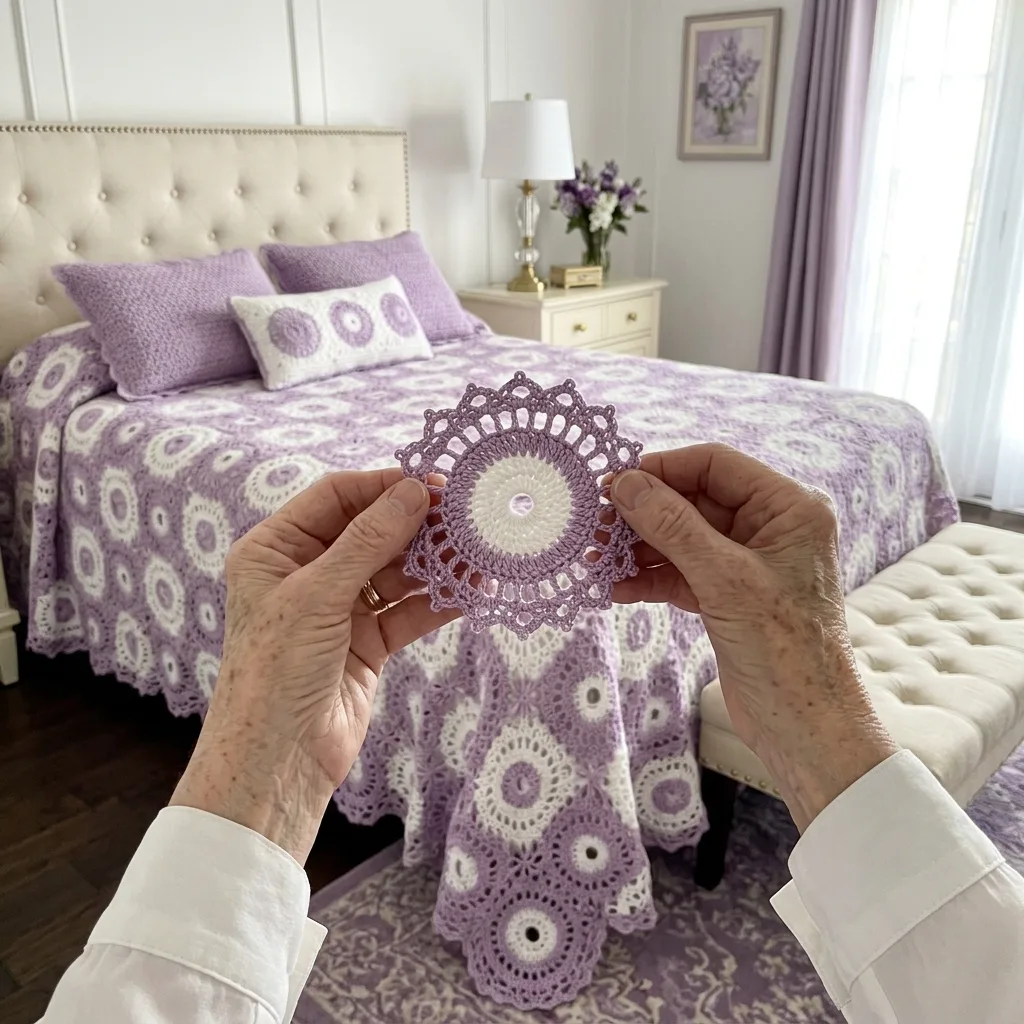
Tiny five-round motifs, easy to learn, joined as you go through their picots.
Each motif takes only about twenty-five minutes, perfect for small pockets of time.
Each motif is a tiny lace ring with an open center, like a string of pearls around a window.
About This Lilac and White Lace Ring Motif Bed Cover Crochet Pattern Pattern
This bed cover is a sea of little lace rings in lilac and white. Each motif is small and round, about 5.5 inches across, with an open hole in the very center. Around the hole sits a dense ring of single crochet in the opposite color, then a solid ring of double crochet, a round of open spokes and an edge of lace loops with tiny picots. The motifs alternate lilac and white in a checkerboard, and small lilac fillers join the gaps, so the whole cover looks like a delicate, old-fashioned lace bedspread full of bubbles and rings.
The center of each motif is made in a charming, simple way. You chain twelve, join them into a ring and work 24 single crochet over the ring, packing them close together. The chain disappears inside the stitches, and you are left with a firm, round ring around an open window. The ring is worked in the contrast color, white on the lilac motifs and lilac on the white motifs, which gives each motif its crisp outline. It looks a little like a pearl bead, and it is the detail people notice first.
From there, the motif is worked in the main color in four quick rounds. A round of double crochet with increases makes the solid ring, a round of double crochet and chain spaces makes the spokes, a round of chain loops opens the lace, and a final round of small scallops with a picot at the top of each one finishes the edge. There are 16 scallops, which divide neatly into four sides of four, so the motifs fit together in a simple square grid.
From the second motif on, you join each new motif to its neighbors as you work the last round, through the picots of two scallops on each shared side. There is no sewing at all. The queen size uses 238 motifs, 119 in lilac and 119 in white, set in 14 columns and 17 rows, and 208 small lilac fillers in the gaps where four motifs meet. The finished cover measures about 76 by 92 inches, with a soft scalloped edge made by the round motifs themselves.
Two edge rounds run around the outside of the cover. A white round of chain loops links the free picots of the outer motifs, and a lilac round fills each loop with single crochet and a picot. This keeps the edge from stretching and gives it a pretty, finished frill. Because the edge follows the motifs, it works for any size of cover without any extra math.
The stitches are chain, slip stitch, single crochet and double crochet. What makes this pattern intermediate is the number of motifs and the join-as-you-go round, which takes a little practice to keep straight. Each motif, though, is quick and easy, and after a few, you will know it by heart. It is a wonderful project for anyone who loves small, portable pieces and the gentle satisfaction of watching a big lace cover grow motif by motif.
The finished cover is light, airy and very feminine. The open rings let the light and the color of the bed show through, and the alternating lilac and white create a lovely, rhythmic pattern. Lilac and white suit a romantic bedroom with cream furniture, floral paintings and purple flowers, a girl's room or a guest room with a vintage feel. It is the kind of cover that makes a bedroom feel like a soft, dreamy hideaway.
Why You'll Love This Lilac and White Lace Ring Motif Bed Cover Crochet Pattern Pattern
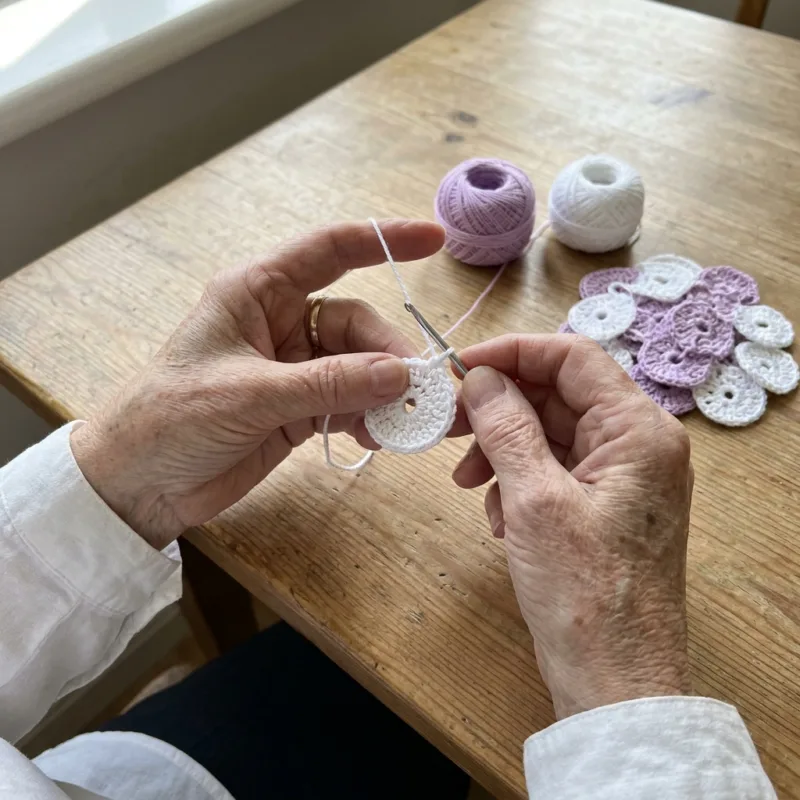
I love tiny motifs, and these little rings are some of my favorites ever. Each one takes only about twenty-five minutes, from the chain ring to the last picot, so I can finish one while waiting for an appointment, on a short train ride or during a coffee break. They fit in a small zip bag with two balls of yarn and a hook, and I took a bag of them with me on a summer holiday and came home with more than forty finished motifs.
The center ring is so satisfying to make. You chain a small circle and pack it full of single crochet, and suddenly you have a firm little ring like a bead. Then the main color takes over and the motif blooms outward in quick rounds: the solid ring, the spokes, the loops and the picots. Watching it grow from a tiny ring into a lacy circle in a few minutes never gets old.
I love the checkerboard of lilac and white. Switching colors with every motif keeps the work fresh, and the two motifs are almost mirror images, one with a white ring and lilac lace, the other with a lilac ring and white lace. When they join, the colors seem to dance across the bed. From across the room, the cover looks like a soft lavender field dotted with white blossoms.
Here are the habits that made this project easy for me:
- Make motifs in pairs, one lilac and one white, so the checkerboard stays even.
- Pack the single crochet tightly over the center ring so it stays round.
- Weave in the center ring ends before you start the main color.
- Keep a tally of finished motifs on a little card in your bag.
Joining as I go is one of my favorite parts of this cover. With every new motif, I slip stitch two of its picots into the motif beside it and two into the motif above, and the cover grows into one piece right on my lap. I never have to face a mountain of sewing at the end. The fillers go in quickly too, and suddenly all the little gaps close up into a neat, lacy grid.
The colors make me feel calm and happy. Lilac is soft and gentle, like spring lilacs or a lavender field at dusk, and white keeps it light and fresh. With lilac curtains, purple flowers in a vase and a cream tufted headboard, this cover turns a bedroom into a romantic, peaceful retreat. It looks lovely in every season, cool and airy in summer and pretty over a warm blanket in winter.
Finally, I love that this cover is made from so many small, happy moments. Each motif is a little finished thing, and every one of the 238 represents a quiet half hour of crochet. Together they become something truly beautiful. I hope you enjoy every one of those moments, and I hope your finished cover becomes a treasured part of your home.
Switch Things Up
Choose a new color pair. The ring motifs look lovely in many color pairs. Sky blue and white feel fresh and coastal, blush pink and ivory look soft and romantic, and sage green and cream feel calm and natural. For a bold look, try navy and white or deep teal and cream. Keep one color light and one a little deeper, and use the deeper color for the fillers, so the checkerboard stands out clearly.
Make it for any bed. Each motif is about 5.5 inches across, so new sizes are easy to plan. Add or remove columns for the width and rows for the length. The number of fillers is always one less than the columns times one less than the rows. These sizes are before the edge rounds:
- Twin: 11 by 17 motifs, 187 motifs and 160 fillers, about 59 by 92 inches
- Full: 13 by 17 motifs, 221 motifs and 192 fillers, about 70 by 92 inches
- Queen: 14 by 17 motifs, 238 motifs and 208 fillers, about 76 by 92 inches
- King: 17 by 17 motifs, 289 motifs and 256 fillers, about 92 by 92 inches
The edge rounds follow the free scallops of the outer motifs, so they work for any size.
Make a sofa throw. Nine columns by eleven rows, 99 motifs and 80 fillers, makes a throw of about 49 by 59 inches. It uses about 40 percent of the yarn and is a lovely way to enjoy the pattern without committing to a whole bed. Draped over a cream sofa or folded at the foot of a bed, it adds a soft, romantic touch to any room.
Make a baby blanket. Seven columns by eight rows, 56 motifs and 42 fillers, gives a blanket of about 38 by 43 inches. For a baby, choose a soft, washable cotton blend in pale shades, and add one extra round of single crochet around the center ring of each motif before Rnd 2, so the center holes are smaller. Weave in every end very securely, and use it as a light pram or cot cover.
Make table linens. Small motifs are perfect for table linens. A row of 3 by 9 motifs makes a pretty table runner, 5 by 5 motifs make a square table topper, and a single motif with the edge rounds makes a sweet coaster or a doily under a vase. In white alone, the motifs look like classic vintage lace and suit any table.
Change the color plan. Instead of a checkerboard, try stripes, with whole rows of lilac and whole rows of white. Or make a large lilac diamond in the middle of the bed, surrounded by white motifs. You can also use three colors, adding a soft purple for the center rings of all the motifs, which ties the cover together. Lay out a few motifs before you decide.
Change the edge. The picot edge is light and dainty. For a deeper frill, add a third round of shells, working 5 dc in each picot of the second round with a sc between. For a straighter edge, fill the dips between edge motifs with half fillers before the edge rounds. You could also work both edge rounds in lilac for a soft, even frame around the whole cover.
Change the yarn weight. In DK or sport cotton with a 4 mm hook, each motif comes out about 4.5 inches, which looks finer and lacier, so a queen needs about 17 by 21 motifs. In bulky yarn with a 6 mm hook, the motifs grow to about 7 inches, so a queen needs only 11 by 13 motifs. Always make two motifs first, join them and measure before you plan.
Materials Needed
— Main Fabric
— Tools Required
The Free Pattern
0% complete
— Lace Ring Motif (Make 238: 119 lilac and 119 white) :
— Layout :
— Lilac Filler (Make 208, lilac) :
— Edge :
Assembly Instructions
- Make one lilac motif and one white motif, block them and check that each is about 5.5 inches across.
- Make the center rings of the motifs in the contrast color and weave in their ends before adding the main color.
- Work Rnds 2 to 5 of each motif, joining each new motif during Rnd 5 to the one on its left and the one above it, in a lilac and white checkerboard, until you have 17 rows of 14 motifs.
- Work a lilac filler in each of the 208 gaps where four motifs meet.
- Work the white and lilac edge rounds around the outside of the cover.
- Weave in all remaining ends, then pin the cover out, spray it lightly with water and let it dry flat so every ring and picot opens.
Common Mistakes & How to Fix Them
A center ring that is too tight or too loose. If you pack too few single crochet over the chain ring, the ring looks thin and the chain shows through. If you work them loosely, the ring stretches and the center hole becomes oval. Work exactly 24 sc and push them close together along the chain as you go, so the ring is firm and round. Keep the chain ring at the same size for every motif. A ring that is too tight will cup the motif, so if your motif bowls, try a slightly looser chain.
Losing the spoke count. Rnd 3 must have exactly 16 spokes, which gives 16 loops in Rnd 4 and 16 scallops in Rnd 5. If you skip two dc instead of one, or forget to skip, you end up with 15 or 17 scallops, and the motif will not divide into four sides of four. Then the joins and the fillers fall in the wrong places. Count the dc of Rnd 2, which should be 32, and count the spokes of Rnd 3 before you close the round. It takes a few seconds and saves a lot of frustration.
Breaking the checkerboard. With 238 motifs in two colors, it is easy to join two lilac motifs side by side by mistake, especially when you pick up a motif from a mixed bag. One wrong motif breaks the checkerboard and is very easy to see on the finished bed. Keep lilac and white motifs in separate bags, and remember the simple rule: odd rows start with lilac, even rows start with white, and the colors always alternate. Check the colors of the left and upper neighbors before you start each joining round.
Joining motifs in the wrong orientation. Every motif must be held with scallop 1 at the top left, so its joining scallops face the right neighbors and its corner scallops face the gaps. Because the motifs are small and round, it is easy to turn one slightly when you pick it up. Place a small stitch marker in scallop 1 of every motif, and hold it at the top left when you join. If a filler cannot reach a corner picot without stretching, a motif nearby is probably turned.

You Might Also Like
Important Notes
Gauge matters because 238 motifs must fit together. With a 5 mm hook, Rnds 1 and 2 should measure about 2.6 inches across, and the finished motif about 5.5 inches. Small differences add up over 17 rows, so measure your first five motifs of each color and then one in every twenty. If your lilac and white motifs come out different sizes, adjust your hook for one color.
Block the cover once all the motifs, fillers and edge rounds are done. Pin it out on a large clean surface or in sections, opening each ring into a round shape and pinning the picots out. Spray it with water until damp and let it dry completely before unpinning. Blocking opens the spokes and loops, makes every center hole round and turns the lace from crumpled to crisp and even.
The yarn amounts in the materials list are estimates for the queen size, including the fillers and edge rounds. Buy all the lilac and all the white at once, from the same dye lots, and keep the labels. Lilac in particular can vary between lots, and in a checkerboard of 238 motifs, a different shade would show as a patch of mismatched motifs. Buy one extra skein of each color for safety.
Wash the finished cover on a gentle cold cycle in a large mesh bag or a zipped duvet cover, with mild detergent. Lilac sits next to white in every motif, so add a color catcher, especially for the first few washes. Never wring or twist the lace. Press out the water, lay the cover flat, reshape the rings and picots while it is damp and let it dry fully.
Thank you for making this lilac and white lace ring bed cover with me. I hope you enjoy every little motif, from the first tiny chain ring to the last picot, and the joy of watching the checkerboard of rings grow across your lap. It is a cover made of many small, gentle moments, and every one of them adds to its beauty.
So find your lilac and white yarn, chain your first little ring today and pack it full of stitches. Finish your first motif, then its partner in the other color, and join them together. Before long, you will have a dreamy lace cover to enjoy for many years.
Crochet Abbreviations
You Ask, We Answer
How big is the finished bed cover, and how many motifs do I need?
Following the pattern exactly, each motif measures about 5.5 inches across. The queen size uses 238 motifs, 119 lilac and 119 white, in 14 columns and 17 rows, plus 208 small lilac fillers, and finishes at about 76 by 92 inches with the edge rounds. On a standard queen mattress of 60 by 80 inches, that gives a drop of about 8 inches on each side and a lacy drape at the foot. Because the motifs are small, it is easy to fine-tune the size: each extra column adds about 5.5 inches of width, and each extra row adds 5.5 inches of length. The fillers are always one less than the columns times one less than the rows, and the edge rounds work for any size. To plan your own, measure your bed plus the drop and divide by 5.5.
With so many motifs, how do I keep the project manageable?
The secret is to treat each motif as a small, complete project. Each one takes about twenty-five minutes, so set a gentle goal, such as two or three motifs a day, and you will be surprised how quickly they add up. Make the center rings in batches, because you can work them while chatting or watching television, then add the main color later. Keep lilac and white motifs in separate bags, and keep a tally card so you always know how many you have. Join as you go from the start, so you never face a pile of loose motifs. Weave in ends right away, at least the center ring ends, because weaving in 476 ends at the end would feel endless. Many people find that this steady rhythm makes a big project feel calm and achievable.
How do I care for and store the bed cover so it lasts?
Wash it only when it really needs it, on a gentle cold cycle in a large mesh bag with mild detergent, and use a color catcher for the first few washes, because lilac sits next to white in every motif. Dry it flat, reshaping the rings and picots while it is damp. Never use a hot dryer, which can shrink cotton and pull the lace out of shape. Between washes, shake it out gently and air it near an open window, away from strong direct sunlight, which can fade lilac over time. To store it, fold it loosely with tissue paper between the layers and keep it in a cotton bag rather than plastic so the yarn can breathe. Refold it along different lines every few months, and once a year check the fillers and joins, resewing any loose picot.
Success!
Thanks for subscribing — check your inbox for a welcome note.
Abbreviations
- ch — chain
- sl st — slip stitch
- sc — single crochet
- dc — double crochet
- picot — ch 3, sl st in 3rd ch from hook
- st(s) — stitch(es)
- sp(s) — space(s)
- rep — repeat
- Rnd — round
- RS — right side