
Sage and Cream Boho Mandala Curtain Crochet Pattern
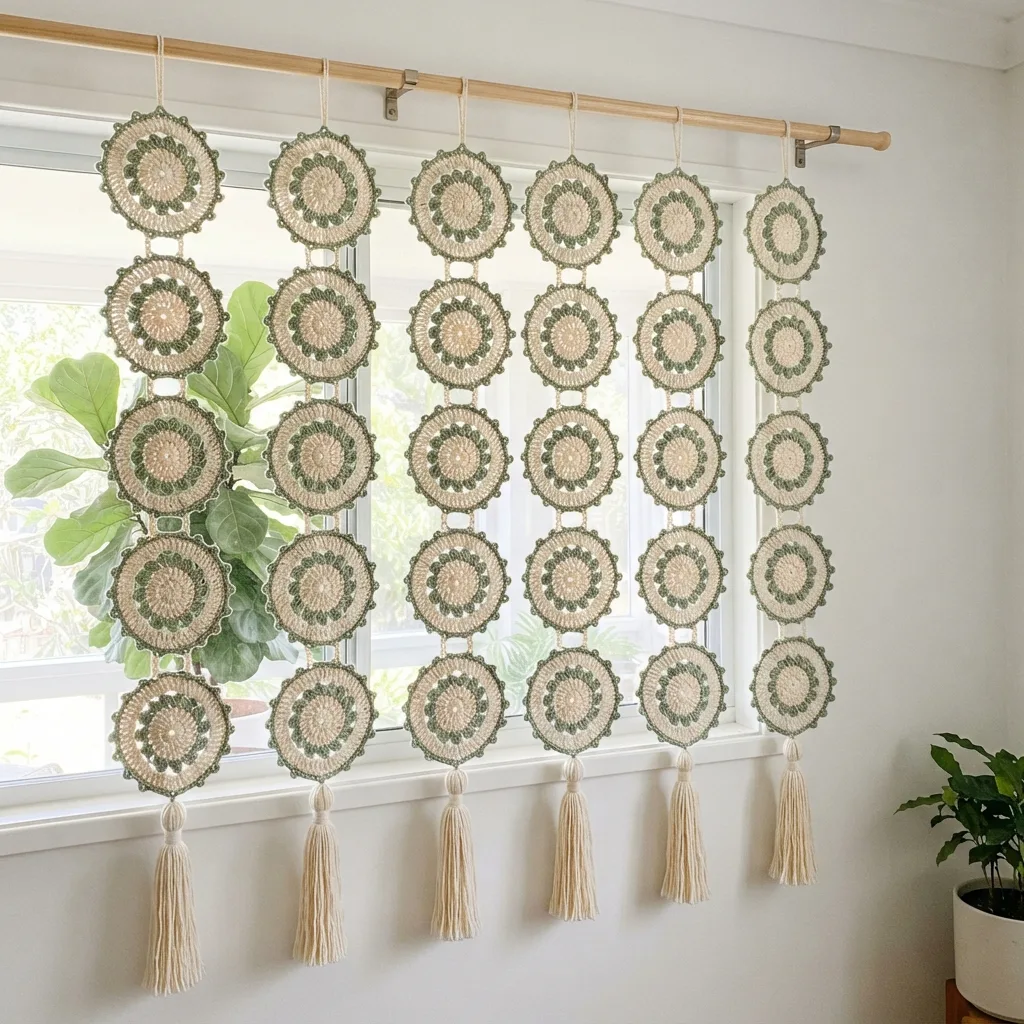
Every round uses only chains, single crochet and double crochet, so a confident beginner can make each mandala.
Each mandala takes about 45 minutes, and the long boho tassels add a few relaxing evenings at the end.
Soft sage and warm cream circles with long tassels give any window a calm, natural, boho feeling.
About This Sage and Cream Boho Mandala Curtain Crochet Pattern Pattern
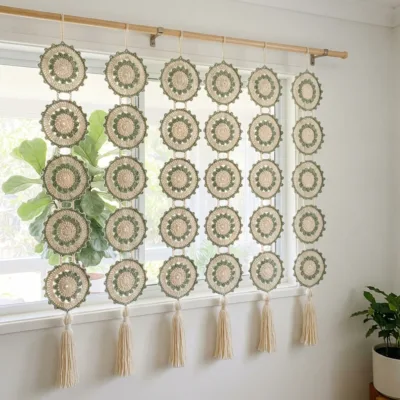
This sage and cream mandala curtain is my favorite way to bring a calm, natural feeling into a room. Instead of squares, it is made of 48 round motifs, each one a small mandala about 6 inches across. Every mandala has a solid warm cream center, a ring of soft sage green shells, a dense cream ring and a thin sage edge dotted with 12 tiny picots. The circles hang in 8 separate columns of 6, joined by short cream chains, and each column ends in an extra long, full cream tassel that gives the curtain its relaxed boho look.
Let me show you how one mandala builds up. The center is two rounds of cream double crochet, which make a flat, solid disk. Then the sage green begins, first with pairs of double crochet separated by little chain spaces, then with a round of open shells. The shells give the mandala a lacy ring that lets light shine through. After that, cream single crochet and chains link the shell tips, and a round of dense cream double crochet fills in a smooth solid band. The last round is sage single crochet with a small picot every seven stitches, which frames the circle like a delicate edging.
The finished curtain measures about 55 inches wide on the rod and about 61 inches long from the top of the loops to the ends of the tassels, which is roughly 140 by 155 cm. Each mandala is about 6 inches across after blocking, each chain link adds about 2 inches, and each tassel hangs about 12 inches below its column. The extra long tassels are part of the design and make the curtain feel airy and soft at the bottom. Because every column is separate, the size is very easy to change, and I share a full size guide further down.
You only need the most basic stitches here: chain, slip stitch, single crochet and double crochet. There is no half double crochet, no post stitch and no complicated join inside the motif. The picots are just three chains made between groups of single crochet. That is why I call this a beginner pattern. The only skill you need to practice is keeping each round flat. If a circle starts to ruffle or cup, the stitch counts in each round will help you see right away where something went wrong.
The mandalas are joined into columns with doubled chain links. Two of the 12 picots on each circle sit exactly opposite each other, one at the top and one at the bottom. You chain from the bottom picot of one mandala to the top picot of the next, then slip stitch back up the same chain so it stays firm. A single cream loop worked into the top picot of the first mandala slides onto the rod, and the long cream tassel ties into the bottom picot of the last one.
When it hangs in a window, this curtain is soft and peaceful. The round shapes leave lots of open space, so the light pours in around every circle, and the sage shells glow gently in the sun. It looks lovely in a bedroom, a reading corner, a yoga room or a living room with plants and natural wood. In the evening, with a warm lamp behind it, the cream centers and the long tassels give the whole room a cozy, quiet mood.
This project suits a confident beginner who is ready for something bigger, and it is just as relaxing for experienced makers. Each mandala is quick and easy, but you will make 48, so patience matters more than skill. If you enjoy round motifs, simple repeats and seeing a large piece grow slowly, you will love it. Take your time with the first mandala, check every count, and keep it as the guide for all the others.
Why You'll Love This Sage and Cream Boho Mandala Curtain Crochet Pattern Pattern
I love this curtain because it feels like taking a deep breath. Sage green and cream are such gentle colors, and the round mandalas have a softness that squares just do not have. When I hung mine in my bedroom, the morning light coming through the circles made the whole room feel calmer. It is the kind of piece that makes you want to sit down with a cup of tea and do nothing at all for a few minutes.
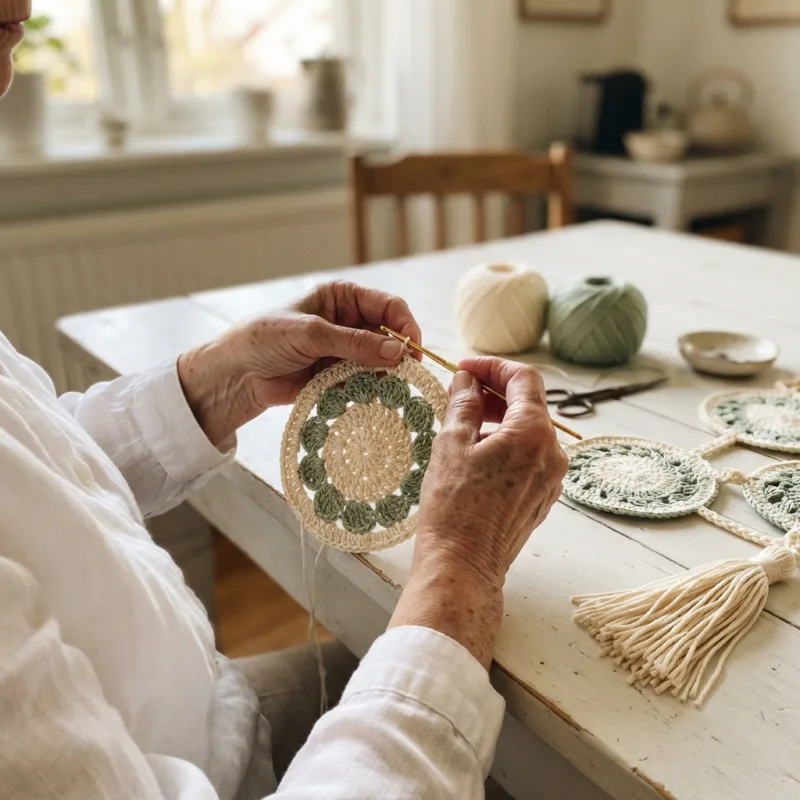
I also love how meditative the mandalas are to make. You go round and round, adding a few more stitches each time, and the circle grows in your hands like a little flower opening. There is no turning, no counting rows and no seaming. I find that after two or three rounds my mind settles, and by the time I add the picot edge, I feel more relaxed than when I started. It is my favorite project for slow evenings.
Watching the curtain grow is very rewarding. One mandala is a pretty coaster, a column of six with a long tassel already looks like a wall hanging, and eight columns together turn into a real statement for your window. I hang each column as soon as it is done, so I can see the shapes fill the window little by little. On busy weeks, even one finished column keeps me excited about the next one.
Here is what makes this pattern special to me:
- Only basic stitches, so it is very relaxing.
- The round shapes let in lots of light.
- The long tassels add a soft boho finish.
- Each mandala fits in a small project bag.
- It suits almost any calm, natural room.
This curtain is also a lovely way to use leftover yarn. The cream center needs only a small amount, and the sage rings take a little more, but nothing that a few half balls cannot cover. If you have bits of green or cream cotton in the same weight, they can go into a few of the mandalas, as long as the shades are close. I always feel good when my leftover basket turns into something I see every day.
Making this curtain taught me how much flat circles depend on even tension. My first mandala ruffled at the edge because I was working the dense cream round too tightly in some places and too loosely in others. When I slowed down and let every double crochet be the same height, the circle lay perfectly flat. Now I always lay each mandala on the table after the dense round and press it with my hand before I add the edging.
Finally, I love giving it as a gift. A boho mandala curtain is a beautiful present for a friend who loves plants and natural decor, for a new apartment or for someone who needs a calm corner in a busy home. It is used every day and admired by every visitor. Knowing that someone opens their morning with my mandalas in their window is the best part of all.
Switch Things Up
For a warm desert look, try terracotta and cream. Work the shell ring and the picot edge in a soft rust or terracotta shade and keep the centers, dense rings, chains and tassels cream. It looks wonderful with wooden furniture, rattan and dried flowers. The yarn amounts stay exactly the same, so you just swap the sage for terracotta.
A mustard and cream curtain is cheerful and still very boho. Use a golden mustard for the shells and the edging, and keep the rest cream. It brightens a north facing room and brings a sunny touch to a kitchen. For a softer romantic feel, choose dusty rose and cream instead, which looks lovely in a bedroom or a nursery with white furniture and soft textiles.
If you want the most natural look of all, make the whole curtain in all cream or an undyed natural cotton. The shells and picots still show beautifully because of their texture, and the curtain looks like a classic boho lace piece. For something a little elegant, try white with golden details, working only the picot edge in golden yellow. Both versions use the same pattern with no changes.
Resizing is simple because every column is the same. Each column is about 6 inches wide plus a 1 inch gap, and each mandala with its chain link adds about 8 inches of length. The loop and long tassel add about 15 inches to every column. Here is a quick guide:
- Narrow window, about 27 by 45 inches: 4 columns of 4 mandalas (16 mandalas).
- Standard window, about 55 by 61 inches: 8 columns of 6 mandalas (48 mandalas).
- Door, about 34 by 77 inches: 5 columns of 8 mandalas (40 mandalas).
- Room divider, about 69 by 85 inches: 10 columns of 9 mandalas (90 mandalas).
A short cafe curtain looks lovely in a kitchen or a bathroom window. Make 8 columns of only 3 mandalas, which is 24 motifs, and hang them on a rod across the middle of the window. With the long tassels the curtain will be about 37 inches long. The lower half of the window gets privacy, and the top stays open to the sky.
For a doorway curtain, follow the door layout and space the columns about 2 inches apart so you can walk through easily. Make the chain links 18 chains long instead of 12, which makes the curtain lighter and lets it sway softly when someone passes. You may want to shorten the tassels to about 6 inches so they do not catch on your shoulders. It is beautiful at a balcony or garden door.
The tassels are where you can really play. Short tassels of about 6 inches, wound 40 times around a 7 inch card, give a neat and modern finish. For a dramatic boho look, make extra long tassels of about 18 inches by winding 40 times around a 19 inch card. They look stunning on a tall window. Plan about 13 extra yards of cream for each 18 inch tassel.
You can also change the yarn weight. In sport weight cotton with a 3 mm hook, each mandala is about 5 inches across, and the standard layout becomes about 47 inches wide. In worsted cotton with a 4.5 mm hook, each mandala grows to about 7 inches, and the standard layout becomes about 63 inches wide, so 7 columns may be enough. Always make one mandala first, block it and measure it before you plan the full curtain.
Materials Needed
— Main Fabric
— Tools Required
The Free Pattern
0% complete
— Mandala Motif (Make 48, cream and sage) :
— Layout :
— Chain Links and Joining (Make 40, cream) :
— Long Tassels (Make 8, cream) :
— Top Loops and Hanging (Make 8, cream) :
Assembly Instructions
- Block all 48 mandalas into flat 6 in (15 cm) circles and lay them out in 8 columns of 6.
- Mark a top picot and the opposite bottom picot on every mandala so each column hangs straight.
- Join the mandalas in each column from the top down with 5 doubled cream chain links, for 40 links in total.
- Make 8 long cream tassels and tie one to the bottom picot of the last mandala in each column.
- Work 1 cream hanging loop into the top picot of the first mandala in each column, for 8 loops in total.
- Slide the columns onto the wooden rod in order, spacing them about 1 in (2.5 cm) apart.
- Give the hanging curtain a light steam, let it rest for a day, then trim all the tassels to the same length.
Common Mistakes & How to Fix Them
The most common problem with round motifs is a mandala that ruffles or cups instead of lying flat. Ruffles happen when there are too many stitches for the size of the round, often because the dense cream round is worked too tightly. Cupping happens when the stitches are too few or the tension is too tight overall. Check the counts after every round, especially 84 dc in Round 6. Then lay the mandala on the table and press it flat with your hand. If it ruffles, relax your tension. If it cups, try going up half a hook size for that round.
Another common mistake is losing a shell in Round 4, so you end up with 11 or 13 shells instead of 12. This happens because the sl st at the start of the round makes the first ch-2 sp easy to miss or to use twice. With the wrong number of shells, Round 5 no longer has 12 chain spaces and the picots will not line up opposite each other. After Round 4, count your shells before fastening off the sage. Placing a marker in the first shell makes it easy to see where the round started and ended.
Columns can hang crooked if the chain links are attached to picots that are not exactly opposite each other. It happens easily because all 12 picots look the same, and it is tempting to grab the nearest one. Even one picot off makes each mandala tilt, and the whole column zigzags down the window. Before joining, mark the top picot and count 6 picots around to find the bottom one, then mark it too. Always slip stitch back up each link so the chain stays firm, and use exactly 12 chains every time.
Long tassels can look thin, tangled or uneven, and with 12 inch strands any difference shows right away. This happens when the yarn is wound loosely, when the wrap count changes from tassel to tassel, or when you trim before the curtain has hung. Wind exactly 40 times for each tassel with the same gentle tension, tie the top very tightly and wrap the neck firmly. After the curtain has hung for a full day, comb the strands with your fingers, then trim all the tassels together with sharp scissors while they hang straight down.

You Might Also Like
Important Notes
Gauge for this curtain is one mandala of 6 inches (15 cm) across after blocking, made in DK cotton with a 3.5 mm hook. The cream center after Round 2 should be about 2 inches across. If your mandala is larger, go down half a hook size, and if it is smaller, go up half a size. Consistency matters more than an exact match, because every circle in a column needs to be the same size. Keep your first mandala as your measuring sample.
Block every mandala before you join it. Pin it into a 6 inch circle on a blocking mat, placing a pin in each of the 12 picots so they point outward evenly, then spray it until damp and let it dry fully. A circle template drawn on paper under the mat makes this quick and accurate. After assembly, give the hanging curtain a light steam to relax the chain links and help the long tassels hang straight.
This curtain uses about 1,010 yards of cream and 635 yards of sage DK cotton, which includes the long tassels, the chain links and the hanging loops plus a little extra for your gauge mandala. Buy all the yarn for each color from the same dye lot at the same time. Soft greens and creams can shift a lot between lots, and the difference shows clearly when two columns hang side by side in daylight.
The finished curtain weighs about 600 grams, and the long tassels add a lot of that weight, so use a sturdy rod with brackets screwed into the wall instead of a tension rod. Wash it by hand in cool water with mild soap, or on a gentle machine cycle inside a mesh laundry bag. Add a color catcher sheet as a safe habit, because the sage is washed with the cream. Press out the water in a towel and lay each column flat to dry.
I hope this sage and cream mandala curtain brings a little calm into your home every day. It may look like a big project, but it is made of small, peaceful circles, and each one you finish is a quiet moment just for you. When the last column goes up and the light comes through all those soft rings, I think you will love the feeling it gives your room.
So do not think about all 48 mandalas today. Just pick up your cream yarn, make that first little circle and add your sage shells. Then make another one tomorrow. Round by round, your window will turn into a gentle boho haven. Happy crocheting, and thank you for making this with me.
Crochet Abbreviations
You Ask, We Answer
What is the finished size of this curtain?
As written, the curtain measures about 55 inches wide on the rod and about 61 inches long from the top of the hanging loops to the ends of the tassels, which is roughly 140 by 155 cm. It is made of 8 columns with 6 mandalas in each, so 48 round motifs in total. Each mandala is about 6 inches across after blocking, each chain link adds about 2 inches, and each long tassel hangs about 12 inches below the last mandala. The width allows for a gap of about 1 inch between columns, which you can change a little by sliding the loops along the rod. To make the curtain bigger or smaller, change the number of columns for width and the number of mandalas for length. Each extra column adds about 7 inches of width, and each extra mandala with its link adds about 8 inches of length. Measure your window before you start so you know exactly how many to make.
Can I use a different yarn weight or make it in another size?
Yes, the pattern works in any yarn weight, and the stitch counts stay exactly the same. Only the size of each mandala and the amount of yarn change. In sport weight cotton with a 3 mm hook, each mandala is about 5 inches across. In DK with a 3.5 mm hook it is about 6 inches, and in worsted cotton with a 4.5 mm hook it grows to about 7 inches. A heavier yarn also makes a heavier curtain, especially with the long tassels, so check that your rod and brackets can hold it. I suggest cotton or a cotton blend, because it lies flat, shows the shells and picots clearly and does not stretch over time. Whatever you choose, crochet one mandala first, block it and measure it. Then divide your window width by that size plus the gap to find the number of columns, and divide the length the same way to find the mandalas per column.
How do I wash and care for the curtain?
Slide the columns off the rod before washing so the loops and chain links do not stretch. Hand washing in cool water with a mild wool or baby soap is the gentlest option. If you prefer the machine, put each column in a mesh laundry bag and use a cold, gentle cycle with a slow spin, because the long tassels can tangle in a fast wash. Add a color catcher sheet as a safe habit, since the sage is washed together with the cream. Never wring the curtain. Roll each column in a large towel and press to remove the water. Then lay the columns flat on a dry towel, pat each mandala back into a round shape, point the picots outward and comb the tassels straight with your fingers. Avoid the dryer, because heat can shrink cotton and make the circles uneven. When everything is dry, hang it back up and let it settle for a day.
Success!
Thanks for subscribing — check your inbox for a welcome note.
Abbreviations
- ch — chain
- sl st — slip stitch
- sc — single crochet
- dc — double crochet
- st(s) — stitch(es)
- sp(s) — space(s)
- rep — repeat