Amanda's Creative Corner Crochet · Kitchen
Free Crochet Patterns Handmade with Love

Blue and Caramel Filet Square Checkerboard Bed Cover Crochet Pattern
Jump to Pattern
Blue and Caramel Filet Square Checkerboard Bed Cover Crochet Pattern
60-90 Hours 0 made this
Beginner Friendly

You only need chain, slip stitch, single crochet and double crochet.

60-90 Hours

Each 12 inch square works up in an evening or two and travels easily.

Bold Checkerboard

Three colors in a diagonal pattern and chunky tassels give a cozy, modern look.

About This Blue and Caramel Filet Square Checkerboard Bed Cover Crochet Pattern Pattern

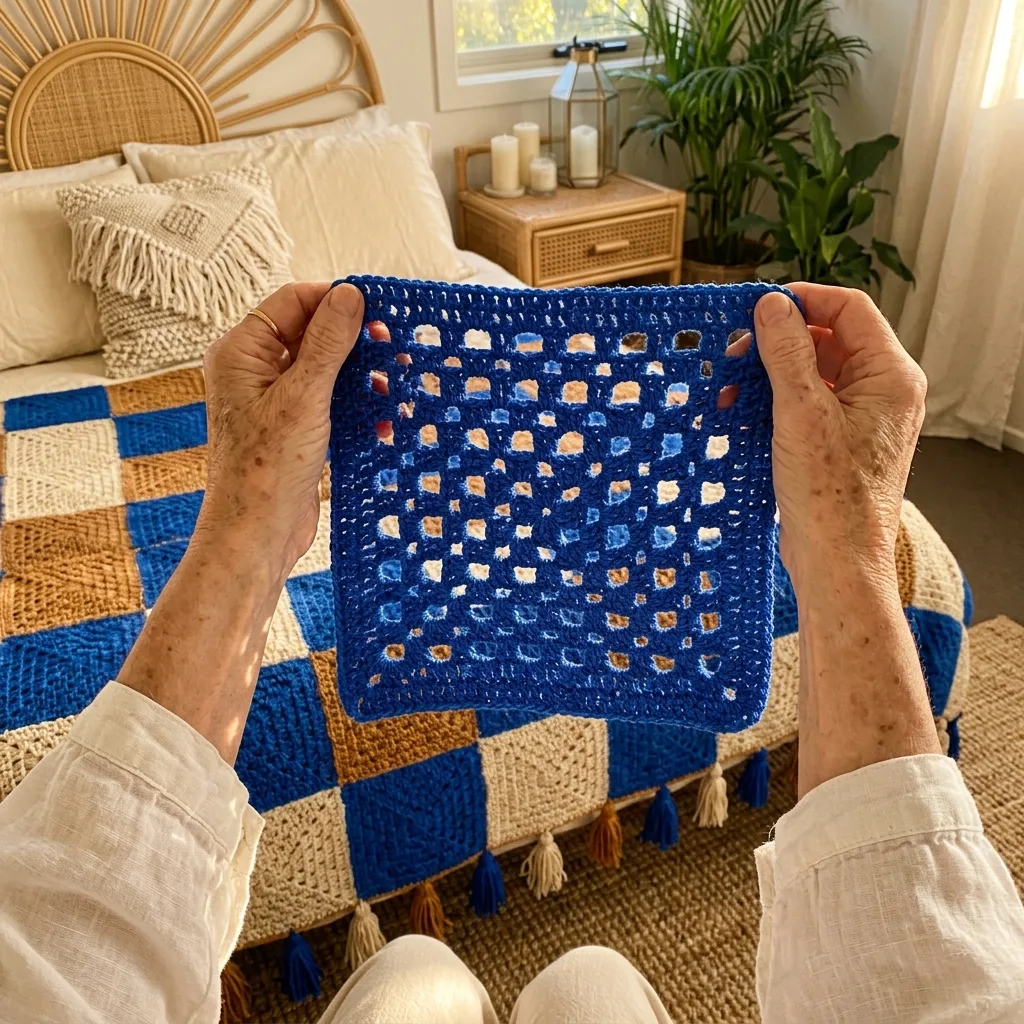
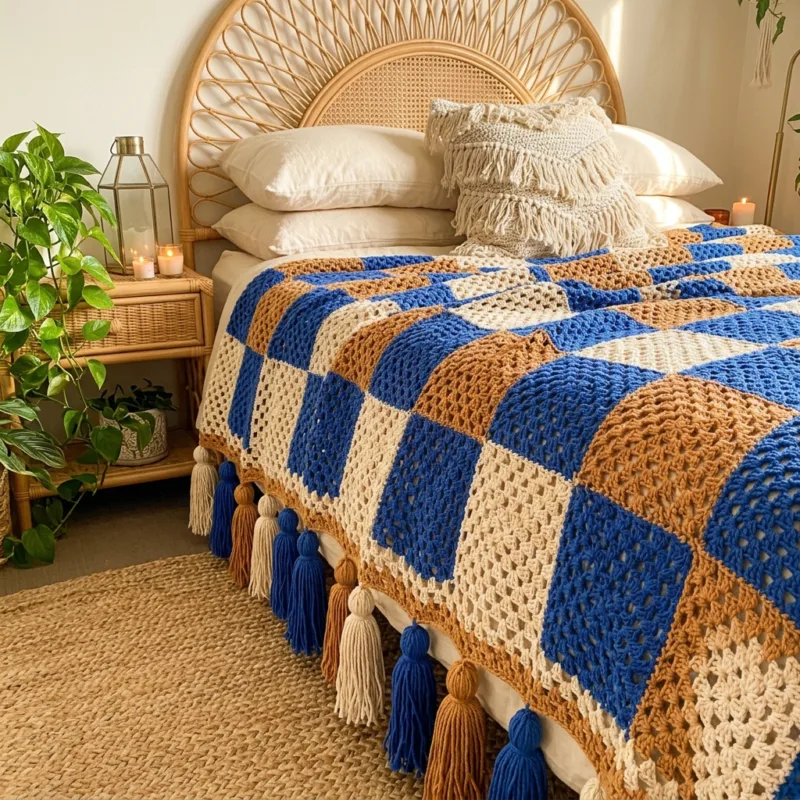
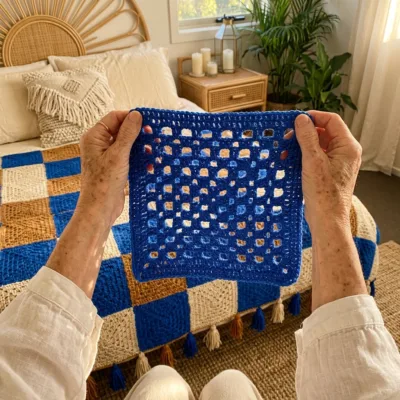
This bed cover is made from 30 open mesh squares, each 12 inches wide, set in a grid of 5 columns by 6 rows. Ten squares are royal blue, ten are caramel and ten are cream, placed in a diagonal checkerboard. Every square is a simple filet grid of 7 by 7 square holes with a solid border.

The squares are joined with slip stitch seams, edged with three rounds of single crochet in royal blue and finished with chunky tassels. It measures about 63 by 75 inches before the tassels, works in US terms and suits anyone who has made a few rows of double crochet and wants a big, rewarding project.
Blue and Caramel Filet Square Checkerboard Bed Cover Crochet Pattern step detail

Why You'll Love This Blue and Caramel Filet Square Checkerboard Bed Cover Crochet Pattern Pattern

I love that every square is small and portable. You can crochet one on the sofa, on a trip or at a friend's house, and the bed cover grows a little each day.

I also love the bold colors. Deep blue, warm caramel and soft cream look rich together, and the tassels make the bed feel finished and cozy.

Switch Things Up

Try forest green, rust and cream for an autumn look, or two soft shades of gray with white for a calm bedroom. Make 12 squares in a 3 by 4 grid for a throw, or 20 squares in a 4 by 5 grid for a twin cover. You can also skip the tassels for a clean edge, or use all one color for the tassels.


Materials Needed

— Main Fabric

01 Bulky weight (5) cotton or cotton blend yarn, royal blue: about 1,000 yards for 10 squares, the border and the tassels
02 Bulky weight (5) cotton or cotton blend yarn, caramel: about 850 yards for 10 squares and the tassels
03 Bulky weight (5) cotton or cotton blend yarn, cream: about 850 yards for 10 squares and the tassels
04 Buy a little extra of each color, because dye lots can vary and the cover is heavy

— Tools Required

05 6.0 mm (J-10) crochet hook
06 Yarn needle
07 Stitch markers
08 Scissors
09 Blocking mats and pins
10 Measuring tape
11 A 6 inch piece of cardboard for making tassels

The Free Pattern

Beginner 60-90 Hours

0% complete

— Filet Square (Make 30: 10 royal blue, 10 caramel, 10 cream) :

Each square is worked flat in rows, then edged with three rounds of single crochet. The mesh makes 7 square holes across and 7 down. Space means ch 1 and skip 1 stitch. In every mesh row the skipped stitches sit above the skipped stitches of the previous mesh row, so the holes line up.
Foundation: Ch 23. (23 ch)
Row 1 (solid): Dc in the 4th ch from the hook (the skipped 3 chains count as the first dc) and in each of the remaining ch across. Ch 3 and turn. (21 dc)
Row 2 (mesh): Dc in each of the next 3 dc (4 dc including the turning chain), *ch 1, skip 1 dc, dc in the next dc; repeat from * 6 more times (7 times in all), dc in each of the last 3 dc. Ch 3 and turn. (14 dc and 7 ch-1 sps)
Row 3 (solid): Dc in each dc and in each ch-1 sp across, the last dc in the top of the turning chain. Ch 3 and turn. (21 dc)
Rows 4 to 15: Repeat Rows 2 and 3 six more times. Row 14 is a mesh row and Row 15 is a solid row. Do not turn after Row 15 and do not fasten off. You now have 7 mesh rows and 8 solid rows. (Row 15: 21 dc)
Round 1 (sc edging): Ch 1, 3 sc in the last dc of Row 15 (corner), sc evenly down the side (19 sc: 1 sc in each of the 15 row ends and 2 sc in 4 of them, spaced evenly), 3 sc in the first foundation ch (corner), sc in each of the 19 foundation ch between the corners, 3 sc in the last foundation ch (corner), sc evenly up the other side (19 sc, worked the same way), 3 sc in the first dc of Row 15 (corner), sc in each of the 19 dc between the corners, join with sl st to first sc. (88 sc: 19 on each side plus 3 in each corner)
Round 2 (sc edging): Sl st into the center sc of the first corner, ch 1, 3 sc in the same sc, *sc in each of the next 21 sc, 3 sc in the center sc of the next corner; repeat from * twice more, sc in each of the last 21 sc, join with sl st to first sc. (96 sc: 21 on each side plus 3 in each corner)
Round 3 (sc edging): Sl st into the center sc of the first corner, ch 1, 3 sc in the same sc, *sc in each of the next 23 sc, 3 sc in the center sc of the next corner; repeat from * twice more, sc in each of the last 23 sc, join with sl st to first sc. Fasten off and weave in the ends. (104 sc: 23 on each side plus 3 in each corner)
Before the three edging rounds the mesh panel should measure about 9 inches square, and after the edging each square should measure about 12 inches. Make one test square first. If it is smaller or larger, change your hook size.

— Layout (5 columns x 6 rows) :

Lay the 30 squares out in 6 rows of 5 so the colors run in diagonal stripes. B = royal blue, C = caramel, W = cream.
Row 1: B, C, W, B, C. Row 2: C, W, B, C, W. Row 3: W, B, C, W, B. Row 4: B, C, W, B, C. Row 5: C, W, B, C, W. Row 6: W, B, C, W, B.
This gives 10 squares of each color. The joined center measures about 60 x 72 inches before the border.

— Border (Make 1, royal blue, worked around the whole cover) :

Work the border in the round with the right side facing. Along each square edge there are 23 sc between the corner points. Work 1 sc in each seam where two squares meet, and 3 sc in each of the 4 outer corners.
Round 1 (royal blue): Join royal blue in any outer corner, ch 1, 3 sc in the same st, *sc in each sc along the edge (23 sc per square) and 1 sc in each seam, 3 sc in the next outer corner; repeat from * around, join with sl st to first sc. (536 sc: 119 on each top and bottom edge, 143 on each long side, plus 3 in each corner)
Round 2 (royal blue): Sl st into the center sc of the first corner, ch 1, 3 sc in the same sc, *sc in each sc across to the next corner center sc, 3 sc in the corner center sc; repeat from * around, join with sl st to first sc. (544 sc: 121 on each top and bottom edge, 145 on each long side, plus 3 in each corner)
Round 3 (royal blue): Sl st into the center sc of the first corner, ch 1, 3 sc in the same sc, *sc in each sc across to the next corner center sc, 3 sc in the corner center sc; repeat from * around, join with sl st to first sc. Fasten off and weave in the ends. (552 sc: 123 on each top and bottom edge, 147 on each long side, plus 3 in each corner)

— Tassels (Make about 70: royal blue, caramel and cream) :

Wrap yarn 12 times around a 6 inch piece of cardboard. Cut a 12 inch length of the same yarn, slide it under the wraps at the top and tie it tightly. Cut the wraps at the bottom and slide the cardboard out.
Wrap a separate piece of yarn around the tassel about 1 inch below the top, tie it off and tuck the ends inside. Trim the bottom evenly.
Attach one tassel in every 6th stitch of Border Round 3 along the foot and both long sides of the cover, about 21 tassels across the foot and about 25 on each side. Pull the top tie through the stitch with a crochet hook and knot it on the back. Repeat the colors in the order blue, caramel, cream.

Assembly Instructions

  1. Make 10 royal blue, 10 caramel and 10 cream Filet Squares, weave in all ends and block every square to 12 inches.
  2. Lay the squares out on a large floor or bed in 5 columns by 6 rows, following the diagonal color plan in the Layout section.
  3. Join the squares into 6 strips of 5. Hold two squares with right sides together and slip stitch through the back loops of both edges from corner to corner (25 stitches including the corners), using royal blue yarn.
  4. Join the 6 strips in the same way, matching the seams, and slip stitch through all four corners where four squares meet.
  5. Work Border Rounds 1 to 3 around the whole cover in royal blue.
  6. Block the finished cover flat with mats and pins, shaping the edges, and let it dry fully.
  7. Make the tassels and attach them along the foot and both long sides of the cover.

Common Mistakes & How to Fix Them

Skipping the wrong stitch in a mesh row makes the holes drift out of line, so always skip the stitch that sits above the skipped stitch of the last mesh row.

Changing the turning chain count makes the sides wavy, so ch 3 at the end of every row and count 21 stitches before you continue.

Squares of different sizes cause wavy seams, so measure each one and block it to 12 inches before joining.

Tight joins pull the cover in, so keep your slip stitches loose and the same tension as your crochet.


Denise

Denise designs cozy granny square blankets and home decor patterns, and she writes every round with exact stitch counts so you can follow along with confidence.


Important Notes

Gauge: the filet panel before the edging should measure about 9 inches square, and each finished square about 12 inches, with a 6.0 mm hook. Make one test square before you start.

Yarn amounts are approximate and the cover is heavy, so buy a little extra of each color.

Blocking helps the open mesh lie flat and keeps the holes square.

Wash the finished cover in cold water on a gentle cycle and dry it flat.


I hope you enjoy making this blue and caramel bed cover as much as I enjoyed designing it. Take it one square at a time, and share it with someone you love when it is done.

Crochet Abbreviations

01 ch — chain
02 sl st — slip stitch
03 sc — single crochet
04 dc — double crochet
05 sp(s) — space(s)
06 st(s) — stitch(es)

You Ask, We Answer

How big is the finished bed cover?

It measures about 63 by 75 inches after blocking, not counting the tassels, which suits a twin bed or works as a generous cover on a larger bed.

Can I use a different yarn weight or make it larger?

Yes. A different yarn weight changes the square size, so make a test square first. For a larger cover, add one column and one row, keep the diagonal color plan and buy about 25 percent more yarn.

How do I wash it?

Wash it in cold water on a gentle cycle and lay it flat to dry. Cotton yarn can soften and relax a little with washing, which adds to its charm.