
Green and Cream Triangle Bedspread Crochet Pattern
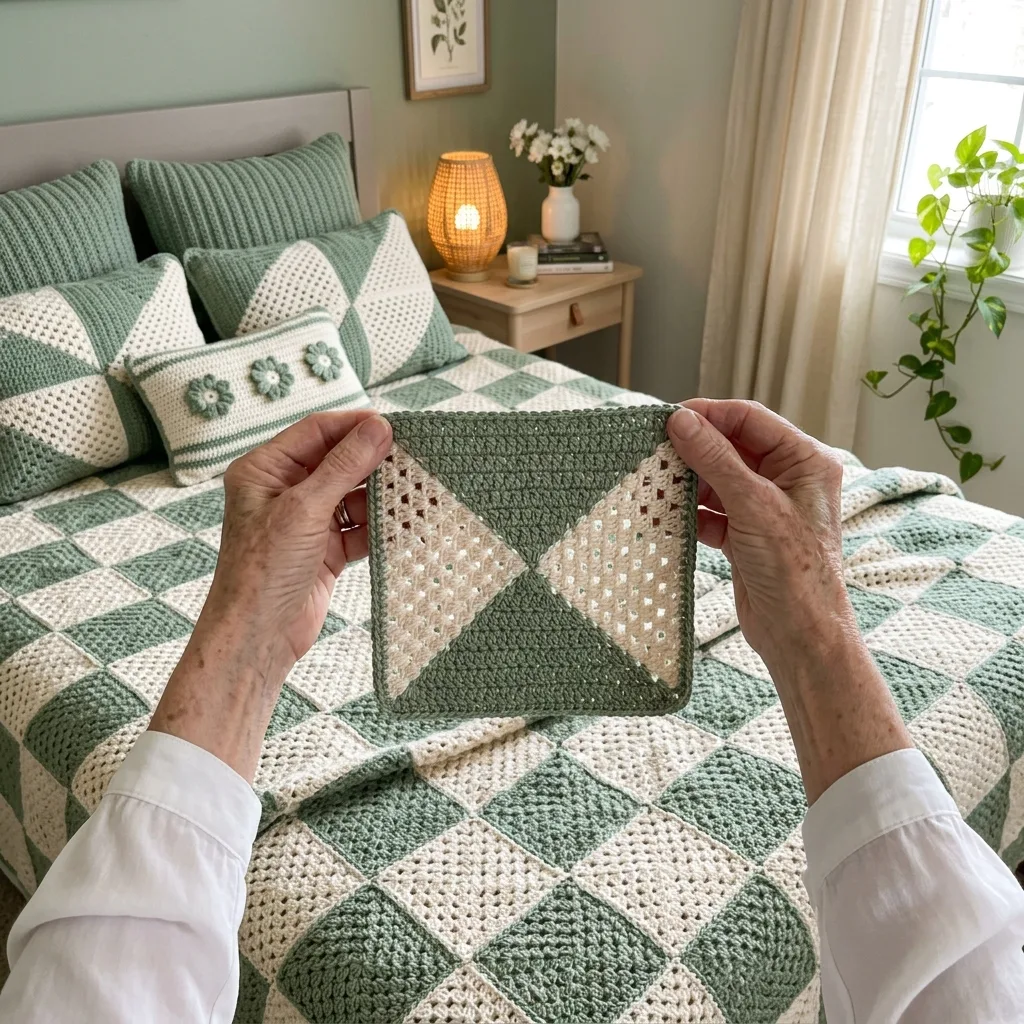
You need to be comfortable with half double crochet, double crochet clusters and sewing seams.
Forty-two portable blocks make this a big project you can work on a little at a time.
Green and cream triangles meet in the center and form diamonds across the whole cover.
About This Green and Cream Triangle Bedspread Crochet Pattern Pattern
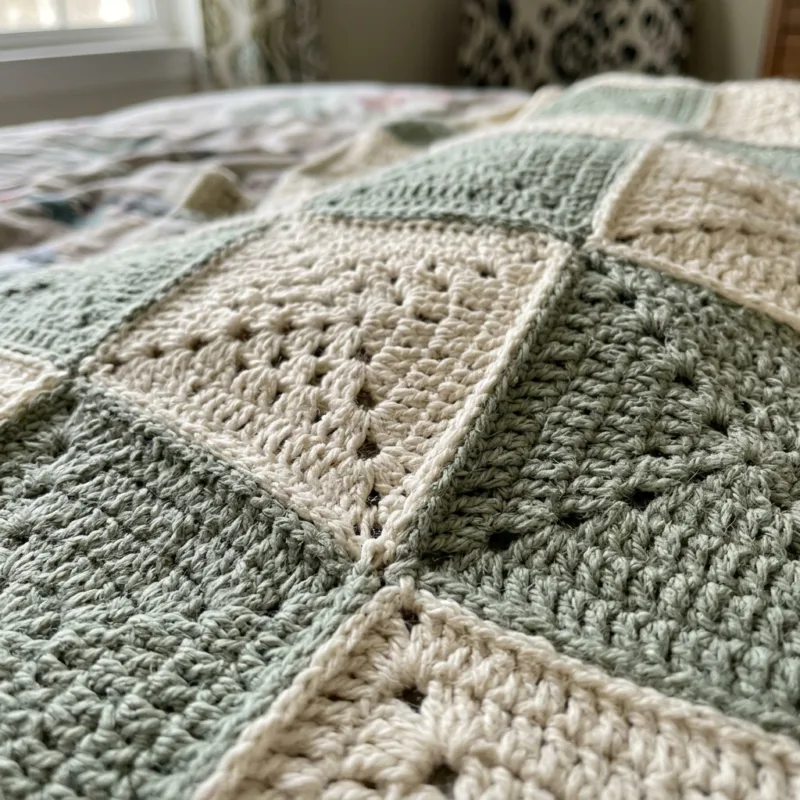
This bedspread is made from 42 square blocks. Each block is built from two sage-green triangles worked in dense half double crochet and two cream triangles worked in open double crochet clusters with small square holes. The four triangles meet at the center, and when the blocks are joined the green and cream triangles form a checkerboard of diamonds.
The finished size is about 72 by 84 inches, with each block measuring about 12 inches. You will use half double crochet, double crochet clusters, single crochet and a little sewing. It suits crocheters who have finished a few blankets and want a calm, classic cover for the bedroom.
Why You'll Love This Green and Cream Triangle Bedspread Crochet Pattern Pattern
I love that every triangle is small and easy to carry. You can make a green triangle on the sofa, then a cream one while you wait for an appointment.
Sage green and cream are quiet colors that suit almost any bedroom. The dense green and the airy cream sit side by side, and I never get tired of looking at them.
Switch Things Up
Try navy and cream, terracotta and cream, or soft gray and white. Make 4 by 5 blocks for a lap throw, or add a row and a column for a larger bed. You can also sew one block into a pillow cover to match, or add a simple shell edge in place of the plain green border.
Materials Needed
— Main Fabric
— Tools Required
The Free Pattern
0% complete
— Green Triangle (Make 84, green) :
— Cream Triangle (Make 84, cream) :
— Block Assembly (Make 42) :
— Layout and Joining :
— Outer Edge (green) :
Assembly Instructions
- Make 84 green triangles and 84 cream triangles, and weave in the ends except the long sewing tails.
- Make each block by laying out 2 green and 2 cream triangles with the green on the top and bottom, then sew the 4 diagonal seams with mattress stitch.
- Work Rounds 1 and 2 of the Block Assembly around each square, then block all 42 squares to about 12 inches and let them dry.
- Lay the blocks out in 6 columns and 7 rows with every block facing the same way, as in the Layout and Joining section.
- Join the blocks into 7 strips of 6, then join the strips, working 52 sl st on every seam.
- Check that the green triangles of the blocks above and below each other meet in green diamonds and the cream triangles meet in cream diamonds.
- Work the Outer Edge around the whole cover, then block the edge lightly and weave in the last ends.
Common Mistakes & How to Fix Them
Losing count in the green triangle. Check that every row has 2 more stitches than the one before, so Row 24 has exactly 48 hdc.
Skipping the clusters at the row ends in the cream triangle. Always work the first cluster in the first st and the last cluster in the last st, or the triangle will lean to one side.
Sewing the diagonal seams without easing. The green side has 24 rows and the cream side has 16, so match 3 rows to 2 rows to keep the seam flat.
Turning a block the wrong way when you join. If the green and cream are not on the same sides in every block, the diamonds will not line up.

You Might Also Like
Important Notes
Gauge: 16 hdc measure about 4 inches wide, and 4 cream clusters measure about 3 inches wide. Each block should block to about 12 inches square. Make one block first and change your hook size if needed.
Yarn amounts and sizes are estimated from the photo, so buy a little extra green and cream and keep the same dye lot together.
Block the finished cover flat so the open holes in the cream triangles stay square and even.
Wash gently in cool water with a color catcher, because the green yarn can bleed onto the cream. Dry flat.
I hope you enjoy watching the diamonds appear as the blocks come together. Send me a message when your first block is joined, I would love to hear how it turned out.
Crochet Abbreviations
You Ask, We Answer
How big is the finished bedspread?
With 6 by 7 blocks of about 12 inches each, it measures about 72 by 84 inches. Add a column or a row of blocks for a larger bed.
Can I use a different yarn weight?
Yes. Worsted cotton with a 4 mm hook makes larger blocks, so you would need fewer of them. Keep the stitch counts the same and check the block size first.
How do I wash and care for it?
Wash on a gentle cycle in cool water with a color catcher, then lay it flat to dry. Reshape the squares by hand while it is damp.
Success!
Thanks for subscribing — check your inbox for a welcome note.
Abbreviations
- ch — chain
- sl st — slip stitch
- sc — single crochet
- hdc — half double crochet
- dc — double crochet
- sp — space
- st — stitch