Amanda's Creative Corner Crochet · Kitchen
Free Crochet Patterns Handmade with Love

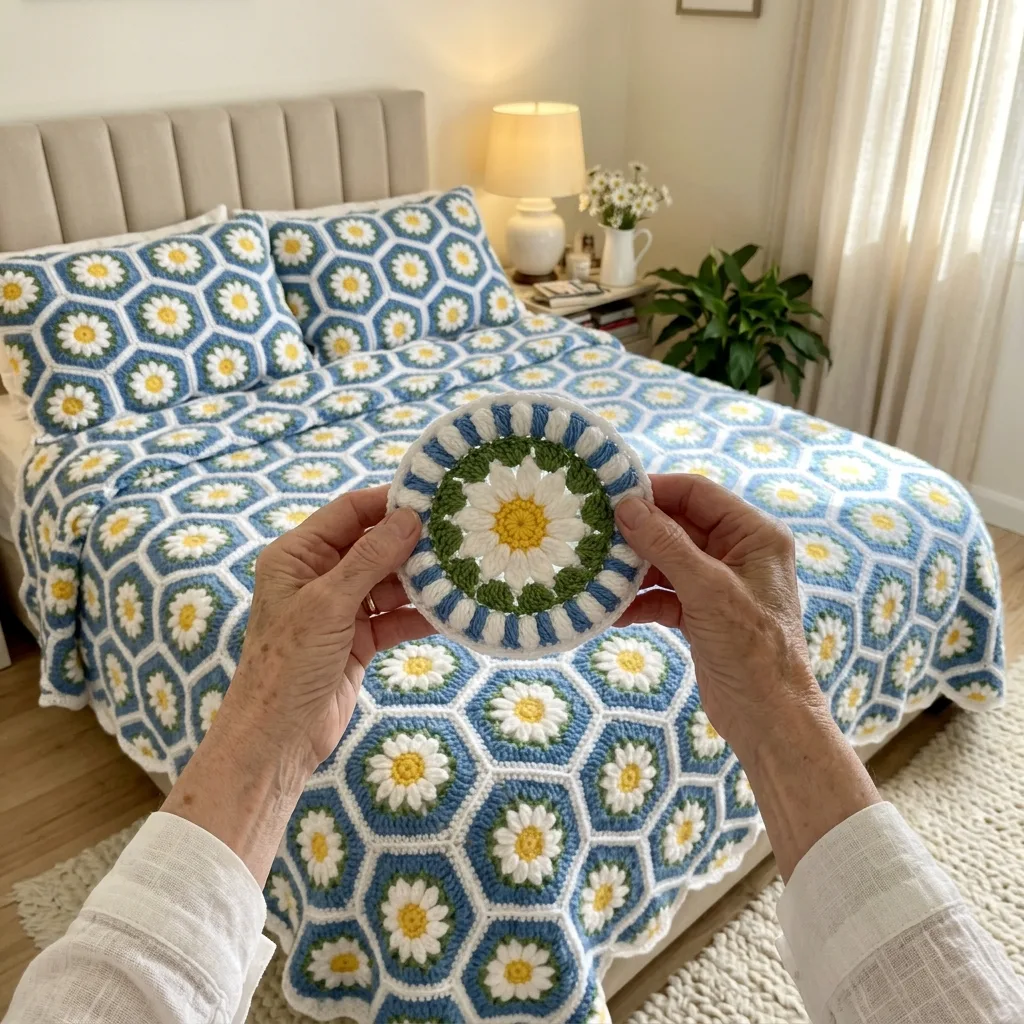
Blue Daisy Hexagon Bedspread Crochet Pattern
Jump to Pattern
Blue Daisy Hexagon Bedspread Crochet Pattern
170-200 Hours 3 made this
Intermediate Level

You need to be comfortable with puff stitches, color changes and sewing hexagons together.

170 to 200 Hours

Each hexagon takes under an hour, so this is a long and happy project for many evenings.

Daisy Puff Petals

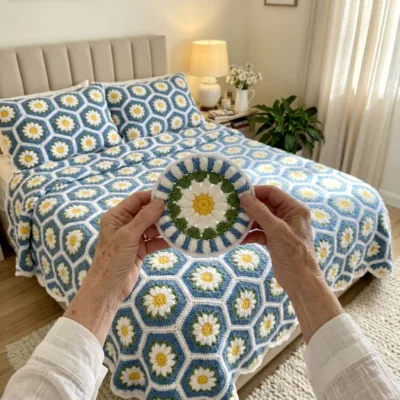
Rolled blue and white puff petals around a yellow daisy bring a spring garden to the bed.

About This Blue Daisy Hexagon Bedspread Crochet Pattern Pattern

This bedspread is made from 165 daisy hexagons. Each one has a soft yellow center, a ring of white petals, a ring of green leaves and an outer ring of rolled puff petals that alternate between sky blue and white.

The hexagons are joined in a honeycomb layout of 15 rows with 11 hexagons in each row, and a white shell edge goes around the whole cover. The finished size is about 82 by 95 inches. You need ch, sl st, sc, dc and a puff stitch, plus a little sewing to join the hexagons.
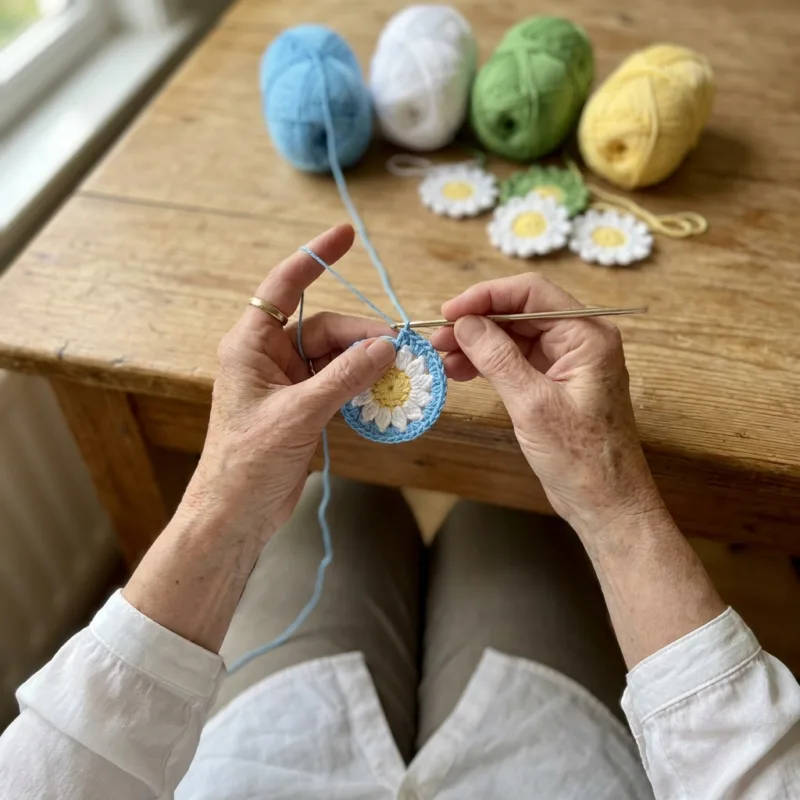
Blue Daisy Hexagon Bedspread Crochet Pattern step detail

Why You'll Love This Blue Daisy Hexagon Bedspread Crochet Pattern Pattern

I love how a daisy grows from a magic ring. The yellow center turns into white petals, the petals turn into green leaves, and then the blue puffs roll out like little buds. One hexagon fits in a small bag, so I made mine in the garden and on the sofa.

Blue and yellow make me happy, and this bedspread makes the whole room feel like spring. It also makes a gift that someone will keep for years.

Switch Things Up

Try pink and cream puffs with a brown center, or lilac and white puffs with a yellow center. Make 6 rows of 5 hexagons for a sofa throw, or 4 rows of 3 hexagons for a baby blanket. A single hexagon also makes a pretty cushion front, or you can use white for every puff for a softer look.


Materials Needed

— Main Fabric

01 Worsted weight (4) 100% cotton yarn in soft yellow (A), about 450 yards (410 m), roughly 270 g
02 Worsted weight (4) 100% cotton yarn in white (B), about 3,100 yards (2,830 m), roughly 1,850 g, including the joining and the edge
03 Worsted weight (4) 100% cotton yarn in leaf green (C), about 1,350 yards (1,235 m), roughly 800 g
04 Worsted weight (4) 100% cotton yarn in sky blue (D), about 950 yards (870 m), roughly 570 g
05 Each hexagon uses about 2.5 yards of A, 15 yards of B, 8 yards of C and 5.5 yards of D

— Tools Required

06 4 mm (US G-6) crochet hook, or the size that gives you the gauge
07 Yarn needle for weaving in ends and seaming
08 Stitch markers
09 Scissors
10 Blocking mats and rustproof pins
11 Measuring tape

The Free Pattern

Intermediate 170-200 Hours

0% complete

— Daisy Hexagon (Make 165, yellow A, white B, green C and blue D) :

Puff st = (yo, insert hook in st, yo, pull up a loop) 5 times in the same st, yo and pull through all 11 loops on the hook, ch 1 to close. The closing ch 1 does not count as a stitch.
Every round is joined with a sl st to the first st of the round. Count every stitch, because the petals, the leaves and the six hexagon corners rely on the counts.
Round 1: With A, make a magic ring. Ch 1, work 12 sc in the ring. Join with a sl st to the first sc (12 sc).
Round 2: Ch 1, 2 sc in each st around. Join. Fasten off A (24 sc).
Round 3: Join B with a sl st in any st. Ch 1, sc in the same st, 3 dc in next st, *sc in next st, 3 dc in next st; rep from * 10 more times. Join with a sl st to the first sc. Fasten off B (12 sc and 12 petals of 3 dc, 48 sts).
Round 4: Join C with a sl st in any sc of Round 3 (the sc between two petals). Ch 1, sc in the same st. *Ch 3, skip next 3 dc, sc in next sc; rep from * 10 more times. Ch 3, skip next 3 dc, join with a sl st to the first sc (12 sc and 12 ch-3 loops).
Round 5: Sl st into the first ch-3 loop. Ch 3 (counts as dc), 6 dc in the same loop (first leaf made). Work 7 dc in each of the next 11 ch-3 loops. Join with a sl st to the top of the beginning ch-3. Fasten off C (12 leaves of 7 dc, 84 dc).
Round 6: Join D with a sl st in the 2nd dc of any leaf (the ch-3 counts as the 1st dc). Ch 1, puff st in the same st (puff 1). *Ch 3, skip next 3 dc, puff st in next dc, ch 3, skip next 2 dc, puff st in the 2nd dc of the next leaf; rep from * 10 more times. Ch 3, skip next 3 dc, puff st in next dc, ch 3, skip next 2 dc, join with a sl st to the top of puff 1 (24 puffs and 24 ch-3 sps).
Colors in Round 6: every odd puff and the ch-3 after it is worked in D (blue), every even puff and the ch-3 after it in B (white). That gives 12 blue and 12 white puffs. Change color on the last yo of the last ch of each ch-3, and carry the unused color loosely behind the puffs.
Round 7: With B, sl st into the top of puff 1. Ch 1, sc in the same puff. *3 sc in next ch-3 sp, sc in the top of next puff; rep from * 22 more times. 3 sc in the last ch-3 sp. Join with a sl st to the first sc (96 sc). The 6 corners of the hexagon will fall on the sc over puffs 1, 5, 9, 13, 17 and 21, which are all blue puffs.
Round 8 (hexagon): Ch 3 (counts as dc), ch 2, dc in the same st (corner 1 made). Dc in next st, [ch 1, skip next st, dc in next st] 7 times. *(Dc, ch 2, dc) in next st for the corner, dc in next st, [ch 1, skip next st, dc in next st] 7 times; rep from * 4 more times. Join with a sl st to the top of the beginning ch-3. Fasten off and weave in the ends (60 dc, 42 ch-1 sps and 6 ch-2 corner sps; 96 sts of Round 7 used).
Each side of the hexagon has 10 dc and 7 ch-1 sps (17 positions) between two ch-2 corner sps. Block each hexagon so that it measures about 7 inches flat to flat, with a corner at the top and bottom.

— Layout and Joining :

Lay out 15 rows of 11 hexagons, 165 hexagons in total. Every hexagon has a corner at the top. Odd rows start flush left, and even rows are shifted right by half a hexagon, so the rows lock together like a honeycomb.
Seams: 15 rows x 10 seams inside the rows = 150 seams. Between the 15 rows there are 14 x 21 = 294 seams. Total: 444 seams of 17 positions each.
Join with B and a whip stitch through both loops of the matching dc and ch-1 sps. Match the ch-2 corner sps of the two hexagons at each end of a seam, and take 2 stitches where three hexagons meet.
The finished honeycomb measures about 80 by 93 inches before the edge.

— Shell Edge (white B) :

Counts: the outline of the cover has 990 hexagon sides in total, 444 seams use up 888 of them, so 102 sides are on the outside. Each outside side has 17 positions. The outline has 54 outer corners (a ch-2 corner sp that points out) and 48 inner joins (where two hexagons meet and the edge turns inward).
Round 1: Join B in any outer corner sp. Ch 1, 3 sc in the same sp. Along each side work 1 sc in each dc and 1 sc in each ch-1 sp (17 sc per side). At each outer corner work 3 sc in the corner sp. At each inner join work sc2tog with the first leg in the corner sp of one hexagon and the second leg in the corner sp of the next hexagon. Join with a sl st to the first sc (102 x 17 = 1,734 sc, plus 54 x 3 = 162 sc at the outer corners, plus 48 sc2tog at the inner joins: 1,944 sts).
Round 2: The join st and the next st are skipped. *5 dc in next st, skip 2 sts, sl st in next st, skip 2 sts; rep from * 322 more times. Then work 5 dc in next st, skip 2 sts and sl st in the last st of the round. Fasten off and weave in the ends (324 shells of 5 dc = 1,620 dc, and 324 sl sts).
1,944 divided by 6 = 324, so the shell repeat divides the round evenly. If a shell lands badly on a corner, move it by one stitch and keep the total number of shells the same.

Assembly Instructions

  1. Weave in all ends on the 165 hexagons, then wet block each one to about 7 inches flat to flat and let it dry.
  2. Lay the hexagons out in 15 rows of 11, with odd rows flush left and even rows shifted right by half a hexagon.
  3. Join the hexagons in each row with a whip stitch in white, matching the corner sps at both ends of each seam.
  4. Join the 15 rows together with the same whip stitch, working each zigzag seam from one side to the other.
  5. Block the whole cover flat with pins so that the hexagons lie evenly and the seams are not tight.
  6. Work Round 1 of the edge in white around the whole cover, following the stitch counts for each side, outer corner and inner join.
  7. Work Round 2 to make the shell edge, then fasten off and weave in the last ends.

Common Mistakes & How to Fix Them

Making puffs that are too loose. Pull each loop up to the same height so the petals are plump and even, and close each puff with a firm ch 1.

Pulling the carried yarn too tight in Round 6. Carry it loosely so the hexagon lies flat and does not pucker.

Losing the corner count in Round 7. The 6 corners of Round 8 must sit over puffs 1, 5, 9, 13, 17 and 21, so mark puff 1 with a stitch marker.

Seaming too tightly. Sew loosely so the lace stays soft and the cover keeps its drape.


Denise

Denise designs cozy home decor crochet patterns with clear written rounds and easy to follow stitch counts.


Important Notes

Gauge: the flower after Round 3 should measure about 3 inches across, and a finished hexagon about 7 inches flat to flat. Make one hexagon first and change the hook size if needed. The sizes and yarn amounts in this pattern are estimated, so check them with your swatch.

Yarn amounts depend on how tightly you crochet and on how big your puffs are. Buy a little extra of the same dye lot of each color.

Cotton stretches when wet, so block the hexagons gently and let them dry flat.

Wash on a gentle cycle in cold water with a color catcher, because the blue and green yarns can bleed onto the white. Dry flat.


I hope this happy bedspread brings a little spring into your home. Take your time, one daisy at a time, and send me a photo when yours is on the bed.

Crochet Abbreviations

01 ch — chain
02 sl st — slip stitch
03 sc — single crochet
04 sc2tog — single crochet 2 together
05 dc — double crochet
06 yo — yarn over
07 puff st — puff stitch, worked as described at the start of the pattern
08 st(s) — stitch(es)
09 sp — space
10 rep — repeat
11 A — soft yellow yarn
12 B — white yarn
13 C — leaf green yarn
14 D — sky blue yarn

You Ask, We Answer

What size is the finished bedspread?

It measures about 82 by 95 inches with the shell edge, which covers the top of a queen bed and drapes over the sides.

Can I use a different yarn weight or make a different size?

Yes. A lighter yarn makes smaller hexagons, so make more of them. For a throw, crochet fewer rows, for example 8 rows of 6 hexagons, and keep the same joining method and edge, but count the outside sides again for your new layout.

How do I wash and care for it?

Machine wash on a gentle cycle in cold water with a color catcher, reshape while damp and dry flat. Avoid hanging it wet, because cotton is heavy and can stretch.