
Red and Cream Flower Lattice Strand Curtain Crochet Pattern
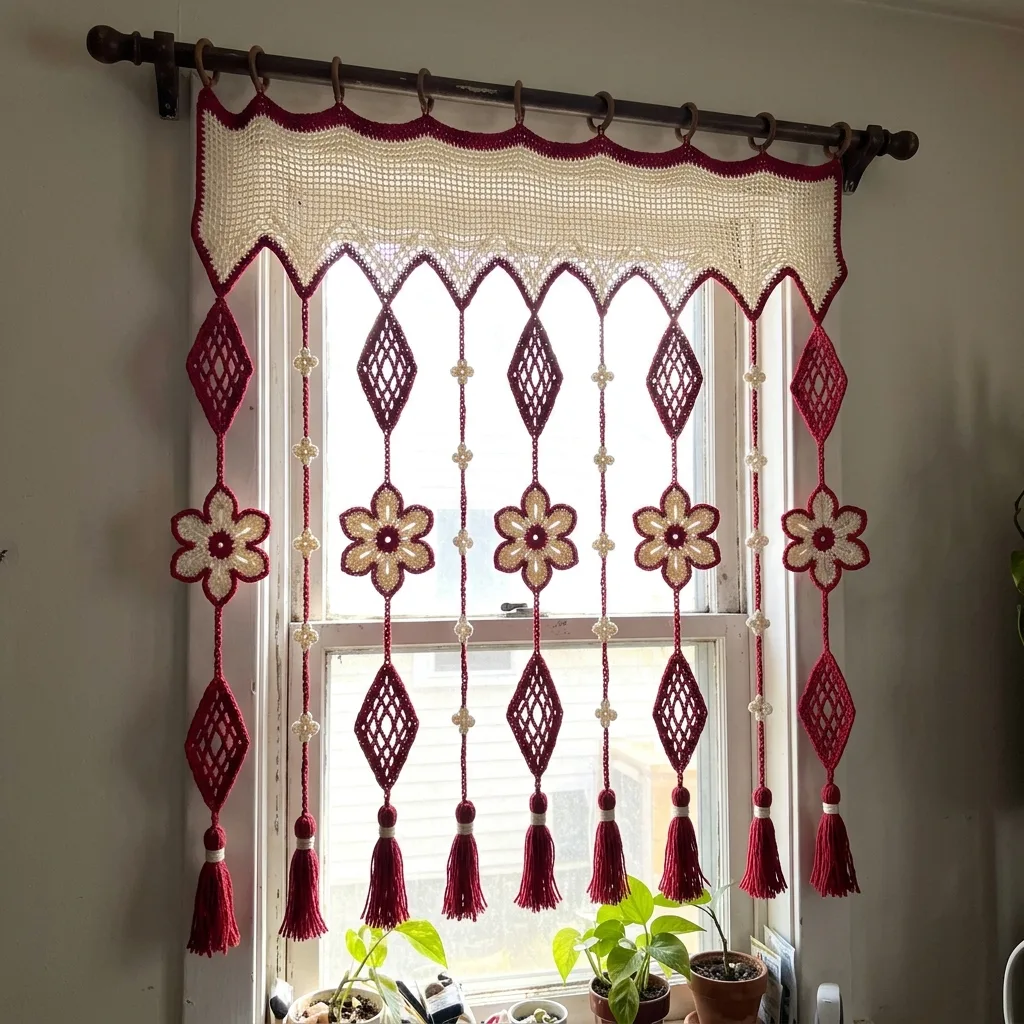
You need filet mesh, motifs worked in rounds, color changes and steady counting on the chains.
Eight big flowers, fifteen lattice almonds and nine tassels make a lovely project for a few weeks of evenings.
Cranberry red and cream give the window a warm, cheerful look that feels at home in every season.
About This Red and Cream Flower Lattice Strand Curtain Crochet Pattern Pattern
This curtain is pure cottage charm. It is worked in a warm cranberry red and a soft cream cotton, and it hangs across the top of a window like a lacy garland. Along the top runs a cream lace valance with a red top edge and a red pointed zigzag at the bottom. From each of the nine points hangs a red chain strand, and the strands take turns carrying two kinds of motifs: open red lattice almonds on the odd strands, and big six-petal flowers on the even strands. Little cream clover flowers sit on the chains in between, and every strand ends in a full red tassel with a cream wrapped neck and a round red head.
The big flowers are the stars of the curtain. Each one starts with a small red center of single and double crochet. Then you work six cream chain loops around it and fill each loop with a long almond petal of single, half double, double and treble crochet. A last round of red outlines every petal, with a tiny point at each tip. Because each petal is worked into a loop, a thin open line runs down its middle like a vein, which gives the flower that delicate look you can see in the photo. A finished flower is about 7.5 inches (19 cm) across.
The lattice almonds are small but very effective. Each one starts with a short chain worked into a tight oval of single crochet. Two rounds of chain loops build an open lattice around it, and a last round of single crochet fills the loops and adds a little point at each end. In red, they look like tiny stained glass windows when the light shines through. They measure about 1.75 inches (4.5 cm) wide and 4 inches (10 cm) long, and you need fifteen of them.
The flowers sit at two different heights. On strands 2 and 6 they hang higher, and on strands 4 and 8 they hang lower, so the petals of neighboring flowers nest into each other instead of bumping. The lattice strands run between them and keep the rhythm steady. The chains are worked with the yarn held double, so they stay firm and carry the weight of the motifs without stretching. Little cream clovers are sewn onto the chains at marked spots, so the strands never look bare.
The finished curtain is about 29 inches (74 cm) wide and about 39 inches (99 cm) long from the top of the valance to the tips of the tassels. That makes it perfect for the upper part of a window, a kitchen window over the sink, or a small window in a hallway. It hangs from ten wooden rings sewn to the red top edge, which slide easily on a wooden rod and look natural and homey. If you want a longer curtain, the strands are easy to extend, and I explain how in the ideas below.
When the sun comes through, the cream petals glow and the red outlines turn deep and rich. The lattice almonds throw tiny patterned shadows, and the tassels give the bottom edge a soft, full finish. The curtain filters the light without blocking it, so the room stays bright, and the red adds warmth even on a gray day. It feels just as right in December, with a few pine branches on the sill, as it does in summer with a vase of daisies.
I call this pattern intermediate. You need to be comfortable with chains, single, double and treble crochet, working into chain loops and changing colors. There are not many pieces, but each flower takes time and care, and the strands need careful counting so they all end at the same line. Plan on about 30 to 40 hours from the first flower to the last tassel, which makes it a nice project for a few cozy weeks.
Why You'll Love This Red and Cream Flower Lattice Strand Curtain Crochet Pattern Pattern
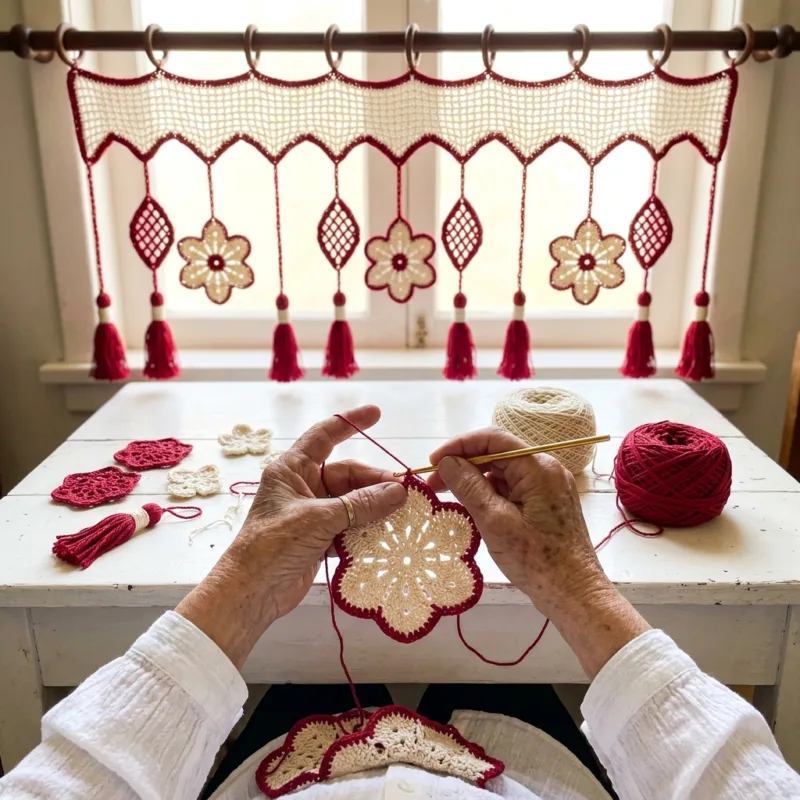
I love this curtain because it makes my kitchen feel like a little country cottage. The red and cream are the colors of my grandmother's tablecloths, and every time I look at the window I think of her. It is the kind of handmade piece that makes people stop and ask about it, and I love telling them that every flower was made right here at my kitchen table.
The motifs are lovely to make on the go. A big flower takes me a little over an hour, a lattice almond about half an hour and a clover just a few minutes. I keep a small project bag with a red ball, a cream ball and a hook, and I make clovers whenever I have a spare moment, in a waiting room or while the kettle boils. Before I knew it, I had a little jar full of cream clovers, and they felt like tiny treasures.
There is a special joy in watching the flowers come to life. The first two rounds are just a small red circle, and then the cream loops go on, and the petals start to fill in one by one. The red outline is my favorite part, because it turns a soft cream shape into a crisp flower in just one round. I always hold the finished flower up to the window to see the light come through the petal veins.
This curtain changed the whole feeling of my kitchen. The window used to have a plain white cafe curtain that nobody noticed. Now the light comes in warm and rosy, the tassels sway a little when the window is open, and the whole room feels cheerful. It also looks wonderful from outside, which I did not expect, and my neighbors tell me it makes the house look loved.
It makes a beautiful gift, especially for someone who loves a cozy home. I would make one for:
- a friend with a farmhouse or cottage kitchen
- a daughter setting up her first home
- a neighbor who loves red and holiday decorating
- anyone who collects vintage linens
It is also a lovely way to use stash yarn. The clovers and the lattice almonds take only a few yards each, so small leftover balls of red and cream can turn into motifs as long as the shades match. I used leftover cream from a tablecloth project for all the clovers, and nobody can tell. For the valance and the flowers, I bought new yarn from one dye lot, because those are the parts where an even color matters most.
Making this curtain taught me a few things. I learned to work the chains with the yarn held double after my first single strand stretched under the weight of two flowers. I learned to stagger the flowers on neighboring strands so the petals nest together. And I learned that red cotton should always be tested for color bleeding before it goes next to cream. I put all of those lessons into the pattern so your curtain turns out just right.
Switch Things Up
Red and white. For a crisper, brighter look, swap the cream for a pure white and keep the red. It looks very fresh in a white kitchen and is wonderful for the holidays with a few pine branches on the sill. Green and cream is the calm choice: work the valance edging, lattices, flower outlines, chains and tassels in a sage or forest green, and keep the petals, mesh and clovers cream. It looks lovely with houseplants and natural wood.
Blue and white, or pink and white. For a seaside look, use white petals and mesh with navy outlines, navy lattices and navy tassels, which looks like blue and white china. For a nursery or a bedroom, white with a soft rose pink is sweet and gentle. White with golden details is my pick for a dining room: everything in white or ivory, with mustard gold outlines, gold lattices and gold tassels for a warm, elegant finish.
A narrow window. For a window about 18 inches (46 cm) wide, make the valance 20 squares wide with 5 points and 5 strands. The foundation chain is then 65 (3 x 20 + 5), and the top edge has 61 sc, so you sew 6 rings every 12 stitches. Use 3 lattice strands and 2 flower strands, one high and one low. You will need about 55 percent of the yarn listed.
A standard window. The pattern as written, 36 squares and 9 strands, fits a window about 28 to 32 inches (71 to 81 cm) wide. If your window is a little wider, make the curtain from two of these panels side by side on one rod. For a window up to about 40 inches (102 cm), add one lattice strand and one flower strand at the right end, which means 8 more squares, 2 more points and 2 more rings.
A door. For the glass panel of a door, make the curtain 13 strands wide with 52 squares, a foundation chain of 161 and 157 sc on the top edge, so 14 rings fit every 12 stitches. Add one more motif and one more link to every strand, so the curtain reaches about 52 inches (132 cm). Hang it from a slim rod at the top and, if you like, tie the tassels loosely to a second rod at the bottom so it stays still when the door moves.
A doorway curtain or a room divider. For an open doorway, keep 13 strands but repeat the motifs until each strand is about 75 inches (191 cm) long, alternating flower and lattice units. For a room divider, hang two or three of these doorway curtains side by side from one ceiling rod, and leave a gap between them so people can walk through. The strands swing softly and the flowers look like a garden hanging in the air.
A shorter cafe curtain. For a very small window or a kitchen cupboard with glass doors, make one flower per flower strand and two lattices per lattice strand. That gives a curtain about 24 inches (61 cm) long including the tassels, and it takes only a few evenings. Shorter or longer tassels change the look too: wind 25 wraps on a 4 inch (10 cm) card for a neat 3.5 inch tassel, or 45 wraps on an 8 inch (20 cm) card for a dramatic 7.5 inch tassel.
A different yarn weight. All the motifs grow or shrink with your yarn, so you can change the size without changing a single stitch count. Here is roughly what to expect:
- DK cotton with a 3.5 mm hook: flowers about 6 in (15 cm), curtain about 23 in (58 cm) wide and 31 in (79 cm) long
- Worsted cotton with a 4.5 mm hook, as written: flowers about 7.5 in (19 cm), curtain about 29 in (74 cm) wide and 39 in (99 cm) long
- Aran cotton with a 5 mm hook: flowers about 8.25 in (21 cm), curtain about 32 in (81 cm) wide and 43 in (109 cm) long
Materials Needed
— Main Fabric
— Tools Required
The Free Pattern
0% complete
— Layout :
— Valance (Make 1, cream with red edging) :
— Six-Petal Flower (Make 8, red center and outline, cream petals) :
— Lattice Almond (Make 15, red) :
— Clover (Make 41, cream) :
— Chain Links and Joining (Make 9 strands, red, yarn held double) :
— Tassels (Make 9, red with cream neck) :
— Top Loops and Hanging :
Assembly Instructions
- Make the valance with its 9 points, red point edging and red top edge, then block it flat with the points sharp.
- Make and block the 8 flowers, 15 lattice almonds and 41 clovers.
- Lay out the motifs under the valance following the Layout, with lattices on the odd strands, high flowers on strands 2 and 6 and low flowers on strands 4 and 8.
- Work the chain links of all 9 strands with doubled red yarn, joining the valance tips, motifs and tails in order.
- Sew a clover over every marked chain.
- Make the 9 tassels with their cream neck bands and red heads, and tie one to the tail at the end of each strand.
- Sew the 10 wooden rings to the red top edge, slide them onto the rod and let the curtain hang overnight.
Common Mistakes & How to Fix Them
Petals that twist or come out uneven. The flower petals are worked into chain loops, and if your loops in Round 3 are tighter or looser than each other, some petals turn out shorter or fatter than the rest. The flower then looks lopsided, and the strands will not hang straight because the top and bottom tips are not opposite. Count all fourteen chains of every loop and keep them the same size as your stitches. After Round 4, lay the flower flat and check that the six petals match before you add the red outline, because the outline makes any difference easier to see.
Chains that stretch under the flowers. Each flower strand carries two big flowers and a tassel, and cotton chain stretches when it holds weight. If you work the links with a single strand, the flower strands can grow longer than the lattice strands within a week, and the tassels no longer line up. Always hold the red yarn double for every link, as the pattern says. Hang one finished flower strand from a door handle overnight before you make the others, and if it stretched more than half an inch, go down half a hook size for the chains.
Flowers that bump into each other. The flowers are wider than the space between two flower strands, so if they all hang at the same height, their petals overlap and push each other out of shape. This happens when you follow one strand recipe for every flower strand. Work strands 2 and 6 as high flower strands and strands 4 and 8 as low flower strands, exactly as the Layout shows. Before you join the second flower on each strand, lay the curtain flat and check that neighboring flowers nest neatly with a small gap between their petal tips.
Tassel heads that look lopsided. If the cream neck band is wrapped loosely or at a slant, the red head sits crooked and the tassel twists to one side. The band should be firm and level, with each wrap lying right next to the last. Wrap the cream band before you trim the tassel, and hold the tassel upright while you wrap so the band stays straight. Slide the head down until it rests evenly on the band, and sew around its whole edge with small stitches. Trim the tassel only after the curtain has hung for a day, because the strands relax.
You Might Also Like
Important Notes
My gauge is 5 mesh squares to 4 in (10 cm) in worsted cotton with a 4.5 mm hook. A blocked flower is about 7.5 in (19 cm) across, a lattice almond about 1.75 in (4.5 cm) by 4 in (10 cm), and a clover about 1 in (2.5 cm). Make one flower first and measure it. If it is too big, go down a hook size, and if it is too small, go up one. Keep that hook for every motif.
Block every motif and the valance before you join anything. Pin each flower flat with a pin in every petal tip, pin the lattice almonds open at both points, and pin the valance with its points sharp. Mist with water and let everything dry completely. The petal veins and the lattice spaces open up beautifully when blocked. Never press with a hot iron, because it flattens the texture of the stitches.
The curtain uses about 630 yd (576 m) of cranberry red and 340 yd (311 m) of cream in worsted cotton. Buy all of each color at the same time and check that the dye lot number on every label is the same. Red shades in particular can change a lot between lots, and a slightly different red in one flower outline or one tassel would show clearly in the window. Keep one label of each color.
The finished curtain weighs only about 570 g, so a normal wooden rod holds it easily. Before you start, wash a small swatch of red and cream together to make sure the red does not bleed. To clean the curtain, hand wash it in cool water with mild soap and a color catcher sheet, because red and cream are used together. Press the water out with towels and dry it flat with the strands straight.
I hope this curtain brings as much warmth into your home as mine has brought into my kitchen. It looks like a big project when you see it hanging, but it is really just a handful of flowers, a few little almonds and a jar of tiny clovers that come together at the end. Take your time, enjoy each motif and do not worry if your first flower is a little uneven. Blocking will help, and every flower you make will be lovelier than the last.
So find your red and your cream tonight and make just one flower. Watch the petals fill in, add the red outline, and hold it up to the window to see the light come through. Before you know it, you will have a whole garden of them and a window that greets you every morning. Happy crocheting, my friend.
Crochet Abbreviations
You Ask, We Answer
What is the finished size of the curtain?
As written, the curtain is about 29 inches (74 cm) wide across the valance and about 39 inches (99 cm) long from the top of the valance to the tips of the tassels. The valance with its points is about 5 inches (13 cm) deep, the strands with their motifs are about 27 inches (69 cm) long, and the tassels with their heads add about 6.5 inches. These sizes are for worsted cotton with a 4.5 mm hook and my gauge of 5 mesh squares to 4 inches. It fits the upper part of a window about 28 to 32 inches wide, or a small window over a kitchen sink. To make it wider, add 4 squares of mesh, one point and one strand at a time, which adds about 3.2 inches. To make it longer, add one motif and one link to every strand. Always count chains rather than measure them, so all nine strands end at the same line.
Can I use a different yarn weight or make it bigger or smaller?
Yes, and you do not need to change any stitch counts. All the motifs, the valance and the chains grow or shrink with the yarn and hook. In DK cotton with a 3.5 mm hook, the flowers are about 6 inches across and the curtain is about 23 inches wide and 31 inches long, which suits a small window. In aran cotton with a 5 mm hook, the flowers grow to about 8.25 inches and the curtain reaches about 32 inches wide and 43 inches long. Thicker yarn also makes heavier strands, so keep holding the chains double and use a sturdy rod. To change the size without changing the yarn, add or remove strands for width, or add or remove motifs for length. I recommend cotton or a cotton blend, because it holds the crisp petal shapes and the open lattice much better than acrylic, which tends to stretch and curl.
How do I wash and care for the curtain?
Cotton is easy to care for, but red needs a little extra attention when it sits next to cream. Before you even start, wash a small swatch of both colors together in warm water and check that the cream stays clean. When the curtain needs a wash, take it down, remove it from the rod and hand wash it in a tub of cool water with a little mild soap and a color catcher sheet. Swish it gently and do not rub or wring the strands. Rinse it until the water runs clear. Press out the water with large towels, then lay the curtain flat on dry towels, open every petal, straighten every strand and comb the tassels with your fingers. Let it dry fully before you hang it, and keep it out of the dryer and strong direct sun, which can fade the red.
Success!
Thanks for subscribing — check your inbox for a welcome note.
Abbreviations
- ch — chain
- sl st — slip stitch
- sc — single crochet
- sc3tog — single crochet 3 together
- hdc — half double crochet
- dc — double crochet
- tr — treble crochet
- 2-dc cluster — two double crochet worked together into the same place
- sp — space
- st(s) — stitch(es)
- PM — place marker
- RS — right side
- in — inch or inches
- cm — centimeters
- mm — millimeters
- yd — yards
- m — meters
- g — grams