
Blue Flower and Pearl Doorway Curtain Crochet Pattern
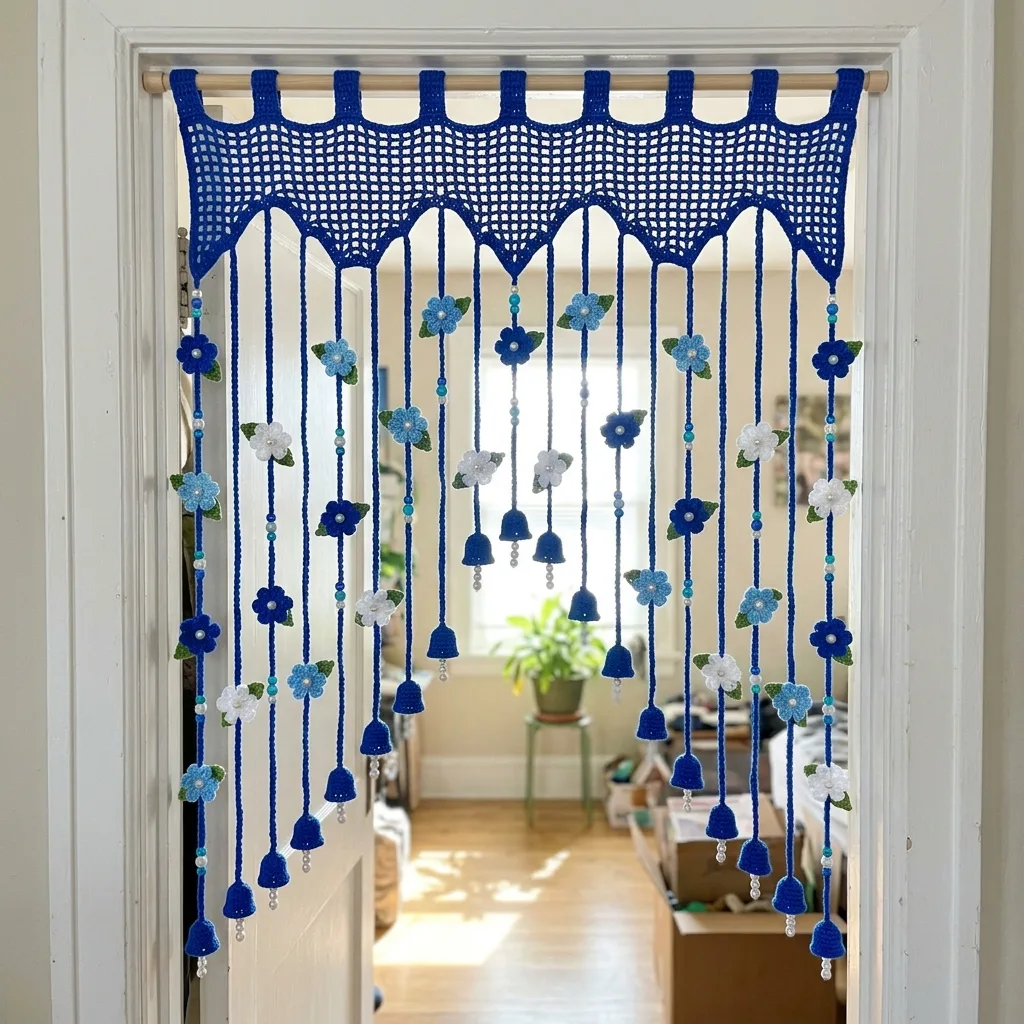
You need filet mesh, chains, simple flower rounds and a little patience for stringing beads before you chain.
With 91 flowers, 91 leaves and fourteen beaded cords, this is a slow and happy project for a season of evenings.
The beaded flower cords sway softly as people walk through, and the pearls catch every bit of light.
About This Blue Flower and Pearl Doorway Curtain Crochet Pattern Pattern
This curtain turns an ordinary doorway into something that makes people smile before they even walk through it. Along the top runs a royal blue filet mesh valance with a pointed zigzag edge, hung from a light wooden rod by little crochet tab loops. From each of the fourteen points hangs a royal blue chain cord, and every cord carries a row of small crochet flowers in three shades: royal blue, sky blue and white. Each flower has a round white pearl in the center and a tiny green leaf just above it. Between the flowers, the cord is strung with royal blue, turquoise and pearl beads, and at the very bottom every cord ends in a little royal blue bell with pearls dangling underneath.
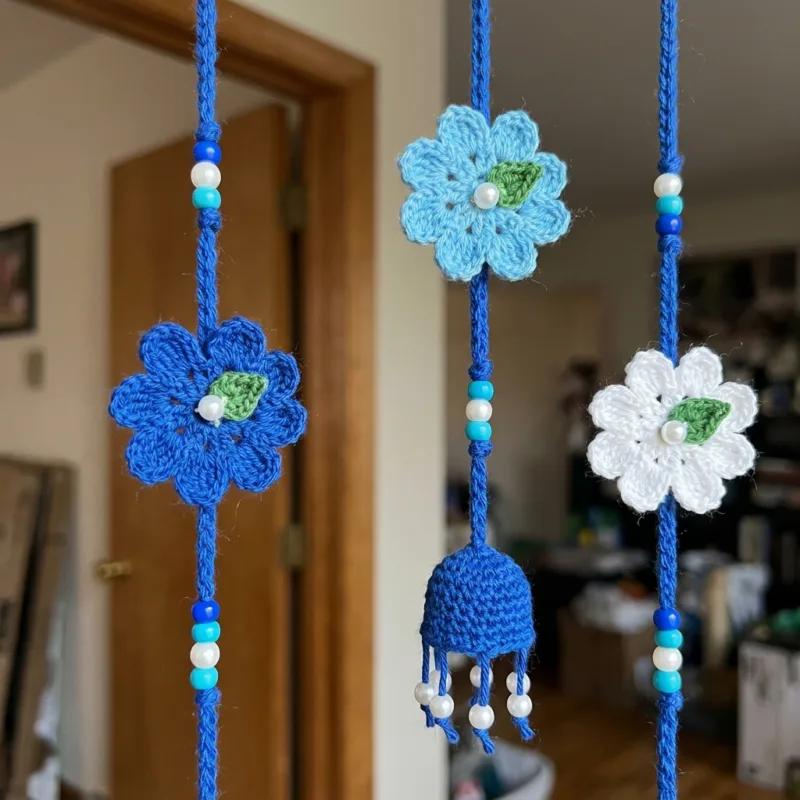
The flowers are the stars of the design. Each one is worked in just three rounds: a ring of single crochet, a round of chain loops, and eight rounded petals made of single, half double and double crochet. They measure about 2.75 inches (7 cm) across in worsted cotton. You make 91 of them in total, about one third in each color, and I give you a simple color order so the shades spread evenly across the whole curtain. The pearl center is sewn on last, and it gives each flower that soft shine you can see in the photo.
The cords are made with a technique called bead chaining. Before you start each cord, you thread all of its beads onto the yarn. Then, while you chain, you slide one bead up to the hook whenever the pattern says, and chain around it so it locks into place. It sounds fiddly, but after the first cord it becomes a gentle rhythm. Each gap between two flowers holds a little group of five beads, and the flowers and leaves are sewn onto the cord at marked spots afterwards, so you never have to wrestle with a flower while you chain.
The valance is the part that holds everything together. It is a simple filet mesh of double crochet and chain spaces, 42 squares wide and five rows deep. Below that, you work fourteen small stepped points, one under every three squares, and each point ends in a tiny chain loop where a cord begins. Along the top edge, fifteen tab loops of single crochet wrap around the rod. The blue mesh frames the doorway like lace and gives the flowers a strong, clean line to hang from.
The finished curtain is about 34 inches (86 cm) wide, which fits most interior doorways. The cords alternate between long and short. The seven long cords have seven flowers and reach about 53 inches (135 cm) from the top of the valance to the pearls, and the seven short cords have six flowers and reach about 47 inches (119 cm). That stagger gives the bottom edge a light, uneven rhythm, so the curtain looks airy instead of like a solid wall. If your doorway is taller and you want the flowers lower, it is easy to add more units to each cord.
When it hangs, the curtain feels playful and fresh. People can walk through it easily, and the cords swing and click softly behind them, then settle back into place. The light catches the pearls and the beads, and the three blues look like a summer sky. It divides a space without closing it, so a hallway still feels open and bright. I love it between a kitchen and a hallway, at the door of a sunny bedroom, or across the opening to a little reading corner.
I call this pattern intermediate. The stitches are basic, but you need to follow a mesh pattern, count carefully and keep your flower colors in order. More than anything, it asks for patience, because there are many flowers, many leaves and a lot of sewing. Plan on about 45 to 55 hours in total. The good news is that most of that time is spent on small, portable pieces you can make anywhere, a few at a time.
Why You'll Love This Blue Flower and Pearl Doorway Curtain Crochet Pattern Pattern
I fell for this curtain because it is really a flower garden you can walk through. Every time I pass under it, the cords move and the pearls tap together, and it makes me smile. It is the first thing guests notice when they come into my hallway, and almost every one of them reaches out to touch a flower. I love making things that people want to touch, and this curtain invites it all day long.
I also love how portable it is. A flower takes me about fifteen minutes and a leaf about five, so I always have a little bag of yarn and a hook with me. I made flowers at my granddaughter's swimming lessons, on the porch in the evening and in front of the television on rainy afternoons. By the end of a month, I had a basket overflowing with blue and white flowers, and it felt like I had picked them from a garden of my own.
There is a special kind of satisfaction in watching this curtain come together. For weeks it is just a pile of flowers and leaves, and you have to trust that it will become something. Then you finish the valance, chain the first cord, sew on the first seven flowers, and suddenly you can see it. Every cord after that goes faster, and hanging the last one feels like a little celebration in the hallway.
It changes a room completely. Before, my hallway door was just an opening with a view of the coat hooks. Now it feels like an entrance to somewhere nice. The blues cool the space down in summer, and the white flowers keep it light. It also gives a soft sense of privacy without closing the door, which is lovely between rooms where you still want to hear what is going on.
It makes a wonderful gift for someone who loves their home, and I have a little list of people who are getting one:
- a friend who just moved into a new apartment
- a daughter setting up a nursery
- a neighbor who loves flowers and blue china
- anyone with a doorway that needs a little joy
This is also a great stash project. The flowers use only about ten yards each, so every leftover ball of blue, white or sky blue cotton can turn into a few more blooms. The leaves use tiny amounts of green, and if you have several greens, mixing two shades looks very natural. I enjoyed opening my yarn basket and finding that a good part of the curtain was already sitting there waiting for me.
I learned a lot while making it. I learned to count the beads onto each cord before I start, because a missing bead is very hard to add later. I learned to sew the flowers on with the yarn tail, because yarn holds better and blends into the cord. And I learned that a curtain with this many beads is heavier than it looks, so a strong rod and good tabs really matter. I have put all of that into the pattern so your curtain goes up smoothly.
Switch Things Up
Red and white. Work the valance, cords and bells in a bright red, and make the flowers in red, coral and white with red and pearl beads between them. It is cheerful for a kitchen doorway and wonderful for the holidays. Green and cream is the calm version: a sage green valance and cords, cream and pale yellow flowers, and wooden beads instead of blue ones. It looks lovely in a room full of plants, and the leaves almost disappear into the cords.
Pink and white. For a little girl's room, try a rose pink valance with pink, blush and white flowers and pearl beads throughout. White with golden details is my pick for an elegant living room: everything in white, with golden beads between the flowers and small golden bells at the ends. Blue and white is the version in the photo, and you can also make it in navy and white for a more nautical feeling near the coast.
A narrow window. For a window about 24 inches (61 cm) wide, make the valance 30 squares wide, which gives 10 points and 10 cords. Use 95 foundation chains (3 x 30 + 5) instead of 131, and the top edge then has 91 sc, so you place 11 tab loops every 9 stitches. Keep the cords shorter, with 4 or 5 flowers each, so they end at the windowsill. You will need about half of the yarn and beads listed for the doorway.
A standard window. The valance as written, 42 squares and 14 cords, also fits a window about 34 to 36 inches (86 to 91 cm) wide. For a window, I make the long cords 5 flowers long and the short cords 4 flowers long, so the bottom sits around the middle of the glass. That uses 63 flowers in total instead of 91, and the curtain becomes a much quicker project. It is a sweet way to try the design before you commit to a full doorway.
A door or a taller doorway. The pattern as written covers about two thirds of a standard door height. For a curtain that almost reaches the floor, add 3 more units to every cord, which adds about 18 inches (46 cm). Long cords then have 10 flowers and short cords 9, for 133 flowers in total. Remember to thread the extra bead groups before you start each cord, and buy about 45 percent more yarn and beads.
A room divider. For a wide opening or to separate two parts of a room, make the valance 63 squares wide with 194 foundation chains, which gives 21 points and 21 cords and about 50 inches (127 cm) of width. The top edge then has 190 sc, so you place 22 tab loops every 9 stitches. Hang it from a sturdy ceiling mounted rod, because a full divider with beads becomes quite heavy. I would make it the full doorway length so it reads as a soft wall.
A shorter cafe curtain. For the top of a kitchen window, make the valance and just two flowers per cord, ending each cord with its bell about 15 inches (38 cm) below the rod. It takes only a few evenings and still shows off the mesh and the flowers. Tassels instead of bells are another easy change: wind 20 wraps on a 3.5 inch (9 cm) card for a small 3 inch tassel, or use 5 inch tassels for a more dramatic end. Shorter tassels keep the look light, and longer ones make the bottom edge feel fuller.
A different yarn weight. The mesh, flowers and bells grow or shrink with your yarn, so you can change the size without changing a single stitch count. Just match the beads to the yarn, so they still slide on and look in proportion. Here is roughly what to expect for the width of the 42 square valance:
- Sport weight cotton with a 3 mm hook: about 23 in (58 cm) wide
- DK cotton with a 3.5 mm hook: about 27 in (69 cm) wide
- Worsted cotton with a 4.5 mm hook, as written: about 34 in (86 cm) wide
- Aran or light chunky cotton with a 5.5 mm hook: about 42 in (107 cm) wide
Materials Needed
— Main Fabric
— Tools Required
The Free Pattern
0% complete
— Layout :
— Valance (Make 1, royal blue) :
— Flower (Make 91: 31 royal blue, 30 sky blue, 30 white) :
— Leaf (Make 91, leaf green) :
— Tassels (Bell Drops) (Make 14, royal blue) :
— Chain Links and Joining (Make 14 cords: 7 long, 7 short, royal blue) :
— Top Loops and Hanging :
Assembly Instructions
- Make the valance with its 14 points and top edge, then block it flat with the points sharp and the top edge straight.
- Make and block the 91 flowers and 91 leaves, and make the 14 bells.
- Following the Layout, thread the bead groups and work the 14 chain cords from the point tips, with long cords on the odd points and short cords on the even points.
- Lay the cords side by side and sew the flowers onto the marked chains in the color order, then sew a pearl in each flower center and a leaf above each flower.
- Attach a bell with its 3 pearls to the end of every cord.
- Work the 15 tab loops along the top edge, slide them onto the rod and let the curtain hang overnight before you straighten the cords.
Common Mistakes & How to Fix Them
Colors that bunch together. With three flower colors and 91 flowers, it is very easy to sew two royal blue flowers side by side, or to end up with a cluster of white in one corner. That happens when you grab flowers from the basket as you go. Sort your flowers into three piles before you start sewing, and follow the numbered color order in the Layout cord by cord. I lay each cord on the floor and place its flowers on top before I sew a single stitch. One minute of checking saves you from unpicking a flower later.
Cords that grow longer after hanging. Each cord carries up to seven flowers, seven leaves, thirty five beads and a bell, and cotton chain stretches under that weight. If your chains are loose, the long and short cords can end up nearly the same length after a week. Keep your chains snug and even, and make sure every bead is locked tightly by its chain. Hang your first finished cord from a door handle overnight before you make the rest. If it stretched more than an inch, go down half a hook size for the cords only, and keep that hook for all fourteen.
Flowers in three different sizes. Different yarn lines, and even different colors of the same line, can be slightly thicker or thinner. When you mix royal blue, sky blue and white, a small difference becomes very easy to see once the flowers hang side by side. Buy all three colors from the same yarn line, and make one flower in each color before you start the full batch. Lay them next to each other and compare. If one color comes out bigger, use a hook half a size smaller for that color only, so all 91 flowers match in the doorway.
A valance that ripples or sags between the tabs. This happens when the foundation chain is tighter than the mesh rows, or when the tabs are spaced unevenly. A tight foundation pulls the top edge in and makes the points flare out, and uneven tabs let the heavy cords drag the band down in some places. Work your foundation chain with the larger hook, then switch back for Row 1. Count the stitches of the top edge before you place the tabs, and space them exactly every 9 stitches as the pattern says, so the weight is shared.
You Might Also Like
Important Notes
My gauge is 5 mesh squares and 6 mesh rows to 4 in (10 cm) in worsted cotton with a 4.5 mm hook. One flower measures about 2.75 in (7 cm) across, one leaf about 1.25 in (3 cm) long and one bell about 1.25 in (3 cm) tall. Make a small mesh swatch and one flower before you begin. If your flower is larger, go down a hook size, and if it is smaller, go up one. Keep that hook for every flower.
Block the valance before you attach any cords. Pin it flat with the points sharp and the top edge straight, mist it with water and let it dry fully. Flowers can be blocked in batches of ten, with a pin through the center and the petals gently opened. Do not wet block the beaded cords, just let them hang. All beads need a hole of at least 2.5 mm so they slide onto worsted cotton.
You need about 640 yd (585 m) of royal blue, 320 yd (293 m) each of sky blue and white, and 185 yd (170 m) of green, all in worsted cotton. Buy every color from the same dye lot, and buy one extra ball of royal blue, since it is used for the valance, all fourteen cords and all fourteen bells. A slightly different royal blue in one cord would show clearly when the light comes through the doorway.
With all its beads and pearls, the finished curtain weighs about 1.3 kg, much heavier than a lace curtain. Use a solid wooden rod at least 1 in (2.5 cm) thick, mounted with strong brackets. To clean it, take it down, hand wash it gently in cool water with mild soap and dry it flat with the cords straight. Because dark and light yarns are used together, add a color catcher sheet whenever you wash it.
I hope this curtain fills your doorway with as much joy as mine brings to my hallway. It is a big project, but it is made of small, happy moments: one flower, one leaf, one bead at a time. Do not rush it. Enjoy choosing which blue comes next, and enjoy the little click of the beads as each cord takes shape in your hands.
So find your three blues tonight and make just one flower. Sew a pearl in its center, hold it up to the light, and you will see why I love this design so much. The rest of the garden will follow, one bloom at a time. Happy crocheting, my friend.
Crochet Abbreviations
You Ask, We Answer
What is the finished size of the curtain?
As written, the curtain is about 34 inches (86 cm) wide and fits most interior doorways. The valance with its points is about 5 inches (13 cm) deep. The seven long cords measure about 53 inches (135 cm) from the top of the valance to the pearls under the bell, and the seven short cords about 47 inches (119 cm). These sizes are for worsted cotton with a 4.5 mm hook and my gauge of 5 mesh squares to 4 inches. To fit your own doorway, measure the inside width of the frame and the height you want the flowers to reach. You can make the valance wider or narrower in steps of 3 squares, because each step adds or removes one point and one cord. For length, each extra unit of beads and one flower adds about 6 inches (15 cm) to a cord. Always count chains rather than measure them, so all the long cords and all the short cords match.
Can I use a different yarn weight or make it bigger or smaller?
Yes. The flowers, leaves, bells and mesh all grow or shrink with the yarn, so you can keep every stitch count the same. In DK cotton with a 3.5 mm hook, the curtain is about 27 inches (69 cm) wide and the flowers about 2.25 inches across, which suits a window more than a doorway. In aran or light chunky cotton with a 5.5 mm hook, it grows to about 42 inches (107 cm) wide with flowers of about 3.25 inches. The one thing that must change with the yarn is the bead size. Thicker yarn needs beads with bigger holes, and thinner yarn looks best with smaller beads, so test a few beads on your yarn before you buy all of them. I also suggest making one complete cord in the new yarn and hanging it overnight before you go further, so you know the real length.
How do I wash and care for the curtain?
I clean this curtain gently, because the beads and pearls do not like a washing machine. Most of the time, a light shake outdoors and a quick pass with a soft brush keeps it fresh. When it needs a real wash, take it down, lay it in a bathtub of cool water with a little mild soap, and swish it gently without twisting the cords. Rinse it the same way until the water runs clear. Add a color catcher sheet, since the royal blue sits right next to white flowers. Press the water out with towels, then lay the curtain flat with every cord straight and every flower opened. Let it dry fully before you hang it, so the wet chains do not stretch under the weight of the beads. Never put it in the dryer, and keep it out of strong direct sun while it dries.
Success!
Thanks for subscribing — check your inbox for a welcome note.
Abbreviations
- ch — chain
- sl st — slip stitch
- sc — single crochet
- sc2tog — single crochet 2 together
- hdc — half double crochet
- dc — double crochet
- bch — bead chain: slide a bead up to the hook and ch 1 around it
- sp — space
- st(s) — stitch(es)
- PM — place marker
- RS — right side
- picot — ch 3, sl st in 3rd ch from hook
- in — inch or inches
- cm — centimeters
- mm — millimeters
- yd — yards
- m — meters
- g — grams
- kg — kilograms