
Caramel Flower Window Square Bedspread Crochet Pattern

Simple stitches arranged into petals, windows and texture, with a stitch count on every round.
Each square takes about an hour, plus the joining and a deep lace border.
A single caramel cotton lets the flowers, windows and lace speak for themselves.
About This Caramel Flower Window Square Bedspread Crochet Pattern Pattern
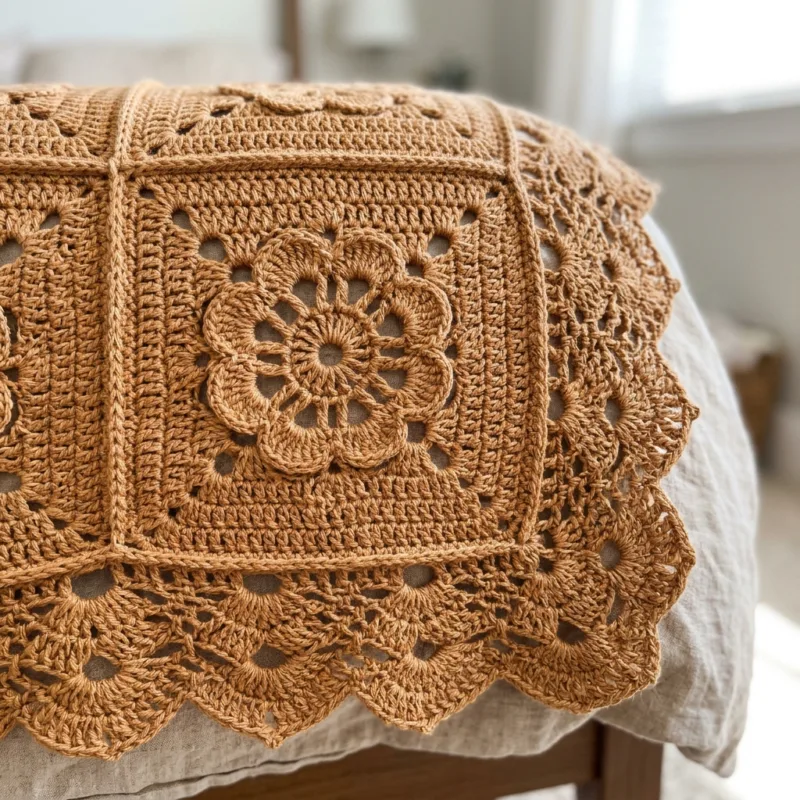
This bedspread is made from one hundred and ten matching squares, all in a single warm caramel cotton. Each square starts with a tiny ring and sixteen thin spokes, like the center of a wagon wheel. Around the spokes, eight round petals open out in plump shells of double crochet, so a big flower fills the middle of the square. Behind the petals, chain loops build the square shape, leaving round open windows on the four diagonals. A band of half double crochet, a textured round of single crochet and chain, and a final round of single crochet finish the frame. On the bed, each flower sits inside its own little carved panel.
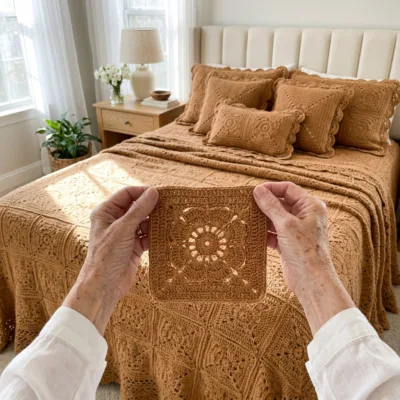
The finished bedspread measures about 108 by 118 inches (274 by 300 cm) including the border. That is a grid of 10 squares across and 11 squares down, each square measuring 10 inches after blocking, plus a deep lace border of about 4 inches all the way around. On a queen mattress the squares cover the top and drape over the sides, and the lace border hangs down toward the floor, so the whole bed is wrapped in caramel. The lace border is the showpiece, with fans, chain loops, shells and little picot scallops at the very edge.
The stitches are chain, slip stitch, single crochet, half double crochet, double crochet and treble crochet, all ones you probably already know. There are no special techniques here, just familiar stitches placed in a clever order. The petals are simple nine double crochet shells, the windows are chain spaces next to the corners, and the textured round is single crochet with a chain one between. Because the whole bedspread is one color, there are no color changes at all, only the two ends from the start and finish of each square.
The squares are joined with a loose slip stitch seam worked on the right side, through both squares at once. That makes a slim corded line between the squares, so the grid looks crisp without any contrasting color. Once all the squares are joined, the border goes around the whole bedspread in six rounds. Two rounds of single crochet steady the edge, then a round of open fans, a round of chain loops, a round of shells and a final round of picot scallops. It looks like heirloom lace, but each round is a simple repeat.
In worsted weight cotton the bedspread has a lovely weight and a soft, matte surface. The petals stand up a little from the background, and the windows let a hint of the bed show through, so the cover has depth and texture in every light. Caramel is a wonderfully warm color, somewhere between toffee, honey and toasted bread. It glows next to cream walls, oak furniture, white flowers and green plants, and it makes a bedroom feel cozy and grounded all year round.
I rate this pattern as intermediate. The stitches are basic, but you need to keep careful count on the petal and window rounds, and the border takes patience. It suits a maker who enjoys a long, calm project and likes having a square in their bag for quiet moments. If you have made a few granny square blankets, this is a lovely next step. Each round is written with its stitch count, so you can check your work as you go and enjoy every square without worry.
Why You'll Love This Caramel Flower Window Square Bedspread Crochet Pattern Pattern
I fell in love with the color first. I found this caramel cotton on a rainy afternoon, and it reminded me of the toffee my grandmother used to make in a big copper pot. I bought one ball just to play with, and by the evening I had a flower square in my hands. It looked so warm and rich that I went back the next week for the rest of the yarn. Sometimes a project starts with a pattern, and sometimes it starts with a color you cannot stop thinking about.
I love the little wagon wheel at the center of each square. The thin spokes look delicate, but they are just double crochet with two chains between. Then the round petals bloom around them, and every time I finish the eighth petal I smile. The windows come next, and when you hold the square up to the light, you can see right through four round openings. Each round changes the look so much that I never get bored, even after many squares.
I also love that this is one color. There are no balls to switch, no ends to hide in the middle and no worrying about color placement. I can carry a ball of yarn and a hook in a small bag and pick up a square anywhere. With one color, your eye goes straight to the texture: the raised petals, the open windows and the little textured frame. I think that is what makes the bedspread look so elegant and calm.
Here is why I keep reaching for this pattern:
- One color means no color changes and very few ends.
- Every square is the same, so the rhythm is relaxing.
- The windows add lightness without making the cover fragile.
- The corded seams make a crisp grid without a contrast color.
- The deep lace border makes it look like a true heirloom.
This bedspread changed the feeling of our bedroom. We had cream walls, a cream headboard and oak furniture, and it all looked a bit pale. The caramel brought warmth to everything, like turning on a lamp on a winter afternoon. The white flowers on the nightstand and the green plant by the window suddenly looked brighter against it. Now it is my favorite room in the house to sit and crochet in.
Making it taught me a few useful lessons. I learned to work the petals loosely, so the shells stay round instead of cupping. I learned to count my chains behind the petals carefully, since those chains decide the size of the windows. And I learned that a deep border is much easier when you think of it one round at a time. Those small lessons have made me braver with every lace edge since.
Most of all, I love that it is made to last. Caramel hides the little marks of everyday life far better than white, and cotton washes well for years. I imagine it on our bed for a long time, then passed to one of my children for their own home. A bedspread made by hand carries all the evenings that went into it, and I hope whoever sleeps under it someday can feel that love.
Switch Things Up
Since this pattern uses one color, choosing a new shade changes the whole mood. Ivory or white makes a classic heirloom bedspread that looks like old lace. Sage green feels fresh and soft, dusty blue is calm and cottage-like, and terracotta is warm and earthy. A deep wine or burgundy looks rich and wintry, and soft gray suits a modern room. Choose a cotton with a gentle twist so the petals and windows stay crisp.
You can change the size simply by changing the number of squares. Each square is 10 inches after blocking, and the lace border adds about 4 inches on every side. The sizes below include a drop on the sides and the foot. For a coverlet that sits only on top of the mattress, take away two or three squares in each direction and keep the border.
- Twin: 6 by 8 squares (48), about 68 by 88 inches
- Full: 8 by 9 squares (72), about 88 by 98 inches
- Queen: 10 by 11 squares (110), about 108 by 118 inches
- King: 12 by 11 squares (132), about 128 by 118 inches
A sofa throw is a beautiful smaller version. Make 5 by 6 squares, thirty in total, and add the full lace border for a throw of about 58 by 68 inches. It takes around thirty-five hours and uses roughly a quarter of the yarn. The lace edge looks lovely hanging over the arm of a sofa. It is also a good way to learn the pattern before you begin the full bedspread.
For a baby, choose a soft baby cotton in a gentle shade like oatmeal, butter yellow or pale peach. Make 3 by 4 squares for a blanket of about 30 by 40 inches before the border. For everyday use, I suggest a simpler edge of three rounds of single crochet instead of the lace, since picots and chain loops can catch little fingers. The windows in the squares are small and firm, but use it with an adult nearby and keep it out of the crib for young babies.
Matching pillows tie the whole bed together. Join four squares in a 2 by 2 block for the front of a large sham, and make the back from four more squares or a panel of half double crochet rows. Join front and back with single crochet on three sides, slip in a pillow, and close the last side. Work Rounds 3 to 6 of the lace border around it for a pretty frilled edge. One square on its own makes a sweet cushion for a chair.
The same square makes lovely table linens too. A row of five squares with the lace border makes a table runner of about 58 by 18 inches. A 4 by 4 block becomes a small tablecloth for a round bistro table, with the lace hanging over the sides. In a fine cotton, a single square with a narrow border makes a beautiful doily under a lamp or a vase.
If the deep lace border is not your style, you can simplify it. Stop after Round 3 for a short fan edge, or work only Rounds 1 and 2 and then a round of reverse single crochet for a neat corded finish. For a rustic look, add a tassel at each corner instead. The squares themselves are so detailed that even a plain edge looks finished and elegant.
You can also play with the yarn weight. In DK cotton with a 3.5 mm hook, squares come out at about 8 inches, so you need more of them, but the bedspread is lighter and drapes beautifully. In aran cotton with a 5.5 mm hook, squares grow to about 11 inches and the bed fills faster. Acrylic or a cotton blend is lighter and warmer, though cotton shows the windows more clearly. Always make one test square in your new yarn and measure it before you buy the rest.
Materials Needed
— Main Fabric
— Tools Required
The Free Pattern
0% complete
— Caramel Flower Window Square (Make 110, caramel) :
— Layout (10 x 11 grid, 110 squares) :
— Corded Slip Stitch Join :
— Deep Lace Border :
Assembly Instructions
- Make 110 Caramel Flower Window Squares and weave in the two ends of each square as you finish it.
- Block every square to 10 by 10 inches, opening the four diagonal windows and pinning the corners square, and let them dry completely.
- Lay the squares out in 11 rows of 10 following the Layout section, mixing squares from different days.
- Work all the horizontal seams with the Corded Slip Stitch Join and the 5 mm hook, wrong sides together, one full row at a time.
- Work all the vertical seams the same way, with a ch 1 across each place where four corners meet.
- Work Rounds 1 to 6 of the Deep Lace Border around the whole bedspread with the 4.5 mm hook.
- Weave in the last ends and block the finished bedspread on a clean floor, pinning out every scallop of the border.
Common Mistakes & How to Fix Them
Petals that cup or ruffle. The nine double crochet shells in Round 4 should sit flat and round around the spokes. If your tension is tight, the shells pull in and cup like little bowls. If it is very loose, they ruffle and overlap each other. Both make the square bumpy, and the windows in Round 6 will not open properly. Work each double crochet at a relaxed, even height, and check that you skip exactly 2 stitches on each side of every shell. Lay the flower flat after Round 4. If it cups, go up half a hook size for that round only.
Chains behind the petals that are too short. Round 5 builds the square from ch-6 loops that run behind the petals. If you work them tightly or count only 5 chains, the loops pull the petals backward, the square shrinks and the windows close into slits. It happens easily because you cannot see the chains well behind the petals. Count each chain out loud, keep them as loose as your other stitches, and make sure each loop lies flat behind its petal. After the round, you should see eight even loops when you turn the square over.
Putting the corner groups in the wrong loops. Round 6 alternates between side loops with 9 dc and corner loops with the windows and trebles. If you start in a corner loop by mistake, or work two side loops in a row, one corner will be missing and the square comes out lopsided. Before you begin, mark the first loop as a side loop and the next as a corner loop, and alternate from there. Count four corners and four sides before you join. This one check saves you from undoing a full round later.
Pulling the slip stitch seam too tight. A slip stitch join looks lovely, but it has almost no stretch, and many people work it as tightly as a chain. Then the seams shrink, the squares bunch together and the bedspread will not lie flat or drape properly. Always use the larger hook for joining, pull each loop up to the size of a normal stitch, and stretch the seam gently every few inches as you go. Lay each joined row on the floor before starting the next. If the seam ripples or pulls, undo it and work it more loosely.

You Might Also Like
Important Notes
Gauge and square size matter in this pattern. With worsted weight cotton and a 4.5 mm hook, Rounds 1 to 5 should measure about 5 inches (13 cm) across the petals, and the finished square should block to 10 inches (25 cm). Make one square and block it before you buy all your yarn. If it is smaller, go up a hook size. If it is larger, go down a size. All the grid sizes in this pattern assume a 10 inch square.
Block every square before you join. Pin it to a blocking mat at 10 by 10 inches with straight sides and square corners, then open the four diagonal windows and round out the petals with your fingers. Spray with water and let it dry completely. Blocking makes every square the same size and shows off the windows. Block the finished bedspread once more after the lace border, pinning out every scallop.
This bedspread uses about 5,900 grams of caramel cotton for the queen size. Buy all of it at once, and check that every ball has the same dye lot number on the label. Warm browns and caramels can vary a lot from lot to lot, and on a large single-color bedspread any change will show clearly in daylight. Buy one or two extra balls so you do not run short in the deep border.
Wash the bedspread on a gentle cold cycle in a large machine, or by hand in a bathtub, with a mild detergent. Caramel cotton may release a little dye in the first washes, so wash it alone and add a color catcher sheet. Do not wring or twist it. Press out the water with towels and lay it flat to dry, opening the scallops of the border as you go. Avoid the dryer and bleach, which can fade and weaken cotton.
I hope this bedspread brings the same warm, golden glow to your bedroom that it brings to mine. It is a long project, but it is made of small, happy moments: a ring of spokes, a circle of round petals, four little windows opening in the light. Do not let the number one hundred and ten worry you. You do not have to make them all today. You only have to make the first square.
So find your caramel cotton, settle into a cozy chair with a warm drink, and start with that tiny ring of sixteen stitches. Watch the flower bloom and the windows open, then block it and hold it up to the window. Then make another. Before you know it, you will have a basket full of squares, and one day soon an heirloom bedspread to love for years. Happy crocheting, my friends.
Crochet Abbreviations
You Ask, We Answer
What is the finished size of this bedspread?
The bedspread in the photos measures about 108 by 118 inches (274 by 300 cm) including the border. It is made from 110 squares in a grid of 10 across and 11 down, and each square measures 10 inches after blocking. The deep lace border adds about 4 inches on every side. On a standard queen mattress, which is 60 by 80 inches, this gives a drop of about 24 inches on each side and at the foot, so the lace hangs close to the floor, with extra length at the head to tuck under the pillows. If your bed is taller or lower, measure from the top of the mattress to the floor and add or remove squares to suit, keeping the border. Remember that a 10 inch square depends on your gauge, so measure your first blocked square and multiply by the number of squares you plan before you buy all your yarn. The variations section lists grids for twin, full and king beds too.
Can I use a different yarn weight or make it smaller?
Yes. The pattern works in any yarn weight, but the size of each square will change, so you need to adjust the number of squares. In DK cotton with a 3.5 mm hook, squares come out at about 8 inches, and you would need about 12 by 14 squares for the same queen size. In aran cotton with a 5.5 mm hook, squares grow to about 11 inches, and 9 by 10 squares cover a queen bed. To make a smaller piece, simply make fewer squares: thirty squares in a 5 by 6 grid make a sofa throw, and twelve squares make a baby blanket. The rounds and stitch counts of the square stay exactly the same in every case, and so do the join and the border method. The border is planned so the fans fit evenly on any grid, with 6 fans per square along each side, so you never need to recalculate the repeat.
How do I wash and care for the bedspread?
Cotton is easy to care for, but a bedspread this size is heavy when wet, especially with a deep lace border, so treat it gently. Wash it on a cold, gentle cycle in a large capacity machine, or by hand in the bathtub with a mild wool or baby detergent. Wash it alone the first few times and add a color catcher sheet, since caramel cotton can release a little dye. Never use bleach, as it weakens cotton and can leave pale patches on colored yarn. Do not hang it wet from a line, because the weight will stretch the squares and pull the lace border long. Instead, press out the water with towels and lay it flat to dry, opening the scallops as you go. Between seasons, fold it loosely and store it in a cotton bag, not plastic, with a sachet of lavender or cedar to keep moths away.
Success!
Thanks for subscribing — check your inbox for a welcome note.
Abbreviations
- ch — chain
- sl st — slip stitch
- sc — single crochet
- hdc — half double crochet
- dc — double crochet
- tr — treble crochet
- sk — skip
- st(s) — stitch(es)
- sp(s) — space(s)
- ch-2 sp — the space made by 2 chains (same for ch-1, ch-3, ch-5 and ch-6)
- rep — repeat