
Lilac Violet Flower Lace Square Bedspread Crochet Pattern
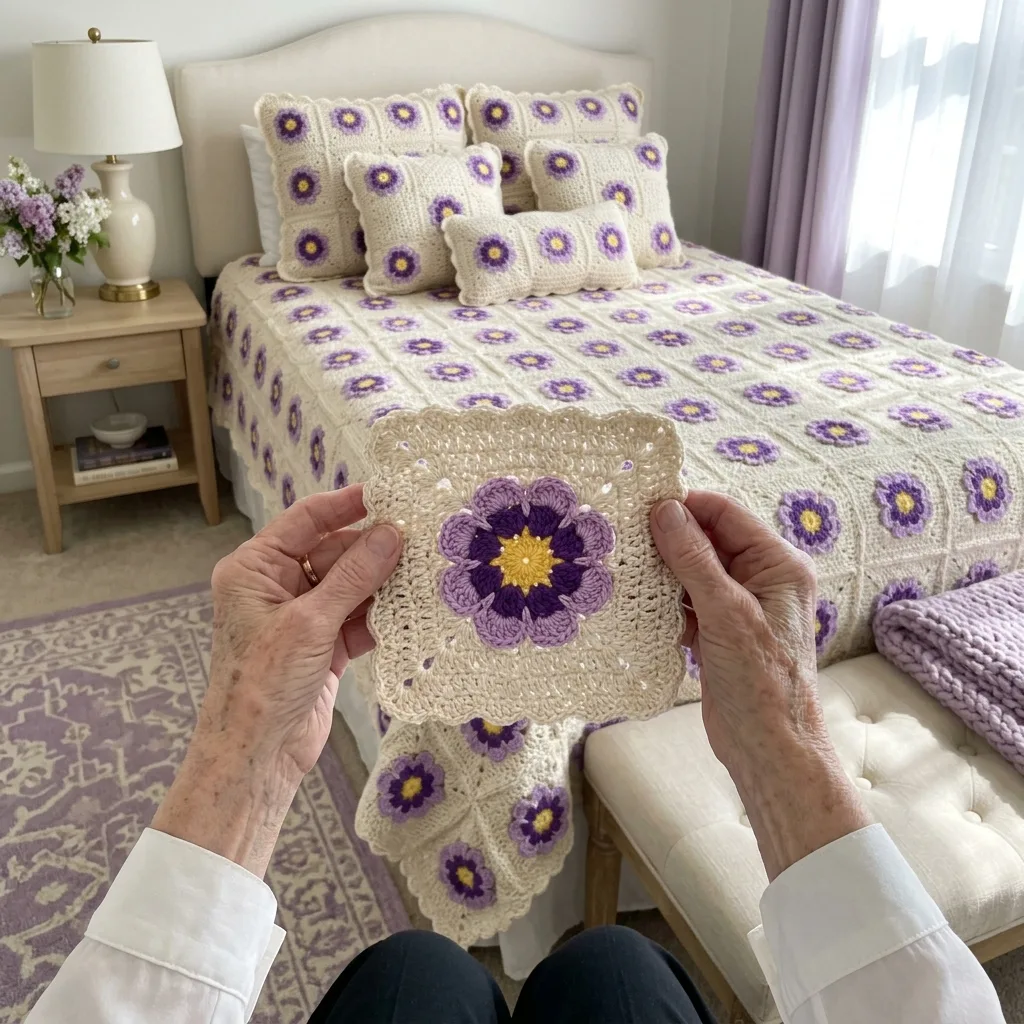
Two layers of petals, a lace square and a loop edge that joins as you go.
Each square takes a little over an hour, with no sewing at the end.
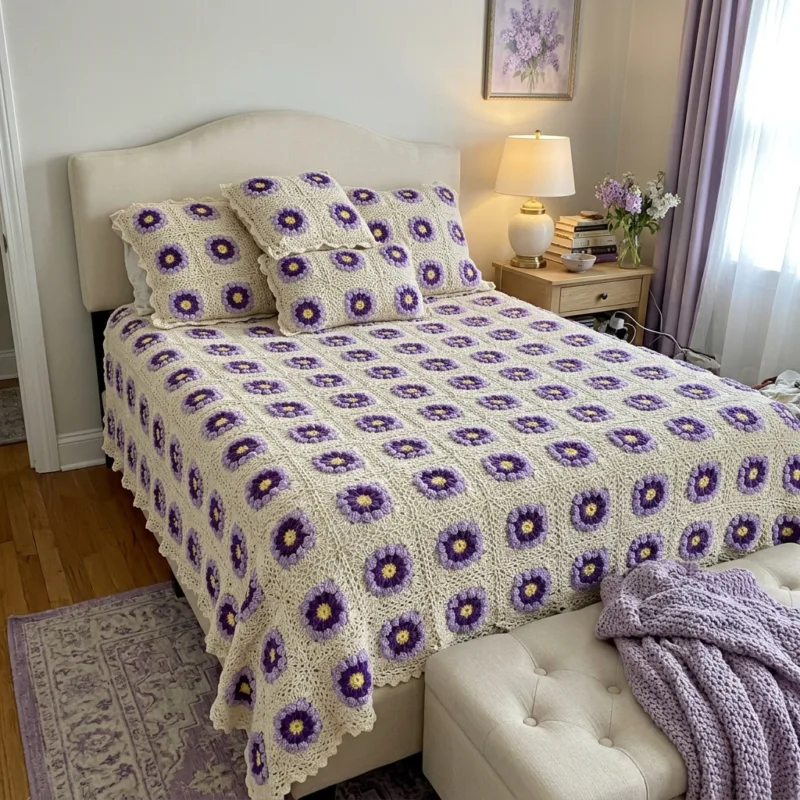
One hundred and ten little violets bloom on cream lace across the whole bed.
About This Lilac Violet Flower Lace Square Bedspread Crochet Pattern Pattern
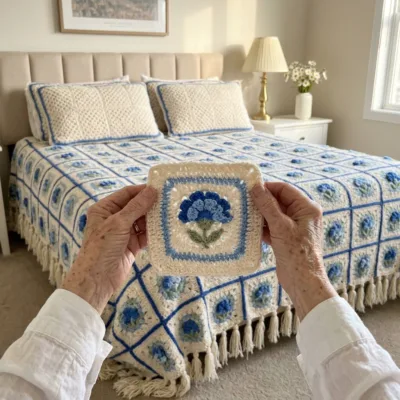
This bedspread is a field of violets on cream lace. It is made from one hundred and ten squares, each with a layered flower in the middle. The flower starts with a tiny sunny yellow center, then five small deep purple petals, and behind them five bigger lilac petals that fan out like a real violet or pansy. Around the flower, the cream lace grows in rounds of chain loops and graded stitches, turning the round flower into a square with open lace corners. A last round of chain loops gives each square a soft, scalloped frame. The squares link to each other at those loops, so the whole bed becomes one airy piece of lace dotted with purple blooms.
The finished bedspread measures about 102 by 112 inches (259 by 284 cm) including the edge. It is a grid of 10 squares across and 11 squares down, with each square measuring 10 inches after blocking, plus two rounds of cream picot loops around the outside. On a queen mattress that gives a drop of about 21 inches on each side and at the foot, so the lace hangs softly toward the floor. Every square is the same, so once you have made one, you know them all.
The stitches are chain, slip stitch, single crochet, half double crochet, double crochet and treble crochet. The two petal layers are made by working chain loops behind the petals of the round before, then filling those loops with new petals, so each layer sits a little behind the last. The flower has five petals, and a clever round of eight single crochet in each of five loops gives forty stitches, which divide neatly into four sides. From there, graded stitches at the corners turn the circle into a square.
The best part is the joining. In the final round, each square has ten chain loops along each side and one at each corner. When a square sits next to one you have already made, you simply replace the middle of each loop with a slip stitch into the matching loop of its neighbor. When your last square is done, the bedspread is joined. Two rounds of cream picot loops go around the outside to finish it with a pretty scalloped hem.
In worsted weight cotton the bedspread is light and airy, but it has enough weight to drape beautifully over the sides of the bed. The flowers stand up a little from the lace, so the surface has a soft, three-dimensional texture. Lilac, purple and cream together feel gentle, romantic and fresh, like a cottage garden in spring or a little bunch of violets on a windowsill. The colors suit cream walls, light wood, brass, fresh lilacs and soft floral rugs, and they make a bedroom feel calm and pretty.
I rate this pattern as intermediate. You need to be comfortable working in the round, changing colors and counting carefully in the round that squares off the flower. The join-as-you-go needs a little attention at first, so I suggest joining your first few squares on a table where you can see the layout. It suits a maker who loves flowers and lace and enjoys watching a project bloom one piece at a time. Every round is written out with its stitch count.
Why You'll Love This Lilac Violet Flower Lace Square Bedspread Crochet Pattern Pattern
Every spring, the violets come up along the path to my front door, and I have always thought of them as a little gift from the garden. This bedspread is my way of keeping them all year round. When I finished the first square and saw the yellow center, the dark purple petals and the lilac ones behind them, it looked just like the violets I pick for my kitchen table. Now there are one hundred and ten of them on my bed, and they never wilt.
I love how the flower comes together in layers. The yellow center is just a few stitches, then the five little purple petals pop up around it. Then you reach behind them to make the loops, and the big lilac petals go on, each one a bit taller in the middle. When the second layer is finished, the flower suddenly looks real and alive. It is the most cheerful part of every square, and it comes right at the start, so it gives me energy for the lace.
I also love that there is no sewing at the end. I have made so many square bedspreads that ended with weeks of joining, and I always dreaded it. With this one, the squares join while I work their last round, so the bedspread grows with every square I finish. I love laying the joined part over my knees as I work and watching the violets spread across it like a meadow.
Here is why this bedspread has a special place in my heart:
- Every square has a little violet that looks like it came from the garden.
- The two shades of purple make the flowers look real.
- The cream lace keeps the whole bedspread light and airy.
- The squares join as you go, with no sewing at the end.
- The picot edge gives it a soft, romantic finish.
This bedspread changed our bedroom completely. We had cream walls, light wood furniture and lilac curtains, and the room was pretty but felt a bit unfinished. Now the violets tie everything together: the curtains, the lilacs in the vase, the floral painting over the bed and the knit throw on the bench. In the morning light, the whole room glows soft purple and cream. It feels like sleeping in a spring garden.
Making it taught me a few useful lessons. I learned to make the flowers in batches, all the yellow centers one evening, all the purple petals the next, which made the color changes much quicker. I learned to count my forty stitches in Round 6 every single time, because that is what keeps the square straight. And I learned to always check which loop I am joining to, since one wrong join can twist a whole row.
Most of all, I love that this is a bedspread to pass on. Cotton lace can last for generations when it is cared for gently, and violets have always meant faithfulness and love. I hope one day this bedspread will be on a granddaughter's bed, and that she will think of the woman who made every little violet for her. That is the most beautiful kind of gift I can imagine.
Switch Things Up
The easiest change is the flower color. Keep the cream lace and the yellow centers, and choose two shades of one color for the petals, a deep shade inside and a lighter one outside. Navy with cornflower blue makes a forget-me-not, and deep rose with pink looks like a little primrose. Golden yellow with butter makes a cheerful buttercup, and burgundy with dusty rose feels rich and romantic. For a mixed garden, make every flower a different color pair.
You can change the size by changing the number of squares. Each square is 10 inches after blocking, and the edge adds about 1 inch on every side. The sizes below include a drop on the sides and the foot, so the lace reaches toward the floor. For a coverlet that sits only on top of the mattress, take away two or three squares in each direction.
- Twin: 7 by 9 squares (63), about 72 by 92 inches
- Full: 9 by 10 squares (90), about 92 by 102 inches
- Queen: 10 by 11 squares (110), about 102 by 112 inches
- King: 12 by 11 squares (132), about 122 by 112 inches
A sofa throw is a lovely smaller version. Make 5 by 6 squares, thirty in total, for a throw of about 52 by 62 inches with the edge. It takes about forty hours and uses roughly a quarter of the yarn. It looks beautiful draped over a cream sofa or folded at the foot of a bed. It is also the perfect way to learn the join-as-you-go method before you begin the full bedspread.
For a baby keepsake, make 3 by 4 squares in soft baby cotton, with pale lilac and white petals or soft pink and white, for a pram cover of about 32 by 42 inches. The lace has open loops that can catch tiny fingers, so I keep this kind of piece for the pram, a christening or a keepsake, used with an adult nearby, rather than as loose bedding in a crib. It makes a precious gift for a new baby.
Matching pillows tie the whole bed together. Four squares joined in a 2 by 2 block make the front of a large sham. Sew it onto a pillow cover in lilac, so the purple shows softly through the lace. A row of three squares makes a lovely lumbar pillow, and one square on its own makes a sweet cushion for a reading chair. Add a round of the picot edge for a pretty finish.
The same square makes lovely small gifts. A single square makes a doily for a dressing table or a mat under a vase of real violets. A row of five squares joined as you go makes a table runner of about 50 by 10 inches for a spring or Easter table. In a fine cotton, a single flower without the lace makes a pretty brooch or a decoration for a gift box.
If you would like a different edge, there are easy options. For a deeper border, add a third round of chain loops and a round of shells before the picots. For a simpler look, work just one round of picot loops. For a plain, tailored finish, work three rounds of single crochet and a round of reverse single crochet. Keeping the edge cream lets the violets stay the stars of the bedspread.
You can also play with the yarn weight. In DK cotton with a 4 mm hook, squares come out at about 8 inches, so you need more of them, but the lace is finer and lighter. In aran cotton with a 5.5 mm hook, squares grow to about 11 inches, and 9 by 10 squares cover a queen bed. Acrylic or a cotton blend works too and is lighter and warmer. Always make one test square in your new yarn and measure it before you buy the rest.
Materials Needed
— Main Fabric
— Tools Required
The Free Pattern
0% complete
— Violet Lace Square (Make 110, cream, lilac, purple and yellow) :
— Layout and Join As You Go (10 x 11 grid, 110 squares) :
— Cream Picot Loop Edge (Color A) :
Assembly Instructions
- Make the centers of all 110 Violet Lace Squares through Round 9, weaving in the flower ends as you go.
- Work Round 10 of each square following the Layout and Join As You Go section, joining each new square at its loops to the square on the left and the square above.
- Lay each new row out on a table before joining it, so every flower faces the same way and nothing twists.
- Work Rounds 1 and 2 of the Cream Picot Loop Edge around the whole bedspread.
- Weave in the last ends, then wet block the finished bedspread on a clean floor, opening the lace and pinning out the edge.
Common Mistakes & How to Fix Them
Working the petal loops in front instead of behind. Rounds 3 and 5 must be worked behind the petals of the round before, by placing each sc around the post of a stitch from two rounds down. If you work in front, the new loops cover the petals and the flower loses its layered look. It is easy to do, because the front of the work is more natural to reach. Fold the petals toward you with your thumb before each stitch so the post is easy to see. After each of these rounds, turn the square over and check that all the loops sit flat on the back.
Miscounting Round 6. The flower has five petals, but the square has four sides, and Round 6 is where those two shapes meet. You need exactly 8 sc in each of the 5 loops, for 40 stitches in all. If you work 7 or 9 sc in a loop, the total changes, the corners in Round 7 land in the wrong places, and the square comes out crooked with the flower off center. Count the 8 sc in each loop as you go, and count all 40 before you join. Then place your 4 corner markers carefully on the 1st, 11th, 21st and 31st stitches.
Loose or tight loops in the lace. Rounds 8 and 10 are made of chain loops, and they only look even when every chain is the same size. Tight chains make the square cup and pull the corners in, while loose chains make the edge wavy and the joins sloppy. Work your chains at the same relaxed tension as your other stitches, and count every chain, especially the ch-4 and ch-5 loops. Lay the square flat after Round 9. If it cups, go up half a hook size for the loop rounds only.
Joining to the wrong loop. When you join as you go, it is easy to skip a loop or join two loops to one, especially near the corners. Then the seam puckers, one square sits a little lower than its neighbor, and the error carries along the whole row. Before you start Round 10, lay the new square next to its neighbors and count the 10 side loops on each joining side. Join in order, starting from the corner loop, and say the numbers out loud. If you do join a wrong loop, undo back to it and rework from there.

You Might Also Like
Important Notes
Gauge and square size matter in this pattern. With worsted weight cotton and a 5 mm hook, Rounds 1 to 6 should measure about 6 inches (15 cm) across, and the finished square should block to 10 inches (25 cm). Make one square and block it before you buy all your yarn. If it is smaller, go up a hook size. If it is larger, go down a size. All the grid sizes in this pattern assume a 10 inch square.
Lace looks its best after wet blocking. Block your first few squares individually so you can check the size. After that, you can block the bedspread in sections as it grows. Soak it in cool water, press out the water with towels, and pin it flat with straight edges, opening the loops and lace corners with your fingers. Let it dry completely. Block the whole bedspread once more after the edge is done.
This bedspread uses about 4,200 grams of cream, 700 grams of lilac, 300 grams of purple and 100 grams of yellow for the queen size. Buy all the cream at once, and check that every ball has the same dye lot number. On a big sheet of cream lace, a change in dye lot will show clearly in daylight. Buy one or two extra balls of cream so you do not run short at the edge.
Wash the bedspread on a gentle cold cycle in a large machine, or by hand in a bathtub, with a mild detergent. Deep purple sits right against cream lace, so always add a color catcher sheet, especially in the first several washes. Never use bleach, which would fade the petals. Do not wring or twist the lace. Press out the water with towels and lay it flat to dry, shaping the edge as you go. Avoid the dryer.
I hope this bedspread brings a little spring garden into your bedroom, whatever the season outside. It is a long project, but every square starts with the happiest moment: a tiny yellow center, five purple petals and five lilac ones blooming behind them. Do not let the number one hundred and ten worry you. You do not have to make them all today. You only have to make the first violet.
So gather your cream, lilac, purple and yellow, find a sunny chair and a cup of tea, and start with that little yellow ring. Watch the petals open, then surround them with cream lace and block your first square. Hold it up to the light and imagine your whole bed covered in violets. Then make another. Before you know it, you will have a garden that blooms all year. Happy crocheting, my friends.
Crochet Abbreviations
You Ask, We Answer
What is the finished size of this bedspread?
The bedspread in the photos measures about 102 by 112 inches (259 by 284 cm) including the edge. It is made from 110 squares in a grid of 10 across and 11 down, and each square measures 10 inches after blocking. The cream picot loop edge adds about 1 inch on every side. On a standard queen mattress, which is 60 by 80 inches, this size gives a drop of about 21 inches on each side and at the foot, so the lace falls toward the floor, with extra length at the head to tuck under the pillows. If your bed is taller or lower, measure from the top of the mattress to the floor and add or remove squares to suit. Since the squares join as you go, plan your layout before you begin. Always measure your first blocked square before buying all your yarn, because the final size depends on your gauge.
Can I use a different yarn weight or make it smaller?
Yes. The square works in any yarn weight, but its size will change, so you need to adjust the number of squares. In DK cotton with a 4 mm hook, squares come out at about 8 inches, and you would need about 13 by 14 squares for the same queen size. In aran cotton with a 5.5 mm hook, squares grow to about 11 inches, and 9 by 10 squares cover a queen bed. To make a smaller piece, simply make fewer squares: thirty squares in a 5 by 6 grid make a sofa throw, and twelve squares make a pram cover. The rounds and stitch counts of the square stay exactly the same in every case, and so do the join and the edge. The edge always works out evenly, with one loop for each free side loop and each joined corner point, so you never need to recalculate a repeat.
How do I wash and care for the bedspread?
Cotton lace is easy to care for, but a bedspread this size is heavy when wet, so treat it gently. Wash it on a cold, gentle cycle in a large capacity machine, or by hand in the bathtub with a mild wool or baby detergent. Always add a color catcher sheet, because the deep purple can release a little dye onto the cream lace, especially in the first washes. Never use bleach, as it weakens cotton and would fade the violets. Do not hang it wet from a line, since the weight will stretch the loops and pull the squares out of shape. Instead, press out the water with towels and lay it flat to dry, opening the lace and shaping the edge. Between seasons, fold it loosely and store it in a cotton bag, not plastic, with a sachet of lavender or cedar to keep moths away.
Success!
Thanks for subscribing — check your inbox for a welcome note.
Abbreviations
- A — Color A, cream
- B — Color B, lilac
- C — Color C, deep purple
- D — Color D, sunny yellow
- ch — chain
- sl st — slip stitch
- sc — single crochet
- hdc — half double crochet
- dc — double crochet
- tr — treble crochet
- sk — skip
- st(s) — stitch(es)
- sp(s) — space(s)
- ch-5 loop — the loop made by 5 chains (same for ch-2, ch-3, ch-4 and ch-7)
- rep — repeat