
Cream Filet Bedspread with Calla Lily Bouquets Crochet Pattern

Simple filet mesh panels, little appliqué flowers and a deep border, all counted row by row.
Twenty-five big panels, twenty-five bouquets and a generous window border.
Every panel carries its own bunch of calla lilies, tied with a purple bow.
About This Cream Filet Bedspread with Calla Lily Bouquets Crochet Pattern Pattern
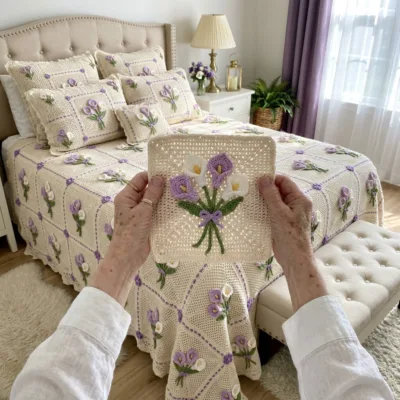
This bedspread is a garden party on lace. It is made from twenty-five large cream panels of filet mesh, the light, open grid of double crochet and chain that our grandmothers loved for curtains and tablecloths. Each panel is framed by a round of purple dashes, like a ribbon threaded around the edge, and the panels are joined with purple seams that form a neat lattice across the bed. A tiny purple flower sits at every crossing. In the center of each panel, a raised bouquet of calla lilies in lilac and white, with sunny yellow centers, long green stems, two leaves and a purple bow, sits on the lace like a gift. A deep cream border with round windows and purple scallops finishes the whole bedspread.
The finished bedspread measures about 112 by 110 inches (284 by 279 cm) including the border. It is a grid of 5 panels across and 5 panels down, with each panel measuring about 21 inches after blocking, plus a border of about 4 inches all the way around. On a queen mattress that gives a generous drop of about 24 inches on the sides, so the window border and purple scallops hang down toward the floor. Because the panels are large, there are only twenty-five of them, which makes the project feel far more manageable than it looks.
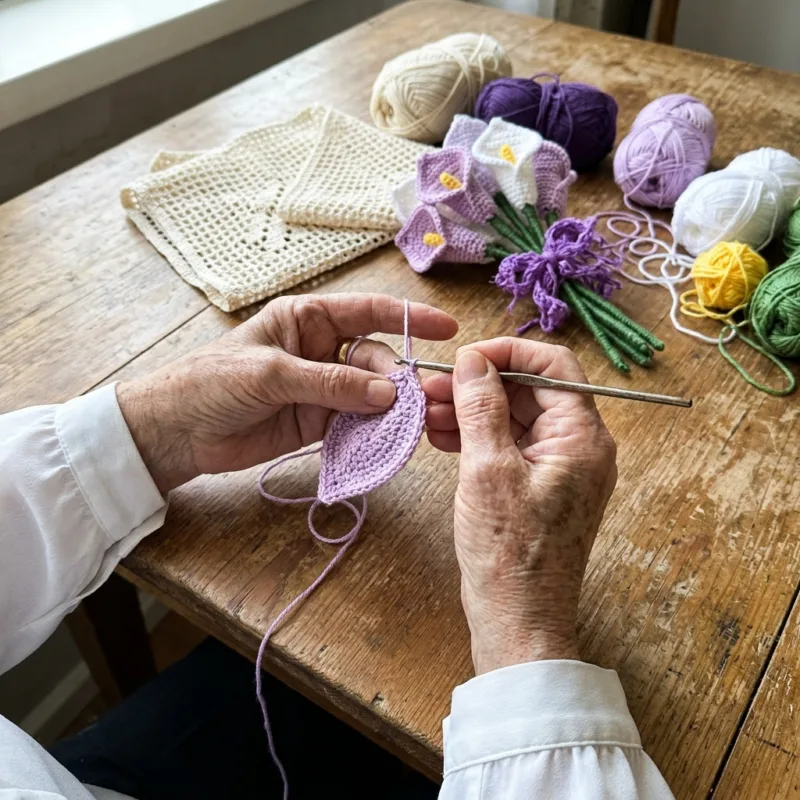
The stitches are chain, slip stitch, single crochet, half double crochet, double crochet and treble crochet. The filet mesh is simply one double crochet and one chain, repeated across every row, so the panels are wonderfully relaxing to make. The calla lilies are tiny pieces worked along a short chain, with stitches that grow from single crochet to treble and back again, so each one comes out in the shape of a curved calla petal. The yellow centers, stems, leaves and bows are just chains and slip stitches. Everything is sewn together into a bouquet and stitched onto the panel.
The panels are joined with purple single crochet on the right side, so the seams become part of the design, echoing the purple dashed frames. After joining, a little five-petal purple flower is sewn over each crossing. The deep border starts with two rounds of cream stitches, then a round of large chain windows that make the round holes along the edge, a round of single crochet to frame each window, and finally a round of purple shells and a round of purple picots. The border is the part that makes people stop and look twice.
In worsted weight cotton the bedspread has a lovely drape and a soft, airy feel. The filet mesh lets a little light through, while the bouquets add color and texture on top. Cream with lilac, purple, white, yellow and green feels fresh, romantic and cheerful, like a bunch of spring flowers on a lace tablecloth. It suits beige and cream rooms, brass lamps, purple curtains and fresh flowers, and it makes a bedroom feel like a little celebration every morning.
I rate this pattern as intermediate. The filet panels are easy and rhythmic, but the bouquets take small, careful work, and you need patience with the sewing and the long border. It suits a maker who enjoys a mix of calm repetitive work and fiddly little projects. When you are tired of mesh, you can make a few callas, and when you are tired of tiny pieces, you can go back to the panels. Every row, round and piece is written out with its stitch count.
Why You'll Love This Cream Filet Bedspread with Calla Lily Bouquets Crochet Pattern Pattern
Calla lilies were in my wedding bouquet, tied with a ribbon, and I have loved them ever since. When I started this bedspread, I wanted every panel to carry a little bouquet, just like the one I held on my wedding day. The first time I tied a purple bow around five tiny callas and laid them on a cream panel, my heart actually skipped. It looked like a gift waiting to be opened, and I knew I had to make twenty-five of them.
I love the rhythm of this project. The filet panels are calm and easy, just double crochet and chain, row after row. I can make them while chatting or listening to the radio, and I barely need to look. Then, when I want something more creative, I switch to the callas and leaves, which are small and quick and full of personality. Having two kinds of work in one project keeps me happy and motivated all the way through.
I also love the little callas themselves. Each one is worked along a short chain, and the stitches grow from tiny to tall and back again, so the petal curls naturally into shape. When you add the yellow center and fold the base around it, it looks so real that people want to pick it up. I keep a small bowl of finished callas on my table, and it always makes me smile.
Here is why this bedspread is so special to me:
- Each panel carries its own bouquet, like a little gift.
- The filet mesh is calm, easy and relaxing to make.
- The purple frames and seams make a pretty lattice.
- The deep window border looks like heirloom lace.
- Only twenty-five panels make a whole queen bedspread.
This bedspread changed our bedroom completely. We had beige walls, a tufted headboard and purple curtains, and the bed felt a little plain in the middle of it all. Now the purple frames pick up the curtains, the bouquets echo the flowers on the nightstand, and the cream lace brightens the whole room. On a sunny morning, it feels like waking up in a flower shop. My husband says it is the prettiest thing I have ever made.
Making it taught me a few useful lessons. I learned to count the cells in every few rows of the filet panels, because one missing chain changes the whole width. I learned to make the bouquet pieces in batches, all the callas one week, all the stems and leaves the next. And I learned to pin each bouquet in place and look at it from across the room before sewing it down, so they all sit straight and at the same angle.
Most of all, I love that this bedspread holds a memory. Every bouquet reminds me of my wedding day, and every panel holds hours of quiet, happy stitching. I hope it will be passed down one day, perhaps as a wedding gift to a grandchild. I like to think of her spreading it on her own bed and finding twenty-five little bouquets waiting for her.
Switch Things Up
The easiest change is the flower and ribbon color. Keep the cream filet panels and choose a new color for the frames, seams, bows and border scallops, and a matching lighter shade for some of the callas. Rose pink and blush look romantic, while navy and sky blue feel fresh and crisp. Sunny yellow and butter are cheerful, and deep red with white is lovely for a winter bedroom. Keep some callas white so the bouquets always look fresh.
You can change the size by changing the number of panels. Each panel is about 21 inches after blocking, and the border adds about 4 inches on every side. Because the panels are large, the sizes change in big steps. For a different bed, you can also make the panels smaller by working fewer cells and rows.
- Twin: 3 by 5 panels (15), about 71 by 110 inches
- Full: 4 by 5 panels (20), about 92 by 110 inches
- Queen: 5 by 5 panels (25), about 112 by 110 inches
- King: 6 by 5 panels (30), about 133 by 110 inches
A sofa throw is a lovely smaller version. Make 2 by 3 panels, six in total, and add the full window border for a throw of about 50 by 71 inches. It takes around forty hours, and it makes a beautiful wedding or anniversary gift. The bouquets look wonderful on a cream sofa, and the window border hangs prettily over the edge.
For a baby keepsake, make a single row of 2 by 2 panels in soft baby cotton for a pram or christening blanket of about 50 by 50 inches with the border. Pale pink callas or white callas with pale yellow centers look sweet. The bouquets have small pieces, so sew every calla, leaf and bow down very firmly at the back, and use it with an adult nearby as a keepsake, not as loose bedding in a crib.
Matching pillow shams make the bed look finished, just like in my photos. Make a smaller filet panel of 39 cells across and 21 rows, frame it with the ribbon round, and sew it onto a cream or lilac cover. Add a bouquet in the center and work the purple shell and picot rounds around the edge. One panel with one bouquet makes a lovely sham, and a smaller panel makes a sweet accent pillow.
The bouquets also make wonderful small gifts on their own. A single bouquet sewn onto a cream filet square makes a lovely doily or table centerpiece. Without a backing, a bouquet makes a pretty brooch, a gift box topper or a decoration for a wedding favor. A row of three bouquets on a long filet strip makes a beautiful table runner for a spring wedding or a garden party.
If you would like a different border, there are easy options. For a simpler edge, skip the window round and work three rounds of cream single crochet, then the purple shells and picots. For a softer look, work the picot round in cream instead of purple. For a deeper, more dramatic hem, work a second window round before the shells. Whatever you choose, keep a touch of purple at the very edge to frame the whole bed.
You can also play with the yarn weight. In DK cotton with a 4 mm hook, panels come out at about 17 inches and the mesh looks finer, so you need about six by six panels for a queen bed. In size 3 crochet thread with a 2.5 mm hook, panels shrink to about 12 inches and look like true heirloom filet, though you would need many more. Always make a small swatch of filet mesh in your new yarn and measure it before you begin.
Materials Needed
— Main Fabric
— Tools Required
The Free Pattern
0% complete
— Filet Mesh Panel (Make 25, cream with a purple ribbon round) :
— Calla Lily Bouquet (Make 25: 5 callas, 5 stems, 2 leaves and a bow each) :
— Little Purple Flower (Make 16) :
— Layout and Join (5 x 5 panels) :
— Deep Window Border :
Assembly Instructions
- Make 25 Filet Mesh Panels with their four framing rounds, and block each one to about 21 inches square.
- Make 25 Calla Lily Bouquets, assembling the callas, centers, stems, leaves and bow for each one.
- Make 16 Little Purple Flowers.
- Lay the panels in 5 rows of 5 and join them with the purple seams, horizontal seams first and vertical seams second.
- Sew a Little Purple Flower over each crossing and sew a bouquet firmly to the center of each panel, all at the same angle.
- Work Rounds 1 to 6 of the Deep Window Border around the whole bedspread.
- Weave in the last ends and block the bedspread flat on a clean floor, opening the border windows and scallops.
Common Mistakes & How to Fix Them
Losing cells in the filet mesh. Each row of the panel must have exactly 39 cells, with one chain between each pair of double crochet. If you work a double crochet into a chain space by mistake, or forget the last double crochet in the turning chain, the panel slowly gets narrower and the edges lean. Over 37 rows, that becomes very noticeable. Count your cells every five rows, and always finish each row with a double crochet in the 4th chain of the turning chain. A panel that is the right width makes the frame rounds and the joining much easier.
Uneven row ends in the frame. Round 1 asks for 74 single crochet along each side, which is 2 in each row end. If you work 1 in some rows and 3 in others, the side waves and the panel will not be square. Work 2 sc into each row end, around the post of the end double crochet, and count each side before turning the corner. If your count is off by one or two, adjust in the middle of the side, not at the corners, so the corners stay crisp.
Bouquets sewn at different angles. With twenty-five bouquets on the bed, even a small tilt shows clearly when you stand back. If one bouquet leans left and another leans right, the bedspread looks untidy. Before sewing, lay all the panels out and pin every bouquet in place, then step back and look from the foot of the bed. Adjust until they all match. Sew each bouquet down with small stitches through the stems, leaves, bow and the back of each calla, so nothing flops when the bedspread is used or washed.
A border that ruffles or pulls. The deep border has six rounds, and small tension changes add up over its long length. If the window round is pulled tight, the border cups up. If the shells are loose, the edge ruffles. Work the border with the same hook and relaxed tension as the panels, and lay a long section flat on the floor every few hours to check it. In Round 2, spread the extra increases evenly along each side, as written, so the window round fits perfectly without stretching.

You Might Also Like
Important Notes
Gauge matters in this pattern. With worsted weight cotton and a 5 mm hook, 10 filet mesh cells should measure about 5 inches (13 cm) across and 10 rows about 5.5 inches (14 cm). Make a small swatch of mesh before you start, and block it. If your swatch is smaller, go up a hook size. If it is larger, go down a size. All the sizes in this pattern assume this gauge and a 21 inch panel.
Block every panel before joining. Pin it to blocking mats at about 21 by 21 inches with straight sides and square corners, open the mesh cells with your fingers, spray with water and let it dry. Block the bouquet pieces gently before assembling them, shaping each calla into a curve. After the border is done, block the whole bedspread flat, but do not press down on the bouquets.
This bedspread uses about 4,000 grams of cream and 750 grams of purple, plus smaller amounts of lilac, white, yellow and green. Buy all the cream and purple at once, and check that every ball has the same dye lot number. A change in the cream would show across the big panels, and the purple frames make any shade change easy to see. Buy one or two extra balls of each so you do not run short.
Wash the bedspread by hand in a bathtub or on a very gentle cold cycle in a large machine, inside a big mesh laundry bag to protect the bouquets. Purple and green sit next to cream and white, so always add a color catcher sheet. Never use bleach. Do not wring or twist it. Press out the water with towels, lay it flat to dry and reshape each bouquet with your fingers. Avoid the dryer.
I hope this bedspread brings the joy of a fresh bouquet into your bedroom every single day. It is a big project, but it is made of two lovely kinds of work: calm, easy filet mesh for quiet evenings, and tiny callas and bows for when you feel creative. Do not let the size of it worry you. You do not have to make it all today. You only have to make the first calla.
So gather your cream and your purples, your white, yellow and green, and start with one little lilac calla on a short chain. Add its yellow center, a stem and a leaf, and tie a bow around it. Hold it in your hand and imagine twenty-five of them blooming across your bed. Then start your first panel. Before you know it, you will have a garden of bouquets on lace to treasure for years. Happy crocheting, my friends.
Crochet Abbreviations
You Ask, We Answer
What is the finished size of this bedspread?
The bedspread in the photos measures about 112 by 110 inches (284 by 279 cm) including the border. It is made from 25 filet panels in a grid of 5 across and 5 down, and each panel measures about 21 inches square after blocking. The deep window border adds about 4 inches on every side. On a standard queen mattress, which is 60 by 80 inches, this size gives a generous drop of about 24 inches on each side and plenty of length to tuck under the pillows, so the purple scallops reach toward the floor. If your bed is smaller or larger, add or remove whole panels, or make each panel smaller by working fewer cells and rows. Always make a mesh swatch first and measure it, because the final size depends on your gauge. The variations section lists layouts for twin, full and king beds too.
Can I use a different yarn weight or make it smaller?
Yes. The pattern works in any yarn weight, but the panel size will change, so you need to adjust the number of panels. In DK cotton with a 4 mm hook, panels come out at about 17 inches, and you would need about 6 by 6 panels for the same queen size. In size 3 crochet thread with a 2.5 mm hook, panels shrink to about 12 inches and look like fine heirloom filet, though you would need many more. To make a smaller piece, simply make fewer panels: six panels with the border make a lovely throw. The bouquets will also change size with the yarn, so make one bouquet and lay it on a panel to check that it looks balanced. The panel rows, frame rounds and border method stay the same in every case, and you can recount the border sides from the panel edge counts.
How do I wash and care for the bedspread?
Because of the raised bouquets, this bedspread needs gentle care. Wash it by hand in a bathtub with a mild detergent, or on a very gentle cold cycle in a large machine with the bedspread inside a big mesh laundry bag. Always add a color catcher sheet, because purple and green can release dye onto the cream panels and white callas, especially in the first washes. Never use bleach. Do not wring or twist the bedspread. Press out the water with towels and lay it flat to dry, reshaping each calla, leaf and bow with your fingers while it is damp. Check the sewing on the bouquets every few washes and secure any loose stitches. Between seasons, fold it loosely with tissue paper between the layers to protect the bouquets, and store it in a cotton bag with a sachet of lavender or cedar.
Success!
Thanks for subscribing — check your inbox for a welcome note.
Abbreviations
- A — Color A, cream
- B — Color B, purple
- C — Color C, lilac
- D — Color D, white
- E — Color E, yellow
- F — Color F, leaf green
- ch — chain
- sl st — slip stitch
- sc — single crochet
- hdc — half double crochet
- dc — double crochet
- tr — treble crochet
- sc2tog — single crochet 2 together
- picot — ch 3, sl st in the 3rd ch from hook
- sk — skip
- st(s) — stitch(es)
- sp(s) — space(s)
- ch-3 sp — the space made by 3 chains (same for ch-1 and ch-2)
- rep — repeat