
Yellow and Sage Diamond Flower Curtain Crochet Pattern
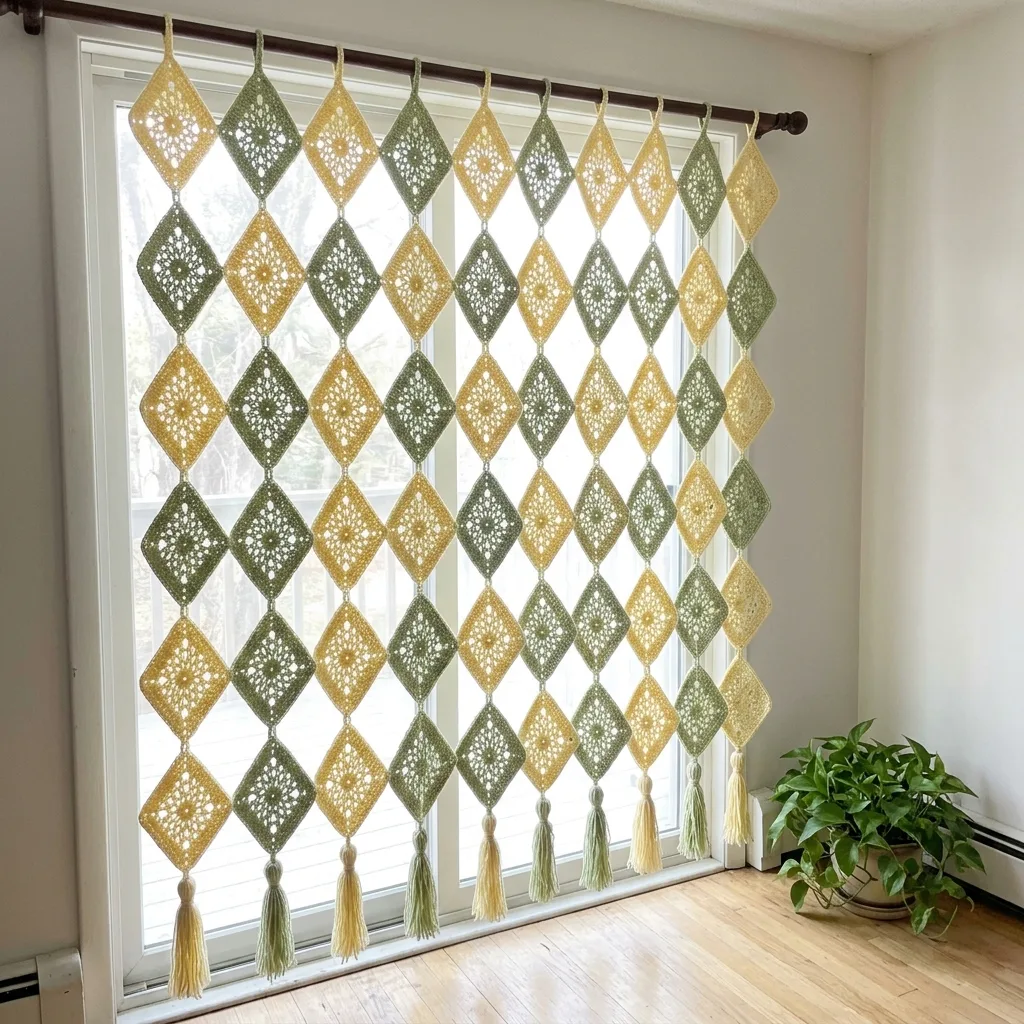
Only chains, slip stitches, single and double crochet, repeated in a calm rhythm you will know by heart after the second motif.
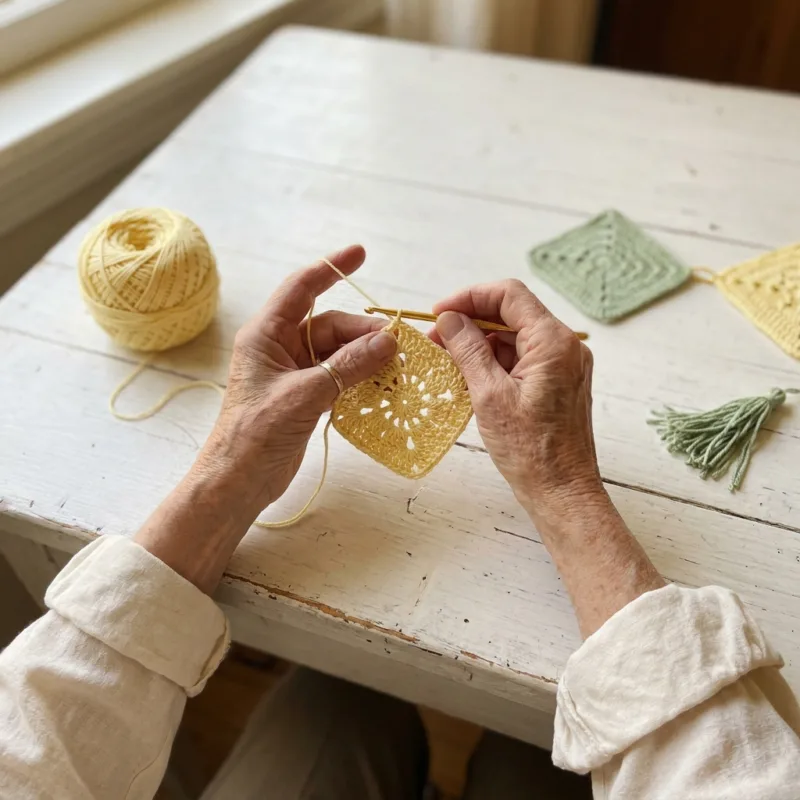
Each motif takes around 25 minutes, so a few motifs a day gets the whole curtain done in a few relaxed weeks.
The open flower centers and the diamond gaps let the daylight shine through, so the whole window glows yellow and green all afternoon.
About This Yellow and Sage Diamond Flower Curtain Crochet Pattern Pattern
This curtain is a wall of little diamonds hanging in a window. It is made of ninety small square flower motifs, turned on point so each one sits like a diamond, and joined into ten long columns. The columns alternate pale butter yellow and soft sage green, starting with yellow on the left, so the whole window reads like a soft spring stripe. Every column hangs from its own yarn loop on a wooden rod and ends in a full tassel in the same color. When I first hung mine, I stood back and could not stop smiling, because it looked like a garden had climbed up the glass.
Each motif begins as a tiny flower. You start with a ring of sixteen double crochet stitches, then open it into eight little petals with chain spaces between them. The third round turns the circle into a square with four corners, and the fourth round grows the square out with neat clusters of three double crochet. The last round is a simple border of single crochet that gives every motif a crisp, even edge and a small chain space at each corner. Those corner spaces become the top and bottom points of the diamond, and they are where everything else attaches.
The motifs are joined point to point with short chain links. I work each link as a chain of five, then slip stitch back along it, so it turns into a firm little cord about three quarters of an inch long. That cord is strong enough to carry the weight of the motifs below it, and it keeps a small window of light between every diamond. Nine motifs make one column, ten columns make the curtain, and the side points of neighboring columns nearly touch. Between them you get a second set of diamond shapes, made only of light, and that is my favorite part of the whole design.
The finished curtain measures about 70 inches wide and 78 inches long from the rod to the tips of the tassels. Each motif blocks to 5 inches square, which is about 7 inches from point to point when it hangs as a diamond. The top of every column has a sturdy loop covered in single crochet, so it slides along the rod without stretching. The tassels are wound on a piece of cardboard, tied at the top, wrapped at the neck and trimmed to 7 inches. They add a bit of weight at the bottom, which helps each column hang straight and calm.
I used a worsted weight cotton for mine, because cotton holds the diamond shape well, does not stretch much, and has a soft matte look in the sun. The stitches you need are chain, slip stitch, single crochet and double crochet, plus the magic ring to start each flower. Nothing here is tricky on its own. What the project asks for is steady tension and a little patience, because ninety motifs is a lot of small wins in a row. The joining, the tassels and the loops are all worked after the motifs, so you can make the motifs anywhere and keep the finishing for a quiet afternoon at home.
This is a good project for a confident beginner who already knows how to make a granny square, and it is a restful one for an experienced crocheter who wants something easy to work while watching a film. If you have never made a square before, make two or three practice motifs first and you will soon see how the rounds fit together. The curtain works in a living room window, a sunny kitchen, a glass door or as a soft divider between two spaces. Wherever it hangs, the light coming through those open flowers changes all day long, and the room feels warmer for it.
Why You'll Love This Yellow and Sage Diamond Flower Curtain Crochet Pattern Pattern
I love projects that I can carry in a small bag, and this curtain is exactly that. One motif needs a hook, a ball of yarn and about twenty-five minutes. I made most of mine in waiting rooms, on the porch with my morning coffee and in the evenings while my husband watched the news. Every motif is finished in one sitting, so I never had to remember where I stopped. By the time I counted my little stack of diamonds, I had made half a curtain without ever feeling like I had started a big project.
I also love how this curtain changes a room. Before I hung it, my kitchen window was just a window. Now in the morning the light comes in pale gold through the yellow columns and soft green through the sage ones, and the shadows of the diamonds fall across the floor. It gives you a little privacy from the street without closing out the day. Even on a gray afternoon the colors look cheerful, like spring is waiting just outside the glass.
Here is what made this project special for me:
- Every motif is small, so the progress feels quick and happy.
- The layout is simple to plan, just columns and two colors.
- It uses only basic stitches, repeated in a calm rhythm.
- It works as a curtain, a door hanging or a room divider.
- The tassels give it a finished, grown-up look.
There is a slow satisfaction in watching the columns grow. I kept my finished motifs in a basket, sorted by color, and every few days I laid them out on the bed in their columns just to look at them. Seeing ten little rows of diamonds getting longer week by week kept me going far better than any deadline could. When the day came to join them, it felt like a celebration, because all the real work was already done and the curtain appeared in a single afternoon.
This curtain also makes a lovely gift. I can picture it in a daughter's first apartment, in a granddaughter's bedroom or in a friend's new home by the sea. You can match the colors to the room, and because it hangs on its own loops it fits almost any rod. A handmade curtain is something people keep for years, and every time the sun comes through it, they will think of you and smile.
Finally, I learned a lot while making it. I learned to check my motif size every ten motifs, because my tension gets looser when I am relaxed. I learned that a firm slip stitch link is worth the extra minute, because a loose one stretches under the weight of the column. And I learned that a good tassel is all about counting the wraps and trimming slowly. Those small lessons are now part of every hanging project I make, and I hope they help you too. Most of all, I learned to enjoy the slow pace and not rush the finishing.
Switch Things Up
This pattern is very easy to change, because every piece is small and the layout is just columns. My first idea is always color. Butter yellow and sage green feel like spring, but you can make the same curtain in red and white for a cheerful farmhouse kitchen, blue and white for a fresh seaside look, green and cream for a calm cottage window, or pink and white for a little girl's room. Keep one light color and one stronger color so the stripe still reads from across the room. Lay out a few test motifs on the windowsill before you buy all the yarn, because colors look different with daylight behind them.
You can also make every column the same color. An all cream or all white curtain looks soft and classic, and if you carry a fine gold metallic thread together with your yarn in the last round of each motif, you get white with golden details that catch the evening light. For a bolder look, try three colors in a repeating order, such as green, cream and yellow. Just count your motifs per color before you buy yarn, so every column has its full set and you are never short in the middle.
Changing the size is a matter of adding or removing columns and motifs. Each column adds about 7 inches of width, and each motif with its chain link adds about 7.75 inches of length. The top loop and the tassel add about 9 inches together. Here are the sizes I use most:
- Narrow window, about 35 by 47 inches: 5 columns of 5 motifs, 25 motifs.
- Standard window, about 70 by 78 inches: 10 columns of 9 motifs, 90 motifs.
- Door, about 35 by 86 inches: 5 columns of 10 motifs, 50 motifs.
- Room divider, about 84 by 94 inches: 12 columns of 11 motifs, 132 motifs.
A shorter cafe curtain is one of my favorite variations. Hang it on a tension rod halfway up a kitchen window and make each column only 3 or 4 motifs long. Three motifs plus a tassel give you about 32 inches of drop, which covers the lower half of most windows and keeps the top open for light. It is also a wonderful way to test the pattern before you commit to the full curtain, and it uses up leftover cotton from other projects beautifully.
For a doorway curtain, I like to make the columns a little longer and leave more space between them so people can walk through easily. Hang the columns about 8 inches apart instead of 7, so the diamonds no longer touch and the strands part like a bead curtain when you push through. Make the top loops slightly bigger, with 18 chains instead of 14, so the columns slide along the rod as people pass. It looks lovely between a kitchen and a hallway, or at the door to a sewing room.
The tassels can change the whole mood of the curtain. Short, plump tassels of 4 inches look tidy and modern, while long 10 inch tassels feel more relaxed and dramatic. You can also mix colors inside each tassel, for example a sage tassel with a few yellow strands, to tie the columns together. If you prefer no tassels at all, finish each column with a small pompom, a single wooden bead on the last link, or simply weave in the last tail for a clean point.
Finally, you can change the yarn weight. In a DK cotton with a 4 mm hook, each motif comes out about 4 inches square and 5.7 inches point to point, so you will need more motifs for the same window, roughly 12 columns of 12. In a chunky cotton with a 6.5 mm hook, the motifs grow to about 6.5 inches square and about 9 inches point to point, and 8 columns of 7 motifs cover a standard window. Always make a test motif, block it and measure it before you plan your layout.
Materials Needed
— Main Fabric
— Tools Required
The Free Pattern
0% complete
— Diamond Flower Motif (Make 90: 45 butter yellow, 45 sage green) :
— Layout :
— Chain Links and Joining :
— Tassels (Make 10: 5 butter yellow, 5 sage green) :
— Top Loops and Hanging (Make 10: 5 butter yellow, 5 sage green) :
Assembly Instructions
- Make all 90 Diamond Flower Motifs, 45 in butter yellow and 45 in sage green, and block each one to 5 inches square.
- Following the Layout, arrange the motifs on point in 10 columns of 9, alternating yellow and green columns and starting with yellow on the left.
- Join the motifs of each column point to point with the Chain Links, working 8 links per column for 80 links in total.
- Work a Top Loop on the top point of each of the 10 columns in the matching color.
- Make the 10 Tassels and sew each one to the bottom point of a column in the same color.
- Slide the loops onto the rod about 7 inches apart, mist the columns lightly so the links and motifs settle, and let them hang overnight.
- Trim all the tassels together to an even 7 inches once the curtain has settled on the rod.
Common Mistakes & How to Fix Them
The most common problem with this curtain is motifs that slowly change size. It happens because tension relaxes as you get comfortable with the pattern, or tightens when you are tired or stressed, and with ninety motifs even a small change adds up. A column of slightly larger motifs will hang longer than its neighbors, and the tassels will no longer line up at the bottom. To avoid it, measure every tenth motif against your first blocked one. If it is more than a quarter inch off, change your hook half a size, or block the odd motifs a little more firmly so they match.
Another mistake is working the corners of Round 5 with too few stitches or forgetting the ch 2 in the middle. Without that small corner space, the points of the diamond curl inward, and you have nothing clean to hook the chain link, the top loop or the tassel into. It usually happens when you work quickly and count only the sides. Place a stitch marker in each ch-3 corner space of Round 4 before you start the border, and remove each marker only after you have worked (2 sc, ch 2, 2 sc) into that space. Then check the round total of 76 sc before fastening off.
Loose chain links are the next trap. If you work the ch 5 loosely or skip the slip stitches back along it, the link stretches under the weight of the motifs below, and the bottom of the column sags lower than the top of the next one. Over time a weak link can pull into a long, thin thread that looks untidy. Keep your chains a little snug, work all five slip stitches back across the chain, and anchor both ends firmly in the corner spaces. When a column is finished, hang it by its top point and compare it with the first column before you move on.
The last common mistake is tassels that end up thin, lopsided or different lengths. This happens when the wraps are not counted, the cardboard changes from one tassel to the next, or the ends are cut while the tassel is lying crooked on the table. Use the same piece of cardboard for all ten tassels, count exactly 30 wraps, and tie the neck at the same 0.75 inch mark every time. Attach every tassel to its column before the final trim, then hold the scissors level and trim them all while the curtain hangs. Uneven tassels show far more than you expect against a bright window.

You Might Also Like
Important Notes
Gauge matters more on this curtain than on a blanket, because every column has to hang to the same length. With worsted cotton and a 5 mm hook, Rounds 1 to 4 should measure 4.5 inches across, and the finished motif after Round 5 and blocking should measure 5 inches square, or about 7 inches from point to point. If your motif is bigger, go down half a hook size. If it is smaller, go up. Make and block one test motif before you buy all the yarn.
Block every motif before you join it. Pin each one to your mats as a square with straight sides and sharp corners, mist it with water, and let it dry completely. Cotton keeps the shape you give it, so blocked motifs hang flat and even, and the chain corner spaces stay open for joining. After joining, hang the columns on the rod and mist the links lightly so the whole curtain settles to one length before you trim the tassels.
You need about 1,350 yards of each color, which is roughly 680 g, including the motifs, the chain links, the top loops, the tassels and a little spare. Buy all the yarn for each color at the same time and check that every ball carries the same dye lot number. In a window the daylight shows every small color change, and a slightly different yellow in one column will stand out. A spare ball also saves you from running short on the very last tassel.
A full curtain in cotton weighs around 1.3 kg, so hang it on a sturdy rod with good brackets, not a thin tension rod. To wash it, place the columns in a large mesh bag and use a gentle cold cycle, or hand wash them in the bathtub. Because pale yellow and sage green are washed together, add a color catcher sheet the first few times. Never wring the columns. Lay them flat on towels to dry, then reshape the motifs and comb the tassels before hanging.
I hope this curtain brings as much light and happiness into your home as mine has brought into my kitchen. It looks like a big project from across the room, but up close it is just one small flower after another, and every single one of them is easy to make. Take your time, enjoy the colors, and let the basket of motifs fill up slowly.
So pick up your hook, choose your two favorite colors and make your first motif tonight. Block it, hold it up to the window and watch the light come through the center. I think that one little diamond will be all the encouragement you need to make the next eighty-nine. Happy crocheting, my friends.
Crochet Abbreviations
You Ask, We Answer
How big is the finished curtain, and how do I make it fit my window?
The curtain as written is about 70 inches wide and 78 inches long, measured from the rod to the tips of the tassels. That comes from 10 columns of 9 motifs, with each motif blocked to 5 inches square, or about 7 inches from point to point. To fit your own window, measure the width you want to cover and divide it by 7 to find how many columns you need, then round to the nearest whole number. For the length, measure from the rod down to where you want the tassel tips to end, subtract 9 inches for the top loop and the tassel, and divide what is left by 7.75 to get the number of motifs per column. An even number of columns gives you the same number of yellow and green columns, while an odd number puts the same color on both edges. Always plan with your own blocked test motif, not with my numbers alone, because every hand crochets a little differently.
Can I use a different yarn weight or make the motifs bigger?
Yes, and the pattern works the same way with any weight, only the size changes. In DK cotton with a 4 mm hook, each motif comes out about 4 inches square, so you will need more motifs to fill the same window. In chunky cotton with a 6.5 mm hook, the motifs grow to about 6.5 inches square, and you will need fewer of them. I recommend cotton or a cotton blend for curtains, because it holds the diamond shape and does not stretch much under its own weight. Acrylic works too, but it can stretch over time in a long column, so keep the chain links firm. Whatever you choose, make one motif, block it and measure it from point to point. Then redo the column and motif math from the first question, and adjust the tassel length so it looks balanced next to the new motif size. Buy a little extra yarn when you change weights, because the yardage per motif changes as well.
How do I wash and care for the curtain?
I wash mine about twice a year, or whenever it starts to look dusty in the sun. Take it off the rod, slip the columns into a large mesh laundry bag, and wash on a gentle cold cycle with a mild detergent. Hand washing in the bathtub works just as well and is kinder to the tassels. Add a color catcher sheet, especially the first few times, because the yellow and the green are washed together. Do not wring or twist the columns. Press the water out with a towel, then lay each column flat and straighten every diamond with your fingers so the points are sharp again. Comb the tassels gently and let everything dry fully before hanging. Strong direct sun can fade cotton over the years, so if your window gets harsh afternoon light, a sheer curtain behind it will protect the colors. Store it rolled in a cotton pillowcase, never in plastic.
Success!
Thanks for subscribing — check your inbox for a welcome note.
Abbreviations
- ch — chain
- sl st — slip stitch
- sc — single crochet
- dc — double crochet
- st — stitch
- sp — space
- rep — repeat
- * — repeat the instructions after the asterisk as directed
- [ ] — work the instructions inside the brackets the number of times stated