
Cream and Chocolate Art Deco Fan Hanging Curtain Crochet Pattern
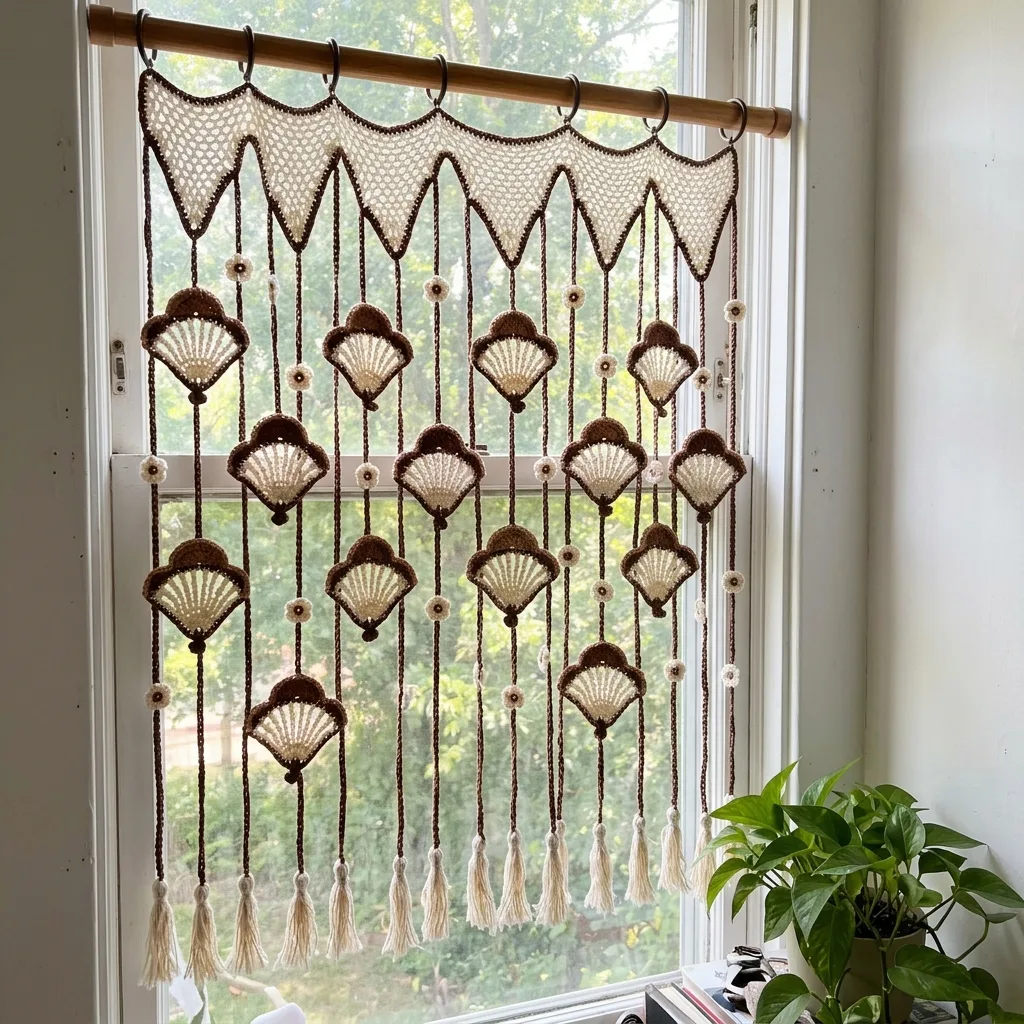
Simple fan rows and shells, with neat color changes and a little strand planning.
Fans and tiny bead flowers are quick pieces you can finish a few at a time.
Cream fans outlined in chocolate brown give any window the look of an old grand hotel.
About This Cream and Chocolate Art Deco Fan Hanging Curtain Crochet Pattern Pattern
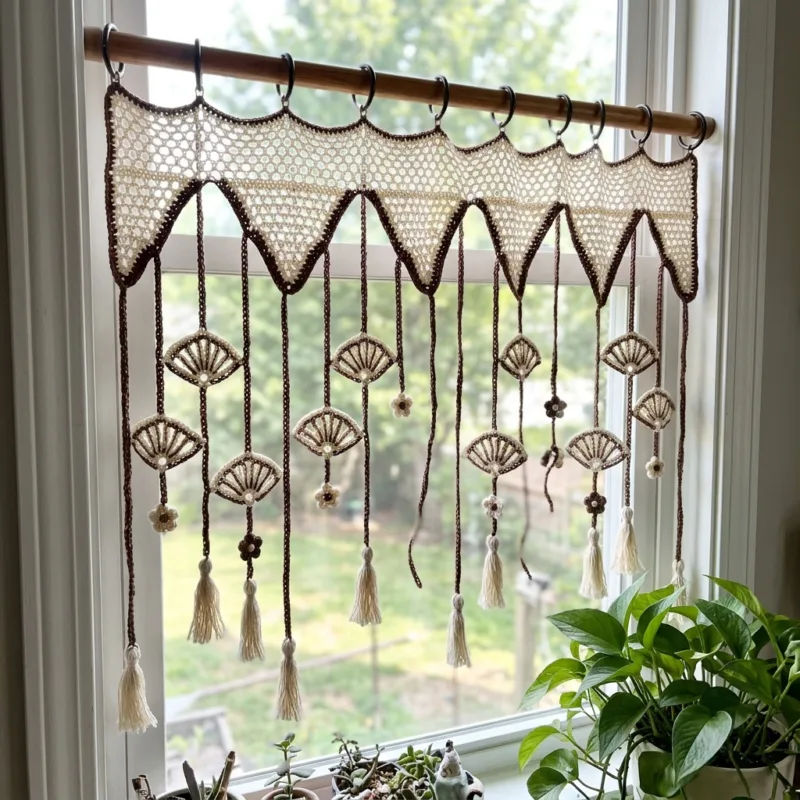
This curtain is a hanging cascade of cream Art Deco fans on fine chocolate brown chain strands. Each fan is shaped like a little shell, pointed at the bottom and rounded at the top, with brown arcs that trace its curves like lines in an old drawing. A scalloped brown dome crowns every fan, and a small brown knot hangs just below its point. Between the fans sit tiny cream bead flowers with brown centers, and whole strands of these little flowers hang between the fan strands. The look is elegant and a little bit vintage, like a window in a grand old hotel.
At the top is a cream lace valance made of ten pointed triangles. Each triangle is worked as a small granny triangle in open rows of double crochet, then edged in chocolate brown along its two sloped sides, so the points form a crisp brown zigzag. The triangles are joined across their tops with two rows of cream single crochet, and a third row wraps the band around eleven dark bronze curtain rings. The rings slide easily on a wooden rod, so the curtain opens and closes smoothly and always hangs straight.
Below the valance there are nineteen strands. Ten fan strands hang from the points of the triangles, and nine bead strands hang from the places where two triangles meet. Every fan strand carries six fans with a bead flower above each fan and one at the end, so it holds seven bead flowers. Every bead strand carries fourteen bead flowers spaced evenly down its length. The fan strands take turns starting high and low, which staggers the fans into a soft diagonal rhythm across the window, and every strand ends in a short cream tassel.
The fans are worked in rows from a magic ring at the point. The first two rows of cream double crochet open into a small fan, then a row of brown single crochet draws the first arc. Two more cream rows widen the fan, and a brown row of shells finishes it with a scalloped dome. The bead flowers are tiny: a brown center, a cream round and six little petals. The strands are worked by chaining down from the valance, sewing on bead flowers, slipping into the top of each fan, carrying the chain behind it and coming out at the point.
The finished curtain measures about 120 cm wide and 180 cm long (47 by 71 inches) from the top of the rings to the tips of the tassels. That suits a standard window, a tall single window or a French door. I used worsted weight cotton and a 5.0 mm hook, which gives the fans a solid, crisp shape and helps the strands hang heavy and straight. Cotton also keeps the two colors clean and sharp, so the brown arcs stay bold against the cream.
What I love about the finished curtain is how it looks in different light. In the morning, the sun shines through the gaps between the strands and the fans look like little lanterns with dark outlines. In the afternoon, the light turns the cream golden and the brown deep and rich. It gives a room privacy and a sense of style without hiding the view, so you still see the trees outside through the fans. It moves gently when a window is open, and the fans turn just a little on their strands.
I rate this pattern Intermediate. You only need chains, slip stitches, single crochet and double crochet, plus a simple puff stitch for the little knots. The challenge is the number of pieces, sixty fans and almost two hundred bead flowers, and keeping your color changes neat. If you have made a few small motifs and can follow rows with stitch counts, you can make this. Plan on about seventy to eighty-five hours. It suits a patient maker who enjoys small pieces and loves a classic, elegant look.
Why You'll Love This Cream and Chocolate Art Deco Fan Hanging Curtain Crochet Pattern Pattern
I fell in love with this design because of old Art Deco buildings. I have always loved the fan shapes you see over doorways, on mirrors and in old theaters, with their strong lines and graceful curves. One day I sketched a fan with brown arcs on the back of an envelope and thought it would make a beautiful curtain motif. The first fan I crocheted came out just like the drawing, and when I hung it in the window with the light behind it, I knew I had to make a whole curtain.
The thing I love most is how portable the pieces are. Each fan takes one short sitting, and the bead flowers take only a few minutes each. I kept a little basket with a ball of cream, a ball of brown, a hook and a needle by my chair, and I made bead flowers during the evening news and fans on quiet weekend mornings. By the time I started joining the strands, I had a big pile of pieces ready, and it felt like opening a treasure box.
This project also taught me how to make clean color changes. With two strong colors, every messy join shows. I learned to finish each cream row, fasten off neatly and join the brown with a slip stitch in the very first stitch, then weave the ends along the row of the same color. It takes a little longer, but the fans look so much crisper. I also learned to count every shell on the dome, because one missed skip makes the scallops lopsided.
Here is what keeps me coming back to this design:
- Classic cream and brown that suits almost any room
- Small pieces that fit in a tiny project basket
- Fans that look like little works of art on their own
- A window that feels elegant and warm all day long
It is also a wonderful gift. I made a shorter version for my niece when she moved into her first apartment, and she says friends always ask where she bought it. A handmade curtain is something a person sees every single day, so it becomes a small part of their home. The cream and brown colors are easy to love, and they fit a farmhouse kitchen as well as a modern living room.
This curtain is kind to your stash, too. The bead flowers take only a little yarn each, so all those half balls of cream and brown from other projects can go straight into them. You can even mix two slightly different creams across the bead strands, because the small pieces hide the difference. The scraps at the end make perfect tassel wraps, and I had almost nothing left when I was finished.
Most of all, I love the slow satisfaction of it. There is a special moment when you hang the last strand and step back to see the whole window at once. All those small evenings of fans and flowers suddenly become one grand, elegant piece. It reminds me why I love crochet so much, and I hope it brings you the same feeling every time you walk past your window.
Switch Things Up
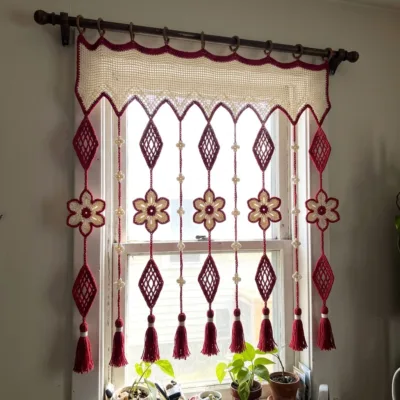
The easiest change is the color pair. Cream and chocolate is warm and classic, but these fans look striking in many combinations. White fans with navy arcs feel fresh and coastal. Ivory fans with golden arcs look rich and festive. Blush pink fans with white arcs are sweet for a bedroom or a nursery, and sage green fans with cream arcs bring a calm garden feeling. For a bold kitchen, try red fans with white arcs, or white fans with red arcs for a cheerful farmhouse touch.
You can change the width to fit your window. Each valance triangle is about 12 cm (4.75 inches) wide and carries one fan strand, and every join between two triangles carries one bead strand. For a narrow window, make 5 triangles with 5 fan strands and 4 bead strands, about 60 cm wide. That takes 30 fans and 91 bead flowers. For any width, the bead strands always number one less than the fan strands.
Length is just as easy to change. Each extra fan, with its bead flower and links, adds about 23 cm (9 inches) to a fan strand, and each bead strand needs two more bead flowers to keep up. For a door about 210 cm tall, keep 10 triangles and work 8 fans per strand. That gives 80 fans and 252 bead flowers in all. For a room divider about 170 cm wide and 230 cm tall, make 14 triangles with 9 fans per strand, which takes 126 fans and 400 bead flowers.
- Narrow window: 5 fan strands of 6 fans, about 60 by 180 cm
- Standard window: 10 fan strands of 6 fans, about 120 by 180 cm
- Door: 10 fan strands of 8 fans, about 120 by 210 cm
- Room divider: 14 fan strands of 9 fans, about 170 by 230 cm
A short cafe curtain is a lovely first version. Keep the 10 triangles but work only 3 fans on each fan strand and 8 bead flowers on each bead strand. That takes 30 fans and 112 bead flowers and hangs about 100 cm (39 inches) long. It covers the lower half of a kitchen or bathroom window, gives you privacy and still lets plenty of light in at the top.
For a doorway curtain that people walk through, leave off the valance and hang each strand from its own ring. Use only fan strands, placed close together, about 8 cm apart, so the opening looks full. Leave off the tassels, or make them very small, because long tassels tangle quickly when people pass. Choose a sturdy cotton, and give each strand a good tug before you hang it so it has already stretched as much as it will.
The tassels are easy to change, too. For neat little tassels, wrap the yarn around a 5 cm piece of cardboard, and for long flowing ones, use a 12 cm piece. Brown tassels on the fan strands and cream tassels on the bead strands add a nice rhythm along the bottom. You can also skip the tassels and end each strand with one more bead flower, which gives a tidy, dotted hem.
Finally, you can change the yarn weight. A sport or DK cotton with a 3.5 mm (E-4) hook makes fans about 8 cm wide, and the same counts give a curtain of about 85 by 130 cm, perfect for a small window. A bulky cotton with a 6 mm (J-10) hook makes big fans, so a large window needs fewer strands. Whatever you choose, make one fan and one bead flower first, block them and measure them before planning.
Materials Needed
— Main Fabric
— Tools Required
The Free Pattern
0% complete
— Art Deco Fan (Make 60, cream with brown arcs) :
— Bead Flower (Make 196, cream with brown center) :
— Valance Triangle (Make 10, cream with brown edge) :
— Valance Band (Make 1, cream) :
— Layout :
— Chain Links and Joining (Strands, brown) :
— Tassels (Make 19, cream) :
— Top Loops and Hanging (cream) :
Assembly Instructions
- Make all 60 Art Deco fans and all 196 bead flowers, then lightly block the fans so their domes lie flat.
- Make the 10 valance triangles, join them across their tops with Rows 1 and 2 of the Valance Band and mark the 9 joins between triangles.
- Follow the Layout to sort the pieces into 10 fan strands and 9 bead strands, and mark which fan strands get the short and long leads.
- Work the 10 fan strands from the triangle points and the 9 bead strands from the marked joins, as described in Chain Links and Joining.
- Make the 19 tassels and tie one to the end of every strand, then trim them all to the same length.
- Work the ring row from Top Loops and Hanging, attaching the 11 dark bronze rings.
- Let the curtain hang for a day to straighten the strands, then slide the rings onto the rod and adjust the spacing.
Common Mistakes & How to Fix Them
Fans that change size are the most common problem. Row 5 has many increases, and a looser or tighter hand on a different day can add a full centimeter to the width. When fans of different sizes hang side by side, the staggered rhythm looks uneven. Keep your first finished fan as a sample and lay every new fan on top of it before working the brown dome. If a fan is clearly bigger or smaller, rip back Row 5 and work it again, or change hook size slightly for that session. Blocking evens out small differences, but only a little.
Lopsided domes come from miscounting the shells in Row 6. If you skip one stitch too many or too few, the last shell runs out of room or the dome leans to one side, and the top center sc is no longer in the middle. Count your stitches at the end of Row 5 and make sure you have exactly 37 dc. Then count each shell as you work, two skipped, seven dc, two skipped, one sc. Place a marker in the 4th sc so you always know where the strand enters. Take your time on this row, because it frames the whole fan.
Messy color joins are easy to see with cream and brown. A loose brown end peeking through cream stitches, or a cream knot sitting on a brown arc, spoils the clean graphic look of the fans. It happens when ends are woven across the other color or tied in knots. Always join with a slip stitch in the very first stitch of the row, and weave each end back along the stitches of its own color. Weave in three directions so the ends stay hidden after washing and blocking. Clean joins take a few extra minutes, but they pay off.
Mixing up the strand order breaks the pattern. If two fan strands start at the same height, their fans line up in rows instead of staggering, and if a bead strand lands at a triangle point, the brown zigzag loses its rhythm. This usually happens when you work strands in a different order than planned. Mark every even triangle point and every join before you start, work the strands from left to right, and check the photo of your layout after each strand. A wrong strand only needs to be undone back to the valance. A quick check after each strand saves hours later.

You Might Also Like
Important Notes
Gauge matters because the fans hang side by side and size differences are easy to spot. With worsted cotton and a 5.0 mm hook, one fan should measure about 11 cm wide and 9 cm tall, and one bead flower about 3 cm across after blocking. Make one of each before buying all your yarn. If yours are bigger, go down a hook size, and if they are smaller, go up one, so the curtain still fits your window.
Blocking makes the fans crisp. Wet each finished fan, roll it in a towel to remove extra water and pin it on a blocking mat, spreading the fan evenly and opening each brown shell on the dome. Pin the valance triangles with sharp points. Let everything dry completely before you build the strands. The bead flowers do not need pinning, just a light press with your fingers while damp so the petals open.
Buy all your yarn at once and check that every ball of each color comes from the same dye lot. Cream shades vary a lot, and a different lot shows clearly when light shines through the fans. The amounts in the materials list include a little extra. If you change the size, plan about 6 m of cream and 4.5 m of brown per fan and about 2 m of cream and 0.5 m of brown per bead flower.
The finished curtain weighs about 900 grams, so use a sturdy wooden rod with strong brackets, and avoid thin tension rods, which may bow. To wash it, hand wash in cool water with mild soap and add a color catcher, because chocolate brown can bleed into cream. Never wring the strands. Press out the water, roll it in a towel, reshape the fans and hang it to finish drying. Squeeze the bead flowers gently to reshape them.
I hope this curtain brings a touch of vintage elegance into your home the way it did into mine. It looks like a grand project when it is hanging in the window, but it is really just one little fan and one tiny flower, made again and again on quiet evenings. Every fan you finish is a small win, and before you know it you will have a whole basket ready to hang.
So grab your cream and brown yarn and your hook, and make just one fan today. Add its brown dome, hold it up to the window and watch the light come through. I have a feeling you will want to start the next one right away. Happy crocheting, friend.
Crochet Abbreviations
You Ask, We Answer
How big is the finished curtain?
As written, the curtain measures about 120 cm wide and 180 cm long, which is roughly 47 by 71 inches, measured from the top of the curtain rings to the tips of the tassels. The width comes from the 10 valance triangles, each about 12 cm across. The length comes from 6 fans, 7 bead flowers, the little knots and the chain links on each fan strand, plus the valance and rings at the top and the tassels at the bottom. The even fan strands hang about 13 cm lower than the odd ones because of their longer lead, which gives the staggered look. That size suits a standard window, a tall single window or a French door. If your window is different, measure it first, then add or remove triangles for the width and fans for the length, using the size list in the section on switching things up. Let the curtain hang for a day before trimming the tassels.
Can I use a different yarn weight or make it a different size?
Yes, the design works in many yarn weights. A sport or DK cotton with a 3.5 mm hook gives fans about 8 cm wide, and the same counts make a dainty curtain of about 85 by 130 cm. A bulky cotton with a 6 mm hook gives big, bold fans, so you can cover a large window with fewer strands. I suggest cotton or a cotton blend for any version, because it holds the fan shape, keeps the brown arcs crisp and helps the strands hang straight. Acrylic is lighter and springier, so the strands may twist and the domes may curl. Whatever you choose, make one fan and one bead flower, block them and measure them before you plan. Then work out how many triangles fit your width and how many fans fit your length. Remember that thinner yarn makes shorter chains, so you may need more chains in each link.
How do I wash and care for the curtain?
Treat it gently and it will stay beautiful for many years. When it needs a wash, slide the rings off the rod and hand wash the curtain in cool water with a mild soap, swishing it slowly instead of rubbing. Add a color catcher sheet to the water, because the chocolate brown can bleed into the cream, especially in the first few washes. Do not wring or twist the strands, as that tangles them and can pull the fans out of shape. Instead, lift the curtain out in your arms, press out the water and roll it in a large towel. Lay it flat, smooth each fan and open the brown shells on the domes with your fingers. Then hang it back on the rod to finish drying, so the strands straighten under their own weight. Between washes, a gentle shake keeps the dust away. Keep it out of harsh direct sun for long periods, since cotton can fade.
Success!
Thanks for subscribing — check your inbox for a welcome note.
Abbreviations
- ch — chain
- sl st — slip stitch
- sc — single crochet
- hdc — half double crochet
- dc — double crochet
- puff st — puff stitch: (yarn over, insert hook in st, pull up a loop) 4 times, yarn over and pull through all 9 loops on hook
- sk — skip
- st — stitch
- sts — stitches
- sp — space
- sps — spaces
- ch-sp — chain space (for example ch-2 sp is the space under 2 chains)
- tch — turning chain