Amanda's Creative Corner Crochet · Kitchen
Free Crochet Patterns Handmade with Love

Pink and Cream Diamond Bed Cover Crochet Pattern

Jump to Pattern
Pink and Cream Diamond Bed Cover Crochet Pattern
180-220 Hours 1 made this
Intermediate Level

You should be comfortable with double crochet, magic rings and simple seaming.

180-220 Hours

Every block is made from four small triangles, so the work is easy to carry around.

Big Pink Diamonds

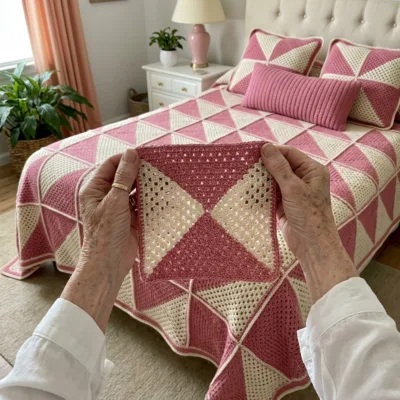
Dense pink triangles and open cream mesh meet to form diamonds across the whole bed.

About This Pink and Cream Diamond Bed Cover Crochet Pattern Pattern

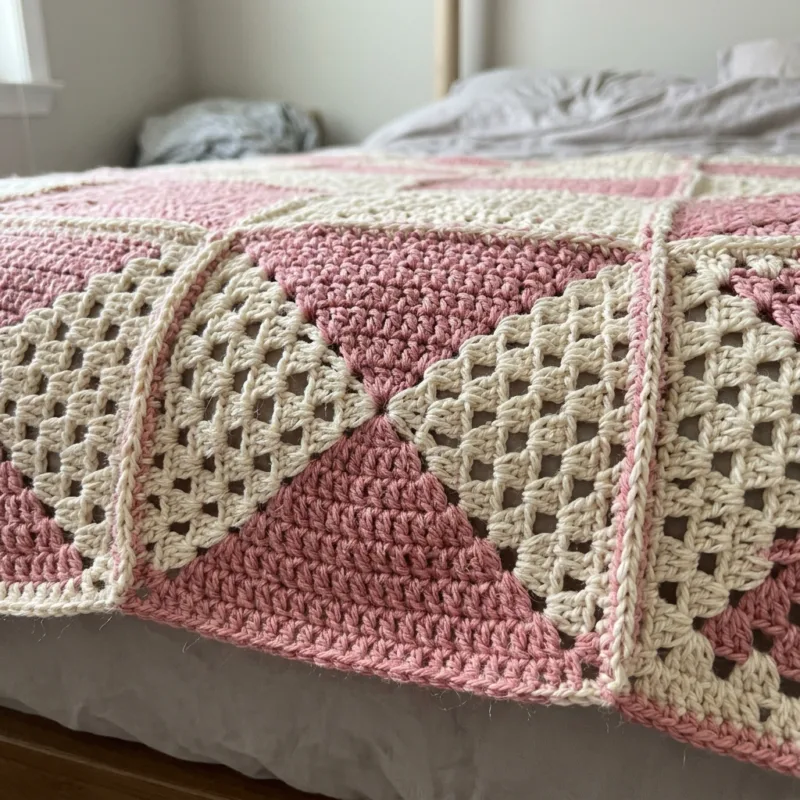
This bed cover is built from square blocks, and every block is made of four triangles joined at the center. Two triangles are worked in dense, solid double crochet in soft rose pink. The other two are worked in open cream granny clusters, so the pink fabric shows through the mesh like a little window.

When the blocks are joined, the pink triangles meet pink and the cream triangles meet cream, which makes large diamonds across the bed. The finished cover measures about 94 by 110 inches (42 blocks, 6 across and 7 down) in worsted weight cotton. A narrow pink edge with a fine cream rim finishes it, and a few extra blocks make matching pillow shams.
Pink and Cream Diamond Bed Cover Crochet Pattern step detail

Why You'll Love This Pink and Cream Diamond Bed Cover Crochet Pattern Pattern

I love this project because the pieces are small. A triangle fits in a tote bag, and you can make one on the bus, in the waiting room or in front of the television. There is no giant blanket in your lap for the first hundred hours.

I also love how the bedroom changes once the cover is on. The pink is warm without being loud, and the cream mesh keeps it light. It is a big project, but every block feels like a small win.

Switch Things Up

Try sage green and cream for a calmer room, or navy and cream for a classic look. For a throw, stop at 4 blocks across and 5 down for about 63 by 79 inches, or make 3 by 4 blocks for a baby blanket of about 47 by 63 inches. Two blocks sewn together and stuffed make a matching pillow cover. You can also swap the border for a simple shell edge if you like more texture.


Materials Needed

— Main Fabric

01 Worsted weight (4) cotton or cotton blend yarn in soft rose pink: about 3,600 yards (roughly 2,100 g)
02 Worsted weight (4) cotton or cotton blend yarn in warm cream: about 2,400 yards (roughly 1,400 g)
03 These amounts include the border and about 10 percent extra, and they are estimates, so swatch first
04 Buy all yarn of one color from the same dye lot

— Tools Required

05 5.0 mm (H-8) crochet hook
06 Yarn needle
07 Stitch markers
08 Scissors
09 Blocking mats and pins
10 Measuring tape

The Free Pattern

Intermediate 180-220 Hours

0% complete

— Solid Pink Triangle (Make 84, pink) :

Each triangle is worked flat from the point to the wide base and turned at the end of every row. Every row adds 4 stitches: 2 at each end. The base (Row 14) has 55 dc and measures about 15.5 inches.
Row 1: Make a magic ring. Ch 3 (counts as dc), 2 dc in the ring, pull the ring closed. Turn. (3 dc)
Row 2: Ch 3 (counts as dc), 2 dc in the same st, dc in the next st, 3 dc in the last st. Turn. (7 dc)
Row 3: Ch 3 (counts as dc), 2 dc in the same st, dc in each of the next 5 sts, 3 dc in the last st. Turn. (11 dc)
Row 4: Ch 3 (counts as dc), 2 dc in the same st, dc in each of the next 9 sts, 3 dc in the last st. Turn. (15 dc)
Row 5: Ch 3 (counts as dc), 2 dc in the same st, dc in each of the next 13 sts, 3 dc in the last st. Turn. (19 dc)
Row 6: Ch 3 (counts as dc), 2 dc in the same st, dc in each of the next 17 sts, 3 dc in the last st. Turn. (23 dc)
Row 7: Ch 3 (counts as dc), 2 dc in the same st, dc in each of the next 21 sts, 3 dc in the last st. Turn. (27 dc)
Row 8: Ch 3 (counts as dc), 2 dc in the same st, dc in each of the next 25 sts, 3 dc in the last st. Turn. (31 dc)
Row 9: Ch 3 (counts as dc), 2 dc in the same st, dc in each of the next 29 sts, 3 dc in the last st. Turn. (35 dc)
Row 10: Ch 3 (counts as dc), 2 dc in the same st, dc in each of the next 33 sts, 3 dc in the last st. Turn. (39 dc)
Row 11: Ch 3 (counts as dc), 2 dc in the same st, dc in each of the next 37 sts, 3 dc in the last st. Turn. (43 dc)
Row 12: Ch 3 (counts as dc), 2 dc in the same st, dc in each of the next 41 sts, 3 dc in the last st. Turn. (47 dc)
Row 13: Ch 3 (counts as dc), 2 dc in the same st, dc in each of the next 45 sts, 3 dc in the last st. Turn. (51 dc)
Row 14: Ch 3 (counts as dc), 2 dc in the same st, dc in each of the next 49 sts, 3 dc in the last st. Fasten off. (55 dc)
Count your stitches every 3 rows. The number in brackets is always 4 more than the row before.

— Cream Mesh Triangle (Make 84, cream) :

Each row is a line of 3-dc clusters separated by ch 1. Row 1 has 1 cluster and every row adds 1 cluster, so Row 14 has 14 clusters. Each row has 4 sts more than the row before, counting every dc and every ch. The base is 55 sts and matches the pink triangle.
Row 1: Make a magic ring. Ch 3 (counts as dc), 2 dc in the ring, pull the ring closed. Turn. (1 cluster, 3 dc)
Row 2: Ch 3 (counts as dc), 2 dc in the same st, ch 1, 3 dc in the last st. Turn. (2 clusters, 7 sts: 6 dc and 1 ch)
Row 3: Ch 3 (counts as dc), 2 dc in the same st, ch 1, 3 dc in the next ch-1 sp, ch 1, 3 dc in the last st. Turn. (3 clusters, 11 sts: 9 dc and 2 ch)
Row 4: Ch 3 (counts as dc), 2 dc in the same st, ch 1, [3 dc in the next ch-1 sp, ch 1] 2 times, 3 dc in the last st. Turn. (4 clusters, 15 sts: 12 dc and 3 ch)
Row 5: Ch 3 (counts as dc), 2 dc in the same st, ch 1, [3 dc in the next ch-1 sp, ch 1] 3 times, 3 dc in the last st. Turn. (5 clusters, 19 sts: 15 dc and 4 ch)
Row 6: Ch 3 (counts as dc), 2 dc in the same st, ch 1, [3 dc in the next ch-1 sp, ch 1] 4 times, 3 dc in the last st. Turn. (6 clusters, 23 sts: 18 dc and 5 ch)
Row 7: Ch 3 (counts as dc), 2 dc in the same st, ch 1, [3 dc in the next ch-1 sp, ch 1] 5 times, 3 dc in the last st. Turn. (7 clusters, 27 sts: 21 dc and 6 ch)
Row 8: Ch 3 (counts as dc), 2 dc in the same st, ch 1, [3 dc in the next ch-1 sp, ch 1] 6 times, 3 dc in the last st. Turn. (8 clusters, 31 sts: 24 dc and 7 ch)
Row 9: Ch 3 (counts as dc), 2 dc in the same st, ch 1, [3 dc in the next ch-1 sp, ch 1] 7 times, 3 dc in the last st. Turn. (9 clusters, 35 sts: 27 dc and 8 ch)
Row 10: Ch 3 (counts as dc), 2 dc in the same st, ch 1, [3 dc in the next ch-1 sp, ch 1] 8 times, 3 dc in the last st. Turn. (10 clusters, 39 sts: 30 dc and 9 ch)
Row 11: Ch 3 (counts as dc), 2 dc in the same st, ch 1, [3 dc in the next ch-1 sp, ch 1] 9 times, 3 dc in the last st. Turn. (11 clusters, 43 sts: 33 dc and 10 ch)
Row 12: Ch 3 (counts as dc), 2 dc in the same st, ch 1, [3 dc in the next ch-1 sp, ch 1] 10 times, 3 dc in the last st. Turn. (12 clusters, 47 sts: 36 dc and 11 ch)
Row 13: Ch 3 (counts as dc), 2 dc in the same st, ch 1, [3 dc in the next ch-1 sp, ch 1] 11 times, 3 dc in the last st. Turn. (13 clusters, 51 sts: 39 dc and 12 ch)
Row 14: Ch 3 (counts as dc), 2 dc in the same st, ch 1, [3 dc in the next ch-1 sp, ch 1] 12 times, 3 dc in the last st. Fasten off. (14 clusters, 55 sts: 42 dc and 13 ch)

— Block (Make 42, 2 pink triangles and 2 cream triangles each) :

Lay out the four triangles with the points (magic ring ends) meeting in the center. Put a pink triangle at the top, a cream triangle on the right, a pink triangle at the bottom and a cream triangle on the left.
Join the four diagonal seams with a whip stitch. Use pink yarn where a pink triangle is joined to a cream one. Each diagonal edge has 14 steps, so match step to step and ease the seam so it lies flat.
Each finished block has 55 sts along each of its 4 outer edges and measures about 15.5 inches square after blocking.

— Layout (Make 42 blocks in a grid of 6 across and 7 down) :

Turn every block the same way: pink triangles at the top and bottom, cream triangles on the left and right. Pink bases then meet pink bases from row to row, and cream bases meet cream bases side to side. This is what creates the pink and cream diamonds.
Join each row of 6 blocks first, using cream yarn for the vertical seams (cream to cream). Then join the 7 rows together with pink yarn for the horizontal seams (pink to pink).

— Border (pink and cream) :

The top and bottom edges are made of pink bases: 6 blocks x 55 sts = 330 sts each. The left and right edges are made of cream bases: 7 blocks x 55 sts = 385 sts each. Count each cream base as 55 (14 clusters with 42 dc, plus 13 ch-1 sps).
Round 1 (pink): Join pink at the top left corner. Ch 1, sc in each st and each ch-1 sp across the top edge (330 sc), ch 2 for the corner, sc evenly down the right edge (385 sc), ch 2, sc across the bottom edge (330 sc), ch 2, sc up the left edge (385 sc), ch 2, sl st to the first sc. (1,430 sc and 4 ch-2 corner sps)
Round 2 (pink): Ch 1, sc in each sc around, working (sc, ch 2, sc) in each ch-2 corner sp. Sl st to the first sc. (332 sc on each top and bottom edge, 387 sc on each side edge, 1,438 sc and 4 ch-2 corner sps)
Round 3 (pink): Ch 1, sc in each sc around, working 3 sc in each ch-2 corner sp. Sl st to the first sc. (1,450 sc)
Round 4 (cream): Join cream in any sc. Ch 1, sl st in each sc around, then sl st to the first sl st. Fasten off and weave in all ends. (1,450 sl sts)

Assembly Instructions

  1. Weave in all yarn ends on the 84 pink triangles and the 84 cream triangles.
  2. Block each triangle lightly so the base measures about 15.5 inches, then let it dry flat.
  3. Join four triangles into a block: pink at the top and bottom, cream on the left and right, with all the points meeting in the center. Whip stitch the four diagonal seams, matching step to step.
  4. Make 42 blocks and block each one to about 15.5 inches square.
  5. Lay the blocks out in 7 rows of 6, with every block turned the same way so pink meets pink and cream meets cream.
  6. Join each row with cream yarn, then join the 7 rows together with pink yarn, keeping the seams loose enough to stay flat.
  7. Work the 4 border rounds around the whole cover.
  8. Steam or wet block the finished cover flat, then let it dry completely before you put it on the bed.

Common Mistakes & How to Fix Them

Losing the +4 on a row. Count your stitches every 3 rows, and if a row is short, check that you worked 3 dc into the last stitch.

Turning a block the wrong way. If one block has its cream triangles at the top, the diamonds will not line up, so lay all 42 blocks out before you join anything.

Seaming too tightly. A tight whip stitch pulls the points of the diamonds out of square, so keep the seam loose and match step to step.

Guessing the border count. Check that each block base has 55 sts before you start, because the border totals depend on it.


Denise

Denise designs cozy crochet patterns for the home and shares every step in a friendly, easy-to-follow way.


Important Notes

Gauge is 14 dc and 7 rows in dc = 4 inches (10 cm) with a 5.0 mm hook. Make a triangle swatch before you start, because the finished size depends on your tension.

Yarn amounts and the finished size of about 94 by 110 inches are estimates. Test one block first and adjust the number of blocks if you want a different size.

Block each triangle and each block before joining. Cotton relaxes a lot when it is wet.

Because pink and cream yarn are used together, wash the cover alone for the first time and use a color catcher sheet.


I hope this bed cover brings as much warmth to your bedroom as it did to mine. Take it one triangle at a time, and send me a photo when the first diamond appears.

Crochet Abbreviations

01 ch — chain
02 sl st — slip stitch
03 sc — single crochet
04 dc — double crochet
05 st(s) — stitch(es)
06 sp — space

You Ask, We Answer

How big is the finished bed cover?

With 42 blocks (6 across and 7 down) it measures about 94 by 110 inches, which covers a queen mattress with a generous drop. Sizes are estimates, so check your gauge first.

Can I use a different yarn weight or make a smaller size?

Yes. A lighter yarn makes smaller triangles, so you would need more blocks for the same size. For a throw, make 4 blocks across and 5 down (about 63 by 79 inches) and plan for roughly half of the yarn.

How do I wash and care for it?

Wash it alone for the first time on a cool, gentle cycle with a color catcher sheet, then lay it flat to dry. Cotton is heavy when wet, so do not hang it.