
Raspberry Sunburst Medallion Lace Curtain Crochet Pattern
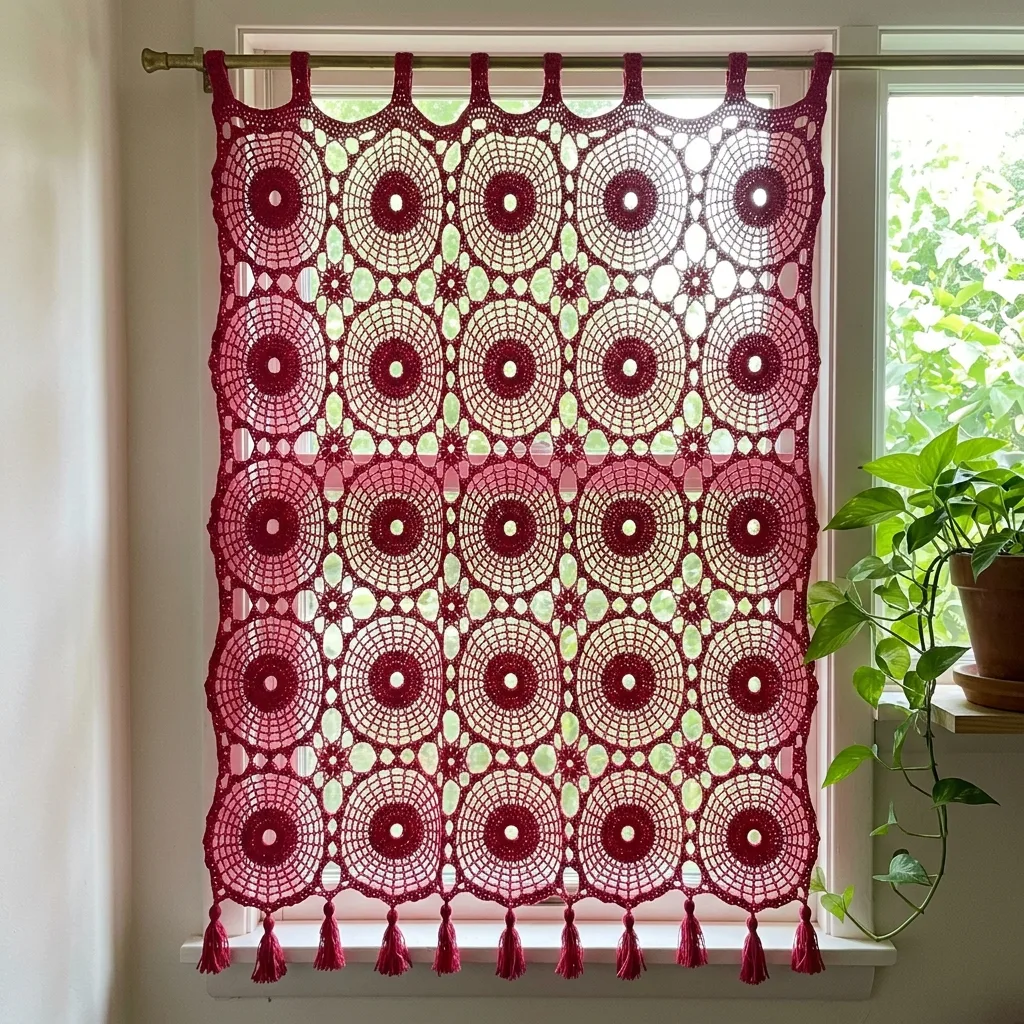
Only chains, single crochet and double crochet, but you join every medallion as you go.
One medallion takes under an hour, so the curtain grows steadily a few circles at a time.
Daylight shining through the raspberry lace fills the whole room with a soft rose glow.
About This Raspberry Sunburst Medallion Lace Curtain Crochet Pattern Pattern
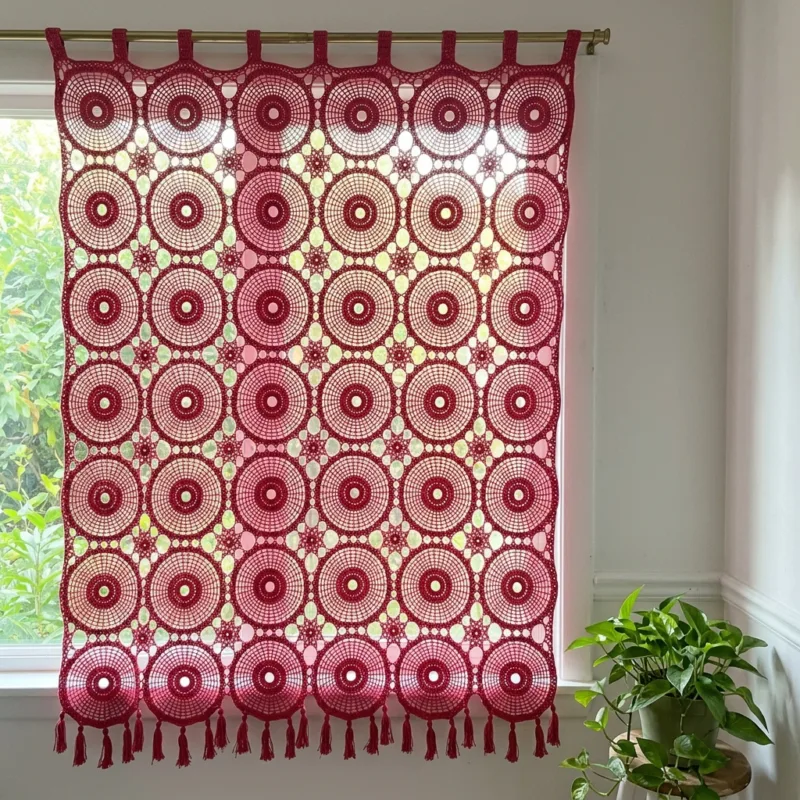
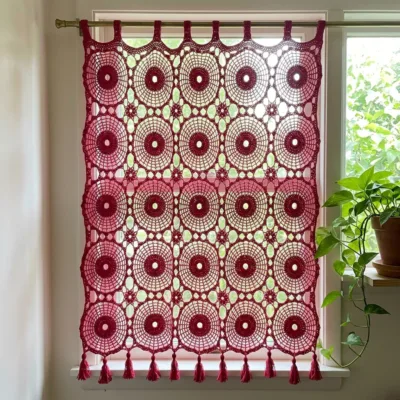
This curtain is a full lace panel made of round sunburst medallions in one deep raspberry red. Each medallion has a small open center, a solid inner ring and several fine mesh rings that spread outward like a spiderweb. The medallions sit in neat rows and columns, joined edge to edge, and little eight-point lace stars fill the gaps where four circles meet. The result looks like old-fashioned lace from a distance and like a field of tiny suns up close. When the light comes through, the red thread glows almost pink.
Every medallion is worked in eight rounds. The first two rounds make the solid center, a ring of double crochet that frames the small hole in the middle. Then a round of chain spaces, a bold round of double crochet groups and three rounds of longer and longer chain loops build the open spiderweb rings. The last round puts a small picot loop in every chain space, sixteen in all. Those loops are where the magic happens, because they are what joins each medallion to its neighbors.
I join the medallions as I go. That means the first medallion is made whole, and every one after it is joined to the ones beside and above it during its last round. You simply replace a picot chain with a slip stitch into the matching loop of the finished medallion next to it. There is no sewing and no seaming at the end. When you finish the last medallion, the panel is done, and only the little stars and the edges are left.
The stars are tiny and quick. Each one starts with a small ring of single crochet, then eight pointed chain arms reach out and slip stitch into the open loops of the four medallions around the gap. They hold the corners together so the panel lies flat, and they add that delicate starry pattern you can see between the circles. Along the top, small crochet tabs slide over the rod, and along the bottom, a short raspberry tassel hangs below each medallion in the last row.
As written, the curtain has 7 columns and 11 rows of medallions, which is 77 medallions and 60 stars. It measures about 98 cm wide and 167 cm long (39 by 66 inches) from the top of the tabs to the tips of the tassels. That fits a standard single window very well. I used a fingering weight mercerized cotton and a 2.5 mm hook, which gives a crisp, light lace that hangs straight and keeps its shape after washing.
The feel of the finished curtain is what makes it so special. It is light and airy, and it moves just a little when the window is open. In the morning, sunlight comes through the open rings and throws round lace shadows on the floor. The raspberry red looks deep and rich in the shade, then turns a warm rose wherever the light hits it. It gives you privacy without blocking the view, so you can still see the garden through the lace.
I rate this pattern Intermediate. You need only chains, slip stitches, single crochet and double crochet, but you must keep your rounds even and follow where each loop joins. It suits someone who has made a few round motifs before and enjoys a long, steady project. Plan on about seventy to eighty-five hours. If you like the rhythm of making the same motif again and again, and you love seeing a big lace piece grow, this one will make you very happy.
Why You'll Love This Raspberry Sunburst Medallion Lace Curtain Crochet Pattern Pattern
I fell in love with this curtain because of the color. I had always made lace curtains in white or cream, and I wanted something bolder for a sunny window. The first time I held one raspberry medallion up to the glass, the light turned it rosy pink, and I knew I had found my project. Red lace feels warm and a little old-fashioned, like something from a grandmother's house, but it also looks fresh and happy in a modern room.
I love how portable the medallions are. Each one fits in the palm of your hand, and a small bag holds a ball of thread, a hook, scissors and a few finished circles. I made many of mine sitting in the garden in the afternoon, and a few more in the car during long drives. Joining as you go does mean you carry the panel with you once it gets big, so I made a stack of single medallions first, then did the joining at home on the sofa.
This curtain also taught me a lot about tension. Thread is less forgiving than yarn, and a tight round shows right away. By the tenth medallion I had learned to relax my hand on the long chain rounds and to count every chain space out loud. I also learned to lay each new medallion over my first one to check the size, a habit that saved me from a lot of ripping back.
Here is what keeps me coming back to this design:
- One color, so there is no color planning at all
- No seaming, because every medallion joins as you go
- Small motifs you can finish in one sitting
- A window that glows warm pink every sunny morning
It makes a beautiful gift, too. I made a short cafe version for my sister's kitchen, and she says it is the first thing she looks at in the morning. A lace curtain feels personal because it lives with someone every day. It is also a gift that lasts for many years if it is washed gently, so all those hours of work keep giving long after you hand it over.
I also love that it uses up thread well. Every medallion uses about the same amount, so you can plan how many balls you need and buy them all at once from the same dye lot. The small leftover ends from each ball go into the stars and the tassels. By the time the curtain was finished, I had almost nothing left, which always feels like a small victory.
Most of all, I love how it changes a room. Before I hung it, my window was just a window. Now it is the prettiest part of the house. When the sun comes through, the whole room turns soft and rosy, and the lace shadows move across the floor as the day goes on. Every time I see it, I remember all the quiet hours that went into it, one little circle at a time.
Switch Things Up
The easiest change is the color. Raspberry red is warm and bold, but this lace looks lovely in many shades. Classic white is timeless and pairs with any room. Cream with tiny golden details, where you work the solid inner ring in a soft gold thread, looks elegant and a little vintage. Sky blue and white, with blue medallions and white stars, feels fresh and coastal. Soft green with cream stars brings the garden inside, and pale pink with white stars is sweet for a bedroom or a nursery.
You can also change the width to fit your window. Each medallion is about 14 cm (5.5 inches) across, so every column you add or remove changes the width by that much. For a narrow window, make 4 columns and 9 rows, which is 36 medallions and 24 stars, about 56 by 139 cm. Remember that the number of stars is always one less than the columns times one less than the rows. Measure your window first and divide the width by 14 to find your column count.
Length works the same way. Each extra row adds about 14 cm. For a door, keep 7 columns and work 14 rows, which is 98 medallions and 78 stars, about 98 by 209 cm. For a room divider, make 10 columns and 16 rows, which is 160 medallions and 135 stars, about 140 by 237 cm. A divider is a lovely way to split a big room without blocking the light, and from both sides it looks the same.
- Narrow window: 4 columns x 9 rows, 36 medallions, 24 stars, about 56 by 139 cm
- Standard window: 7 columns x 11 rows, 77 medallions, 60 stars, about 98 by 167 cm
- Door: 7 columns x 14 rows, 98 medallions, 78 stars, about 98 by 209 cm
- Room divider: 10 columns x 16 rows, 160 medallions, 135 stars, about 140 by 237 cm
A short cafe curtain is a perfect first version. Keep 7 columns but work only 5 rows, which is 35 medallions and 24 stars, about 98 by 83 cm. It covers the lower half of a kitchen or bathroom window, gives privacy and still lets plenty of light in at the top. It is also a nice way to test your tension and your thread before you commit to a full curtain.
For a doorway curtain that people walk through, join the medallions into separate vertical strips instead of one panel. Make 7 strips of 14 medallions each, joined only top to bottom, and leave out the stars. Hang each strip from its own tabs on the rod, close together. People can slip between the strips, and the curtain falls back into place behind them.
The tassels are easy to change, too. For a tidier look, wrap the thread around a 5 cm piece of cardboard for small tassels. For a more dramatic window, wrap it around a 12 cm piece for long, flowing ones. You can also put a tassel below every bottom star as well as every medallion, or leave the tassels off entirely and let the round edges of the last row form a soft scalloped hem.
Finally, you can change the thread or yarn weight. A finer size 10 cotton thread with a 1.75 mm hook gives medallions about 9 cm across and a very delicate, heirloom lace, but you will need more of them. A sport weight cotton with a 3.5 mm hook gives medallions about 17 cm across, so a window needs fewer of them and the work goes faster. Always make one medallion first and measure it before you plan the rest.
Materials Needed
— Main Fabric
— Tools Required
The Free Pattern
0% complete
— Sunburst Medallion (Make 77, raspberry red) :
— Layout :
— Chain Links and Joining (Medallions 2 to 77) :
— Lace Star Filler (Make 60, raspberry red) :
— Tassels (Make 7, raspberry red) :
— Top Loops and Hanging (Make 14 tabs, raspberry red) :
Assembly Instructions
- Make the first Sunburst Medallion completely, then work every other medallion through Round 7 and join it in Round 8.
- Follow the Layout to build the panel of 7 columns and 11 rows, joining each medallion to the one on its left and the one above as described in Chain Links and Joining.
- Lay the joined panel flat and work a Lace Star Filler in each of the 60 gaps where four medallions meet.
- Make the 7 tassels and tie one below each medallion in the bottom row.
- Work the 14 tabs from the Top Loops and Hanging section along the top row of medallions.
- Wet block the whole panel flat, pinning each medallion round and each star open, and let it dry completely.
- Slide the curtain rod through the tabs, spread them evenly and hang the curtain.
Common Mistakes & How to Fix Them
Medallions that slowly grow or shrink are the biggest risk in this pattern. Thread shows every change in tension, and the long chain loops in Rounds 5 to 7 are where it happens most, because it is easy to pull them tight without noticing. When the size drifts, the joins stop lining up and the panel ripples or pulls. Keep your first finished medallion as a sample and lay every new one on top of it before Round 8. If a medallion is more than half a centimeter off, rip back to Round 5 and work the chains again.
Joining the wrong loops is another easy slip. If you start Round 8 with the medallion turned a little, loop 1 is no longer at the top, and the next medallion joins one loop off. The panel then twists slowly, and the gaps for the stars come out uneven. To avoid it, always place a stitch marker in the first ch-7 space of Round 7 and treat that as the top. Count the loops before each join. If you notice a mistake later, undo only that medallion's last round and join it again.
A panel that ruffles or pulls at the corners usually means the stars were worked too tight or too loose. The stars hold four medallions together, and if their chain points are shorter than the gap, the corners bunch up. If they are longer, the corners sag and the lace looks loose. Lay the panel flat before working each star and let the gap stay at its natural size while you join. If your stars pull, try ch 5 instead of ch 4 on each side of the point, and if they sag, try ch 3.
Weaving in ends poorly can ruin the look of a lace curtain. With 77 medallions and 60 stars there are well over two hundred ends, and in see-through lace every bump and loose tail shows against the window. It happens when ends are woven straight across open spaces or cut too short. Weave each end through the solid stitches of the same round, back and forth in three directions, and never across a chain space. Leave about 1 cm before trimming, then trim again after blocking, once the thread has settled into place.

You Might Also Like
Important Notes
Gauge matters here because every medallion must match its neighbors. With fingering weight mercerized cotton and a 2.5 mm hook, one medallion should measure about 14 cm across after blocking. Make one before you buy all your thread, block it and measure it. If yours is bigger, go down a hook size, and if it is smaller, go up one. Remember that each column and each row changes the size of the curtain by the width of one medallion.
Blocking turns this curtain from nice into beautiful. Soak the finished panel in cool water, press out the water gently and roll it in a towel. Lay it flat on blocking mats and pin each medallion round, opening the mesh rings and each star point with your fingers. Use plenty of rust-proof pins along the edges so the rows stay straight. Let it dry completely, which can take a full day, before you hang it.
Buy all your thread at once and make sure every ball comes from the same dye lot. Red shades vary a lot from lot to lot, and the difference shows clearly when sunlight comes through the lace. The amount in the materials list already includes a little extra. If you change the size, plan about 12 m of thread for each medallion and about 1 m for each star, then add the tabs and tassels.
The finished curtain weighs only about 300 grams, so any normal curtain rod holds it easily, even a thin tension rod. To wash it, hand wash in cool water with mild soap and never wring it. Strong red thread can bleed in its first wash, so add a color catcher and wash it alone. Roll it in a towel, lay it flat to shape it, then hang it back on the rod to finish drying.
I hope this curtain brings a warm rosy glow into your home the way it did into mine. It looks like a huge lace project when it is hanging in the window, but it is really just one little circle made again and again, and joined to the last one with a few slip stitches. Every medallion you finish is a small win, and before you know it you will have a whole row.
So find your raspberry thread and your hook and make just one medallion today. Hold it up to the window and watch the light shine through it. I have a feeling you will want to start the second one right away. Happy crocheting, friend.
Crochet Abbreviations
You Ask, We Answer
How big is the finished curtain?
As written, the curtain measures about 98 cm wide and 167 cm long, which is roughly 39 by 66 inches, measured from the top of the tabs to the tips of the tassels. The panel itself is 7 medallions wide and 11 medallions tall, and each medallion is about 14 cm across after blocking. The tabs add about 5 cm at the top and the tassels add about 8 cm at the bottom. That size fits a standard single window. If your window is a different size, measure its width and height and divide each by 14 to find how many columns and rows you need, then use the size list in the section on switching things up. Lace stretches a little when it hangs, often a few centimeters on a long panel. I like to hang the curtain for a day before trimming the tassels, so the final length is just where I want it.
Can I use a different yarn weight or make it a different size?
Yes, this design works in several weights. A size 10 cotton thread with a 1.75 mm hook makes medallions about 9 cm across and a very fine, heirloom lace, but a window will need many more of them. A sport weight cotton with a 3.5 mm hook makes medallions about 17 cm across, so you need fewer and the work goes faster, though the lace looks a bit chunkier. I suggest mercerized cotton for any curtain, because it holds its shape, keeps a crisp edge and hangs straight in the light, while acrylic tends to stretch and curl. Whatever you choose, make one medallion, block it and measure it before you plan. Then divide your window width and height by that size to find your columns and rows, and count your stars as one less than the columns times one less than the rows.
How do I wash and care for the curtain?
Treat it gently and it will last for many years. When it needs a wash, take it off the rod and hand wash it in cool water with a mild soap, swishing it slowly instead of rubbing. Red thread can bleed, especially the first time, so wash it on its own and add a color catcher sheet to the water. Do not wring or twist the panel, since that stretches the chain loops and can pull the joins out of shape. Instead, lift it out in your arms, press out the water, roll it in a large towel and lay it flat on blocking mats. Pin the edges straight and open up the medallions with your fingers, then let it dry fully before hanging. Between washes, a gentle shake outdoors keeps it fresh. Strong summer sun can fade red over time, so a sheer liner behind it helps in a very sunny window.
Success!
Thanks for subscribing — check your inbox for a welcome note.
Abbreviations
- ch — chain
- sl st — slip stitch
- sc — single crochet
- dc — double crochet
- sk — skip
- st — stitch
- sts — stitches
- sp — space
- sps — spaces
- ch-sp — chain space (for example ch-7 sp is the space under 7 chains)