
Red and Cream Hexagon Bedspread Crochet Pattern
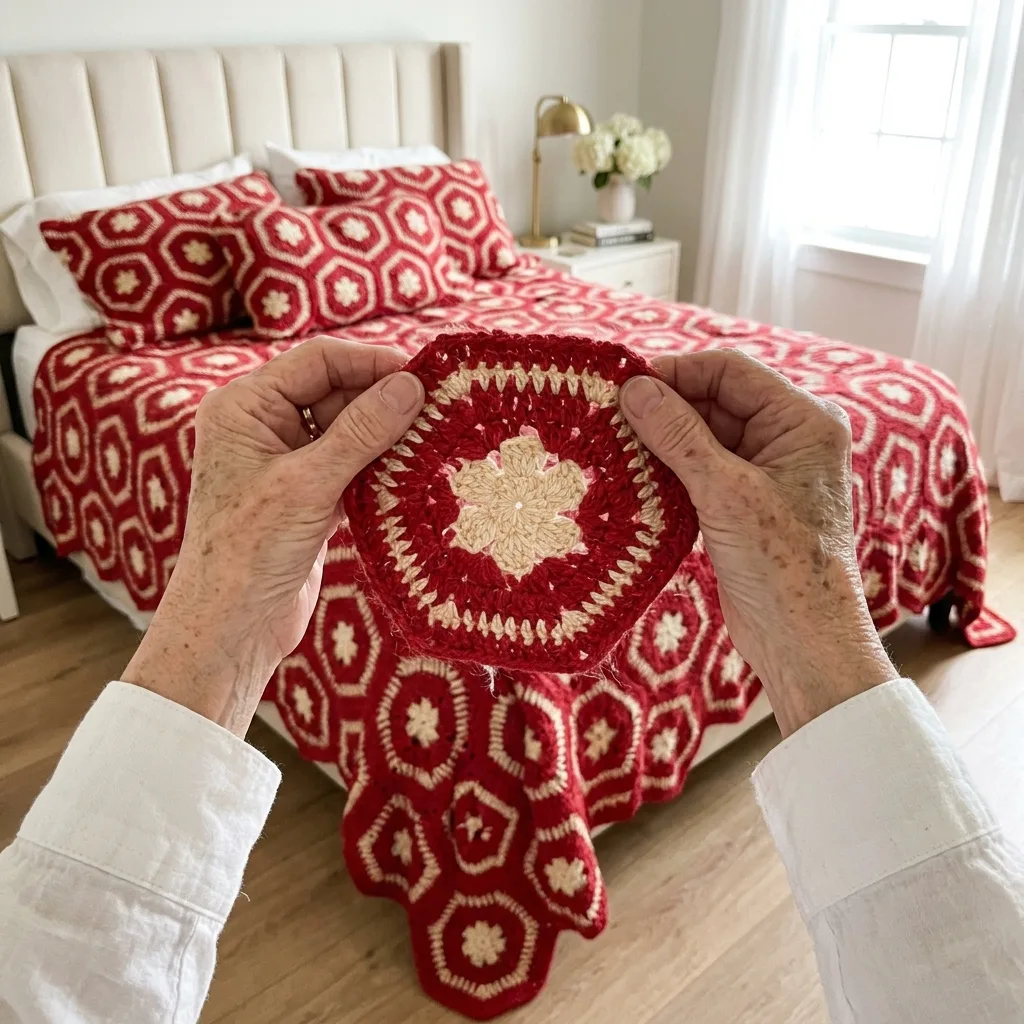
Hexagon rounds with long spike stitches that make the cream dash stripes, all fully counted.
Each hexagon takes a little over an hour, plus joining and a two-round edge.
Red spike stitches cover a cream round in some places and let it peek through in others.
About This Red and Cream Hexagon Bedspread Crochet Pattern Pattern
This bedspread is a bright red honeycomb made from one hundred and two hexagons, each with a warm cream heart. Every hexagon begins with four cream rounds that form a six-sided flower in the middle. Then the red rounds grow around it, and here is the clever part: twice, a cream round is worked and then covered with a red round of long spike stitches. Where the red spikes sit close together, the cream disappears. Where a short single crochet sits between the spikes, a little dash of cream peeks through. The result is a row of cream stripes in the middle of every side, like rays shining out from the cream center, with solid red at each corner.
The finished bedspread measures about 101 by 117 inches (257 by 297 cm) from point to point, including the edge. The hexagons are set with their points toward the head and the foot of the bed, in twelve rows that alternate between 9 and 8 hexagons. Each hexagon measures about 11 inches across from flat side to flat side and about 12.5 inches from point to point. On a queen mattress that gives a drop of about 19 inches on each side and at the foot, and the zigzag edge of hexagon points hangs down toward the floor like a row of red pennants.
The stitches are chain, slip stitch, single crochet and double crochet, plus the spike double crochet and two simple decreases in the edge. A spike double crochet is an ordinary double crochet worked into a stitch two rounds below, so the long red stitch reaches down over the cream round. It sounds tricky, but it is one of the easiest ways to make stripes without carrying yarn. Each hexagon has only four color changes, so you weave in eight ends per motif.
The hexagons are joined with red single crochet on the right side, worked through two hexagons at a time, side by side. Every side of every hexagon has exactly 34 stitches plus its corner spaces, so the seams always match. Once all the hexagons are joined, a round of cream single crochet and a round of red single crochet go around the whole zigzag edge, with extra stitches at the outward points and decreases at the inward notches. The thin cream line along the edge echoes the cream centers beautifully.
In worsted weight cotton the bedspread is warm and substantial, with a lovely drape over the sides of the bed. The spike stitches give the red bands a subtle ridged texture, and the cream centers stand out like snowflakes or little six-sided flowers. Red and cream together feel cheerful, cozy and a little bit festive, perfect for winter and wonderful at Christmas. The colors suit cream walls, light wood, brass lamps and white flowers, and they bring a warm glow to any bedroom.
I rate this pattern as intermediate. The hexagon itself is simple, but you need to keep careful count on the spike rounds and place the spikes into the right round. Joining hexagons also takes a little more thought than joining squares, so I suggest laying out the first two rows on the floor before you start. It suits a maker who loves color and graphic patterns and enjoys a project that grows into something striking. Every round is written out with its stitch count, so you can check your work as you go.
Why You'll Love This Red and Cream Hexagon Bedspread Crochet Pattern Pattern
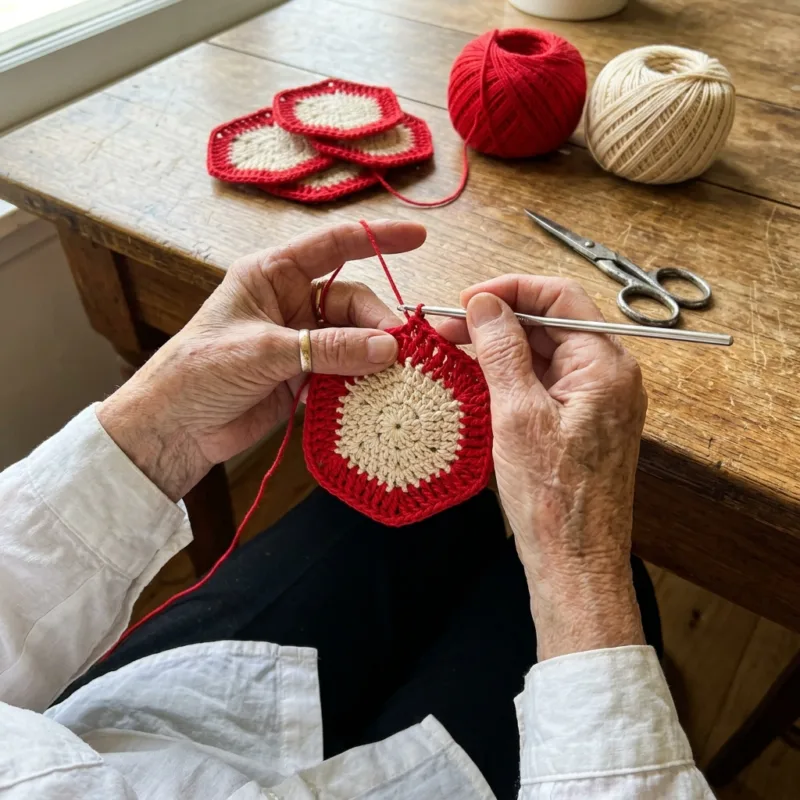
I have always loved hexagons. There is something so satisfying about six sides that fit together perfectly with no gaps, like a honeycomb in a beehive. For years I made hexagon blankets in soft pastels, but one winter I wanted something bold and cheerful, and red and cream was the answer. The first time I finished a hexagon and saw the cream dashes shining out from the center, I knew I had something special.
I love the spike stitch rounds most of all. After the cream round, you pick up the red and start reaching down two rounds with long double crochet stitches. At the corners, the red covers everything. In the middle of each side, you alternate a short single crochet with a long spike, and little cream dashes appear as if by magic. It is such a simple trick, but people always ask me how I made the stripes without carrying yarn.
I also love how the hexagons come together. Laying them out on the floor is like doing a puzzle, and when the rows fit together into a honeycomb, it feels very rewarding. The zigzag edge is a bonus: you do not need to make any half hexagons, and the points hang down over the sides of the bed in a playful, cheerful way. I think it gives the bedspread a lot of personality.
Here is why this bedspread brightens my day:
- Bold red and cream look cheerful in any season.
- The spike stitches make stripes without carrying yarn.
- Hexagons fit together like a honeycomb with no gaps.
- The zigzag edge needs no half motifs.
- It looks wonderful at Christmas and all winter long.
This bedspread changed our bedroom completely for the winter months. Our room is cream and light wood, calm but a little pale in the dark season. With the red hexagons on the bed, the whole room glows, especially in the evening with the brass lamps on. At Christmas I add a few red candles and a bowl of pinecones, and the room feels like a cozy cabin. My grandchildren call it the honeycomb bed.
Making it taught me a few useful lessons. I learned to keep my spike stitches relaxed, so they lie flat over the cream instead of pulling it in. I learned to count the stitches on each side of every round, because a hexagon with one long side never quite fits its neighbors. And I learned to join the hexagons in rows first, then join the rows, which made the honeycomb much easier to manage.
Most of all, I love that this is a bedspread for real life and many winters. Cotton washes well and gets softer over time, and red and cream never go out of style. I hope this bedspread will come out of the cupboard every December for many years, and that someday a grandchild will snuggle under it and remember the cozy winters at grandma's house.
Switch Things Up
The easiest change is the color pair. Keep the light color for the center and the dash rounds, and choose a new bold color for the rest. Navy with cream looks crisp and nautical, while forest green with cream feels like a winter cabin. Mustard with white is cheerful and retro, and dusty pink with ivory is soft and sweet. For a calm modern look, try charcoal with light gray.
You can change the size by changing the number of rows and hexagons. Each hexagon adds about 11 inches across, and each new row adds about 9.4 inches in length, because the rows nest into each other. The rows always alternate between a long row and a short row with one hexagon fewer. Here are some starting points.
- Twin: rows of 7 and 6, 10 rows (65 hexagons), about 79 by 98 inches
- Full: rows of 8 and 7, 11 rows (83 hexagons), about 90 by 107 inches
- Queen: rows of 9 and 8, 12 rows (102 hexagons), about 101 by 117 inches
- King: rows of 11 and 10, 12 rows (126 hexagons), about 123 by 117 inches
A sofa throw is a lovely smaller version. Make rows of 5 and 4 in 6 rows, twenty-seven hexagons in total, for a throw of about 57 by 61 inches. It takes around thirty-five hours and uses about a quarter of the yarn. It is cheerful on a cream sofa or folded at the end of a bed, and it makes a wonderful Christmas gift for someone special.
For a baby blanket, use a soft baby cotton or cotton blend in the same weight, and make rows of 3 and 2 in 5 rows, thirteen hexagons in total, for a blanket of about 35 by 50 inches. Soft mint with white or pale yellow with cream are lovely for a nursery. The fabric is solid and the edge is firm, but always use it with an adult nearby, and keep crochet blankets out of the crib for young babies.
Matching pillows tie the whole bed together, just like in my photos. Join seven hexagons into a flower shape, one in the middle and six around it, for a large round cushion front. Or join two rows of three hexagons for a sham, and sew it onto a red pillow cover. A single hexagon makes a sweet cushion for a kitchen chair. Add the cream and red edge around each one for a neat finish.
The hexagon also makes lovely small pieces for the home. A single hexagon makes a cheerful trivet or table mat. A row of five hexagons joined point to point makes a pretty table runner for a holiday table. Six hexagons sewn into a little box shape make a fun storage basket. These are great ways to use up leftover yarn from the bedspread.
If you would like a straight edge instead of points, you can make half hexagons. Work the hexagon in rows instead of rounds, over only three of its six sides, and join them into the notches along the sides and the ends. Then work two rounds of single crochet around the whole bedspread. The straight edge tucks neatly under a mattress and suits a more tailored room.
You can also play with the yarn weight. In DK cotton with a 4 mm hook, hexagons come out at about 9 inches across, so you need more of them, but the bedspread is lighter and drapes more. In a bulky yarn with a 6.5 mm hook, hexagons grow to about 14 inches, and rows of 7 and 6 in 10 rows cover a queen bed much faster. Acrylic or a cotton blend is lighter and warmer. Always make one test hexagon in your new yarn and measure it first.
Materials Needed
— Main Fabric
— Tools Required
The Free Pattern
0% complete
— Red and Cream Hexagon (Make 102, red and cream) :
— Layout (12 rows of 9 and 8, 102 hexagons) :
— Red Seam Join (Color A) :
— Cream and Red Zigzag Edge :
Assembly Instructions
- Make 102 Red and Cream Hexagons and weave in all the ends of each one as you finish it.
- Block every hexagon to about 11 inches from flat side to flat side, pinning all six points evenly, and let them dry completely.
- Lay the hexagons out in 12 rows that alternate between 9 and 8, with the points toward the head and foot of the bed.
- Join the hexagons of each row into a strip with the Red Seam Join, wrong sides together.
- Join the strips together along their zigzag sides, with a ch 1 across each corner where the zigzag turns.
- Work Rounds 1 and 2 of the Cream and Red Zigzag Edge around the whole bedspread.
- Weave in the last ends and give the finished bedspread a final light blocking on a clean floor, pinning out every point.
Common Mistakes & How to Fix Them
Spike stitches in the wrong round. The spike double crochet in Round 8 must go into Round 6, and the ones in Round 10 into Round 8, which is two rounds below. If you work into the cream round just below, the spike is short, the cream does not get covered at the corners, and the stripes look messy. If you go three rounds down, the spike is too long and the hexagon puckers. Before you start each spike round, look closely and find the red round under the cream one. Insert your hook there every time, right below the stitch you are skipping.
Pulling the spikes too tight. A spike stitch must lie flat over the cream round below it. If you pull the long loop tight, the cream round gets squeezed, the side of the hexagon curves inward and the hexagon will not sit flat against its neighbors. Pull each long loop up slowly until it reaches the height of the current round and lies flat, then finish the stitch without tugging. After each spike round, lay the hexagon on the table. If it cups or the sides look wavy, undo the round and work the spikes more loosely.
Hexagons with uneven sides. Every round adds exactly 4 stitches to each side, and the final round must have 34 sc on every side. If one side has 33 or 35, the hexagon will not line up with its neighbors, and the seams will pucker or leave gaps. This usually happens when a corner gets 3 dc instead of 2, or a stitch is skipped near the join of the round. Count each side after every round, at least for your first few hexagons. Use a stitch marker at the start of each round so the join does not move.
Joining the rows in the wrong order. Hexagons are easier to join in strips first, then strips together, but the strips must alternate between 9 and 8 hexagons and nest correctly. If two long rows end up side by side, the edges will not match and the honeycomb breaks. Lay out every new pair of rows on the floor before joining, and check that each short-row hexagon touches two hexagons above and two below. Join one zigzag seam at a time, and check the fit at every corner before moving on to the next side.

You Might Also Like
Important Notes
Gauge and hexagon size matter in this pattern. With worsted weight cotton and a 5 mm hook, Rounds 1 to 4 should measure about 4.5 inches (11 cm) across, and the finished hexagon should block to about 11 inches (28 cm) from flat side to flat side. Make one hexagon and block it before you buy all your yarn. If it is smaller, go up a hook size. If it is larger, go down a size. All the sizes in this pattern assume this gauge.
Block every hexagon before you join. Pin it to a blocking mat with all six points evenly spaced and all six sides straight. Spray with water until damp and let it dry completely. Blocking flattens the spike stitches, straightens the sides and makes every hexagon the same size, which makes the honeycomb fit together neatly. Block the finished bedspread once more after the edge is done.
This bedspread uses about 4,200 grams of red and 2,000 grams of cream for the queen size. Buy all of it at once, and check that every ball has the same dye lot number. Reds can vary a lot between lots, and on a bold piece like this, a change in shade will show clearly. Buy one or two extra balls of each color, so you do not run short on the last rows or the edge.
Wash the bedspread on a gentle cold cycle in a large machine, or by hand in a bathtub, with a mild detergent. Bright red is famous for bleeding onto lighter colors, so always add a color catcher sheet, and consider washing a test hexagon first to see how much dye it releases. Never use bleach. Do not wring or twist it. Press out the water and lay it flat to dry, shaping the points. Avoid the dryer.
I hope this bedspread brings a cheerful glow to your bedroom on the darkest winter days. It is a long project, but it is made of the simplest, happiest pieces: a cream flower center, a few red rounds and those clever spike stitches that make the cream dashes shine out like rays. Do not let the number one hundred and two worry you. You do not have to make them all today. You only have to make the first hexagon.
So pick up your red and your cream, settle into a cozy chair with a mug of something warm, and start with that little cream ring. Watch the six sides appear, then add your first round of spikes and see the stripes come to life. Then make another. Before you know it, you will have a stack of hexagons, and one day soon a honeycomb bedspread you will love for many winters. Happy crocheting, my friends.
Crochet Abbreviations
You Ask, We Answer
What is the finished size of this bedspread?
The bedspread in the photos measures about 101 by 117 inches (257 by 297 cm) from point to point, including the edge. It is made from 102 hexagons in 12 rows that alternate between 9 and 8 hexagons. Each hexagon measures about 11 inches from flat side to flat side and about 12.5 inches from point to point after blocking, and each new row adds about 9.4 inches in length, because the rows nest into each other. On a standard queen mattress, which is 60 by 80 inches, this size gives a drop of about 19 inches on each side and at the foot, with the zigzag points hanging lower. If your bed is taller or lower, measure from the top of the mattress to the floor and add or remove hexagons to suit. Always measure your first blocked hexagon before buying all your yarn.
Can I use a different yarn weight or make it smaller?
Yes. The hexagon works in any yarn weight, but its size will change, so you need to adjust the number of hexagons. In DK cotton with a 4 mm hook, hexagons come out at about 9 inches across, and you would need rows of 11 and 10 in about 15 rows for the same queen size. In a bulky yarn with a 6.5 mm hook, hexagons grow to about 14 inches, and rows of 7 and 6 in 10 rows cover a queen bed. To make a smaller piece, simply make fewer rows and shorter rows: twenty-seven hexagons make a sofa throw. The rounds and stitch counts of the hexagon stay exactly the same in every case, and so do the join and the edge method. Just count your free sides, outward points and inward notches before the edge, and always make one test hexagon first.
How do I wash and care for the bedspread?
Cotton is easy to care for, but a bedspread this size is heavy when wet, so treat it gently. Wash it on a cold, gentle cycle in a large capacity machine, or by hand in the bathtub with a mild detergent. Always add a color catcher sheet, because bright red often releases dye onto cream, especially in the first several washes. You can wash one spare hexagon first to test the yarn. Never use bleach, as it weakens cotton and would leave pink patches. Do not hang it wet from a line, since the weight will stretch the hexagons and pull the points long. Instead, press out the water with towels and lay it flat to dry, shaping the points as you go. Between seasons, fold it loosely and store it in a cotton bag, not plastic, with a sachet of lavender or cedar to keep moths away.
Success!
Thanks for subscribing — check your inbox for a welcome note.
Abbreviations
- A — Color A, bright red
- B — Color B, warm cream
- ch — chain
- sl st — slip stitch
- sc — single crochet
- dc — double crochet
- spike dc — spike double crochet, worked into a round below
- sc2tog — single crochet 2 together
- sc3tog — single crochet 3 together
- yo — yarn over
- sk — skip
- st(s) — stitch(es)
- sp(s) — space(s)
- ch-2 sp — the space made by 2 chains
- rep — repeat