
Sand and Blue Lattice Heart Bedspread Crochet Pattern
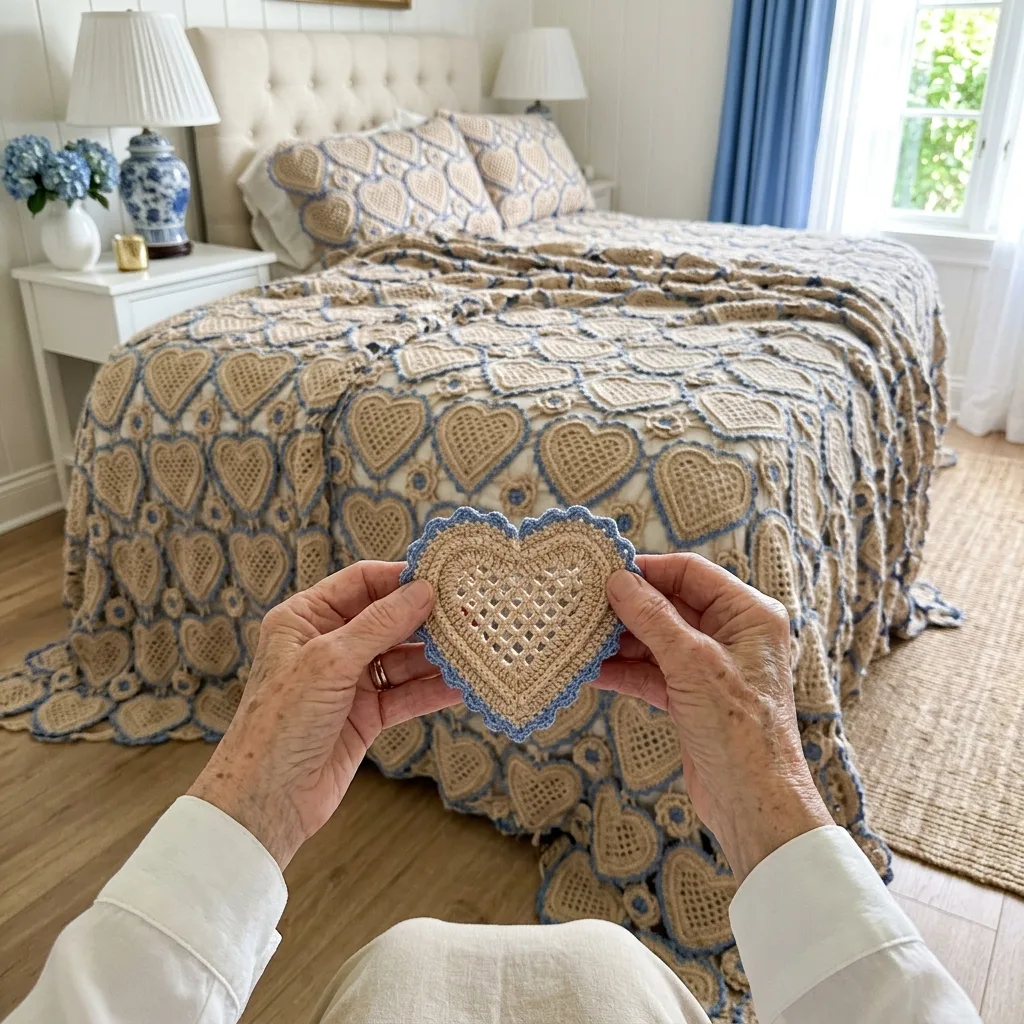
A heart worked in the round, a lattice of chains and a picot edge that joins as you go.
Each heart takes under an hour, and each little rosette about fifteen minutes.
One hundred and forty-three lattice hearts, every one framed in cornflower blue.
About This Sand and Blue Lattice Heart Bedspread Crochet Pattern Pattern
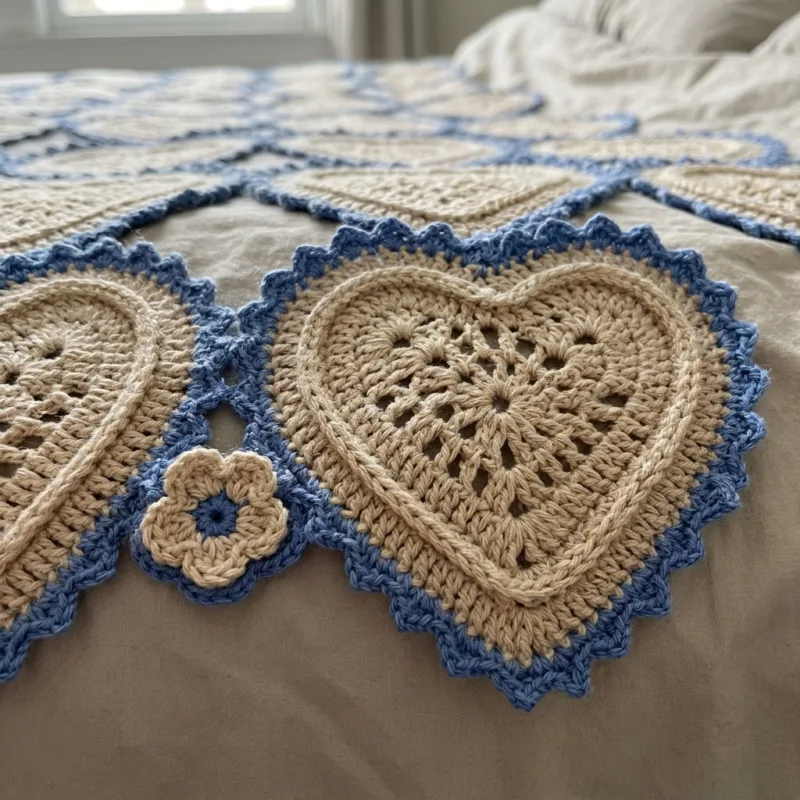
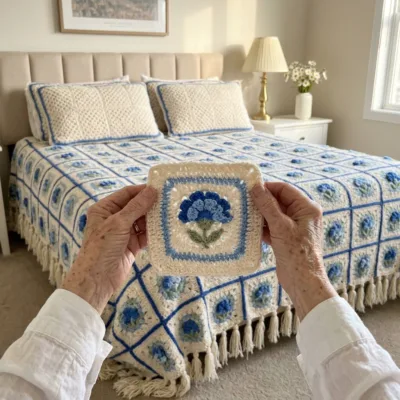
This bedspread is a whole bed full of hearts. It is made from one hundred and forty-three sand beige heart motifs, each one worked in the round from a tiny ring. The first round already forms a small heart shape, with treble crochet for the rounded lobes and a double treble for the point. Three rounds of chains and double crochet open out into a lattice inside the heart, then two solid rounds give it a raised double outline. A final round of cornflower blue scallops, each with a little picot at its tip, frames the heart like a valentine trimmed in lace. Small sand rosettes with blue centers fill every gap between the hearts, so the whole cover looks like a garden of hearts and flowers.
The finished bedspread measures about 103 by 110 inches (262 by 279 cm). The hearts are arranged in 13 rows of 11, all pointing toward the foot of the bed, and each heart measures about 9 inches across after blocking. One hundred and twenty rosettes sit in the spaces where four hearts meet, and forty-four more hang along the edges, so the outside of the bedspread finishes in a soft row of little flowers and blue scallops. On a queen mattress that gives a drop of about 20 inches on each side and at the foot.
The stitches are chain, slip stitch, single crochet, half double crochet, double crochet, treble crochet and double treble crochet. The heart shape comes from the very first round, where taller stitches build the lobes and the point, and every round after that simply follows the shape. The lattice is made by working one double crochet into each stitch of the round before, with longer chains between them each time. The raised outline is half double crochet worked into the back loops only, which leaves a little ridge on the right side.
The motifs join as you go in the blue scallop round. Each heart links to the heart beside it at two picots on the widest part of its lobes, and to the heart above it with the picots on either side of the point and the notch. The rosettes join in their own last round, linking to the four hearts around each gap. There is no sewing at the end, and when the last rosette is done, the bedspread is finished. The blue scallops and flower centers tie everything together into one pretty, lacy piece.
In DK weight cotton the bedspread is light and airy, with a soft drape and a gentle texture. The lattice inside each heart lets a little light through, and the raised outlines catch the light from the window. Sand and cornflower blue are a calm, fresh combination, like a beach in early summer or a cottage kitchen with blue and white china. They suit white paneling, blue hydrangeas, porcelain lamps and natural jute, and they make a bedroom feel sweet without being childish.
I rate this pattern as intermediate. The heart is worked in the round, which is easier than it sounds, but you need to keep careful count in the first round and watch the point as the heart grows. The join-as-you-go needs a little attention at first, so I suggest laying out the first two rows on a table. It suits a patient maker who loves small motifs and enjoys watching a big project come together piece by piece. Every round is written out with its stitch count, so you can always check your work.
Why You'll Love This Sand and Blue Lattice Heart Bedspread Crochet Pattern Pattern
I made my first crochet heart for my husband on our first anniversary, a tiny thing in red cotton that he still keeps in his wallet. When I designed this bedspread, I wanted to make that same little gesture, but big enough to cover our whole bed. Now there are one hundred and forty-three hearts on it, one for every reason I could think of. It sounds sentimental, and it is, but that is exactly why I love it so much.
I love how the heart appears in the very first round. You make a little ring, work a few trebles and double crochets into it, and there it is: a tiny heart, ready to grow. Each round after that makes it bigger and lacier, and the lattice opens up in the middle like a window. When the blue scallops go on at the end, the heart suddenly looks dressed up for a party. It is one of the most satisfying motifs I have ever made.
I also love the little rosettes. They take only a few minutes each, and I make them in batches while I watch television in the evening. They are like the sprinkles on a cake: small, quick and cheerful, and they make the whole bedspread look finished. When I join them into the gaps between the hearts, I love watching the spaces fill up with tiny flowers.
Here is why this bedspread is so close to my heart:
- Every motif is a little heart, made with love.
- The hearts are small and quick, perfect for carrying in a bag.
- The blue scallops make each heart look like a valentine.
- The rosettes fill the gaps and form a flowered edge.
- Everything joins as you go, with no sewing at the end.
This bedspread changed our bedroom completely. We had white walls, a cream headboard and blue curtains, and the room was pretty but a little plain. Now the blue scallops pick up the curtains, the hydrangeas on the nightstand and the blue and white lamp. The sand hearts warm up all that white, and the room feels like a seaside cottage on a sunny morning. I often find myself just standing in the doorway and smiling at it.
Making it taught me a few useful things. I learned to mark the point of each heart with a stitch marker, because it is easy to lose track of it in the lattice rounds. I learned to keep my blue scallops relaxed, so the hearts lie flat when they are joined. And I learned to make all the hearts for a row before I start joining, so I can choose the neatest ones for the center of the bed.
Most of all, I love that this bedspread carries a message. Every heart is a little reminder of the people I love, and I hope it will stay in our family for many years. Perhaps one day it will cover a grandchild's bed on their wedding night, and they will count the hearts and know they were made with love. That is the best gift I can imagine leaving behind.
Switch Things Up
The easiest change is the color. Keep the hearts in a soft neutral and choose a new color for the scallops and the rosette centers. Blush pink with ivory looks romantic, and red with cream is perfect for Valentine's Day or a winter bedroom. Sage green with oatmeal feels fresh and calm, while lavender with white is soft and dreamy. For a bolder look, make the hearts in a bright color and the scallops in white.
You can change the size by changing the number of hearts in each row and the number of rows. Each heart adds about 9 inches across, and each row adds about 8 inches in length, because the point of each heart tucks into the notch of the one below. Remember to make one rosette for every place where four hearts meet, plus two for every gap along the edges. Here are some starting points.
- Twin: 8 across by 11 rows (88 hearts), about 74 by 93 inches
- Full: 10 across by 12 rows (120 hearts), about 94 by 102 inches
- Queen: 11 across by 13 rows (143 hearts), about 103 by 110 inches
- King: 13 across by 13 rows (169 hearts), about 121 by 110 inches
A sofa throw is a lovely smaller version. Make 6 hearts across and 7 rows, forty-two hearts in total, with thirty interior rosettes and twenty-two edge rosettes, for a throw of about 56 by 60 inches. It takes around forty-five hours. It makes a beautiful wedding or anniversary gift, and it looks lovely folded at the foot of a bed or over the back of an armchair.
For a baby keepsake, make 4 hearts across and 5 rows in soft baby cotton, with white hearts and pale pink or pale blue scallops. That gives a pram cover of about 38 by 42 inches. The lattice and picots have small openings, so I keep this kind of piece for the pram, a christening or a keepsake, used with an adult nearby, rather than as loose bedding in a crib. It makes a wonderful gift for a new baby.
Matching pillows make the bed look finished, just like in my photos. Join six hearts in two rows of three with rosettes in the gaps, and sew the panel onto a pillow sham in the scallop color, so the blue shows softly through the lattice. A single heart sewn onto a small cushion makes a sweet accent pillow for a chair. Two hearts joined at their sides make a lovely little sachet when stitched to a lavender bag.
The heart motif also makes lovely small gifts. A single heart makes a coaster, a doily or an ornament for a Christmas tree. A row of hearts joined at their sides becomes a garland for a nursery or a wedding table. Six hearts joined into a ring with a rosette in the center make a pretty table centerpiece. These are wonderful ways to use up leftover yarn from the bedspread.
If you would like a straighter edge, add half rosettes along the sides. Work Rounds 1 to 3 of the rosette, then work Round 5 over only half the petals and join it into the gaps at the edge. Then work two rounds of blue single crochet around the whole bedspread for a neat, straight finish. For a bolder edge, work a row of blue shells along the bottom so the bedspread hangs evenly.
You can also play with the yarn weight. In size 3 crochet thread with a 2.5 mm hook, hearts come out at about 6 inches and look very fine, but you will need about twice as many. In worsted cotton with a 4.5 mm hook, hearts grow to about 11 inches, and 9 across by 11 rows cover a queen bed. Acrylic or a cotton blend works too and is lighter and warmer. Always make one test heart in your new yarn and measure it before you buy the rest.
Materials Needed
— Main Fabric
— Tools Required
The Free Pattern
0% complete
— Lattice Heart (Make 143, sand and blue) :
— Flower Rosette (Make 164: 120 interior and 44 edge) :
— Layout and Join As You Go (11 hearts x 13 rows) :
— Flower Edge :
Assembly Instructions
- Make 143 Lattice Hearts through Round 6, marking the point of each one, and weave in the sand ends as you go.
- Work Round 7 on each heart following the Layout and Join As You Go section, joining each new heart to the heart on its left and the heart above.
- Make 120 interior Flower Rosettes and join one into each gap where four hearts meet while working Round 5.
- Make 44 edge Flower Rosettes and join them into the gaps along all four sides following the Flower Edge section.
- Weave in the last ends, then wet block the finished bedspread on a clean floor, opening each lattice and pinning out every scallop and rosette.
Common Mistakes & How to Fix Them
Losing the point of the heart. The point is the stitch that gets extra increases in Rounds 2 to 6, and in a lattice round it can be surprisingly hard to find. If you increase in the wrong stitch, the point moves to one side, the heart leans and it will not line up with the hearts around it. Place a stitch marker in the point stitch of Round 1 and move it up every round as soon as you work the point increase. Before you join each round, fold the heart in half along the notch and point and check that both sides match.
Pulling the lattice chains too tight. Rounds 2 to 4 rely on the chains between the double crochet to make the lattice. If they are tight, the heart cups and the outline in Rounds 5 and 6 puckers. If they are too loose, the lattice sags and the heart ruffles. Keep your chains as relaxed as your other stitches, and lay the heart flat after Round 4. If it cups, go up half a hook size for the lattice rounds only. A flat heart at this stage is the secret to a neat finished motif.
Working the outline in both loops. Round 6 is worked in the back loops only, which leaves the front loops of Round 5 as a little ridge and creates the raised double outline you see in the photos. If you work through both loops, the ridge disappears and the heart looks flat, and it will not match hearts made correctly. Look at the top of each stitch before inserting the hook and choose the loop farther from you. If you notice partway round that you slipped into both loops, undo the round, because the difference shows clearly on the bed.
Joining the wrong shells. Each heart joins at very specific shells: 5 and 6 or 23 and 24 at the sides, and 1, 28, 14 and 15 at the notch and point. If you count from the wrong place, the hearts sit at an angle, the gaps become uneven and the rosettes no longer fit. Always start counting from the notch, where Round 7 begins. Mark the joining shells with stitch markers before you start the round. Lay the new heart beside its neighbors on a table and check the fit before you make the first join.

You Might Also Like
Important Notes
Gauge and motif size matter in this pattern. With DK cotton and a 3.5 mm hook, Rounds 1 to 4 should measure about 6 inches (15 cm) across the lobes, and the finished heart should block to about 9 inches (23 cm) across. Make one heart and block it before you buy all your yarn. If it is smaller, go up a hook size. If it is larger, go down a size. All the layout sizes in this pattern assume a 9 inch heart.
Lace looks its best after wet blocking. Block your first heart and rosette individually to check the size. After that, you can block the bedspread in sections as it grows. Soak it in cool water, press out the water with towels, and pin it flat, opening each lattice, scallop and rosette with your fingers. Let it dry completely. Block the whole bedspread once more when it is finished.
This bedspread uses about 3,100 grams of sand and 1,100 grams of blue DK cotton for the queen size. Buy all of it at once, and check that every ball has the same dye lot number. Blues in particular can vary between lots, and with blue scallops around every heart, a change in shade would show across the bed. Buy one or two extra balls of each color, so you do not run short on the last rows.
Wash the bedspread on a gentle cold cycle in a large machine, or by hand in a bathtub, with a mild detergent. Cornflower blue sits right against sand beige, so always add a color catcher sheet, especially in the first several washes. Never use bleach. Do not wring or twist it. Press out the water with towels and lay it flat to dry, shaping the hearts and rosettes. Avoid the dryer, which can shrink cotton lace.
I hope this bedspread fills your home with as much love as it has filled mine. It is a long project, but it is made of the sweetest little pieces: a tiny heart that appears in the very first round, a lattice that opens like a window, a row of blue picots, and little flowers tucked into every gap. Do not let the number of hearts worry you. You do not have to make them all today. You only have to make the first one.
So gather your sand and your blue, find a cozy chair and a cup of tea, and make that first little ring. Watch the heart take shape and the lattice open up, then trim it in blue and hold it up to the light. Then make another. Before you know it, your bed will be covered in hearts, and you will have an heirloom to treasure for years. Happy crocheting, my friends.
Crochet Abbreviations
You Ask, We Answer
What is the finished size of this bedspread?
The bedspread in the photos measures about 103 by 110 inches (262 by 279 cm), including the flower edge. It is made from 143 hearts arranged in 13 rows of 11, with 120 rosettes in the gaps where four hearts meet and 44 more along the edges. Each heart measures about 9 inches across after blocking, and each row adds about 8 inches in length, because the point of each heart tucks into the notch of the one below. On a standard queen mattress, which is 60 by 80 inches, this gives a drop of about 20 inches on each side and at the foot. If your bed is taller or lower, measure from the top of the mattress to the floor and add or remove hearts to suit. Always measure your first blocked heart before buying all your yarn, because the final size depends on your gauge.
Can I use a different yarn weight or make it smaller?
Yes. The heart works in any yarn weight, but its size will change, so you need to adjust the number of hearts. In size 3 crochet thread with a 2.5 mm hook, hearts come out at about 6 inches, and you would need about 17 across by 20 rows for the same queen size. In worsted cotton with a 4.5 mm hook, hearts grow to about 11 inches, and 9 across by 11 rows cover a queen bed. To make a smaller piece, simply make fewer hearts: 42 hearts make a sofa throw, and 20 hearts make a pram cover. The rounds, stitch counts and joining shells stay exactly the same in every case. Just remember to make one interior rosette for each place where four hearts meet, and two edge rosettes for every gap along each side, and always make one test heart first.
How do I wash and care for the bedspread?
Cotton lace is easy to care for, but a bedspread this size is heavy when wet, so treat it gently. Wash it on a cold, gentle cycle in a large capacity machine, or by hand in the bathtub with a mild wool or baby detergent. Always add a color catcher sheet, because the cornflower blue can release a little dye onto the sand hearts, especially in the first washes. Never use bleach, as it weakens cotton and would fade the blue. Do not hang it wet from a line, since the weight will stretch the lattice and pull the hearts out of shape. Instead, press out the water with towels and lay it flat to dry, shaping each heart and rosette as you go. Between seasons, fold it loosely and store it in a cotton bag, not plastic, with a sachet of lavender or cedar to keep moths away.
Success!
Thanks for subscribing — check your inbox for a welcome note.
Abbreviations
- A — Color A, sand beige
- B — Color B, cornflower blue
- ch — chain
- sl st — slip stitch
- sc — single crochet
- hdc — half double crochet
- dc — double crochet
- tr — treble crochet
- dtr — double treble crochet
- sk — skip
- st(s) — stitch(es)
- sp(s) — space(s)
- ch-3 sp — the space made by 3 chains (same for ch-1, ch-2 and ch-4)
- rep — repeat